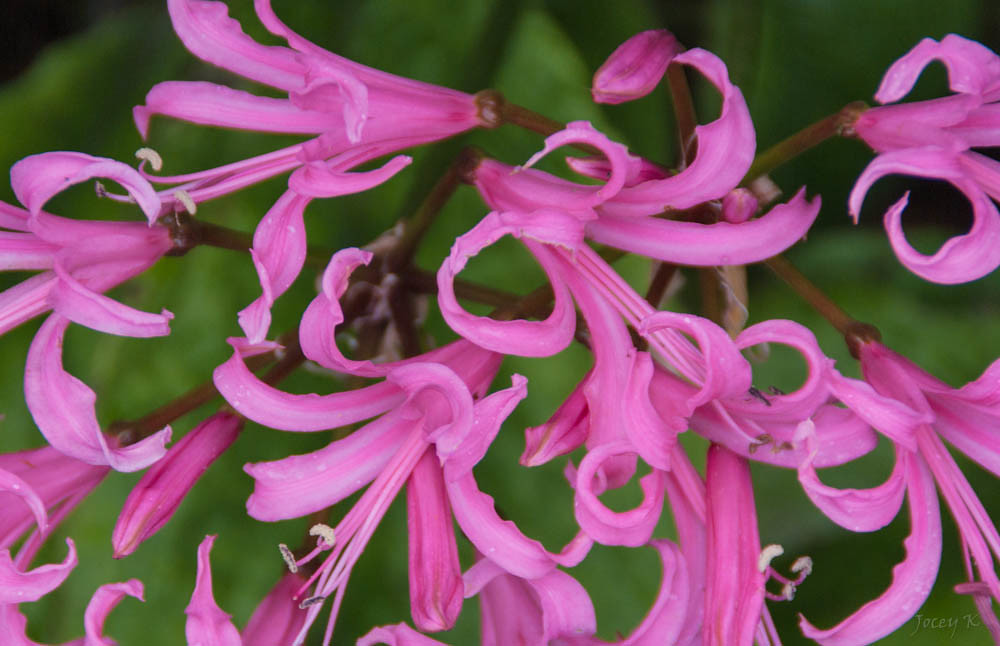
I have to admire their heartless lust
Performing with no emotional fuss,
And when it’s done, no flower cares
That its lover still sprawls bare
To bees and wind, to hummingbirds.
Petals don’t worry if they’re the third
Or fourth—it just doesn’t matter
After they’ve spread pollen’s splatter.
They live to turn their airy tricks.
No rumpled sheets, no mess to fix,
No wet spots stuck to sated thighs
And stamens aren’t concerned with size
Or any of our skillful lies
Or hearts destroyed as sorrows rise.
No flower mourns when another dies.
*****
‘April’ was first published in Snakeskin… in March.
Elizabeth Hurst is originally from Los Angeles and moved up to San Francisco many years ago. She lives out by the beach with her husband, Gerald Stack.
“April Flowers” by Jocey K is licensed under CC BY-SA 2.0.
 Form in Formless Times
I am a poet too, and not necessarily a good one, but I nonetheless seem to have a sense that allows me see rhythmic errors in other people’s poems.
In this case, I think the ending would be more effective if it read like this:
No flower mourns when others die.
The way it’s written now, the poem has a rhythmic hiccup in it.
David Stephenson has published quite a few of my poems. Not long ago I suggested an improvement to one of his already published poems. He was very gracious about it, and agreed that my suggestion was a good one, but said he might never republish that poem, meaning he might not have an opportunity to change it.
People reading this probably think I’m nervy, but my attitude is this: Great poetry (of which David has definitely written some) really belongs to all of humanity. I know that if someone suggested a change to one of my poems that improved it, I would adopt that change whether or not the poem was already published.
LikeLiked by 1 person
Caleb, you have an interesting point regarding the hiccup; but perhaps the poet liked her hiccup-sometimes they feel suitable. More importantly, when I read the poem as it stands I take “another dies” as referring to another flower; but if “others die” is substituted, I read it as more generalised, referring to humans, animals, flowers, everything, and it changes the meaning for me. I like the more limited “another”.
LikeLiked by 1 person