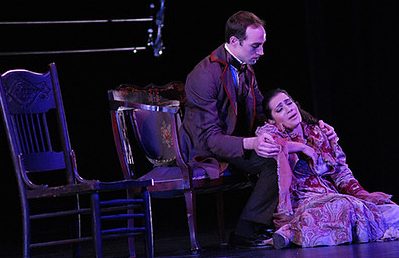
Although we came in hopes to find
the most amazing staging yet,
the final act still filled the mind
with all the trappings of regret.
Although the happy lovers met
with joyous singing – hers and his –
we’ve seen from Carmen to Cosette
how sad the ending always is.
Why do we cry for womankind,
for Tosca on the parapet,
for Butterfly, her love declined,
for Manon and for Juliet?
Haven’t we seen the sweetest pet
fall victim to the wily Wiz?
Haven’t we seen – from death to debt –
how sad the ending always is?
The villain always lurks behind
the arras, holding out the net
that will entrap the golden hind,
the mark of arrows ready set.
At first we didn’t feel the threat;
we never thought our hopes a chiz,
But now we’ve learned our alphabet:
How sad the ending always is!
But pour champagne, my friends, and let
the golden bubbles rise and fizz!
For just a moment we’ll forget
how sad the ending always is.
*****
Gail White writes: “It was Barbara Loots who called my attention to the fact that the plots of many operas could end with the words “and then she dies.” Being an opera heroine is almost always fatal. My first poem on this theme was a short one, “Opera Rondeau”. Then it occurred to me that the same idea would support a ballade. Writing this was fun, as finding enough rhymes for “is” pushed me into the realm of slang. And, of course, life is indeed a process of finding happy distractions from an inevitable tragic ending.”
‘After the Opera’ was first published in Pulsebeat Poetry Journal.
Gail White is a widely published Formalist poet and a contributing editor to Light. Her new chapbook, Paper Cuts, is out on Amazon or from Kelsay Books. She lives in Breaux Bridge, Louisiana, with her husband and cats.
“This picture makes me happy” by James Jordan is licensed under CC BY-ND 2.0.


Well done!
LikeLiked by 1 person
What a splendid poem! And what an inspiration for me…
As many of us know at first hand
opera isn’t always grand
in Trovatore
the ending’s gory
but musicals don’t always do the biz
the title gives it away: Les Mis
yet only a tad of regret will linger
when you get to the end of Meistersinger
il barbiere
doesn’t get hairy
if you don’t feel too familiar
with doings in Seviglia
then surely you should go
to the hitching of Figaro
(it’s a town with many goings-on
but don’t feel too sorry for the Don
his end although it seems benighted
is one that he himself invited)
it’s fate not people you should blame
for soaking hankies at Boheme
and as for la Sonnambula
al fine ancor ambula!
For an ending that’s not bleak
lend an ear to Gianni Schicch’
despite her threat the soprano
doesn’t finish in the Arno
Mortality’s not going to wring the heart
the stiff who’s stiffed was stiff before the start
And when there comes the final curtain
however it ends you can be certain
as the last fold of velvet falls
the audience shuffles from the stalls
and fumbles for their cloak-room stub
the brass are already in the nearest pub
LikeLiked by 1 person
Thank you, Robin!
LikeLiked by 1 person
Exqusite. Exquisite!
LikeLiked by 1 person
Gail, you write a splendid ballade!
Susan McLean
LikeLiked by 1 person