Tag Archives: inevitability

Paul Burgess, ‘Another Old, Familiar Story’

“The strong survive, and all of that,”
he’d tell the limply dangling cloth
between his beak, a former moth,
but doesn’t sense the lunging cat,

who doesn’t think the wheels that run
consider cats their proper prey.
Yet, now he’s just a dead display
beneath the slowly dying sun.

Who knows if later down the road
that truck won’t strike a rotting tree
and bring to bear on top of me
its paralyzing wooden load?

Though like a reel of comic scenes,
it’s also how our stories go:
the endings are the same, we know,
but brought about by varied means.

*****

Paul Burgess writes: “Earlier in the summer, a bird appeared in front of me casually holding a dying moth and looking almost cheerful. The encounter got me thinking about deaths that come suddenly, without malice, and without much meaning to the creatures or things that have caused them. I can’t say exactly why, but some combination of my mood and the circumstances made the sight more vivid and significant to me than it might have been on another day.”

‘Another Old, Familiar Story’ was first published in Snakeskin.

Paul Burgess is the sole proprietor of a business in Lexington, Kentucky that offers ESL classes in addition to English, Japanese, and Spanish-language translation and interpretation services. He has recently contributed work to The Road Not Taken, Blue Unicorn, Light, The Orchards, Pulsebeat, Snakeskin, Lighten Up Online, and several other publications.  https://paulburgesswritingandlanguage.blog/

Kaka (Nestor sp) and Pururi Moth (Aenetus virescens)” by Nga Manu Images NZ is licensed under CC BY-NC-ND 2.0.
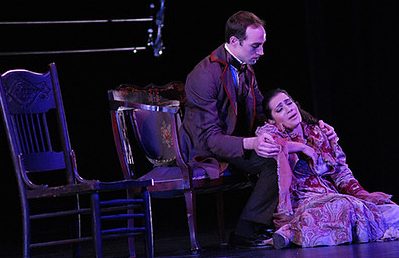
Ballade: Gail White, ‘After the Opera’

Although we came in hopes to find
the most amazing staging yet,
the final act still filled the mind
with all the trappings of regret.
Although the happy lovers met
with joyous singing – hers and his –
we’ve seen from Carmen to Cosette
how sad the ending always is.

Why do we cry for womankind,
for Tosca on the parapet,
for Butterfly, her love declined,
for Manon and for Juliet?
Haven’t we seen the sweetest pet
fall victim to the wily Wiz?
Haven’t we seen – from death to debt –
how sad the ending always is?

The villain always lurks behind
the arras, holding out the net
that will entrap the golden hind,
the mark of arrows ready set.
At first we didn’t feel the threat;
we never thought our hopes a chiz,
But now we’ve learned our alphabet:
How sad the ending always is!

But pour champagne, my friends, and let
the golden bubbles rise and fizz!
For just a moment we’ll forget
how sad the ending always is.

*****

Gail White writes: “It was Barbara Loots who called my attention to the fact that the plots of many operas could end with the words “and then she dies.”  Being an opera heroine is almost always fatal.  My first poem on this theme was a short one,  “Opera Rondeau”.  Then it occurred to me that the same idea would support a ballade.  Writing this was fun, as finding enough rhymes for “is” pushed me into the realm of slang.  And, of course, life is indeed a process of finding happy distractions from an inevitable tragic ending.”

‘After the Opera’ was first published in Pulsebeat Poetry Journal.

Gail White is a widely published Formalist poet and a contributing editor to Light. Her new chapbook, Paper Cuts, is out on Amazon or from Kelsay Books. She lives in Breaux Bridge, Louisiana, with her husband and cats.

This picture makes me happy” by James Jordan is licensed under CC BY-ND 2.0.