Category Archives: Chapbooks

A.M. Juster: ‘Cancer Prayer’

Dear Lord,
Please flood her nerves with sedatives
and keep her strong enough to crack a smile
so disbelieving friends and relatives
can temporarily sustain denial.

Please smite that intern in oncology
who craves approval from department heads.

Please ease her urge to vomit; let there be
kind but flirtatious men in nearby beds.

Given her hair, consider amnesty
for sins of vanity; make mirrors vanish.

Surround her with forgiving family
and nurses not too numb to cry. Please banish
trite consolations; take her in one swift
and gentle motion as your final gift.

*****

A.M. Juster writes: “One of my favorites.”

A.M. Juster is the Plough Quarterly poetry editor. His work has appeared in Poetry, Paris Review, Hudson Review and other journals. His tenth book is Wonder and Wrath (Paul Dry Books 2020) and his translation of Petrarch’s Canzoniere is due from W.W. Norton in early 2024.
www.amjuster.net

Photo: “A Silent Calling” by Alyssa L. Miller is licensed under CC BY 2.0.

Susan McLean, ‘Rules for Love’

Don’t wear make-up, ever. Don’t act girly.
Don’t collect shoes or shop until you drop.
If your hair is straight, don’t make it curly.
Don’t play dumb or play his games. Don’t stop
reading or saying what you think. Don’t flatter.
Don’t claim that you love football if you don’t.
Don’t sidestep. Don’t pretend it doesn’t matter
if he puts down your friends or if he won’t
do his fair share of housework. Do your best
to give your talents scope and free his own.
Grill steaks; eat chocolate. This is not a test.
If he won’t love you, you’ll do fine alone.
Sex is a bonus. Give as good as you get,
but make it clear you don’t intend to marry.
Love what you have, and what you don’t, forget.

These worked for me. (Your own results may vary.)

*****

Susan McLean writes: “This poem got its start in answer to a contest at the magazine The Spectator in the UK for a poem about “rules for love.” The words rules and love don’t normally go together, because love is something that often seems to break all the rules. Yet most people have their own mental set of requirements for love, which they will not easily set aside, as well as an internalized list of dos and don’ts that they think are the way to achieve love. I found it entertaining to try to pin down some of mine, knowing that each person will have a different list. How often women run into articles in women’s magazines that purport to tell them exactly how to find lasting love! This poem tries to be funny by saying the sorts of things that would never appear in those articles. It was not among the winners at The Spectator, but it was a lot of fun to write. Trying to pin down one’s own rules for love produces an indirect self-portrait. The poem first appeared in my second book, The Whetstone Misses the Knife.”

Susan McLean has two books of poetry, The Best Disguise and The Whetstone Misses the Knife, and one book of translations of Martial, Selected Epigrams. Her poems have appeared in Light, Lighten Up Online, Measure, Able Muse, and elsewhere. She lives in Iowa City, Iowa.
https://www.pw.org/content/susan_mclean

Photo: “love rules” by hmmlargeart is licensed under CC BY-NC-ND 2.0.

Julia Griffin: ‘A Remembered Swan’

Former Ballerina with Alzheimer’s is able to remember her old dance routine when she hears “Swan Lake” – Yahoo! News 16th November 2020

A sudden glow: the hollowed arms upswept
Above the wandering head, the starry burst
Streaking the dark. The cobwebbed feet have kept
Their knowledge, not their power: she has been cursed,

Long since, this maimed princess. A crueller stroke
Than Rothbart’s holds her caged, blots out her sky;
How can frail forelimbs beat away his smoke?
How can a grounded spirit hope to fly

Back to its Lake? – except that something strange
Still beats in her, beneath her parchy skin:
A memory.
Among art’s kindlier things,
This timelessness, created out of change:
A ballerina, spotlit from within,
Trailing her lovely, half-extended wings.

*****

Julia Griffin writes: “I feel the form works with the subject-matter. This was inspired, of course, by the news story – and the way it seemed to reverse Yeats’ great poem by making the swan a deliverer from helplessness.”

Julia Griffin lives in south-east Georgia/ south-east England. She has published in Light, LUPO, Mezzo Cammin, and some other places, though Poetry and The New Yorker indicate that they would rather publish Marcus Bales than her.
Her poem ‘Wasp Waste’ was reprinted in the Potcake Chapbook ‘Robots and Rockets‘, and much more of her poetry can be found in Light, at https://lightpoetrymagazine.com/?s=julia+g&submit=Search

Photo: “swanlake c Lotte Reiniger” by janwillemsen is licensed under CC BY-NC-SA 2.0.

Amit Majmudar: ‘The Last Meditation of Marcus Aurelius’

Among the Quadi, on the river Gran
I hate no one, love no one, am no one,
My armor hollow, crumpled, a tumbling can
Among the Quadi, on the river Gran.
River awash with bodies, rinse my hand.
I neither love nor hate what it has done.
Among the Quadi, on the river Gran
I neither love nor hate what I’ve become.

I neither love nor hate what I’ve become
Among the Quadi, on the river Gran
Slaughtering boys with long hair spun of sun.
I neither love nor hate what I have done
Galloping after stragglers on the run.
Rinse, rinse my hand, as only a river can.
I love no one, hate no one, am no one
Among the Quadi, on the river Gran.

*****

This poem originally appeared in The Classical Outlook, Vol. 97, No. 3

Amit Majmudar writes: “I am a fan of Marcus Aurelius, and I wrote this little poem around the same time I wrote an essay about harmonics between the Meditations and the Bhagavad-Gita, which I published my translation of in 2018.
Yet the original idea—a triolet that plays with that oddly pentametric subtitle of one of the chapters of the Meditations—occurred to me years ago. I am pretty sure I wrote, or tried to write, a triolet with this refrain maybe fifteen years ago. I lost it, never sent it out, one of the literally hundreds of poems I write but never send out. (Creatively I am like a fish, laying a superabundance of eggs, expecting only a small percentage to survive.)
When I reread the Meditations recently, getting my thoughts together for the essay, I saw that subtitle and had the same idea a second time, or remembered having had the idea (and hence inadvertently had it again). These two triolets are my attempts at reconstructing a poem I wrote and forgot years ago. I could not recall if I had made “Among the Quadi, on the river Gran” the first or second line of that ur-triolet. So I blundered around and found my way into this “double triolet.”
The image of Marcus Aurelius as a reluctant Stoic warlord is irresistible to me. I think the best commentary on this poem is the essay I wrote at the same time, published over at Marginalia at the Los Angeles Review of Books. This is the link to that essay:
https://themarginaliareview.com/the-gita-according-to-marcus-aurelius/

Amit Majmudar is a poet, novelist, essayist, translator, and the former first Poet Laureate of Ohio. He works as a diagnostic and nuclear radiologist and lives in Westerville, Ohio, with his wife and three children. 
      Majmudar’s poetry collections include 0’, 0’ (Northwestern, 2009), shortlisted for the Norma Faber First Book Award, and Heaven and Earth (2011, Storyline Press), which won the Donald Justice Prize, selected by A. E. Stallings. These volumes were followed by Dothead (Knopf, 2016) and What He Did in Solitary (Knopf, 2020). His poems have won the Pushcart Prize and have appeared in the Norton Introduction to Literature, The New Yorker, and numerous Best American Poetry anthologies as well as journals and magazines across the United States, UK, India, and Australia. Majmudar also edited, at Knopf’s invitation, a political poetry anthology entitled Resistance, Rebellion, Life: 50 Poems Now. 
      Majmudar’s essays have appeared in The Best American Essays 2018, the New York Times, and the Times of India, among several other publications. His forthcoming collection of essays, focusing on Indian religious philosophy, history, and mythology, is Black Avatar and Other Essays (Acre Books, 2023). Twin A: A Life (Slant Books, 2023) is the title of a forthcoming memoir, in prose and verse, about his son’s struggle with congenital heart disease. 
      Majmudar’s work as a novelist includes two works of historical fiction centered around the 1947 Partition of India, Partitions (Holt/Metropolitan, 2011) and The Map and the Scissors (HarperCollins India, 2022). His first children’s book also focuses on Indian history and is entitled Heroes the Colour of Dust (Puffin India, 2022). Majmudar has also penned a tragicomic, magical realist fable of Indian soldiers during World War I, Soar (Penguin India, 2020). The Abundance (Holt/Metropolitan, 2013), by contrast, is a work of contemporary realism exploring Indian-American life. Majmudar’s long-form fiction has garnered rave reviews from NPR’s All Things Considered, the Wall Street Journal, Good Housekeeping, and The Economist, as well as starred reviews from Kirkus and Booklist; his short fiction won a 2017 O. Henry Prize.   
      Majmudar’s work in Hindu mythology includes a polyphonic Ramayana retelling, Sitayana (Penguin India, 2019), and The Mahabharata Trilogy (Penguin India, 2023). His work as a translator includes Godsong: A Verse Translation of the Bhagavad-Gita, with Commentary (Knopf, 2018).

Photo: “File:0 Marcus Aurelius Exedra – Palazzo dei Conservatori – Musei Capitolini (1).jpg” by Unknown artist is licensed under CC BY-SA 3.0.

Maryann Corbett: ‘The Nutshell Studies of Unexplained Death’

Crime scene dioramas created as teaching tools by Frances Glessner Lee
Renwick Gallery, Washington, D.C.

Well-behaved voyeurs
bend above these exquisite
dollhouse miniatures

where the small-scale poor
die in ’40s dailiness.
Blood speckles a floor

tiled in one-to-twelve
scale. Ditto bath fixtures, beds,
plates shocked from a shelf—

Here’s a girl’s sliced neck.
Here’s another, legs jutting
from a tub, freaklike.

Is this Dresden head
brush-tipped with the purpling
livor of the dead?

To appreciate
such intently crafted pain,
one must contemplate

finger-cramping care:
quarter-inch-high postcards, penned
with a single hair.

A close eye for sin’s
rigor vitae: tiny socks
hand-knitted with pins.

Strict detail is key.
Look there for the rage of God.
Search for that and see,

sisters. As will I,
taken with the pains by which
quiet women die.

*****

Maryann Corbett writes: “In the autumn of 2018, I visited Washington, D.C. to speak at Catholic University, and while I was there, my sister-in-law took me to visit the Renwick Gallery. Its permanent displays are all lovely, but what stayed with me was a visiting exhibition: the Nutshell Studies. The quaintness of the doll-sized views and the perfection of craft in the recreated period interiors contrasted eerily with the bloody crimes laid out in them. They all stayed with me for a long time, and I did more digging about their creator and her work. The resulting poem—in haiku stanzas, because a small form seemed appropriate—was first published in Pangyrus. It’s included in the book In Code, which centers on my years in the Revisor’s Office but talks about all sorts of social evils.”

Maryann Corbett earned a doctorate in English from the University of Minnesota in 1981 and expected to be teaching Beowulf and Chaucer and the history of the English language. Instead, she spent almost thirty-five years working for the Office of the Revisor of Statutes of the Minnesota Legislature, helping attorneys to write in plain English and coordinating the creating of finding aids for the law. She returned to writing poetry after thirty years away from the craft in 2005 and is now the author of two chapbooks, five full-length collections already published, and a forthcoming book. Her fifth book, In Code, contains the poems about her years with the Revisor’s Office. Her work has won the Willis Barnstone Translation Prize, has appeared in many journals on both sides of the Atlantic, and is included in anthologies like Measure for Measure: An Anthology of Poetic Meters and The Best American Poetry 2018.

Her web page: maryanncorbett.com

Photo: “Murder is Her Hobby Exhibition” by massmatt is licensed under CC BY 2.0.

Pino Coluccio: ‘Where Has All The Mayo Gone?’

Hungry late, I clank around
the kitchen for a snack.
A pickle first and then, why not,
I peel apart a pack

of luncheon meat, some Swiss, a leaf
of something limp and wan,
and now — oh no, the lid’s on tight
but look — the mayo’s gone.

It feels like only yesterday
I parked my father’s car,
peeked at other shoppers’ carts
and tootled to a jar

for slathering on hotdogs
and for dolloping on frites —
there’s loads of foods whose fatty goodness
mayonnaise completes.

My pumpernickel won’t go down —
it’s like a warning bell,
the chilly clink of stainless steel
on glass. I know it well.

And wonder under nibbles if
at bottom human lives
aren’t always scraping empty jars
with tips of pointless knives.

*****

This is another of Pino Coluccio’s favourite poems from his first collection ‘First Comes Love‘. He doesn’t choose to comment on it, but I too like it; I like the way it clanks around the kitchen for a couple of verses, and then hits you with existential despair in the last lines. Which might be a matter of personal taste: I like eating limes and lemons, and I find Coluccio’s reflections equally tasty.

Pino Coluccio won Canada’s 2018 Trillium Award for English Poetry with his second collection, ‘Class Clown’. His poem ‘City Sunsets’ is featured in the most recent Potcake Chapbook, ‘City! Oh City!He lives in Toronto.

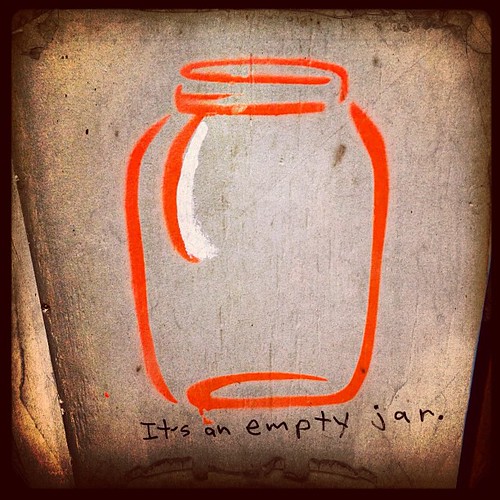
Photo: “It’s an empty jar #signage” by Stv. is licensed under CC BY-NC-SA 2.0.

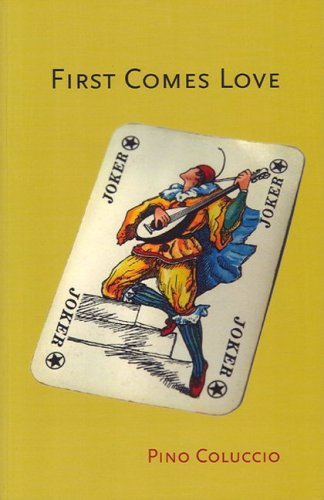
Potcake Poet’s Choice: Pino Coluccio, ‘First Comes Love’

There comes a time when sitting home alone
looking at your life — I’m such a knob —
gets to be a drag. You hate your job,
your car’s a piece of crap, and what you eat
is fatty, fried and salty. But then you meet
a girl. The life you made a mess of pulses.
And not content to mess up just your own,
you settle down and mess up someone else’s.

*****

Pino Coluccio writes that this poem is one his personal faves. It’s from his first book, also titled ‘First Comes Love‘, published by Mansfield Press. His poem ‘City Sunsets’ is featured in the most recent Potcake Chapbook, ‘City! Oh City!

Pino Coluccio lives in Toronto.

Nina Parmenter: ‘The Quantum Fox’

Have you seen the quantum fox,
the fox in flux, the paradox?
His whereabouts is rare, because
he’s in his den, and in this box.

This hokum locus tends to vex
the best of us; the mind rejects
the concept of his flightiness
as fiction or as foxy hex.

But fiction’s just refocused facts –
a lens that bends, a parallax.
The fact remains that Foxy lacks
a fix, til someone interacts.

See, should you pry inside the box,
you’ll find a fox, or not a fox,
and then this quantum nonsense stops
and everything is orthodox.

*****

Nina Parmenter writes: “I love reading ‘Quantum Fox’ out loud because it’s one of the few poems of mine I reliably know by heart and if performing it, I read it with props (er, a fox and a box funnily enough). Sometimes I  also recite it to myself to distract my brain if it’s overheating! It’s one of the older poems in my book ‘Split, Twist, Apocalypse‘ (relatively – written around 2019 I think) and I can’t remember where the inspiration came from – I think it was just the nice feel of the words ‘Quantum Fox’!”

Nina Parmenter has no time to write poetry, but does it anyway. Her work has appeared in Lighten Up Online, Snakeskin, Light, The New Verse News, Ink, Sweat & Tears, and the Potcake Chapbook ‘Houses and Homes Forever’. Her home, work and family are in Wiltshire.
https://ninaparmenter.com/

Fennec fox in box” by Joel Abroad is licensed under CC BY-NC-SA 2.0.

Launch: Potcake Chapbook 12, ‘City! Oh City!’

City! Oh City! – poems on the light and dark of urban life. Thirteen of the best contemporary English-language poets present their wildly differing takes on the glamour and squalor, the joy and heartbreak, the varied people and the hidden wildlife of our modern cities.

Five of the poets are new to the Potcake Chapbook series, and I’m delighted to be adding Kate Bingham of England, Francis O’Hare of Northern Ireland, Pino Coluccio of Canada, and Quincy R. Lehr and J.D. Smith of the US. They join eight returning poets. Amit Majmudar and Maryann Corbett deserve special mention for their brilliant use of form to capture contradictory situations: Majmudar’s static street scene which suddenly changes pace to a hectic chase, Corbett’s interwoven Baroque chamber ensemble and homeless encampment with their separate realities in a shared evening in Saint Paul, Minnesota. In addition: Michael R. Burch, Jerome Betts, Terese Coe, Marcus Bales, Martin Elster and myself; everyone contributes to this memorable capture of the complexity of the modern city.

Bios, photos and links to read more of their work can all be found on the Sampson Low site’s Potcake Poets page, while all the chapbooks in the series, showing which poets are in which, are here. Each of the 12 chapbooks is profusely illustrated (of course) by Alban Low, and can be yours (or sent as an intriguing gift) for the price of a coffee.

Value the city – citification is civilisation!

Potcake Poet’s Choice: David Whippman, ‘Who Were You?’

I never really found out who you are.
I only saw what I preferred to see.
I realise now it wasn’t meant to be.
I thought you were my one true shining star.
My cordon bleu, champagne and caviar
But really you’re a lukewarm cup of tea.
I thought you cared: you soon enlightened me.
I should have just admired you from afar.

It really was a silly thing to do,
Dropping my guard to let you in my head.
You left such an emotional mess behind.
And now you’re gone, I look around and find
An empty wallet and an empty bed.
And still there is the question: who are you?

*****

David Whippman writes: “As someone who is by aptitude a prose writer (much as I love poetry, both reading and writing it) I gravitate to a structured form of verse because I don’t have that  instinct necessary for writing good free verse. The sonnet form gives a ready-made structure and discipline, but allows some fluidity as well.

David Whippman is British, in his 70s, long retired after a career in healthcare. He writes stories and articles as well as poems. Outside of writing, his hobbies are music, chess and visual art. (And reading, of course.)

Image: “question mark” by WingedWolf is licensed under CC BY-NC-ND 2.0.