Category Archives: long poem

Long poem: Using forms: John Gallas, ‘Western Man’

1.

Clip clop
clip clop
steady up yon stuntgrass rise, boy,
long as low and stony-brown,
slow like weeks with nothing in them:
saddle-tick,
dirt-crump,
poker-face.

Clip clop
clip clop
privy-top and anchor-wires,
church-cross, store-spike, steady boy,
up yon one-street, just more-trodden dust:
saddle-tick,
dirt-crump,
poker-face.

Clip clop
clip clop
steady, boy, through sad wood civics,
rippled in yon saloon-glass store-side,
road-end, horses maybe leaving:
saddle-tick,
dirt-crump,
poker-face.

Clip clop
clip clop
rise, boy, steady, way ahead,
purple-white mountains, nothing in them
maybe, like weeks maybe:
saddle-tick,
dirt-crump,
poker-face.

2.

My brother’s name was Crazy Sean.
They shot him in the head.
He rattled through the summer corn
and turned the green shucks red.

I laid him in the willowbrake.
I couldn’t stand to pray.
I kissed his cheek for pity’s sake,
and then I rode away.

The plains are full of buffalo.
The woods are red and gold.
The mountaintops are white with snow.
His memory keeps me cold.

I’ve rode through Hope and Whisky Creek.
I’ve rode through Faith and Love.
I’ve laid in Hate and Hide-and-Seek,
and run from God-Above.

The prairie shines, the buckdeer cry.
The hawks hang in the heat.
Clipclop clipclop, the world rolls by.
They say revenge is sweet.

3.

Somewhere still, stark as an afternoon;
Ached in long planks of sunshine;
Like a gambler’s card dropped on an empty land;
Vauntsquare, the nailed-up main street creaks
Against the air. Clipclop – hotel, laundry, saddles,
Telegraph, clap-houses, guns. The horse stops.
Into this hollow spine of fellowship blows a slow
O of wind. Three men clatter at a boardwalk:
Nacarat boots, sharktooth mojos – oh my brother.

4.

I shot one on the shithouse board. His head
smashed like a squash and sprayed the backboards red.
He pissed his boots and died. The stinking hole
spit up a fat, black fly, which was his soul.
I shot one in the barbershop. The chair
caught fire, and ate his o-colonied hair.
He fell out like a slice of spitroast meat.
The duster wrapped him in its winding-sheet.
I shot one in the cornfield. Larks of blood
flew off his skull and twittered in the mud.
He rattled through the stalks. His mashy head
threw up its brain and turned the green shucks red.
I took a bath and threw away my gun.
I rode away wherever. I was done.

5.

drizzle pops on his hatbrim,
cord and wool and steam-sodden,
saddleticks like an empty stomach.

windpump wires and tin-dump,
like horizon-drowning, horse, then man,
hat, gone, clipclop, dusk drips in.

paraffin lamplight pricks the town,
glo-worms, night hunched above,
coyotes carry their eyes like stars.

6.

reckoning
done
how will he ever be warm

purpose
gone
how will he outrun the storm

bearings
none
how will he find another

riding
alone
how will he tell his brother

*****

John Gallas writes: “‘Western Man’ is a weird one: I have a quite spooky love of Westerns, jogging as they do some very deep links with Old En Zed, remnants (many remnants!) of which I grew up with and in. Those old wooden towns, the dim General Stores, the slightly grim and mostly silent (mostly) men, the cheek-by-jowlness of town and bush. It means quite a lot to me. I find the end of most Clint Eastwood films, and especially ‘Once Upon A Time in the West’, as the hero says ‘I gotta go now’, and rides away into lonliness after some bloody vengeance or other, inexpressibly moving.”

(“Old En Zed” = old New Zealand. – RHL)

‘Western Man’ is collected in ‘Star City‘.

John Gallas, Aotearoa/NZ poet, published mostly by Carcanet. Saxonship Poet (see http://www.saxonship.org), Fellow of the English Association, St Magnus Festival Orkney Poet, librettist, translator and biker. Presently living in Markfield, Leicestershire. Website is www.johngallaspoetry.co.uk which has a featured Poem of the Month, complete book list, links and news.

Photo: “lone cowboy” by GarrettRiffal is licensed under CC BY-NC-SA 2.0.

Weekend read: Daniel Galef, ‘Auriol to a Patron at Le Chat Noir’

For it was Auriol who concocted the Chat Noir-Guide toward the end of the nineteenth century. The Guide provides, for every objet d’art and knick-knack purportedly on display in the bar, fantastical tales of provenance.
From Cabaret to Concert Hall, Steven Moore Whiting


Come in, come in! Here, have a glass of beer—
The best in Paris! Whence derives such praise?
The Comte du Saint-Clement, when he drinks here,
And several other lumières Françaises
All say so. (Rimbaud swore “the best in France!”)
Perhaps you have been eyeing some of our
Objets and esoterica? Perchance
You’d like to hear their provenance? Le Soir
Has called the Chat’s decor the greatest work
Of art collection since the Louvre. These darts
Were thrown by Pippi Pavlo of Le Cirque.
This mirror-frame once held a Queen of Hearts
Played by the Duke of Sandwich in the game
At which he famously invented soup.
That specimen was lost before it came
To us—pinched by a croupier with the croup.
The mirror, too, is memorable—this crack
Imparted by a blow from cannon fire.
The cannoneer collapsed. Upon his back
They found the selfsame mark. Since then, each buyer
Has met a grisly fate—until bought by
A suicidal poet named Pierre.
It didn’t work. He gave it to Le Chat
In payment for a shot. We hung it there.
The timepiece on the mantle was a gift
From Pope Immaculate to me. Of course,
At that time, I had left the church. A rift
Arose when I ordained a bishop’s horse.
Ignore the wireless just beside—the news
Is so depressing, no? So . . . uninspired.
The mud, the blood, the bombs, the flu, the coups,
Enough to make Scheherazade tired.
But here! This silhouette is me—back then
I had a beard. I lost it in a duel
With three mad Turkish painters in Ardennes.
The third defaulted. Still I shot. It’s cruel
To leave a loser living. I was called
“The Caesar of Sargasso”—naturally
There wasn’t a resemblance. He was bald
While, under wraps as “Cleopatra Lee”
I worked with Pasteur researching a cure
To hair loss. Though the lab sank in a storm,
I drank the last drop as I swam to shore,
And thus my coiffure’s never lost its form.
This bronze, by Claus of Innsbruck, is a hoot—
So said the critic who is sealed inside
Its twin, the Triton by the stairs. Poor brute!
He knocked for half a week before he died.
It’s best not to insult these artist types.
I have the Gift myself, but can’t unearth it.
To catch the Muse is much like hunting snipes:
They bite, and taste too gamey to be worth it.
Each crystal on that chandelier’s a shard
From Louie Something’s windows at Versailles.
They say there came a witch, old, hunched, and scarred,
One night at midnight. With her one bright eye
She sneered once through the pane, and then departed.
Within a week, the king went mad and smashed
The lot of them, while mumbling “It has started!”
It’s cursed, of course. Too pretty to be trashed.
The candles are of beeswax. And what bees!
They live like princes. Endless fields of flowers
Are tended by the gardeners at Nice
And watered by a set of special showers
Constructed for the grounds by Lord Brunel.
We light them only rarely. For a guest
Such as yourself, I’ll gladly burn one. Well,
Just half. Come back someday, we’ll burn the rest.
These coasters? Quite mundane. They’re bits of planks
I salvaged from the Hesperus. Oh yes,
I once was quite the soldier. Only blanks
I ever loaded in my gun. The rest
Must have a chance, you know. It isn’t fair
To pit them up against whom Nelson dubbed
“The finest shot in Europe.” On a dare,
I handed him my pistol once. He clubbed
Me with his wooden leg. What’s that? His arm?
Oh no, that’s merely what the papers said.
In fact, it was his leg. It does no harm
To stretch the truth a little. Nelson plead
For them (the press) to print it right, but they
Insisted that an arm read better. He,
Of course, cried “What a silly thing to say!
An arm can’t read! Perhaps an eye?” You see,
They listened—Nelson loved Le Chat. You’ll find,
If you direct attention here, I’ll show
You where he signed the bar. Just why he signed
As “Ferdinando Smitty,” I don’t know.
That stool you’re sitting on I carved myself
With a pocketknife from one great slab of teak
When, hounded through a forest by some elf
I climbed a tree and hid there for a week.
That tree was this: The chair. The table, too,
Unless that one’s the Pharaoh’s table—no,
But come along, I’ll show that one to you,
Just past these poker-playing dogs (Van Gogh).
Don’t touch, the paint is fresh! I knew the model,
Lovely gal. Alsatian, I recall.
Her only vice, a weakness for the bottle;
Poor dear! Not drink—the bottle, that was all.
Our barman is a secret Count, a bastard
Practicing the rapier to reclaim
His stolen birthright. So far, he has mastered
Fourteen styles of swordplay. Soon his name
Will grace kings’ lips. For now, he’s just our skinker.
The chambermaid, as well, has quite a story.
A moron, yes? Wrong! Why, that genius thinker
Solved the famous Kjotz Conjecture. Glory
Is nought to her. She labors for mankind,
And for her god (the Devil). The Sorbonne
Has offered her a chair. But she declined.
(They say her mother was Napoleon’s son.)
That busboy? Oh, don’t heed him. He is lame
Not from trench foot, as some (and he) insist,
But—let me see—oh, yes!—a goon whose name
Was “Olaf” chopped his toes off at the wrist,
And now he’s quite—But pray, don’t touch that curtain!
The outside light must never be allowed
To touch these treasures. They’ll tarnish, I am certain.
(Besides, those drapes were Victor Hugo’s shroud.)
Our rum’s supplied by pirates. These fine cups
Looted from the Louvre. These splendid spoons
Are those with which the Mongol chieftain sups.
The silver forks are forged from gold doubloons.
Our beer, which I can see you quite enjoy,
Is brewed by tight-lipped monks who take a vow
Never to speak a lie—I, as a boy
Was in the order. (I have left it now.)

*****

Daniel Galef writes: “A few years ago when I was learning the Gymnopedies and Gnossiennes on piano I also tried reading up on Erik Satie, whose circle was full of interesting eccentrics, especially those frequenting Rodolphe Salis’s famous fin-de-siecle cabaret in Montmartre the Chat Noir: George Auriol, Vital Hocquet, Alphonse Allais, &c. As a fiction writer, I am fascinated by lies and liars and what drives them, and was particularly taken by the fact, mentioned in passing, that Auriol had written and published a fake guidebook for the Chat Noir. I’ve since read more about Auriol, and even tracked down and read (with the help of Google Translate) a scan of the Guide itself (and highly recommend it, if it’s still to be found online), but when it was the only thing I knew about him that line alone in Whiting’s book was enough to serve as springboard for this weird, sort of Browning-y monologue poem, which is one of my favorite things I’ve ever written. The long version was written first even though it was published second; it appeared in 2022 in Bad Lilies, and later I snipped a sonnet out of it, which was published in 2020 in Light (and then in a slightly different form in my first book Imaginary Sonnets).

Daniel Galef’s poetry, half-serious and half-non-, has been published in a variety of venues themselves both serious and non-. His first book, Imaginary Sonnets, collects 70 persona poems from the point of view of various historical figures and literary characters, including Lucrezia Borgia, Christopher Smart’s cat, and a taco. “A Nightingale to a Sad Poet” first appeared in the Spring/Summer 2025 issue of Sein und Werden. Other recent writing can be found in the Indiana Review, the Best Small Fictions anthology, and Scientific American.

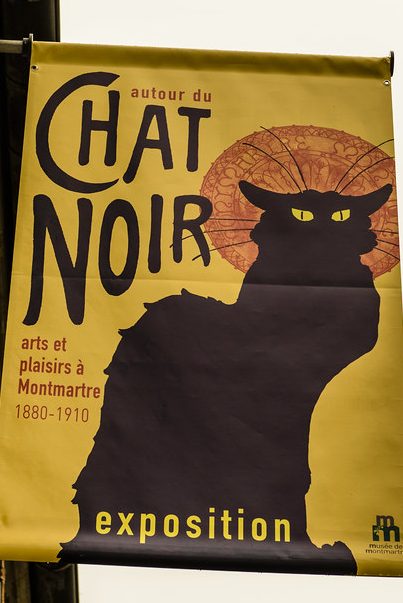
Photo: “Le Chat Noir” by Son of Groucho is licensed under CC BY 2.0.

Sonnet series: Jean L. Kreiling, ‘My Brother’s Last Year’

  1. What My Brother Says

He says I’m not myself, but in my eyes
and in my arms, he is. I hug him, feeling
that he’s lost weight, but brother-warmth defies
that deficit. Disease and “cure” both stealing
small pieces of him, he has had to quit
his role as family cook, and he can’t drive.
But he retains his reason and his wit,
so much so that it seems clear he’ll survive;
they say he won’t. He says his life’s been great,
though certainly too short. He still stands tall
and truthful: he unblinkingly looks straight
ahead, says what he sees, and leads us all.
He looks thin, but he always has been slim.
He says I’m okay, mostly. He’s still him.

  1. What Looms

It’s always there: a cloud—no, more than that,
a monstrous weight, insistent, ugly—no,
invisible, but foul. Its habitat
is everywhere; there’s no place he can go
to break away from its unfailing grip
and find a self not poisoned by his own
insidious insight, where he can strip
his days of its unnerving undertone.
His daughter’s funny story makes him chuckle,
he briefly cares about a football game,
but you can almost see his psyche buckle
again as deathless facts and fears reclaim
their sure dominion, making him aware
again of all that looms. It’s always there.

  1. Walking with My Brother and His Wife

They’re holding hands, as they so often do,
as we three walk a path in woods behind
their house, our sneakers swishing through
mid-fall’s crisp russet leaves. This path will wind
predictably through acres of old trees
and end at their backyard. Along the way,
we talk of plans, the weather, memories;
most of their plans are now in disarray,
like scattered leaves in autumn’s chill. They stroll
as easily as if they could predict
more than this path, own more than land, control
the odds that he’ll grow old. What fears afflict
them, they defer; they face the chill unbowed.
They’ll hold hands for as long as they’re allowed.

  1. Therapy

I write these sonnets as if that might ease
my mind; it doesn’t, and these lines can’t do
a thing for him. Like stopgap therapies
that promise him another month, a few
neat poems only shuffle deck chairs, shaping
elaborations on the theme that dulls
his days with brain fog. He won’t be escaping;
he knows he’s sinking. As my brother mulls
his measureless calamity, I count
out syllables, choose metaphors, debate
rhyme schemes, and watch the icy water mount
in seas that he cannot long navigate.
I write as if I’d find breath in a word,
as if safe passage might yet be secured.

  1. Progress

It’s not the kind of progress we would hope
for; it’s the damned disease that’s making strides.
My brother’s gaining only ways to cope
with each new deficit as it divides
him further from the life that he once led—
a life he’d thoughtfully constructed, made
of love, ideas, and work. Inside his head,
the enemy destroys the cells that weighed
the sense of printed words, and so he learns
to listen to the Post; when his synapses
don’t fire at numbers anymore, he turns
the checkbook over to his wife. The lapses
disturb but don’t defeat him; he finesses
each injury as the assault progresses.

  1. Nothing

I visit him again, this time by train.
(The ten-hour drive gets tougher as I age,
but then, what right do I have to complain?
To grow old is a gift.) This may assuage
my sense there’s nothing I can do, although
a visit’s nearly nothing. Yes, I care;
that’s what my presence demonstrates, I know,
but it will make him strain for things now rare
or difficult: the teasing repartee,
a walk outdoors, shared meals and memories.
He reassures me that he feels okay,
though I watch him declining, by degrees.
I bring his favorite chocolates, as if sweets
could mask the bitter taste nothing defeats.

  1. Want

Not long before the end, he made it clear:
there was so little that he wanted—just
to stay with those he loved, not disappear
into the latter part of dust to dust.
So many of us want so much: we crave
the shiny toy, the extra buck, and more
when less would do—stuff that will never save
our souls or bodies. I knew that before
my brother’s diagnosis, and today
I can’t claim to have unlearned pointless greed.
I find, though, that it’s easier to weigh
the worth of things desired, to measure need,
to understand there isn’t much I lack.
He wanted only time. I want him back.

*****

Jean L. Kreiling writes: “My brother Bill was wise and witty and loving, and deserved a far longer life; I miss him every day. He was teased and adored by his three older sisters, he made our parents proud, and he created a beautiful family of his own.  His magnificent wife and his three devoted grown children took good care of him in the year between his brain cancer diagnosis and his death, but it was a very difficult year for Bill and all who loved him.”

This tribute to him as a series of shakespearean sonnets was originally published in Pulsebeat Poetry 11.

Jean L. Kreiling is the author of four collections of poetry; her work has been awarded the Frost Farm Prize, the Rhina Espaillat Poetry Prize, the Kim Bridgford Memorial Sonnet Prize, and three New England Poetry Club prizes, among other honors.  A Professor Emeritus of Music at Bridgewater State University, she has published articles on the intersections between music and literature in numerous academic journals.  She lives on the coast of Massachusetts.

Photo: “Holding Hands on the Hornby Separated Bike Lane” by Paul Krueger is licensed under CC BY 2.0.

Helena (“Nell”) Nelson, ‘Separation’

i

Mrs Philpott goes to bed alone.
The clock in the hall ticks on.
Philpott turns to cut glass, then stone.

All the things we do to be loved,
all of them pointless.
The clock ticks on.

Nothing but moonlight dawns.
The distance from downstairs
to upstairs yawns.

Philpott sags and snoozes alone
in the wishing chair,
in the wishing air.

All the things we do to be loved –
in the night they slip far away.
It will never be day.

The clock ticks on
as well it may.

ii

She wakes first. He has not slept
in the chair all night.

At first light
he has crept

into the bed on the other side.
He will not (cannot) say it, but

everything about him is sorry –
only half of him is under the duvet

and his eyes aren’t really shut.
She pulls the covers over them both and he falls

into a sleep as deep and sound
as a lost child who has wandered far out of sight

(while his mother calls and calls and calls)
and is finally found.

*****

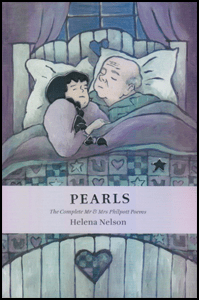
This poem is one of over 80 in Helena Nelson’s ‘Pearls – the Complete Mr & Mrs Philpott Poems’. Starting with poems of the end of their first marriages, it tracks their decades-long second marriage through (as the blurb says) “dreams, anxieties and needs – even sudden spurts of happiness – despite the rainy holidays, arguments and illness. The ordinariness of their love is magical and miraculous. Because ordinary love is a kind of miracle.”

People talk about “novels in verse” but those often don’t capture the poetry of verse. This is definitely a novel in poetry, and the most rereadable novel I’ve come across in a long time.

Helena Nelson writes: “happy that you like Pearls. I made it as well as I could, but it largely came unasked for. I don’t think I have anything to say about it.”

Helena Nelson runs HappenStance Press (now winding down) and also writes poems. Her most recent collection is Pearls (The Complete Mr and Mrs Philpott Poems). She reviews widely and is Consulting Editor for The Friday Poem.

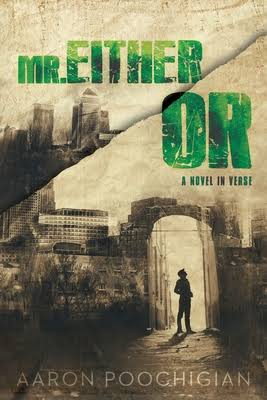
Aaron Poochigian, intro to ‘Mr. Either/Or’

Washington Square, playground of NYU,
and you are in the grass, your shoes and socks
like sloughed snakeskin around you. Speed-chess players
at concrete tables cuss and slap their clocks
as cops with nothing nine-one-one to do
roust dormant derelicts from greenhouse layers
of coats and trash. Nearby, a Gingko tree,
and under it a blonde in horn-rimmed glasses
eating up The Stranger by Camus.

You almost feel at home in this milieu;
for five years now you have been skipping classes,
tipping beers and averaging a ‘C’
to mask your hazardous identity,
the wicked one, known only to a few
code-numbered codgers in the F.B.I.
Somewhere at Quantico a dossier
redacts your selfless service as a fly
collecting wide-eyed snapshots for Defense,
a freak inferno burning evidence,
a ricin prick, a ‘beddy-bye’ bouquet,
and all too often the unlucky guy
sent in the long last seconds of suspense
to snip the ticker and defuse a war.

Who knows? Someday it might be nice to play
one person, but for now you live as two:
student and agent, Mr. Either/Or.

*****

Aaron Poochigian writes: “I think of the ‘Mr. Either/Or’ books as entertainments, airport novels to be devoured like genre fiction. I mixed together Pynchon’s ‘The Crying of Lot 49’, Byron’s ‘Don Juan’ and Lee Child’s Jack Reacher thrillers, and the adventures of Mr. Either/Or are what came out. I only hope that they are fun.

“The section published here introduces you to the main character, Zach Berzinski, an FBI agent undercover as an NYU student. This chapter is especially dear to my heart because it describes Washington Square Park with its cast of buskers and undergrads. It’s one of my favorite hang-outs. In 1917, Marcel Duchamp and other Bohemian artists declared the park ‘The free and independent Republic of Bohemia’, a sovereign polity outside of the USA.” 

Aaron Poochigian earned a PhD in Classics from the University of Minnesota and an MFA in Poetry from Columbia University. His latest poetry collection, American Divine, the winner of the Richard Wilbur Award, came out in 2021. He has published numerous translations with Penguin Classics and W.W. Norton. His work has appeared in such publications as Best American Poetry, The Paris Review and Poetry.
aaronpoochigian.com
americandivine.net

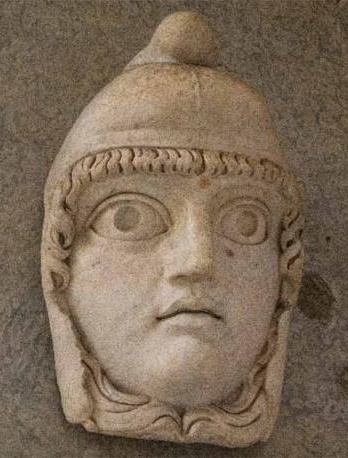
Weekend read: long poem: ‘Catullus LXIII’ translated by George Simmers

Across the sea goes Attis in his ship of sleek rapidity,
To Phrygia, and its forest, which he rushes into eagerly,
The great goddess’s territory, her tree-dark sanctuary.
There he grabs a flint; he jabs and savages his genitals,
Stabs until he’s sure he’s lost the burden of virility;
His blood spills its darkness on the sacred ground surrounding him.
SHE now, never he, SHE reaches for a tambourine,
The tympanum, Cybele, that is used by your initiates,
She beats out her message on the leather of the instrument;
Up she rises, and calls out to all her followers:

        My she-priests hurry, to these woods of our divinity.
        Hurry all you wanderers, all great Cybele’s worshippers,
        You searchers for an otherwise, you riskers and adventurers
        You voyagers who’ve dared the seas that match you in your truculence,
        You like me whose dream has been self-immolated genitals,
        Like me detesting Venus with the utmost of ferocity,
        Set free your minds with the liberty of ecstasy.
        Gladden our goddess, hurry here to worship her,
        Hurry to this Phrygian domain of femininity,
        Hurry to the cymbals, to the gentle flute’s seductiveness,
        Towards the fevered drums and the Maenads’ ululations
        There we must hurry for the celebration ritual.

Attis thus addressed them; she had all the look of womanhood;
Tongues lisped lovingly and cymbals clashed resoundingly.
Attis led on frenziedly, her wild breath labouring
Free as a heifer who’s escaped the yoke of drudgery,
Weary in her lungs, she through the woods leads rhythmically
The Gallae, who are following behind her storming leadership.

They reach the home of Cybele, wearied out and staggering,
Hungry, over-stretched, exhausted by excessiveness.
Sleep commands their eyelids to slide down sluggishly
Excitement leaves their bodies; rage gives way to drowsiness.

Dawn comes. Sunlight. The golden face that radiates
Alike above the firm soil and the great sea’s turbulence,
Which drives away darkness and banishes the weariness
Even from Attis, who is gradually awakening.
(For the goddess Pasithea’s taking Somnus to her bosom now.)
Attis, pseudo-woman, is freed now from delirium
Remembers what she did before, and sees herself now lucidly,
And knows what she has lost, and now her heart weighs heavily.
It labours in her body as she turns and walks back steadfastly,
Steadfastly and sadly, heading back towards her landing-place.
Her tearful eyes look out to sea; she renders this soliloquy
Remembering her birthplace despairingly, lamentingly.

        My motherland, my origin, the one place that created me,
        I must shun you like a thief now, like some dishonest runaway.
        Deserting you for Ida, for a bleak and chilly wilderness,
        Where brute beasts lurk, fired by hunger and rapacity.
        Freed now from my madness by the shock of the reality,
        My eyes weep with a longing for the home that was my nourisher.
        Must life be now this wilderness, with only fading memories
        Of when I was a man – but I have severed that identity –
        A young man, supple, and the flower of the gymnasium,
        A champion of champions among the oily combatants
        Who wrestled for the glory – one who won the admiration
        And the friendship of so many – how my home was garlanded!
        But nevermore now I’ve become Cybele’s mere serving-wench,
        Now that I’m a Maenad, a half-man, whose sterility
        Must sentence me to exile, to a life of pointless wandering,
        Neighbour to the boar and the wild deer in its solitude.
        On these wild slopes of Ida, shadowed by the peaks of Phrygia.
        How I hate my rashness; my regret becomes an agony,

Her words flying upward reached the ears of a deity,
They reached the ears of Cybele, who unleashed from their harnesses
The lions of her anger, with instructions to the left-hand one:
‘Go seek out Attis, be my agent of ferocity,
Pursue him till he’s overtaken by insanity,
Make him regret attempting to escape from my supremacy,
Lash your flanks with your tail, whip up your aggressiveness
Let the place re-echo with untamed outlandish bellowing,
Toss your long red mane in anger,’ so ordered Cybele,
Loosening the brute, who charged away unstoppably,
Raging, careering, crashing through the undergrowth,
Till it reached the white shore, where the sea was opalescent,
And that is where it saw him, Attis, solitary, delicate.
The lion charged and Attis, in a terrified delirium,
Fled towards the forest, to a destiny of hopelessness,
To existence as a slave there, the property of Cybele.

Great Goddess Cybele, Lady of Dindymus,
Vent your anger, I beseech you, far from my place of residence.
May only others feel your goad to madness and to ecstasy.

*****

George Simmers writes: “I’m not normally one for explaining poems, but my Englished version of Catullus’s poem LXIII in the current Snakeskin might be fairly mystifying to anyone coming to it unprepared.

“This is a poem that is over two thousand years old, and a remarkable one. The Victorian critic W.Y. Sellar described the ‘Attis’ as the most original of all Catullus’s poems: ‘As a work of pure imagination, it is the most remarkable poetical creation in the Latin language.’

“First – to deal with a possible misconception; the Attis of this poem is not the god of that name, but a young Greek man who sails to Phrygia, the home of the Great Mother, the goddess Cybele (pronounce the C hard, like a K). In homage to her he castrates himself, to become like one of her Galli, or attendant priests. Attis celebrates jubilantly, but next morning wakes up and registers the finality of what he has done, and the irrecoverable loss of his previous identity. The poem ends with Cybele setting her lions onto him, to drive him into the forest of madness.

“Summarising the story bluntly makes it sound like a simple fable of self-harm and regret, but Catullus is not a simple poet. The poem is made more complex by the intensity of his identification both with the exultant castrated Attis, and with his later regret. Another way of looking at the poem is as a tragedy – Attis’s desire to reshape himself is a hubris that leads to his destruction. Yet although Attis is labelled a pseudo-woman (‘notha mulier’) the reality of his desire to become a woman, and the intensity of his joy when he has liberated himself from maleness, are never in doubt. Significantly, when he later expresses regret, it is not for the loss of his sexual identity, but for his social one. It is possible to see the poem as an expression of the conflict within the poet himself, between his wayward hedonistic urges and his strict Roman ethic; he imagines an extreme case of abandoning a Roman (upright male) identity and discovering the consequences.

“The poem’s intensity is in part created by the metre – galliambic. There may be Greek precedents – scholars disagree, I think – but this poem has no known fore-runner in Latin verse. It seems to be based on the rhythms of the Galli’s ceremonial music (at the Roman Megalesian festivals, presumably, where the Great Mother was celebrated, by priests carrying tambourines and castrating-knives). It is an insistent, forward-driving metre, with a unique line ending, a pattering of three short syllables. English versification is different from Roman, and direct imitation of the galliambic metre in English does not work (although Tennyson had a go in his poem Boadicea). I have tried to find an equivalent that produces a similar forward-driving rhythm. It is based on a line of two halves; before the caesura I have allowed myself some freedom, to avoid predictability, but the second half of every line hammers with dactyls, always ending with a three-syllable word or phrase. This is the best solution I’ve found to the poem’s challenge. I’ve looked at various free-verse translations, but they all seem rather slack, lacking the energy of the original. Translations into blank verse or heroic couplets make the poem too staid. The prosody of the original was unique, controlled, purposeful, and a translation needs to be equally unexpected and distinctive.

“I suspect that my version may work better spoken aloud than on the page – but then I’m attracted to T.J. Wiseman’s theory that the original poem was originally written for performance (perhaps as accompaniment to a dance, perhaps at a Megalesian festival). Elena Theodorakopoulos agrees, and in a rather good essay available on the Internet, has written:

I am convinced that the poem must have been written with performance at or around the Megalesia in mind. My suggestion is that it was written for one of the gatherings patrician families held at their homes during the Megalesia [….] It makes sense to imagine the poem performed at such an event: the thrill of the violence and the orgiastic frenzy, the mystery of who exactly Attis was, and the sexual ambivalence of the performance, would all have provided the perfect ambience for such a gathering. And when the final lines are spoken, asking the great goddess to visit others with her fury and to keep away from the speaker’s house (domus), they are spoken by the poet himself, whose identification with Attis’ frenzy during the reading must help to appease the goddess and to keep the noble domus in which the performance has taken place safe from harm.

“Catullus LXIII is a poem full of subtleties and mysteries (I keep on finding new things in it, and new ways to tweak my version,and you can expect the translation in Snakeskin to be updated from time to time). Like most readers I was first attracted to Catullus by his short poems of love and hate. I am gradually discovering that there was so much more to him. I’m now looking at poem 64…”

*****

George Simmers used to be a teacher; now he spends much of his time researching literature written during and after the First World War. He has edited Snakeskin since 1995. It is probably the oldest-established poetry zine on the Internet. His work appears in several Potcake Chapbooks, and his recent diverse collection is ‘Old and Bookish’. ‘Catullus LXIII’ is from Snakeskin 320, and the explanation is from the Snakeskin blog.

Photo: from Snakeskin 320 (August/September 2024)

Weekend read: Quincy R. Lehr, ‘Thud!’

There’s thudding from the floor above that never seems to stop.
I’m trying to sleep, or waiting for the other shoe to drop
as midnight clomps toward 2 AM and hours of darkness dwindle
into the gray of going to work. This rent’s a fucking swindle.

Where’s my damn connection gone? The internet’s too slow.
Get me Jobs or get me Gates. Those bastards need to know.

I called her on a Friday, and we swore that we would meet.
I hailed a taxi, ended up along a different street —
similarly named, but swathed in layers of graffiti.
A drip of sweat ran down my neck; the air was cold and sleety.

Where’s that old-time romance gone? Who will sigh and blubber
over at hers at 3 AM with a lavatory rubber?

I saw a TV talking head while ordering a bagel
who talked about the budget mess — but then he quoted Hegel
about the end of history. Some Weltschmerz is okay,
but save it for the pop songs, man, and don’t get in the way.

Where’s my hometown paper gone? The owner’s on the run
from ranters on the blogosphere. Something must be done.

He met my eyes and shook my hand, and though you wouldn’t know it,
that jerk-off in a business suit calls himself a poet/
critic/impresario and manages quite well.
He smiled and quoted Dante, but I only thought of Hell.

Where’ve our tortured artists gone, Catullus or Syd Barrett?
Chasing after the latest grant and following the carrot.

The upstairs stomps are quicker now and spreading to the hall.
My head’s beneath the pillow. Damn it — won’t she ever call?
I half hope that she’s safe in bed and blithely fast asleep,
but fantasize her all alone and looking up mid-weep.

Where’s the just comeuppance gone? What happened to bad karma?
It got renamed and bottled up and bought out by Big Pharma.

There’s violence in the movies, and there’s violence on TV;
there’s violence on the city streets…. Fuck off! Don’t talk to me!
There’s anger in the headlines, and there’s fury in the verse
spat out at downtown open mikes. I don’t know whom to curse.

Where’ve the old-time standards gone? The censors look forlorn
from hip hop, emo, techno, goth. What happened to the porn?

Times Square’s gone all Disneyfied. The red-light district’s blue.
Godspeed to all you chicks with dicks, and hello, Scooby-Doo.
Farewell, Adult Emporium! You’re now a clothing store,
maybe a Planet Hollywood — and God knows which sucks more.

Where’s my filthy city gone? They smothered it in bleach,
hired a doorman, raised the rent, and placed it out of reach.

What’s to blame? Is it our greed or lack of common sense?
Is it violence in our past, or just incompetence?
Perhaps it’s economic or the crush of circumstance.
Or was it just a thwarted wish to get into her pants?

Where’s that upstairs thumping gone? The silence settles deep
into the still and humid air. I still can’t get to sleep.

*****

Quincy R. Lehr writes: “Thud! is a New York City madsong, with gentrification, insomnia, political decay, and urban loneliness mixing together in a sort of minestrone soup of misery that is also, I think, pretty funny.”

Born in Oklahoma, Quincy R. Lehr is the author of several books of poetry, and his poems and criticism appear widely in venues in North America, Europe, and Australia. ‘Thud!‘ was first published in Measure and was reprinted in the Potcake Chapbook ‘City! Oh City!‘ His book-length poem ‘Heimat‘ was published in 2014. His most recent books are ‘The Dark Lord of the Tiki Bar‘ (2015) and ‘Near Hits and Lost Classics‘ (2021), a selection of early poems. He lives in Los Angeles.
https://www.amazon.com/Quincy-R.-Lehr/e/B003VMY9AG

Photo: “sleepless” by ebrkut is licensed under CC BY-ND 2.0.

Weekend read: Duncan Gillies MacLaurin, ‘The Real Pity’

No, Wilfred, I never
believed your endeavour
was more than a clever display.
Did you think you could rescue
the boys in the mess queue,
or – no less grotesque – you’d betray
your comrades by opting to stay
in shock in Craiglockhart’s sick bay?
Naive pretence
is no defence
for senseless sacrifice.
Admit it, you
were stupid to
ignore Sassoon’s advice
and blithely return to the fray,
quite deaf to the price you would pay.

You based your decision
on lack of a vision
and fear of derision combined.
You went back to that battle
where kids died “as cattle”
to leave tittle-tattle behind,
regardless of what you might find.
No doubt you were out of your mind!
Or, more exact,
you lacked all tact.
Death was not your “chum”.
One week passed,
and then, at last,
the Armistice had come.
You thought you were helping mankind.
Your nerves were so numb you were blind.

The telegram telling
the news reached your dwelling
as people were yelling “Hooray!”
You were inconsequential
despite your potential.
What did you essentially say?
“Was it for this the clay…?”
Whose drum did you dumbly obey?
You grew obsessed
with your new quest;
it made you big and bold.
Was it fulfilled
when you were killed,
just twenty-five years old?
I have to report with dismay
there’s no lack of soldiers today.

*****

The following is an explanatory essay by Duncan Gillies MacLaurin, entitled ‘Owen, Sassoon, Barker and Me’:

If anything might rouse him now
The kind old sun will know.

– from Wilfred Owen’s sonnet, “Futility

It would have been late 1976 or early 1977 when my English teacher, Peter MacDonald, introduced me, a 14-year-old Scottish public schoolboy, to Wilfred Owen. Pixie, as he was called by the boys, had hardly given us the gist of Owen’s life, death, and poetry, when I found myself pole-axed. I hadn’t got my head around the fact that Owen chose to return to fight in the war that he was denouncing in his poetry even though serious shellshock exempted him from service, when I was told that he was killed just one week before the Armistice. It was too much for me.

Reciting Wilfred Owen’s sonnet “Futility” in chapel a few weeks later, I sensed in poetry an alternative to the spiritual life I had known hitherto. Not that I reacted immediately. I didn’t begin writing poetry until I was 20. And it was not until late 1989 that I returned to the poet whose fate had hit me so hard.

It started the way it sometimes does, with a couple of lines scribbled down just before bedtime. The lines were: “If your heart is your legend,/ if your pen is your weapon…” The next day I sat down with my guitar and put the lines to a tune. Although I hadn’t had Wilfred Owen in my thoughts, I found that the piece was to be about him. A year later, “Letter to a Dead Poet” was published in The Dolphin Newsletter, an internal journal of the English Department at Aarhus University, Denmark.

Letter to a Dead Poet

Hey Wilfred Owen,
where were you going
when you got blown away?
Had your heart been your legend,
had your pen been your weapon,
had your conscience elected to stay
watching the sparrows play,
you might have been here today.
I don’t believe your sacrifice
was generous or free;
the fact you paid the highest price
betrayed “Futility”:
“Was it for this the clay…?”
What were you trying to say?

What use are the laurels?
What use are the morals
in all of your quarrels combined?
You went back to that battle
where kids died “as cattle”
to leave tittle-tattle behind
and claimed you were just being kind.
You must have been out of your mind!
And when at last your blood was spilled
Death was not your friend;
one week after you were killed,
the War was at an end.
How could you be so blind?
What were you hoping to find?

My English literature professor, Donald Hannah, who specialised in WWI poetry, was full of praise.

In 2008 (by chance the year Donald Hannah died) I started revising the piece, enlisting the help of other poets on a couple of online workshops. In the process I became even more critical of Wilfred Owen, and people were saying things like: “If he wasn’t already dead there’s a fair chance this would finish him off.” Even my wife, a novelist and investigative journalist, disliked my revisions. One poet, Janet Kenny, was sympathetic though. She commented:

You must have known that this would upset everybody. Owen is so beautiful and
touches us in the deepest way. But I admire the courage this must have taken. It reminds me of Edward Bond’s “First World War Poets”:

You went to the front like sheep
And bleated at the pity of it
In academies that smell of abattoirs
Your poems are still being studied
You turned the earth to mud
Yet complain you drowned in it
Your generals were dug in at the rear
Degenerates drunk on brandy and prayer
You saw the front—and only bleated
The pity!
You survived
Did you burn your general’s houses?
Loot the new millionaires?
No, you found new excuses
You’d lost an arm or your legs
You sat by the empty fire
And hummed music hall songs
Why did your generals send you away to die?
They saw a Great War coming
Between masters and workers
In their own land
So they herded you over the cliffs to be rid of you
How they hated you while you lived!
How they wept over you once you were dead!
What did you fight for?
A new world?
No — an old world already in ruins!
Your children?
Millions of children died
Because you fought for your enemies
And not against them!
We will not forget!
We will not forgive!


I just wanted to show that there was at least one other naughty boy. I love the poems of Wilfred Owen. I seriously like your poem. It would be impossible to imitate his voice (and
unacceptable) but the irreverence IMO hits the correct note. Your poem is deliberately
“vulgar” and unpretentious and is all the more telling for that reason.


(From the online workshop, Eratosphere, 2008, quoted with Janet Kenny’s permission)

Thus encouraged, I persevered, and in 2012 my new version was published in the newly-founded poetry e-zine, Angle. One of the editors was Janet Kenny.

The Real Pity

No, Wilfred, I never
believed your endeavour
was more than a clever display.
Did you think you could rescue
the boys in the mess queue,
or – no less grotesque – you’d betray
your comrades by opting to stay
in shock in Craiglockhart’s sick bay?
Naive pretence
is no defence
for senseless sacrifice.
Admit it, you
were stupid to
ignore Sassoon’s advice
and blithely return to the fray,
quite deaf to the price you would pay.

You based your decision
on lack of a vision
and fear of derision combined.
You went back to that battle
where kids died “as cattle”
to leave tittle-tattle behind,
regardless of what you might find.
No doubt you were out of your mind!
Or, more exact,
you lacked all tact.
Death was not your “chum”.
One week passed,
and then, at last,
the Armistice had come.
You thought you were helping mankind.
Your nerves were so numb you were blind.

The telegram telling
the news reached your dwelling
as people were yelling “Hooray!”
You were inconsequential
despite your potential.
What did you essentially say?
“Was it for this the clay…?”
Whose drum did you dumbly obey?
You grew obsessed
with your new quest;
it made you big and bold.
Was it fulfilled
when you were killed,
just twenty-five years old?
I have to report with dismay
there’s no lack of soldiers today.

The two lines that inspired the piece are gone, yet the sentiment they express is still its backbone. My new title is a reference to something Owen wrote in a preface to a posthumous collection of his poetry: “My subject is War and the pity of War. The Poetry is in the pity.”

A significant new element in the latest version is the fact that Owen’s mother received the dreaded telegram just as the church bells in Shrewsbury were ringing out in celebration of the Armistice.

The alleged advice from Siegfried Sassoon in the first stanza is undocumented. It was an idea that came from reading about their relationship in Pat Barker’s historical novel, Regeneration (Viking Press, 1991), which is centred around the humane treatment that Owen, Sassoon and others received from the man in charge at Craiglockhart, Dr Rivers. Sassoon was at Craiglockhart (in Edinburgh) because his declaration proclaiming the futility of the war had been read aloud in Parliament. Sassoon wasn’t ill, but the government didn’t know what else to do with this war hero turned pacifist. Owen and Sassoon became good friends, and they had a lot in common. They were both homosexual and both strongly ambivalent about the war. Sassoon, the seasoned poet, recognised Owen’s budding poetical talent and helped him with it. There is no doubt that it was a case of hero worship on Owen’s part. Even though they would not allow themselves to refuse to go back to the front, because they saw it as their duty, on a personal level they would not have wanted each other to have to return. While Sassoon’s return to the front was merely the result of a mature adult’s battle with his own conscience, Owen was a damaged young man who should never have been allowed to return. I have imagined that Sassoon told Owen that he (Owen) didn’t need to return to the front, but that Owen chose to follow his hero’s example rather than his advice. Sassoon grieved bitterly over Owen’s death and claimed he would never be “able to accept that disappearance philosophically”. (Siegfried’s Journey, Faber and
Faber, 1945, p. 72)

In an interview with critic Rob Nixon in 1992 Barker talks about issues that were central for the two poets:
Barker: Yes, it is about various forms of courage. What’s impressive about Sassoon’s courage actually is not just the obvious thing that it takes a lot of courage to get decorated, and that it takes a lot of courage to protest against the war, so he’s being brave in two distinct ways. In fact, it’s a much deeper form of courage than that because—partly because of his sexual makeup—he had a very deep need, I think, to be visibly tough and heroic and hypermasculine and prove he could do it. The bravest thing he does, it seems to me, is to deny that psychological need in order to protest against the war.
Nixon: I think one of the great strengths of the novel is the way it deals with the complexity of the condition of the pacifist-warrior rather than simply taking head-on the question “Is war good or bad?” It’s not an ethical book in that narrow, straightforward sense, but ethical by staging the dilemmas of that condition.
Barker: It’s not an antiwar book in the very simple sense that I was afraid it might seem at the beginning. Not that it isn’t an antiwar book: it is. But you can’t set up things like the Somme or Passchendaele and use them as an Aunt Sally, because nobody thinks the Somme and Passchendaele were a good idea. So in a sense what we appear to be arguing about is never ever going to be what they [the characters] are actually arguing about, which is a much deeper question of honor, I think. “Honor” is another old-fashioned word like “heroism”, but it’s very much a key word in the book.
p.7 of “An Interview with Pat Barker” in Contemporary Literature 45.1 (2004)

The ethos of the committed pacifist scorns mere personal safety. Both Owen and Sassoon returned to the War despite their opposition to it. Yet Barker also points to the ambivalence of the positions the two poets held:
Barker: …part of the paradox of Sassoon’s position and, indeed, of Wilfred Owen’s, is that they are simultaneously condemning the war wholeheartedly and claiming for the combatant a very special, superior, and unique form of knowledge, which they are quite implicitly saying is valuable. That you cannot know what we know, and what unites us is something you cannot enter.
(Ibid., p.8)

Barker later states the ambivalence the two men felt even more baldly. She is also astute in her assessment of the class privileges they enjoyed despite their pacifism:
Barker: On the one hand, you’ve got the war poets telling everybody the horrors as vividly as they can. But at the same time, in both Owen’s and Sassoon’s cases, refusing to say the other truth, which is that a lot of it those two particular men enjoyed. So you get an alternative area of silence developing, and that interests me.
The other thing that interests me is how in the second year of the war you had the increased persecution of the pacifists and the increased persecution of homosexuals. There were two very, very nasty campaigns going on. A lot of state spying of a very nasty kind. There was one poor woman, Alice Wheeldon, who was sent to prison with ten years’ hard labor because a police spy alleged that she had plotted to kill Lloyd George by sticking a curare-tipped blowdart up through his shoe. This was a woman who kept a second-hand clothes shop in Leicester. And she got ten years’ hard labor. Unlike Sassoon, you see, who didn’t get sent to prison. You need to be working class and a woman to actually get yourself sent there.
(Ibid., p.19)

What spurred me to write this piece? As is often the case, it was the combination of two factors. On the one hand, my own public-school background meant that I was able to identify with and feel sympathy for Wilfred Owen. On the other hand, I wanted to condemn the elitist culture and stiff-upper-lip ethos that sent an excellent poet to an early grave.

Duncan Gillies MacLaurin, 4th November 2018

*****

Duncan Gillies MacLaurin is a Scottish poet who was born in Glasgow in 1962. He studied Classics at Oxford, left without a degree, and spent two years busking in the streets of Europe. He met a Danish writer, Ann Bilde, in Italy in 1986 and went to live in Denmark, where he teaches English and Latin. His collection of 51 sonnets, I Sing the Sonnet (2017), is online at Snakeskin. He blogs here.

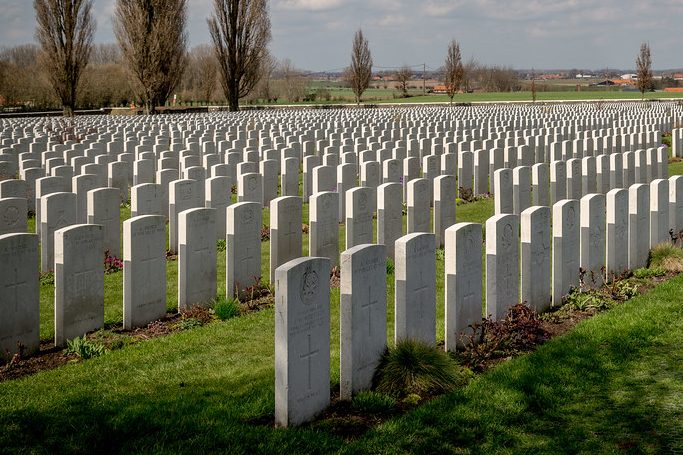
Photo: “Tyne Cot WW1 Cemetery” by PapaPiper is licensed under CC BY-ND 2.0.

Weekend read: SF poem: RHL, ‘The Uncertainty of Light’

On an asteroid
there was an alien artefact.
If such it was… a droid…
I’ve no idea, in fact.
Its metal (leg?) seemed (deployed?)
and so I touched it, but responses lacked.

Once there were women; once I was a man
(touching a leg then always brought response)
before the search for life and light began
to change me into this dark renaissance.
The teacup storms on which I’ve tossed,
when she or I have bitched and bossed
till all the loves I’d ever marked
were all the women that I’ve lost.
They chose the certainty of Dark
over the uncertainty of Light.

The joys of life are what’s uncertain:
hopes of what’s behind the curtain,
knowing the results will grate
of things that you anticipate,
knowing your life could be wrecked
by what you never could expect.
And though you think you’re circumspect,
you can’t deflect, inspect, collect.
Knowing the harvest is unknown
with crops that grew from deeds you’d sown,
while all your greatest hopes and dreams
will be exceeded by the future’s smallest gleams.

Because change never stops, you find what matters
is never really known.
You may get verbal assurance of your future status,
but was it “throne” or “thrown”?
The only certainty would be
if, offered immortality,
you feared what such an altered world would lose, would save,
and chose instead to go into the Dark
with furnace no less dark than the grave
wherein there lies no risk of further blight.
Most people choose the Certainty of Dark
over the Uncertainty of Light.

But we who strive to stay alive
long enough for rejuvenation
hope, hope only, we will thrive,
post-humans in a re-Creation,
unknowing what our ape-based genes
will do with power dominance,
with war, with sex, Earth mined and undermined,
but glad to take the chance.
How else can we see scenes
of how it all turns out — destroyed? refined? —
unless we scrape through, level up with wounds and scars
and watch a world we love and leave behind?
So at last I am here, between the stars,
transiting the darkness of the Void,
the empty galaxy’s apparent night,
chanting the mantra that keeps spirits buoyed:
Let there be Post-Humanity’s own light!

Between the spiral arms in the near-void
there’s still thin light of distant galaxy and star,
still specks of dust, rarely an asteroid.
Earth left (millennia in old Earth years ago),
I cross the dark immortally, beyond, afar,
through what is darkness only to Earth-eyes
which myriad wavelengths up and down can’t know,
but which I now apprize.
Light here abounds,
and boundlessly surrounds, astounds.

Take the smallness from slight,
take the bad from the blight,
take the fear out of flight
and you’re left with the light, the light, the light.
We stumble from dark caves of night
into day, trying not to tumble;
our parents the dark; post-humans the light;
ourselves just the stumble.

*****

This poem (published in this week’s Bewildering Stories) is a response to conversations in which people have expressed pessimism about the value of life extension, rejuvenation, cryonic preservation and resuscitation… anything beyond the certainties of a clear end to life after a normal lifespan. “How will you… why would you… what if they… you won’t understand… you won’t have…” Ah, but everyone who has immigrated into a foreign culture has done this: had to learn a new language in order to find a job and start making friends and find out how everything works. Some of us are comfortable doing this; some people aren’t. I’ll take the uncertainty, and enjoy its discomforts… because it’s just so interesting!

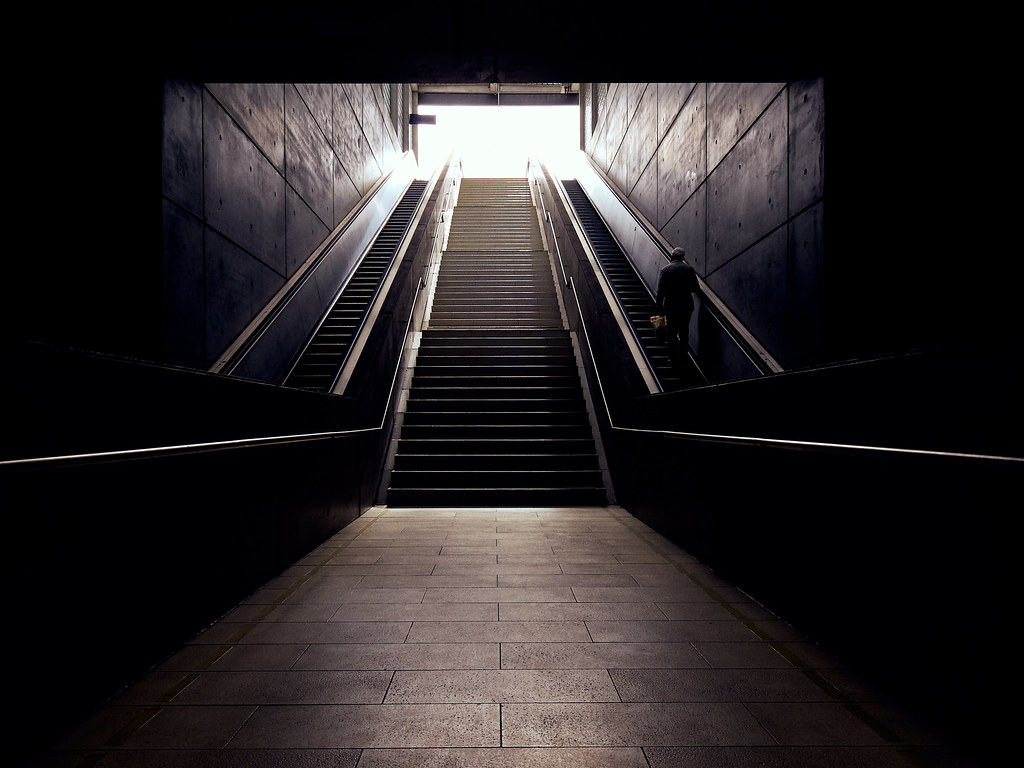
Photo: “Into the Light: The Future is Uncertain” by tenzin.peljor is licensed under CC BY-SA 2.0.