Category Archives: nonce forms

Using form: Susan Jarvis Bryant, ‘Sorceress’

She is polished and pernicious 
Her demeanor is delicious 
She will soften the suspicious 
     With her smile 
 
She’ll abash you then disarm you 
She’ll harass and she’ll alarm you 
Then she’ll nonchalantly charm you  
     That’s her style 
 
She’ll reject and then she’ll choose you 
She’ll respect and then she’ll use you 
She’ll protect and then she’ll bruise you 
     In a flash 
 
She’ll dismiss you then possess you  
She will curse you then she’ll bless you 
She’ll distress and then impress you 
     With panache 
 
She’ll accuse and then assuage you 
She’ll abuse and she’ll upstage you 
She’ll amuse and she’ll enrage you 
      Every day   
 
She’ll assist you then she’ll spurn you 
She’ll enlist you then she’ll burn you  
She will twist and she will turn you 
     Every way 
 
She will praise and then berate you 
She will raise and then deflate you 
She’ll amaze and still frustrate you 
     You can’t win 
 
She’s capricious and malicious 
She is smoothly surreptitious 
She conceals a core that’s vicious  
     With a grin

*****

Susan Jarvis Bryant writes: “This is one of those poems that simply wrote itself. It’s a nonce form that appeared in my head as a song without lyrics.  The lyrics came easily. I love the way words fit together to create music – a melodious flow that lifts images to a greater height. Passion always assists me in the creative process, and this poem is written about someone in particular… someone that irked me greatly… someone I will never mention. I’ll just nod and smile a satisfied smile when reading the poem. Poetry composition can be immensely cathartic.”

‘Sorceress’ was originally published in Snakeskin.

Susan Jarvis Bryant is originally from the U.K. and now lives on the coastal plains of Texas. Susan has poetry published on The Society of Classical Poets, Lighten Up Online, Snakeskin, Light, Sparks of Calliope, and Expansive Poetry Online, The Road Not Taken, and New English Review. She also has poetry published in The Lyric, Trinacria, and Beth Houston’s Extreme Formal Poems and Extreme Sonnets II anthologies. Susan is the winner of the 2020 International SCP Poetry Competition and was nominated for the 2022 and 2024 Pushcart Prize. She has published two books – Elephants Unleashed and Fern Feathered Edges.

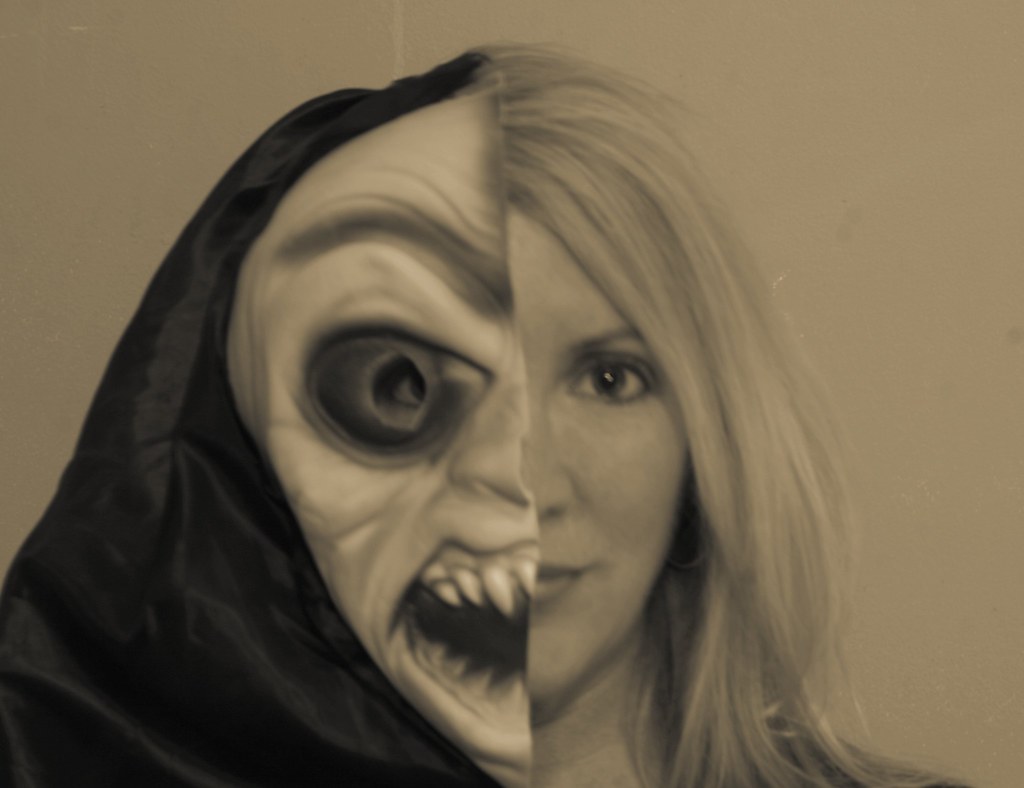
Photo: “Day 47-Split Personality” by Bazule is licensed under CC BY-ND 2.0.
Sonnet variation: Juleigh Howard-Hobson, ‘Sylvan Episode’

He looked at me as if I ought to know
just who he was
but I did not. I looked away, then so
did he. Alas
I didn’t recognize the Great God Pan
in human form.
I simply thought he was another man.
I felt a warm
gaze inviting me once more. I turned to
see him changed. A
God again, hooves and furry legs, horns grew.
He gestured “Hey?”
I was too dumbstruck to do more than stare.
He shook his curls and sprinted off somewhere.

*****

Juleigh Howard-Hobson writes: “I wrote this when I lived off-grid on ten acres up in rural Washington State.The forest that made up half my property was dark and creepy. The Great God Pan was no more out of place than BigFoot or werewolves. All of which I imagined I saw/heard from time to time (I use italics as I am not absolutely convinced it was all imagination). Nothing out there ever hurt me, so all’s well that ends well–I’ve since moved back to civilization, which is far more frightening in many ways. As for the form–well, that just was how the poem decided to be.”

Juleigh Howard-Hobson’s work can be found in Think Journal, Able Muse, New Verse Review (including this poem), The Deadlands, Autumn Sky Poetry and other venues. She has been nominated for “The Best of the Net”, Pushcart, Elgin & Rhysling Awards. Her latest book is Curses, Black Spells & Hexes (Alien Buddha). A member of the HWA and the SFPA, she lives on the coast of the Pacific Northwest. In a poetically haunted house. 
X: poetforest

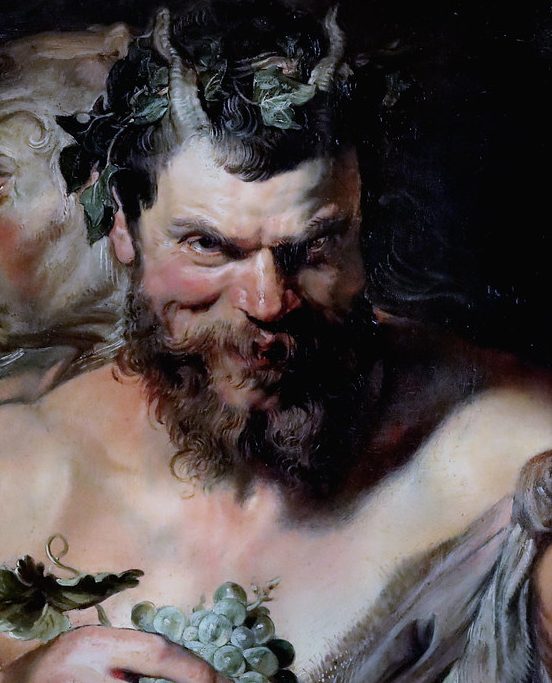
Photo detail “IMG_4017RBA Peter Paul Rubens 1577-1640 Anvers Deux Satyrs Two Satyrs ca 1619 Munich Alte Pinakothek” by jean louis mazieres is licensed under CC BY-NC-SA 2.0.

Nonce form: Aaron Poochigian, ‘Reunion Show’

Remember rage the way we used to love it
and what mad masks we wore when we began.
Think of the shrieking eagle on our van,
the decal, with its wings aflame
and our prophetic name,
The Downward Spiral,
the viral
expansion of it,
the perks and packed arenas
before the groupies got between us,
the label dropped us, and the fad wound down.

Boys, since this bar is in a nowhere town
let’s pound out, with our amps cranked up to ten,
sincerer tribute to the angry art
than we could handle at our start.
The blasphemy we hurled
against the world
back then
was out of season.
Now we have damned good reason
to smash things up like ruined men,
and all my lyrics will be from the heart.

*****

Aaron Poochigian writes: “I played in punk bands in high school and college and wrote that poem after I had gone all-in on poetry. I imagined what it would be like to get back together with my former band-mates at a later age. ‘Reunion Show’ is one of the first poems in which I let the nonce form discover itself with various line lengths and rhyme scheme. I tried to just let it all come together. Here is another later one like that: https://newcriterion.com/article/happy-birthday-herod/

‘Reunion Show’ was first published in The Dark Horse.

Aaron Poochigian earned a PhD in Classics from the University of Minnesota and an MFA in Poetry from Columbia University. His latest poetry collection, American Divine, the winner of the Richard Wilbur Award, came out in 2021. He has published numerous translations with Penguin Classics and W.W. Norton. His work has appeared in such publications as Best American Poetry, The Paris Review and Poetry.
aaronpoochigian.com
americandivine.net

Twitter: @Poochigian
Facebook: Aaron Poochigian
Instagram: aaronpoochigian

Photo: “Saxon Blondie 08.03.2019 Fotografías para iRock ______________ #multienfoque #picoftheday #photography #photo #photographer #photooftheday #nofilter #sinfiltro #instapic #instacool #wacken #woa #rock #show #alemania #festival #metal #rock #saxon #nibb” by ISENGARD is licensed under CC BY-NC-ND 2.0.

Helena Nelson, ‘Invitation’

a homage to Donne’s ‘Nocturnal on St Lucies day’

The shortest day is soon. Time for a pact.
I don’t mean with Saint Lucy (Lucy’s day
falls earlier in the month). But hey
let’s meet and talk and counteract
such darkness of the heart
as coincides with winter’s formal start.
We can read Donne’s ‘Nocturnal’, view its art,
its provenance and what on earth it means.
Location doesn’t matter. We have screens.

Nobody writes a poem now like that —
not something so precise and well controlled.
Of course, we hear what we are told:
the world is round, a rhyme is flat,
‘poetics’ have moved on
and these days no-one wants to write like Donne
who was amazing, right? But dead and gone.
Or not that dead. I’d say he’s still alive
in stanza three and certainly in five.

They call Donne ‘metaphysical’, you know,
a word still popular in jacket blurbs
for living, writing bards where verbs
(or verbiage) propel the flow
but hard now to be sure
whether they mean what Johnson meant. The more
‘meta’ you get with blurbs, the more obscure.
When ‘metaphysical’ foretells a treat
it might be true; it might be mere conceit.

But in ‘Nocturnal’, metaphor leans out
and mystifies. It’s not the usual thing
like glass or compasses or string.
It’s nothing. No thing. Less than nowt.
He says what he is not
in several different ways. In fact, the knot
of nothingness becomes his central plot.
The poet in him can’t forget that ‘none’,
his rhyme for ‘run’, echoes both ‘sun’ and ‘Donne’.

So he’s the sum of everything he feels:
annihilated by the loss of one
without whom he is not a man,
just numb. And yet he still appeals
to logic to make clear
how dark existence is. Yes, she was dear.
Each syllable recounts her loss, his fear,
and this is now and then and now, since this
both the year’s and the day’s deep midnight is.

*****

Helena Nelson writes: “In 1617 when, after the death of his wife, John Donne wrote ‘A nocturnall upon S. Lucies day, Being the shortest day’, St Lucy’s Day coincided with the winter solstice in the author’s hemisphere. Then they changed the calendar, and these days, Saint Lucy’s Day is 13 December. But the winter solstice falls over a week later (this year 21 December).

“Every year on the solstice, I think about John Donne’s solstice poem, every year it gets more apposite, since it is essentially about death. Last year, I did a formal online discussion about it, and I wrote an invitation using the form that is Donne’s, though obviously for a less serious purpose. It allowed me to think it through. I’m thinking about the poem again today, so here’s the invitation.”

Helena Nelson runs HappenStance Press (now winding down) and also writes poems. Her most recent collection is Pearls (The Complete Mr and Mrs Philpott Poems). She reviews widely and is Consulting Editor for The Friday Poem.

Photo: “John Donne, Poet” by lisby1 is marked with Public Domain Mark 1.0.

Weekend read: Maryann Corbett, ‘A Valediction: of Maintenance Work’

Time was, we spent our muscle and our nous
propping an aging house
against the pummeling of its hundred years.
Clean paint, neat gardens, upkeep rarely in arrears,
sober as Donne. Yet now each year afresh
burdens us with new failings of the flesh:

Legs that once mounted ladders without qualm
tremble. Nor are we calm
confronting pipework; torsos will not shrink,
backs bend, or shoulders fold to grope below a sink.
Hands shake; eyeballs glaze over. What appalls
is that our bodies buckle like our walls:

plaque in arteries, soot in chimney stacks,
stubborn and troublous cracks
in teeth, in plaster. House! Ought we to call
ourselves—and you—new poster children for the Fall,
for that hard doctrine grumbling down the ages
that Sin’s to blame, with Death and Rot its wages?

Entropy as theology—would Donne
jape at it? Wink and pun
as in his randy youth? Or solemnly
robed in his winding sheet, sing Mutability,
spinning into the praise of God in Art
the fact that all things earthly fall apart?

Or pull from air some bit of modern science,
yoking (even by violence)
thermodynamics, shortened telomeres,
transplants, genetics, sex, the music of the spheres?
Strange physics and wild metaphors—all grand,
but Rot and Death, plain woes we understand,

are better fought with checkbooks than with verse.
We’ll sit, these days. We’ll nurse
our beers, while able bodies stir their dust.
A distant siren whines—we sigh; it whines for us.
Let plumbers, painters, carpenters begin
this season’s round of battling Death and Sin.

*****

Maryann Corbett writes: “Last summer, Clarence Caddell was just beginning work on a new magazine, The Boroughand was planning a second issue while the first came together. He had in mind an issue centered on Donne, and he commissioned me to contribute a poem. I’d read the wonderful biography Super-Infinite: The Transformations of John Donne by Katherine Rundell not many months before, so a lot of the life was fresh in my mind–but it was also the season of endless repair that is the eternal truth of owning a house that’s 113 years old.  It wasn’t hard to pull together a poem about the woes of home ownership with tidbits that “everyone knows” about Donne–his worldly-to-holy conversion, the familiar line about his yoked-by-violence metaphors–under an allusive title, and in a stanza form a bit like one of his. (Alas, this blog can’t show you the indents that would best imitate Donne’s way of laying out a poem. You’ll have to imagine all the trimeter second lines indented and the hexameter fourth lines hanging out farther left.) In the end, Clarence had to use the poem to fill out his first issue, so it sat alone, unassisted by an issue theme.”

Maryann Corbett earned a doctorate in English from the University of Minnesota in 1981 and expected to be teaching Beowulf and Chaucer and the history of the English language. Instead, she spent almost thirty-five years working for the Office of the Revisor of Statutes of the Minnesota Legislature, helping attorneys to write in plain English and coordinating the creation of finding aids for the law. She returned to writing poetry after thirty years away from the craft in 2005 and is now the author of two chapbooks and six full-length collections, most recently The O in the Air (Franciscan U. Press, 2023). Her work has won the Willis Barnstone Translation Prize and the Richard Wilbur Award, has appeared in many journals on both sides of the Atlantic, and is included in anthologies like Measure for Measure: An Anthology of Poetic Meters and The Best American Poetry.


Photo: “House Repairs” by JessNityaJess is licensed under CC BY-NC-SA 2.0.

Cowboy poetry: Using form: Doc Mehl, ‘Poems Used To Rhyme’

Poems used to rhyme.
In time, the couplets were dispensed.
Incensed, today’s poet rebels from rhyming schemes,
It seems. The writer, newly shedding the shackles of quatrains,
Refrains from even a modicum of lilt.

And built now from unpaired diphthongs,
His songs have lost a measure of glue.
It’s true. No longer does the ear delight
In flight of fancy, in teeter-totter,
Like water on the endless sand, the to-and-fro,
And no, this tide will not abate.

Of late, I find that poems no longer draw me in.
They’re thin.

*****

Doc Mehl writes: “For the last two decades I’ve written rhyming western poetry, and I’ve performed both the poetry and my original western-themed music at cowboy poetry events in the western U.S. and Canada. I’ve recorded two spoken-word CDs of my rhyming poetry, and several CDs of my original music.
I’m not averse to free verse. (OK, I must pause momentarily to savor the rhyme in that sentence.) Still, the author of a free verse poem ought to be able to convincingly answer this question: “Why do you maintain that this work should be categorized as poetry rather than prose?”
In this poem (“Poems Used To Rhyme”), I liked the gamesmanship of sneaking the rhyming word of each “couplet” into the beginning of the second line rather than at the end of the second line. The resulting poem might first appear to be a tongue-in-cheek free verse poem about why rhyme is important. Still, the magic of the closely juxtaposed rhyming words can’t help but rise from the ether.”

‘Poems Used To Rhyme’ was first published in Rattle #85 with a link to audio.

Newly transplanted from Colorado to Black Diamond, Alberta, Al “Doc” Mehl traces his family roots to central Kansas, where his grandfather raised six children on the family homestead. His debut music CD is titled “Asphalt Cowboy,” and his second music CD titled “I’d Rather Be…” was released in 2008. Doc Mehl has also published a CD of original poetry titled “Cowboy Pottery,” and a second spoken-word poetry CD titled “The Great Divide,’ named 2013 “Cowboy Poetry CD of the Year” by both the Western Music Association and the Academy of Western Artists. In 2020, Doc published his first collection of poetry, “Good Medicine: Read Two Poems and Call Me in the Morning.” And in 2022, Doc released two new CDs of music, “West of the 22” and “Tried and True. Doc’s poems and musical lyrics have been featured on the website http://www.CowboyPoetry.com, he has been published in the poetry journal “Rattle,” and he was a first-place silver buckle winner at the National Cowboy Poetry Rodeo in Montrose, Colorado in 2009.

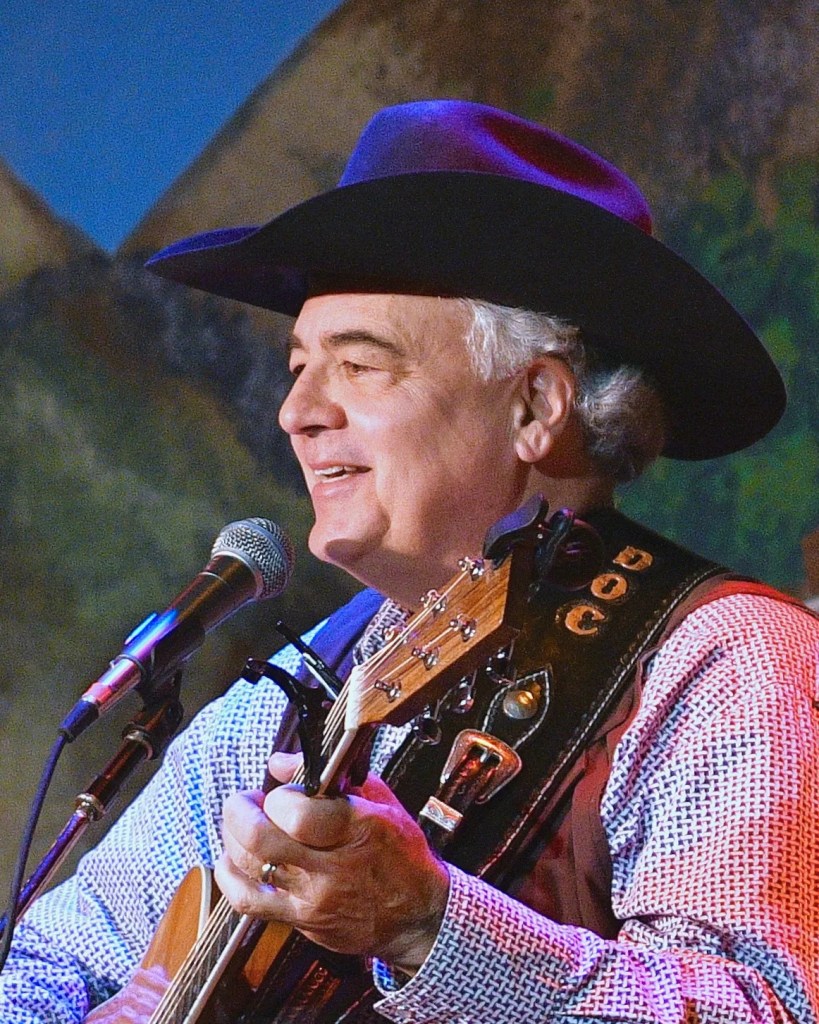
Photo: https://docmehl.com/photo-gallery

Using form: Nonce form, riddles: Aaron Poochigian, ‘The New New Amsterdam’

I am the scam
you go in for, the diamonds in the pavement,
ecstatic evenings caught on traffic cam,
rare toilets and consensual enslavement.

Scholars and brawlers are inside of me.
What could I be?

I am
the new New Amsterdam.

I am those glam
high-rises and the derelicts’ despair,
graffiti worthy of the Met, and sham
Versace hawked to chumps in Union Square.

Purists and tourists are inside of me.
What could I be?

I am
the new New Amsterdam.

I am the ham
ironist, the perverse poobah of shock,
the firetruck stranded in a rush-hour jam
while conflagration rages round the block.

Birders and murders are inside of me.
What could I be?

I am
the new New Amsterdam.

I am the slam
Where Subway Ends, a scrum of mad musicians,
Sunday phone calls with a far-off fam,
Halal street food, and infinite ambitions.

Shoo-ins and ruins are inside of me.
What could I be?

I am
the new New Amsterdam.

*****

Aaron Poochigian writes: “Riddles go back to a time before ‘English’ was our English, before Shakespeare and Chaucer, the time of bards and Beowulf. The Anglo-Saxon riddles have the rhythms of poetry. They tell it slant like poetry does sometimes. The tantalizing, first-person self-description that defines the genre gave me a ‘way in’ to talk about a subject that would have been too vast otherwise—New York City.”

‘The New New Amsterdam’ was first published in The Rising Phoenix Review.

Aaron Poochigian earned a PhD in Classics from the University of Minnesota and an MFA in Poetry from Columbia University. His latest poetry collection, American Divine, the winner of the Richard Wilbur Award, came out in 2021. He has published numerous translations with Penguin Classics and W.W. Norton. His work has appeared in such publications as Best American Poetry, The Paris Review and Poetry.
aaronpoochigian.com
americandivine.net

Twitter: @Poochigian
Facebook: Aaron Poochigian
Instagram: aaronpoochigian

Photo: “NYC Night Life” by Tom Roeleveld is licensed under CC BY-NC-ND 2.0.

Using form: Susan Jarvis Bryant, ‘To Autumn’

Your flare of red turns Winter’s hoary head
To gaze upon your blaze and feel the heat
      And fever of your beat.
Your spice and sizzle catch his breath and spread
Through icy sighs to melt the lick of frost
      That dusts the dawn
With hints of chill intent. His plot is lost
In honeyed-apple charm and plummy balm.

You temper smitten Winter’s bitter breeze.
Your foxy bronze and lush rufescent blush;
      Your gold and ruby rush
 Ignite the leaves that shiver on the trees.
You burn through thickest wisps of morning mist.
      Birds laud your glow.
The granite skies grow blue as clouds are kissed
By dreams so hot they thaw all thoughts of snow.

When it’s your time to go you’ll fade with grace
As branches shed their tawny tears of grief –
      Each crisp and crinkled leaf
Will pool and pile. As Winter shows his face
Your fluffy, brush-tailed fans will slump and sleep.
      They’ll hit the sack
Until they spy the coyest crocus peep –
Spring’s message to the world that you’ll be back!

*****

Susan Jarvis Bryant writes: “My poem is a quirky nod to Keats’ timeless and beautiful ode with a much louder and sassier version of the fall with not a mellow trait in sight.  There is no time for mourning loss in this poem. Autumn vows (in true Terminator style) she’ll be back! The form I chose is a nod to the traditional but with two short lines in each stanza – an act of rebellion in keeping with this fiery season.”

‘To Autumn’ was originally published in Snakeskin 321.

Susan Jarvis Bryant is originally from the U.K., but now lives on the coastal plains of Texas. Susan has poetry published on The Society of Classical Poets, Lighten Up Online, Snakeskin, Light, Sparks of Calliope, and Expansive Poetry Online. She also has poetry published in The Lyric, Trinacria, and Beth Houston’s Extreme Formal Poems and Extreme Sonnets II anthologies. Susan is the winner of the 2020 International SCP Poetry Competition and has been nominated for the 2024 Pushcart Prize. She has just published her first two books, Elephants Unleashed and Fern Feathered Edges.

Photo: “Fall Color on the Pond” by fossiled is licensed under CC BY-NC-SA 2.0.

Using form: unconventional couplets: Helena Nelson, ‘The Hill’

His heart is okay (it has been checked)
but not far from the top his pace is checked

and he stops. ‘Enough. Let’s go back.’
Mrs Philpott doesn’t want to go back.

If they get to the summit, they’ll see the view.
He doesn’t give tuppence about the view.

‘It’s not far,’ she says. ‘Too far,’ he says.
She doesn’t care a bit what he says,

she wants to get to the top of the hill. ‘Come on,’
she says. ‘Best foot forward.’ ‘You go on,’

he says. ‘I’ll wait here.’ So she walks on her own
and quickly sets up a pace of her own

not pausing and not once looking back
until for some reason she stops and looks back

and he’s quite out of sight, could be anywhere
and a sort of fear catches her where

head and heart meet. This stupid emotion is love
and because of that, because of her love,

if he won’t get to the top of the hill,
then she won’t get to the top of the hill

either. Anyway, a few drops of rain
fall on her hair and she knows he hates rain.

He might even have turned
and gone home without her. She turns

and half-runs down the path. He’s waiting for her,
sitting on his coat and waiting for her.

‘About time,’ he says. ‘Where have you been?’
She says, ‘Where do you think I’ve been?’

He doesn’t ask about the view from the top.
She doesn’t tell him she didn’t get to the top.

She might think, ‘This is the story of my life,’
but although this is the story of her life

that is not what she thinks.
She thinks something else.

*****

This poem comes from midway through Helena Nelson’s 2022 book ‘Pearls – The Complete Mr & Mrs Philpott Poems‘, some 100 poems (I haven’t counted) detailing their years of marriage, starting with a couple of references to their first marriages, through to their own noticeable ageing.

The book’s blurb asks: ‘Where did Mr and Mrs Philpott come from? The author has no idea. They popped into her head over twenty years ago and have refused to go away. Their story is one of ordinary, difficult, everyday love. And yet they themselves aren’t ordinary. Their dreams, anxieties and needs, their separate and difficult pasts, have somehow coalesced into mutual understanding–even sudden spurts of happiness–despite the rainy holidays, arguments and illness. The ordinariness of their love is magical and miraculous. Because ordinary love is a kind of miracle.’

Helena Nelson writes: “I didn’t choose this absorption with the Philpotts. It just happened, and it seems I really have stopped writing them now. But I’m terribly fond of them and often think about them. Probably one of my top favourite Philpott poems is ’The Hill’. Nearly all the poems have some kind of formal pattern underpinning them. Even when they appear to be free, the rhythms are deliberate. I don’t know if I could say any more about them. I feel as though they’ve gone off on their own now, for better or worse, and I’m happy about that.”

Helena Nelson runs HappenStance Press (now winding down) and also writes poems. Her most recent collection is Pearls (The Complete Mr and Mrs Philpott Poems). She reviews widely and is Consulting Editor for The Friday Poem.

Photo: “Day 40: Grey Skies” by amanky is licensed under CC BY-NC-ND 2.0.

Using form: Nonce form: RHL, ‘Camelot at Dusk’

From under low clouds spreading from the south
The red sun drops slow to night’s waiting mouth.
Rush lamps are lit; the guards changed on the walls;
Supper will not be served in the Great Halls
With Arthur still away. Each in their room,
The members of the Court leave books or loom
To say their Vespers in the encroaching gloom.

Lancelot, up in his tower,
Sees the sunset storm clouds glower,
Feels his blood’s full tidal power,
Knows he has to go.
In her bower, Gwenivere
Puts a ruby to her ear,
Brushes firelight through her hair,
Feels her heartbeat grow.

Guard, guard, watch well:
For the daylight thickens
And the low cloud blackens
And the hot heart quickens
To rebel.

From his tower, caring not
For consequences, Lancelot
Crosses courts of Camelot,
Pitying his King.
In her bower, Gwenivere
Feels his presence coming near,
Waits for footfalls on the stair,
Lets her will take wing.

Guard, guard, watch well:
If attention slackens
When the deep bond beckons,
Evil knows Pendragon’s
In its spell.

And as the storm clouds, rubbing out the stars,
Deafened the castle and carved lightning scars,
Drenched Arthur rode for flash-lit Camelot
Where he, by Queen and Knight, was all forgot.

*****

‘Camelot at Dusk’ was originally published by Candelabrum, a now-defunct poetry magazine in the UK which appeared twice-yearly from April 1970 to October 2010. Candelabrum provided what was, in the 1970s, a very rare platform for British poets working in metrical and rhymed verse.

Technically, the poem uses a variety of forms. The opening and closing passages use iambic pentameter with simple sequential rhyme for a level of detachment (and the only times Arthur is mentioned by name). The passages with Lancelot and Gwenivere use shorter trochaic lines with denser rhymes for more intensity. The passages of warnings to the guards… well, they have a shifting but repeating structure all their own.

Because of the bracketing of the more emotional passages by the more detached opening and closing, the piece feels very complete. As a whole, it is a nonce form. Whether I can ever repeat it successfully, I don’t know. I have tried, but not been satisfied with the result.

‘Camelot at Dusk’ can also now be found in The Hypertexts, which gives it a very respectable Seal of Approval. And it features in the Potcake Chapbook ‘Lost Love’.

Photo: “Eilean Donan Castle at Dusk” by Bruce MacRae is licensed under CC BY-NC-SA 2.0.