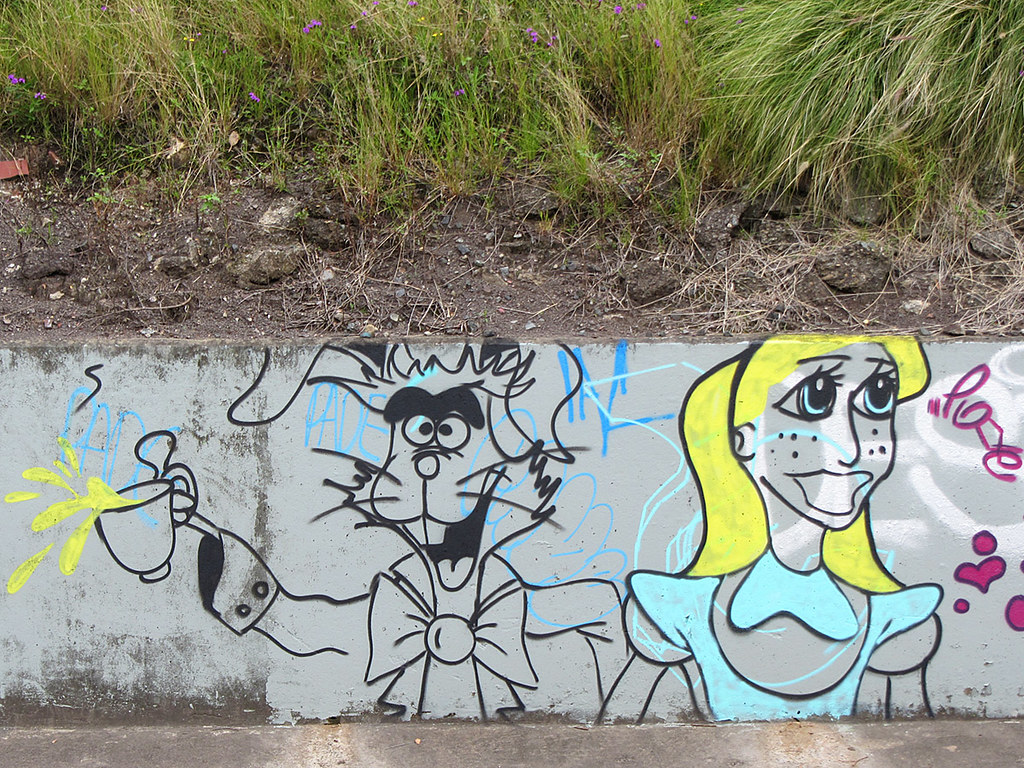
Ladies, on whom my attentions have waited If you consider my merits are small Etiolated, alembicated, Orotund, tasteless, fantastical, Monotonous, crotchety, constipated, Impotent galamatias Affected, possibly imitated, For Christ’s sake stick it up your ass.
Ladies, who find my intentions ridiculous Awkward insipid and horridly gauche Pompous, pretentious, ineptly meticulous Dull as the heart of an unbaked brioche Floundering versicles feebly versiculous Often attenuate, frequently crass Attempts at emotions that turn out isiculous, For Christ’s sake stick it up your ass.
Ladies who think me unduely vociferous Amiable cabotin making a noise That people may cry out “this stuff is too stiff for us” — Ingenuous child with a box of new toys Toy lions carnivorous, cannons fumiferous Engines vaporous — all this will pass; Quite innocent — “he only wants to make shiver us.” For Christ’s sake stick it up your ass.
And when thyself with silver foot shalt pass Among the Theories scattered on the grass Take up my good intentions with the rest And then for Christ’s sake stick them up your ass.
*****
It is always sad with a favourite author to realise you’ve read everything they published, and there will be no more. Occasionally, though, some additional manuscript turns up–typically not of the highest standard, but enjoyable all the same. This is the case with a notebook of some fifty poems that T.S. Eliot wrote in his twenties and sold to his New York benefactor John Quinn. Edited and extensively annotated by Christopher Ricks, the work was finally published as ‘T.S. Eliot – Inventions of the March Hare – Poems 1909-1917‘ in 1996.
This odd poem manages to (incompletely) combine ballade form with a parody of the final quatrain of FitzGerald’s ‘Rubaiyat of Omar Khayyam’.
I Because I do not do the limerick line Because I do not do Because I do not do the limerick Desiring this man’s schtick or that man’s joke I will stick to knocking out free verse (If here and there a rhyme so much the worse) In mournful moans Presented ragged-right upon the page.
II There once was a Lady with three White leopards, a juniper tree, And a bag full of bones That sang their sad moans Of what they had once hoped to be.
III At every turning of the turning stair, Your breathing hard, your eyesight edged with dark, You see the face of hope and of despair.
You breathe the vapor of the fetid air And toil as if some atmospheric shark At every turning of the turning stair
Was hunting through the gathering darkness there, While back and forth across the narrative arc You see the face of hope and of despair.
At every turning there’s a window where You contemplate a drop that’s still more stark At every turning of the turning stair.
Instead you circle upward as you swear Like you are looking for a place to park. You see the face of hope and of despair.
You can’t endure the future’s dismal dare Nor drag yourself to put out your own spark At every turning of the turning stair.
You’re learning how to care and not to care And whether you will make or be a mark. You see the face of hope and of despair At every turning of the turning stair.
IV Higgledy piggledy Here we are all of us Trudging along where some Billions have trod
Smelling the flowers and Trusting religionists’ Tergiversational Rodomontade.
V If the word that is lost isn’t lost, And the word that is spent isn’t spent Then silence is actually speaking, And meaning is something unmeant.
If the meaning is what is unheard And the word is the thing that’s unspoken Then how do you hear if a word Has a meaning that hasn’t been broken.
If the unspoken word must be still And the unheard is what it’s about To have heard the unhearable meaning The inside has got to be out.
If the unheard were out of this world And the light shone in darkness were dark Then the unlit unheard would be meaning If the snuffer provided the spark.
If the yadda can yadda its yadda And the pocus was what hocus took Then gobble must surely be gobble Though dee separates it from gook.
VI Awake! Your hope to turn or not to turn Is wasting time – but go ahead and yearn To see the light or hear the word to know A heaven human beings can’t discern.
There’s nothing there for such as you and me; We make our meaning up from what we see And hear and touch and taste and smell and think — But all there is is fragments and debris.
The steps are just the steps, the stairs the stairs, The rest is merely human hopes and prayers That do no more than hopes and prayers can do, And nothing’s chasing you except your heirs.
No unmoved mover writes upon some slate That mortals may abate or not abate; No hope and no despairing of that hope Reveals what nothing states, or doesn’t state.
Whatever happens happens because of us We get a muss when we don’t make a fuss Demanding right from wrong not mere convenience: We’re all complicit underneath this bus.
Awake! Don’t hope to turn or not to turn, Don’t pray that this is none of your concern. Awake! What will it take for you to learn That if it all burns down you, too, will burn?
*****
Marcus Bales has produced this wonderful set of parodies of the long T.S. Eliot poem ‘Ash Wednesday‘, beginning with a piece in the poem’s style for Part I, Because I do not hope to turn again Because I do not hope Because I do not hope to turn Desiring this man’s gift and that man’s scope
but then moving into a limerick for Part II’s Lady, three white leopards sat under a juniper-tree
and a 22-line villanelle for Part III’s At the first turning of the second stair
and a double dactyl for Part IV’s Who walked between the violet and the violet
and quatrains for Part V’s If the lost word is lost, if the spent word is spent If the unheard, unspoken Word is unspoken, unheard;
and finally rubaiyat with a strong flavour of FitzGerald’s Omar Khayyam for Part VI’s Although I do not hope to turn again Although I do not hope Although I do not hope to turn
‘Ash Wednesday‘ has proved one of Eliot’s best-known and most quoted poems, with its signature mixture of Christian mysticism, personal emotion, loose form and scattered rhyme, rich imagery and memorable wordplay. Bales’ ‘Slash Wednesday‘ is an appropriate tour de force of a back-handed homage, mocking Eliot’s ragged rambling with a sampling of forms that could have been used (inappropriately) instead.
Not much is known about Marcus Bales except that he lives and works in Cleveland, Ohio, and that his work has not been published in Poetry or The New Yorker. However his ’51 Poems’ is available from Amazon. He has been published in several of the Potcake Chapbooks (‘form in formless times’).
This is being posted a couple of days late for Ash Wednesday, but as it’s for the already late T.S. Eliot that shouldn’t matter too much…