Tag Archives: animal intelligence

Acrostic sonnet: Mike Mesterton-Gibbons, ‘Veronika The Cow’

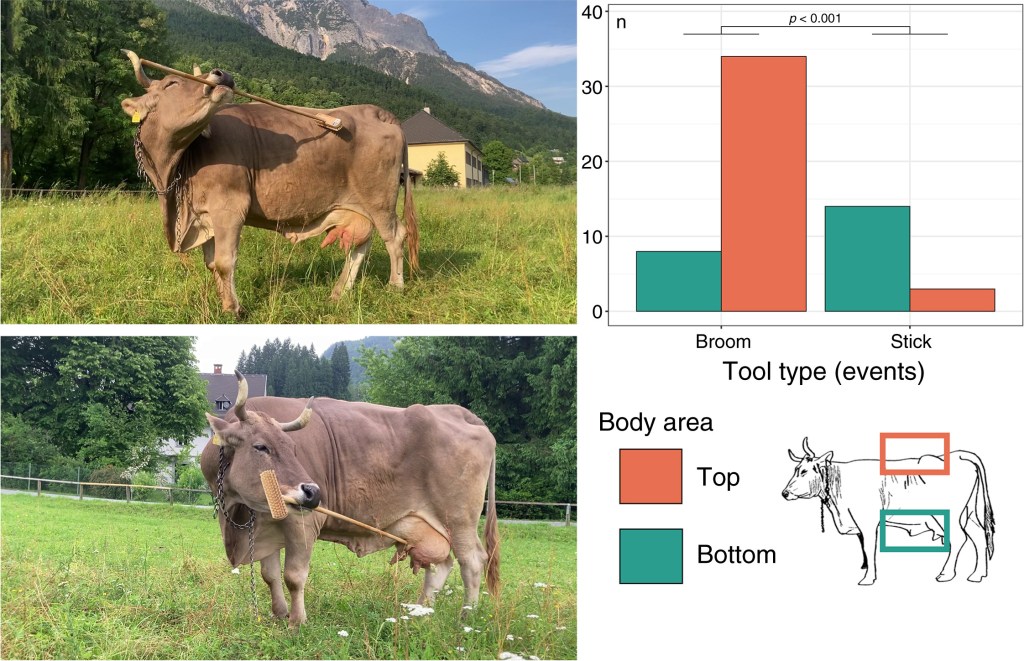
(Science has reported the first evidence in cattle of
using a single tool for multiple purposes, a skill 
previously seen only in humans and chimpanzees.) 

Veronika the cow can wield a broom,
Enabling her to scratch her back and breast,
Relieving itch. This Austrian, for whom
Old age brings fame, is now the manifest
New poster-girl for multi-purpose tools
In use by livestock, widely thought to lack
Keen intellect. But what if they aren’t fools
And, copying Veronika, attack
The status quo with brooms held high – if smart
Hoofed animals refuse to constitute
Earth’s humans’ prime rib roast supply and start
Campaigns to claim their basic right, pursuit
Of happiness? . . . Will humans have a beef
With Austria’s tool-user-cow-in-chief?

*****

Mike Mesterton-Gibbons writes: “Yes, Veronika uses opposite ends of the broom for different purposes. There’s a nice video of her in action on the Science website where I first read about her. The article and video are here: https://www.science.org/content/article/no-bull-austrian-cow-has-learned-use-tools

Mike Mesterton-Gibbons is a Professor Emeritus at Florida State University who has returned to live in his native England.  His poems have appeared in Current Conservation, the Ekphrastic Review, Light, Lighten Up Online (where this poem was first published), the New Verse News, Oddball Magazine, Rat’s Ass Review, WestWard Quarterly and other journals. Links to all these poems can be found at  https://www.math.fsu.edu/~mesterto/Unscramble/wordplay.html. In 2025 he won the Children’s Unpublished category of the Eyelands Book Awards with Flora’s Flock and Other Stories to Read Aloud.

Veronika’s tooling technique and targeted areas (cow tools)” by Antonio J. Osuna-Mascaró, Alice M. I. Auersperg is licensed under CC BY 4.0.
Steven Clayman: ‘Enmeshed In Pure Feeling’

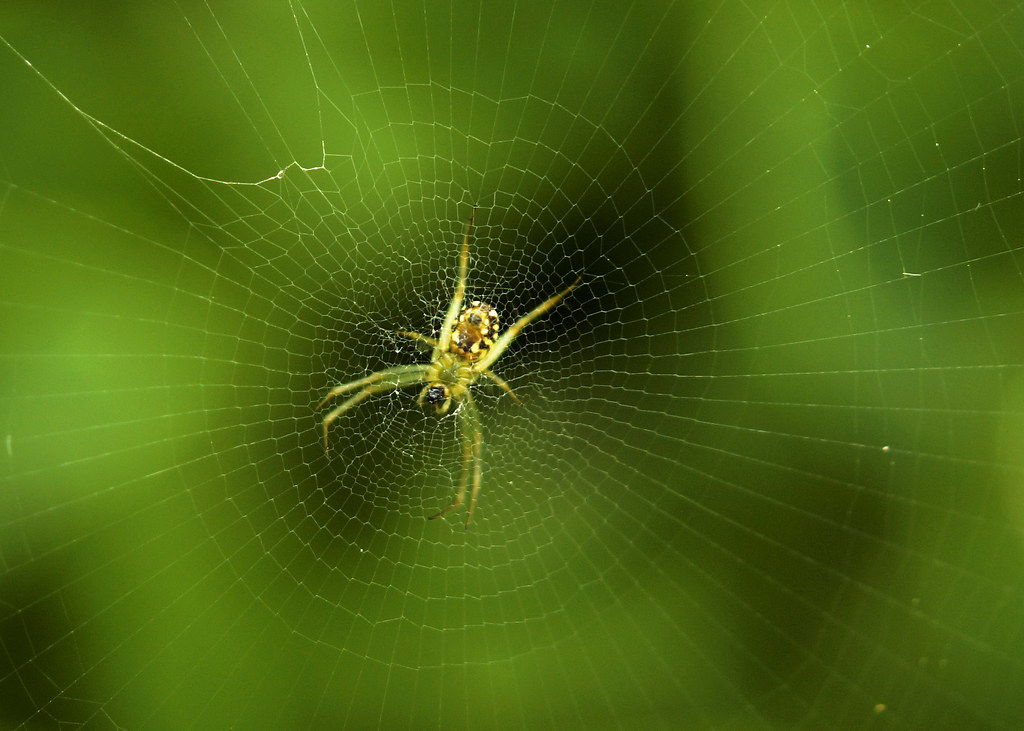
I spied her entwine an out-spiraling net,
each jittery stride trailing radial spans
before coming to rest
astride her last strands.
 
Still-standing and idling
then inching and sidling
till centered she sits, wind-wafted and wheeling,
unhearing, unseeing, enmeshed in pure feeling.
 
From above, a tableau of flutter and flop;
from within, she awaits the faintest pin drop.
A gnat mid-air, full stop, enstranded;
arachnid sensed where it had landed.
 
She swivels right
to eight o’clock.
One silken vibe
betrayed the spot.  

*****

Steve Clayman writes: “The poem’s content was inspired by a remarkable book on the sensory systems of animal species (An Immense World, by science journalist Ed Yong).   Reading the book gave me vertigo, the good kind that arises from being drawn into the “alien” perceptual worlds that other species inhabit.  In a chapter on tactile senses, Yong writes that many web-spinning spiders are nearly blind and deaf, but are extraordinarily sensitive to vibrations.  Thus the web is far more than a trap for prey:

It’s also a surveillance system, which extends the range of the spider’s senses well beyond the reach of its body….  It is as much a part of the creature’s sensory system as the [sensors] on its body. Most orb-weavers sit in the middle of their webs and rest their legs on the radial spokes that funnel vibrations toward them.  From this position, they can distinguish the vibrations generated by rustling wind or falling leaves from those created by struggling prey.  They can probably work out where those struggles are coming from by comparing the strength of the vibrations hitting each of their legs….  If the prey stops moving, they can find it by deliberately plucking the silk and “listening” to the return vibrational echoes. 

“As for the poem’s form, I came up with the first line and the rest emerged organically, in the course of dealing with the possibilities of that starting point.  So the overall form was not planned, although after the first line I was determined to avoid using the word spider or web throughout the poem.”

*****

‘Enmeshed in Pure Feeling’ was first published in Lighten Up Online, edited by Jerome Betts.

Steven Clayman is professor of sociology at UCLA. He likes to think that his light verse is at least loosely related to his research specialization in conversation analysis and the study of language use in everyday life.  His scholarly work appears in linguistics, communication, and sociology journals, and in the books (co-authored with John Heritage) Talk in Action (Wiley-Blackwell) and The News Interview (Cambridge University Press).  His poems have appeared in Lighten Up Online, Philosophy Now, Better Than Starbucks, Light: A Journal of Light Verse, and Asses of Parnassus.
 

Spider and Web” by kendoman26 is licensed under CC BY-NC-SA 2.0.