Not verbose, she’s quite the obverse. Anna Graham has one fixation— rearranging conversation as voices rant on. Here, ears rehearse
how letter counters can construe; how each artist paints their traits; how calipers find replicas for mates. The game won’t wane—it spells anew.
Is she just wired or truly weird? She does lament her mental quirk at night. Some ghastly thing will lurk: serpents in a dream appeared
with pertness. Asleep, she can’t outrun a rioter, her editor . . . a teardrop turning predator . . . a charging gnu with loaded gun
Mornings end each nightly bout as Anna walks the beach for miles, where Laughing Gulls will make her smile. Esprit persists… is that spelled out?
*****
Barbara Lydecker Crane writes: “I was unaware British people tend to pronounce this surname ‘Gray-um’ instead of the American ‘Gram’. I’m punning on the American pronunciation, and the poem won in the humor category of the Chicagoland Poetry Contest in 2021. Although I’m not nearly as obsessive as this fictional woman is about anagrams and “mirror words” (a pair that spell each other backwards), I enjoy such wordplay. My book BackWords Logic (Local Gems Press, 2017) is all quatrains that contain mirror words, with line drawings by Frances McCormick.”
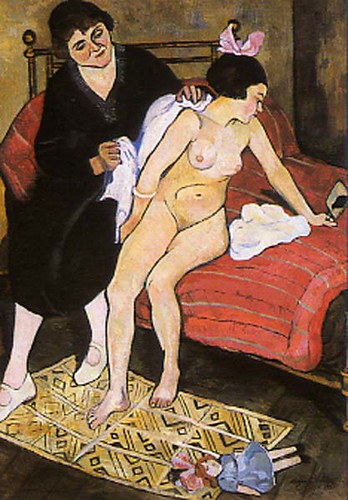
What, you haven’t heard of me, despite my art and stormy life? There’s much to tell of pride and bitterness, of bliss and hell— but not regret. I’ll fill my pen and write.
I was born a bastard. Maman worked, a laundress, while I’d roam Montmartre, spying through café and whorehouse doorways, trying to snitch some fruit or francs. I laughed and lurked. With lumps of coal I loved to draw on streets. Ditching convent school at puberty, I learned to earn my way. I felt free in circus work, curvaceous and petite and daring on the high trapeze, strong until I hurt my back—I fell headlong.
That set me back, but new work came along— also daring, deemed risqué—being painted, a model for men. Few were sainted . . . nor was I. I didn’t think it wrong to give a man some pleasure and to claim my own. For one artiste I posed unclad and soon became his favorite lover. I had his child, and kept my word: I didn’t name that man on papers with a ‘Father’ line and kept on working. Maman tended him, my son, Maurice Utrillo—a pseudonym so he would not be stigmatized by mine, that of the saucy urchin shedding clothes— and budding painter, watching men compose.
I watched the colors bloom as men composed. Toulouse-Lautrec’s hues, both somber and bright, would join or jar to make a mood just right. He’d talk of wealthy clients and gallery shows while I could study his techniques with paint. He studied me and loved my breasts, my hair, my thighs, my openness to him. I dared to love that rich midget with no restraint. When he refused to marry me, my feigned suicide didn’t change his mind. But what I learned while posing, I combined with my good eye, instinctive and untrained. I’d use my wits (and likely my libido) to paint in oils, with honesty my credo.
I painted nude women by my credo. When I showed Degas my work, he praised me with, “Madame, you’re one of us!” That raised my nerve; like those Montmartre men, I’d show my art—although I’d wish my name need not be printed next to ‘woman artist,’ a tag suggesting Other like a warning flag. I’m already Other in my lot as Bastard-with-a-Bastard history. Will I be known for art or just my life of scandal? I never stayed a bougeois wife, as two would always tangle into three; our pacts permitting infidelity could not prevent one partner’s jealousy.
His cryptic music vented jealousy; Eric Satie was moody, odd, hysteric— and amusing, in and out of bed. Eric and Paul Mousis loved me zealously and it was bound to chafe, our double link. Mousis was rich; Satie holed up in one squalid room. He slowly came undone without me to himself—he took to drink till drink took him. Maurice, by then eighteen, also drank. Since he was prone to rage and smashing things since an early age, Maman would feed him wine to calm such scenes. When briefly sober, it was to me he came— I treasured hearing Maman as my name.
Of course Maurice Utrillo made his name with me his mother-teacher and his Papa (I tell you now) Pierre-Auguste Renoir! Maurice was barely sane, but all the same, prolific and successful in his art. His painter colleague André, with brains and flair, had tireless desire in our affair; our turbulent trio could not live apart. With André as our agent, income flowed— I once took fifty children to the circus . . . Montmartre beggars crowded round to work us . . . we’d help out any artist friend who owed. The stream of money later dried to drought, but while it flowed I bloomed by giving out.
Too soon I knew my bloom was giving out— I missed men’s wide-eyed stares, their swiveled heads. André, still youthful, strayed to other beds; Maurice would drink or sit around and pout. We three unraveled into separate ways. Instead of painting nudes I painted flowers; they didn’t sell but brightened up the hours of living alone, inviting in malaise, till I found Gazi. This young, exotic man takes care of me and listens to my stories, roughly true—my slights, successes, glories. I’m seventy-two. I’ll end where I began, a bastard bitch whose art was bold and right. My pride and grit leave little room for spite.
*****
Here is what the judge for the 2024 Kim Bridgford Memorial Sonnet Contest wrote: Praise for the winning sonnet crown: Among a strong group of finalists, “Roughly True” distinguished itself across the board—in form, in voice, in message, in grace. After reading these seven sonnets in the voice of French painter Suzanne Valadon, I felt as if I had just taken short courses in poetic form, meter, rhyme, and art history, all expertly and candidly delivered by the fully realized persona of an accomplished, but overshadowed figure, one exquisitely resurrected here in verse. ~Dan Albergotti, Judge
Barbara Lydecker Crane writes: “I was surprised and thrilled to win this contest, and further pleased that the judge seemed to recognize the same strength of character in Suzanne Valadon that I did. The more I researched her life and work, the more I felt I actually knew this gritty woman a bit, despite our wildly different lives. As I get older I find I am more interested in writing about others than myself. My latest book, You Will Remember Me (Able Muse), is a collection of persona poems about portrait artists and their works. I am currently writing a new series of persona poems, this time about landscape artists and their works. This time, rather than writing all sonnets, each poem takes a different form; but all (so far) are in rhyme and meter. That seems fitting both for older times and for the craft and musicality I strive for, to befit the art that I hope to see with these poems one day, perhaps in a new book. And there is something about writing in form that, to me, is exactly like framing a picture. What a difference that makes; it says “completed,” and adds its own panache to the art.”
A billboard seen in Toronto read Sonnet Insurance.
Dear Sonnet staff: I’m eager for your plan! I’ll want an underwriter old-school-based, Petrarchan or like Larkin in his taste: he’ll speak my terms. I’ll benefit from your man adjusting rhymes, making meter strict, assuming the risk of an errant anapest. Does your firm ensure I’ll stand time’s test? Do you pull strings to have each effort picked by a premier publication? One quick draft in the condition of a pre-existing sonnet, and the English-speaking world might dote upon it. But truth be told, my first attempts aren’t craft. Sonnet Insurance, kindly file this letter; insure me later, when it’s written better.
*****
Barbara Lydecker Crane write: “I am a shameless pun lover; seeing this billboard, though, certainly begged for some. “My Letter to Sonnet Insurance” was published a few years back in Light.“
In 2024 Barbara Lydecker Crane won the Kim Bridgford Memorial Sonnet Crown Contest and First Prize in the Helen Schaible Contest, modern sonnet category. She has twice been a finalist for the Rattle Poetry Prize. Able Muse recently published her fourth collection, You Will Remember Me. She enjoys making and looking at art, travel, and her family, which includes four fast-growing grandchildren and one near-perfect husband: he does not read poetry.
“Write nothing down in ink” is the secret’s first rule; “You promise not to tell?” said the secret’s first fool.
A secret’s likely safe if entrusted to a stranger; one who knows no English will further lessen danger.
Don’t hide a guilty secret no other person knows; like mold behind a ceiling, a spreading fester shows.
Secrets may be sweet, too delicious not to share. To savor them together might double tempting fare.
Revealing every secret, a link to each regret, will drain away a soul to an empty fishing net.
“Three may keep a secret if two of them are dead.” . . . but more about the bodies, Ben Franklin never said.
*****
Barbara Lydecker Crane writes: “Sometimes when I am casting around for new ideas to write about, I browse Bartlett’s Familiar Quotations. That’s how this one got started; the rest is classified information!” (But it is known that the poem was first published in Autumn Sky Poetry Daily.)
Barbara Lydecker Crane was a finalist for two recent Rattle Poetry Prizes. She has received two Pushcart nominations and various awards from the Maria W. Faust and the Helen Schaible Sonnet Contests. Her poems have appeared in Atlanta Review, Ekphrastic Review, First Things, Light, THINK, Valparaiso Literary Review, Writer’s Almanac, many others, and in several anthologies. Her fourth collection, You Will Remember Me (ekphrastic, persona sonnets) was recently published by Able Muse Press, and is available from Amazon: https://www.amazon.com/You-Will-Remember-Me-Ekphrastic/dp/1773491261. Barb lives with her husband near Boston.
Justin Case is a very cautious man. He keeps a cache of bottled water, food and a pair of spares in the trunk of his sedan. Others think that he’s aloof or rude when he inspects each fork and spoon for germs. His sisters know he swivels out of kisses. He navigates the office on his terms; Justin shuns each outstretched hand–and misses clinching business deals. He cannot fathom why colleagues eye him strangely when he hits an elevator button by lifting past them his wing-tipped toe. With snakebite kit and mosquito netting, he’s ready to embark upon his lunchtime stroll in Central Park.
*****
Barbara Lydecker Crane writes: “This poem, first published in the Atlanta Review, was one of the first persona poems I wrote: I’ve written several dozen over the years, and I find I love trying to speak for another person, real or imaginary. Maybe the process develops empathy, as well–who knows?”
Barbara Lydecker Crane was a finalist for two recent Rattle Poetry Prizes. She has received two Pushcart nominations and various awards from the Maria W. Faust and the Helen Schaible Sonnet Contests. Her poems have appeared in Atlanta Review, Ekphrastic Review, First Things, Light, THINK, Valparaiso Literary Review, Writer’s Almanac, many others, and in several anthologies. Her fourth collection, You Will Remember Me (ekphrastic, persona sonnets) was recently published by Able Muse Press, and is available from Amazon: https://www.amazon.com/You-Will-Remember-Me-Ekphrastic/dp/1773491261. Barb lives with her husband near Boston.
Mom banged her hairbrush down in a reprimand of love. “What an awful question! You don’t understand love.
“Of course Dad loves you. How can you question that? He doesn’t have to blare it out, like a brass band of love.
“You aren’t a princess to be coddled on a lap or praised without good reason. That’s a never-never land of love.
“Your father works hard, with a great deal on his mind. Now don’t go causing trouble, making a demand of love.
“Yes, I know he yells and sends you to your room a lot. But be glad he never hits you with the backhand of love.
“Once, banished to your room, you drew a picture poem for him. I watched him beam at you with unplanned love.
“He said he’s proud of you. I’ve heard him tell you twice.” She brushed my hair, hard. “Barbara, that’s a brand of love.”
Barbara Lydecker Crane writes: “Based on a real interaction with my mother when I was about five, I think this poem reflects a different style of parenting back then (this was in the 50’s), perhaps a British approach: “don’t spoil your children with a lot of praise or affection.” I like modern ways better! As for the form, I love ghazals because you always know where you are headed–the fun is choosing your route to get there.”
Barbara Lydecker Crane was a finalist for two recent RattlePoetry Prizes, including with this poem. She has received two Pushcart nominations and various awards from the Maria W. Faust and the Helen Schaible Sonnet Contests. Her poems have appeared in Atlanta Review, Ekphrastic Review, First Things, Light, THINK, Valparaiso Literary Review, Writer’s Almanac, many others, and in several anthologies. Her fourth collection, You Will Remember Me (ekphrastic, persona sonnets) was recently published by Able Muse Press, and is available from Amazon: https://www.amazon.com/You-Will-Remember-Me-Ekphrastic/dp/1773491261. Barb lives with her husband near Boston.
Small herds of Two-Legs roll across the plain and stop to stare at us in our domain.
They rumble in their giant metal hunks, which belch the fumes that irritate our trunks.
These creatures demonstrate a lack of strength. They seldom run, nor walk for any length.
We assume their eyesight is defective: the flat things that they click must be corrective.
Why do they retreat from every shower, since rain-washed hide will dry within the hour?
When darkness comes these creatures enter tents and miss the night-shift intrigue of events.
As for their young, we’ve spotted precious few— a doubtful future, from our point of view.
We shake our heads when Two-Leg herds arrive. We have concluded they will not survive.
*****
Barbara Lydecker Crane writes: “I wrote this while looking at videos of wildlife in Tanzania – in one, an elephant was peering into a tent with excited humans inside, whispering and filming; I had fun imagining that the elephant had been sent by his herd on a reconnaissance mission, and would report back to them.”
Barbara Lydecker Crane,a Rattle Poetry Prize finalist in 2017 and 2019, has received two Pushcart nominations and several awards. Her poems have appeared in Ekphrastic Review, First Things, Light, Measure, THINK, and many others. Her fourth collection, entitled You Will Remember Me (sonnets in the imagined voices of artists through history, with many color images of artwork) is about to be published by Able Muse Press.




 Form in Formless Times