Tag Archives: bears

Unforgettable nonsense: Christopher Isherwood, ‘The Common Cormorant or Shag’

The common cormorant (or shag)
Lays eggs inside a paper bag,
The reason you will see no doubt,
Is to keep the lightning out.
But what these unobservant birds
Have never noticed is that herds
Of wandering bears may come with buns
And steal the bags to hold the crumbs.

*****

There are a couple of anomalies about this poem. First, some people doubt that it is by Christopher Isherwood, because the poem had been circulating anonymously since 1938 but didn’t appear under his name until 1982 in his nonsense-animals collection ‘People One Ought To Know’. But he had actually written the collection as early as 1928, as I gather here. Secondly, cormorants and shags are similar but different birds of the same family, at least in current terminology; however as Wikipedia says, ‘No consistent distinction exists between cormorants and shags. The names “cormorant” and “shag” were originally the common names of the two species of the family found in Great Britain.’ And anyway, it’s a nonsense poem, so who really cares? It is amusing, and easy to memorise because it is in verse.

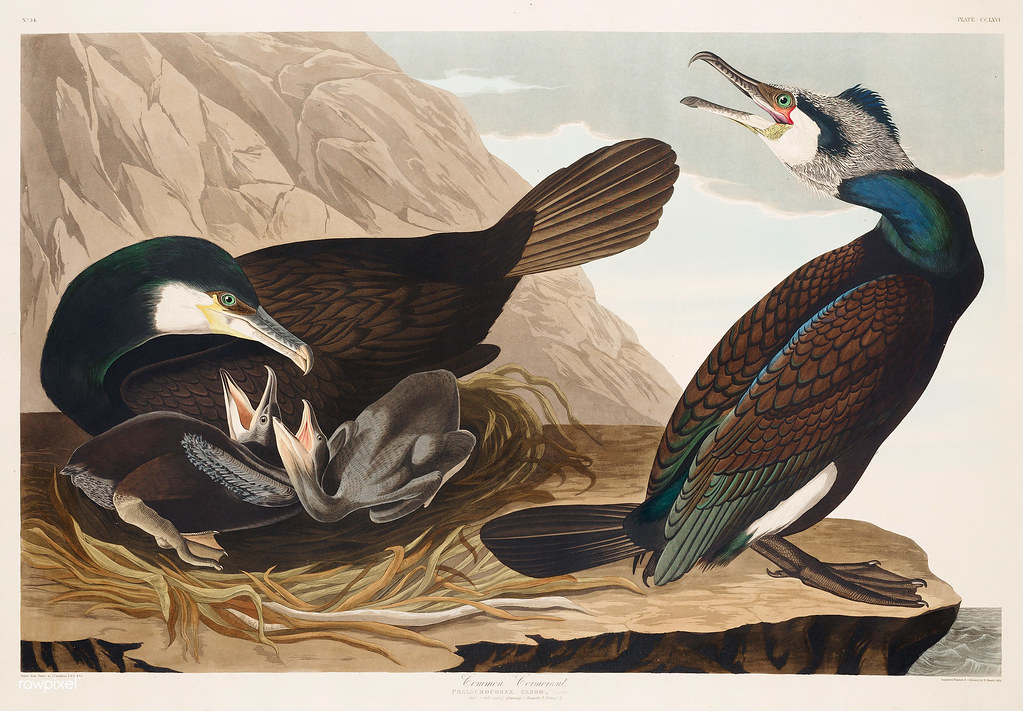
Illustration: “Common Cormorant from Birds of America (1827) by John James Audubon (1785 – 1851), etched by Robert Havell (1793 – 1878). The original Birds of America is the most expensive printed book in the world and a truly awe-inspiring classic.” by Free Public Domain Illustrations by rawpixel is licensed under CC BY 2.0.

Using form: Spenserian sonnet: Charles Martin, ‘On the Problem of Bears’

Bears are frustrated by their lack of speech,
Their claws leave blackboards shrieking for repairs,
And that’s why bears are seldom asked to teach
And almost never get Distinguished Chairs
Unless they come across one unawares
Whose rich upholstery they quickly shred.
Some of them have been known to have affairs
With a man or woman lured into their bed—
This often ends up badly with one dead,
The other executed for the crime,
Or given a life sentence in a zoo.
Bears are familiar with existential dread,
Bears put their pants on one leg at a time:
The problems bears have are your problems too.

*****

Charles Martin writes: “The poem is written in a variation on the Spenserian Sonnet form, which I have been writing for several years now. In this case, I enjoy the contrast between the strictness of the form and the raucousness of its subject. As I recall, I began it on a morning walk, and I think finished it shortly after the walk ended. 

“The poem will next appear in The Khayyam Suite this spring, published by The Johns Hopkin University Press, which has published my last two collections of poetry, Signs & Wonders and Future Perfect, both of which are still in print. (Future Perfect has a sonnet sequence written in the Spenserian form.) Poems have recently been published in Literary Matters, The Hudson Review, Classical Outlook, and in Best American Poetry, 2024.”

Charles Martin is a poet, translator of poetry, and essayist. The Khayyam Suite is the fifth of his eight books of poetry to appear in the Fiction and Poetry Series of the Johns Hopkins University Press. His poems have appeared in Poetry, The New Yorker, The Yale Review, The Hudson Review, Literary Matters, The Hopkins Review and, in numerous anthologies, including Best American Poetry, The Norton Anthology of Poetry, and War No More: Three Centuries of American Antiwar and Peace Writing. He has received an Academy Award in Literature from the American Academy of Arts and Letters, a Creative Writing Fellowship from the National Endowment for the Arts, an Ingram Merrill Grant, a Bess Hokin Award from Poetry magazine, and a Pushcart Prize. His residencies include the Djerassi Foundation and Ragdale, and he served as Poet in Residence for five years for the American Poets’ Corner at the Cathedral of Saint John the Divine. His translation of Ovid’s Metamorphoses received the 2004 Harold Morton Landon Award from the Academy of American Poets, and he has also translated The Poems of Catullus and the Medea of Euripides. He is the author of the critical introduction to Catullus in the Hermes Book series of Yale University Press and of numerous essays on, and reviews of, classical and contemporary poetry.

Photo: from the Bantam/Seal cover of Marian Engle’s novel ‘Bear’, referenced in https://www.cbc.ca/radio/ideas/why-the-classic-canadian-novel-bear-remains-controversial-and-relevant-1.5865107

Potcake Poet’s Choice: Bruce McGuffin, ‘Why It’s Important To Take Your Saxophone Hiking’

Whenever I go for a walk in the wood
I carry a saxophone, everyone should.
You need it in case you get caught unawares
By a band of unruly and ravenous bears.

When the bears leap from bushes intending to eat you,
You won’t have the time that it takes to retreat, you
Had better be ready to pull out your sax
If you don’t want to finish your day as bear snacks.

Play a song they can dance to, try Latin or swing.
Dancing bears like to rhumba, they might highland fling.
But beware, every bear is a dance epicure.
If you play Macarena they’ll eat you for sure.

Bruce McGuffin writes: “A respected poet1 once described Light Verse as “a betrayal of the purpose of poetry”. All I can say is whatever gave him the idea that poetry only has one purpose? With almost 8 billion people in the world there must be 8 billion plus purposes for poetry. Everybody wants to feel a little light and laughter now and then, and for me that’s one of the purposes of poetry. This silly poem (which originally appeared in Light Poetry Magazine, February 2020) about dancing bears, with its driving, almost chant-like, rhythm makes me happy whenever I read it. I hope it will make other people happy too.”

[1] Robin Robertson in Guardian Interview, September 28, 2018. 

Bruce McGuffin writes all kinds of poetry, but meter has a way of sneaking in even when it’s not invited, sometimes bringing rhyme along for the ride. His subjects range from the profound to the utterly frivolous with a decided tilt toward frivolous, which he justifies by claiming he writes for his own amusement. He divides his time between Lexington Massachusetts, where he has a day job as an engineer at a radio research lab, and Antrim New Hampshire, where he lives with his wife and pretends to be practical (when he’s not writing poetry). At work the practical engineers think he’s a theorist, and the theorists think he’s a practical engineer. His poetry has appeared in Light, Lighten Up Online, The Asses of Parnassus, Better Than Starbucks, and other journals.