Tag Archives: early humans

RHL, ‘Walking then Running’

Like ants searching randomly across a table
like water dribbling across uneven ground
and pooling here, running to the side,
filling and flowing to the next dip,
so we have walked out of Africa
for a hundred, two hundred thousand years,
over the hills, around the coasts,
seeking the greener grass, the next best land,
glad of a tree, glad of a cave,
catching the lightning for our own hearth,
settling, pooling, then spilling out
over the next hill, round the next headland,
following bird flight, following game herds,
exploring then leading then fetching our families,
finding and fighting with those who were there before,
killing or trading, absorbing or raping,
loving, despising the different, the ogres and trolls,
like a stain spreading out round the world,
and walking then running up as though to take a free kick,
walking then running up as though to bowl,
walking then running as along a diving board to
bounce once, twice in the air and launch into space…
Here comes, there goes the human race.

*****

The future is unknowable beyond the point where AI becomes more intelligent than humans, and autonomous. Enjoy what you have now, you will be nostalgic for it soon enough…

I wrote this piece as a long rambling exploratory sentence which picks up speed and purpose towards the end and a concluding rhyme. This (not exactly formal) poem was first published in Bewildering Stories a few years ago.

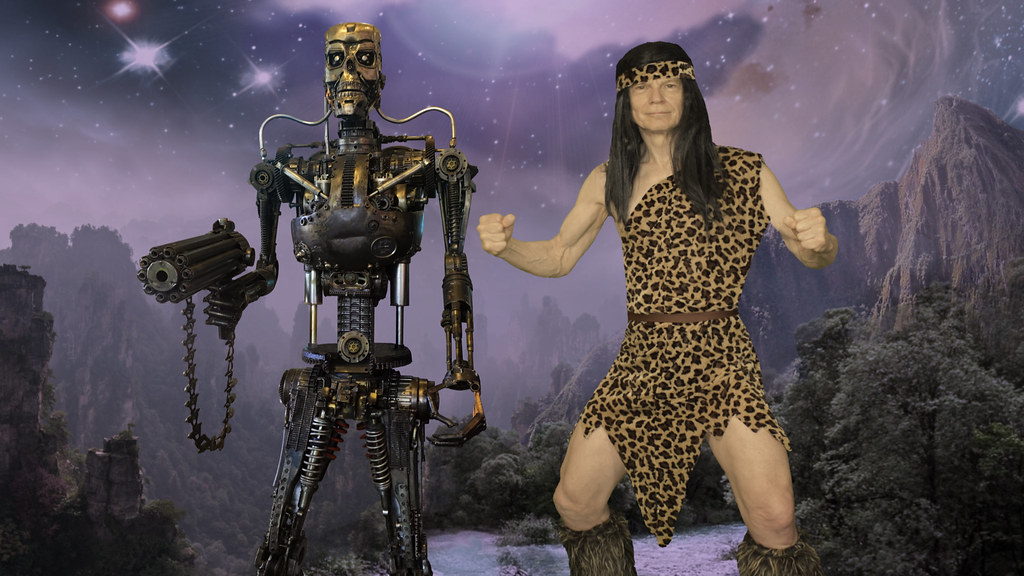
Aboard Starship Hedonian – The Terminators [809]” by TimWB2020 is marked with CC0 1.0.
Poem: “This Ape I Am”

Under our armoured mirrors of the mind
where eyes watch eyes, trying to pierce disguise,
an ape, incapable of doubt, looks out,
insists this world he sees is trees, and tries
to find the scenes his genes have predefined.

This ape I am
who counts “One, two, more, more”
has lived three million years in empty lands
where all the members of the roving bands
he’s ever met have totaled some ten score;
so all these hundred thousands in the street
with voided eyes and quick avoiding feet
must be the mere two hundred known before.

This ape I am
believes they know me too.
I’m free to stare, smile, challenge, talk to you.

This ape I am
thinks every female mine,
at least as much as any other male’s;
if she’s with someone else, she can defect –
her choice, and she becomes mine to protect;
just as each child must be kept safe and hale
for no one knows but that it could be mine.

This ape I am
feels drugged, ecstatic, doped,
hallucination-torn, kaleidoscoped,
that Earth’s two hundred people includes swirls
of limitless and ever-varied girls.

This ape I am
does not look at myself
doesn’t know about mirrors, lack of health,
doesn’t know fear of death, only of cold;
mirrorless, can’t be ugly, can’t be old.

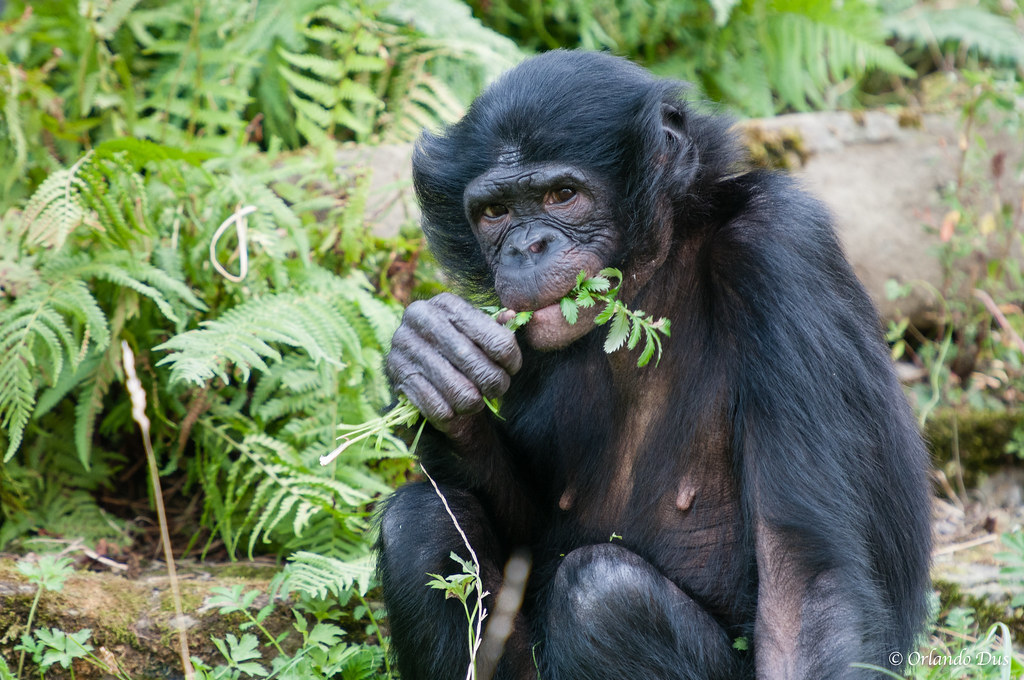
This is one of my favourite poems. Originally published in Ambit ten years ago, it has been reprinted in magazines as diverse as Better Than Starbucks, Verse-Virtual and, last month, Bewildering Stories. It speaks to what I believe is a largely overlooked truth, that we are genetically predisposed to function best in social groups or households of 20 to 30 people, within a larger network of six to ten such groups. These provide the numbers of people that we can know well (the social group) and people that we can also recognise and interact with comfortably (the larger network). This is the world of chimpanzees and bonobos, and of the hunter-gatherer existence of early humans.

In practical terms, I am in favour of recreating the sense of community of the village, even within the context of cities. Develop housing complexes that become neighbourhoods – keep schools small – reintegrate nursing homes into the community, let the children and the old people interact – and (a further step in acknowledging our hunter-gatherer humanity) keep everyone in touch with parks, with gardens of fruit, flowers and vegetables, with trees and birds, and with a variety of animals.

Technically the poem is written in iambic pentameters, loosely structured in stanzas of varying length, with lines mostly rhymed but with no set rhyme scheme. (And note: a stanza’s initial “This ape I am” needs to be counted with the next line to produce the pentameter.) Iambic pentameters provide a natural mode for meditative or expository verse. The rhythm is comfortable for quiet reflection or narration. The rhyme in this case is a secondary enhancement.