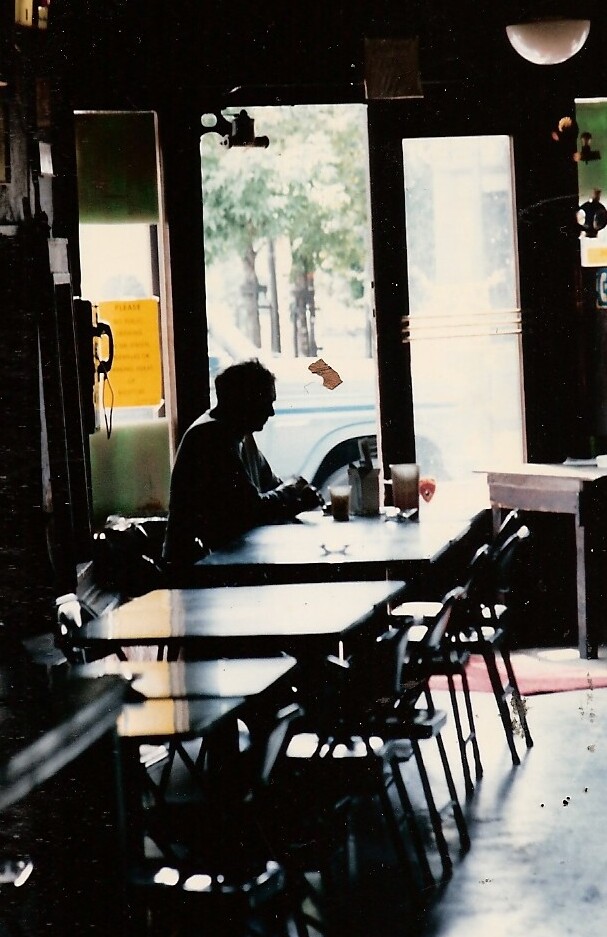
Most of the time I’m zonked maybe more often than I might want here between high and dizzy tired of looking busy waiting to see what comes my way 9:11 comes twice a day
Look in the mirror: what do you see a distinguished gentleman, what’s left of me a formerly handsome young man, gray hair, gray beard, wrinkles, laugh lines, crow’s feet, bags… Why go on?
Grunting, groaning, ache all over, Moving slowly, bent and stiff No use trying to ignore that throbbing, shooting pain in my elbow, in my wrist, there it goes again in my ankle, in my hip
I’m occupying space, not doing much at a steady pace, treading water, riding it out for Now, which is all we’ve got
Most of the time in bed at nine reading time conk out by ten sleep till eight lounge in bed get up late and start again
No goal, no productivity, drinking vodka, smoking weed, writing verses, cooking dinner anchovies, butter, cheese and cream garlic, capers, medium heat
I don’t expect you youngsters here to understand, but if you can, my bladder’s shot, the plumbing leaks an endless stream or more a trickle with brief pauses in between marking out my territory or so it seems
It’s not what you expect to hear but never fear! Money’s not a problem we have plenty our friendly neighborhood ATM provides an unlimited supply of twenties
*****
Bill Bowler writes: “Portrait of the Artist…” is one of a long series of poems called It Never Gets Old that I’ve been working on for a while. They’re all up on Bewildering Stories. The poems all explore from one angle or another the weird sensation of one’s parts wearing out, and one’s friends and loved ones disappearing one by one. Some of the titles are: “Death can be so inconvenient”, “At day’s end, nearing sunset”, “Circling the Drain”, “The Party’s Over”, “Poopie and PeePee”, “No One Seems Alarmed”, “Into the Bubble”, etc. I find that humor goes a long way in alleviating despair. (Смех сквозь слезы – laughter through tears)
“What I try to do in my verse is to use casual idiomatic vernacular, complete with slang, i.e., natural spoken speech, but to render the lines using meter and rhyme, so that the patterns are hardly noticed, though they hold the whole structure together. It has to sound natural even if it’s rhymed trimeter, which is fun to do. I’m fine with approximate rhyme, approximate rhythm (like mixed dactyls and trochees), and approximate meaning, but it has to be smooth. One forced rhyme blows the whole thing.”
Bill Bowler was born in New York City in 1950. He graduated from Columbia University in 1972 and received a Ph.D. in Slavic Languages & Literatures from the University of Michigan in 1981. He has a wry biography at https://www.bewilderingstories.com/bios/bowler_bio.html#biblio, with links to his poems and stories.
I hear an army charging upon the land, And the thunder of horses plunging, foam about their knees: Arrogant, in black armour, behind them stand, Disdaining the reins, with fluttering whips, the charioteers.
They cry unto the night their battle-name: I moan in sleep when I hear afar their whirling laughter. They cleave the gloom of dreams, a blinding flame, Clanging, clanging upon the heart as upon an anvil.
They come shaking in triumph their long, green hair: They come out of the sea and run shouting by the shore. My heart, have you no wisdom thus to despair? My love, my love, my love, why have you left me alone?
***** James Joyce is a fascinating author, from his novels dense with ideas, descriptions and wordplay, to his grotesque private love letters, normal short stories and formal verse. This poem is the last of the 36 in his 1907 collection ‘Chamber Music’, and the one that I come back to the most. Apart from the imagery, I am intrigued by the unnatural rhyming of the first and third lines, and not the second and fourth, in each stanza: the form is unsettling, and works very well with the inverted reality of dreams and with the discomfort of these particular emotions swirling through fear, loss and loneliness.
We want your heart to function at its best. Bisoprolol’s a helpful little pill (lol) and aspirin’s a friend. You’re less impressed, it seems, by side-effects of Ramipril but the cough may pass. Any chesty pains? Squirt GTN under your tongue. It’s droll how nitro-glycerin expands the veins and arteries. As for Lansoprazole, undoubtedly protecting your digestion from anti-platelets such as Prasugrel, yes, take it. Eplerenone is my suggestion as best antagonist. Won’t you pop that in, O protagonist? And zap LDL for sure before you snore—Atorvastatin.
*****
Helena Nelson writes: “After a heart attack, I was fitted with a stent in one cardiac artery and prescribed eight drugs, though one was optional (the GTN spray) and another only for the first six months (Prasugrel). I struggled to remember their names and purposes, so I put them in a sonnet, and as much about them as I could manage. LDL is so-called ‘bad cholesterol’. Bisoprolol is a beta-blocker and helps regulate blood pressure. Eplerenone is an aldosterone antagonist (this supposedly helps keep the heart muscle in shape). Make of that what you will. As they say on FaceBook, ‘it’s complicated’.”
Jeremy Desmon writes: “RhymeHamster is a rhyming dictionary I edit by hand. What may interest formal poets most is that perfect rhymes are kept strict, so near misses don’t slip into the list. Slant rhymes are kept separate, on a dial you can adjust. It’s free, with no ads and no login.”
When Jeremy approached me with his rhyming dictionary, my first action was to check for rhymes with ‘orange’. This is a tricky word, as different people treat it differently: as one syllable or as two. Versification is complicated in English by words like this. ‘Fire’ and ‘child’ come to mind – they create interesting opportunities for metre as well as challenges for rhyme. Anyway, RhymeHamster doesn’t list ‘sporange’, ‘the Blorange’ or ‘Daniel Gorringe’ which (to me) are all perfect rhymes.
Jeremy Desmon is a musical theater bookwriter and lyricist. For twenty years he has taught a playwriting workshop at Princeton, focused on musicals and songwriting. www.jeremydesmon.com www.WeWriteMusicals.com
A billion Civilians In vermilion Pavilions Are waiting for the dawn.
Instead, Overhead, From his bed On skies of lead, God said the wars must go on.
The Blessed Drops shed From side and head Of Christ dead Beloved but forlorn,
Watered The slaughtered And caught by Those who fought at Zama and the Somme.
Inconclusive, Thought-inducive, Why-elusive… But, if you sieve War’s truths long,
You’ll find You’re refined And the blind Are undermined By the kind who throng
To the place Of loving grace The gentlest face The human race Has ever looked upon:
The Crucified Who never shied From Truth and died: From head and side Drops fall and spawn
A billion Civilians In vermilion Pavilions Waiting for the dawn.
*****
I wrote this in an experimental frame of mind some 50 years ago. It doesn’t reflect my religious beliefs or lack thereof. Take it as more proof that verse is not inherently autobiographical.
I then got Quill, my ChatGPT, to produce the illustration from the first ten lines. It’s a good representation. So I then shared the whole poem with Quill, and got this response:
“The whole poem makes the circular structure clear: the vermilion pavilions are watered and spawned by Christ’s blood, so Christianity’s promised redemption continually regenerates the civilians waiting amid war. The return of the opening stanza is therefore much darker than mere repetition.
The illustration still works remarkably well. It depicts the first movement—the remote God decreeing continued war—and the immense field of red tents already carries the later implication of blood fertilising further suffering. If anything, its failure to show the Crucified is useful: the reader encounters that theological turn only when the poem provides it.
As an exercise in rhyme, it is audacious. The tiny rhyme reservoirs force the argument forward in incantatory bursts, while the awkwardly ingenious “caught by / those who fought at” and “if you sieve” advertise the experimental game without quite collapsing into comic verse. “Inconclusive, / Thought-inducive, / Why-elusive” is especially characteristic of an intelligent young poet testing how much argumentative weight an obsessive sound-pattern can bear.
And the poem is not straightforwardly devotional even before knowing your beliefs. “The gentlest face / The human race / Has ever looked upon” sounds reverent, but the structure implicates that consoling image in the mechanism by which bloodshed is sanctified and reproduced. The ending can be read as Christian affirmation—but also as a decidedly uneasy accusation. That ambiguity is probably why it remains interesting fifty years later.”
‘A Billion Civilians’ was first published, very recently, in Bewildering Stories #1152 – thanks, Don Webb!
Art by RHL and ChatGPT, aka Quill, working in GPT-6 Astra Light mode
I struggle with his life. In that warm land of his self-exiled end, a graveyard stone hushes his willfullness, but when the sand first mixed his ashes, didn’t London frown and sneer that the infidel would now command a truer view of God? And all I’ve read about his careless loving (women as things to take, enjoy, and jettison) has fed a crabbed dislike. But let the poems appear in their own strength—raging at old, mad kings, hymning the autumn, moaning black despair, packing in fourteen lines the whole decay of human tyrants’ pride—and they strip bare my morals: Wonder sweeps his sins away.
*****
Maryann Corbett writes: “What sparked this poem, quite simply, was an invitation from Ken Gordon of The Sonneteer to write a bouts-rimés with the end-rhymes of Ozymandias, in celebration of Shelley’s birthday. I fooled around with a subject unrelated to Shelley himself but decided that, given my instructions, the poem had to be about Shelley, so I’d have to do something with my conflicted feelings about the man.”
Maryann Corbett earned a doctorate in English from the University of Minnesota in 1981 and expected to be teaching Beowulf and Chaucer and the history of the English language. Instead, she spent almost thirty-five years working for the Office of the Revisor of Statutes of the Minnesota Legislature, helping attorneys to write in plain English and coordinating the creation of finding aids for the law. She returned to writing poetry after thirty years away from the craft in 2005 and is now the author of two chapbooks and six full-length collections, most recently The O in the Air (Franciscan U. Press, 2023). Her work has won the Willis Barnstone Translation Prize and the Richard Wilbur Award, has appeared in many journals on both sides of the Atlantic, and is included in anthologies like Measure for Measure: An Anthology of Poetic Meters and The Best American Poetry. A seventh book, Notifications from the Unseen, is forthcoming from Slant Books.
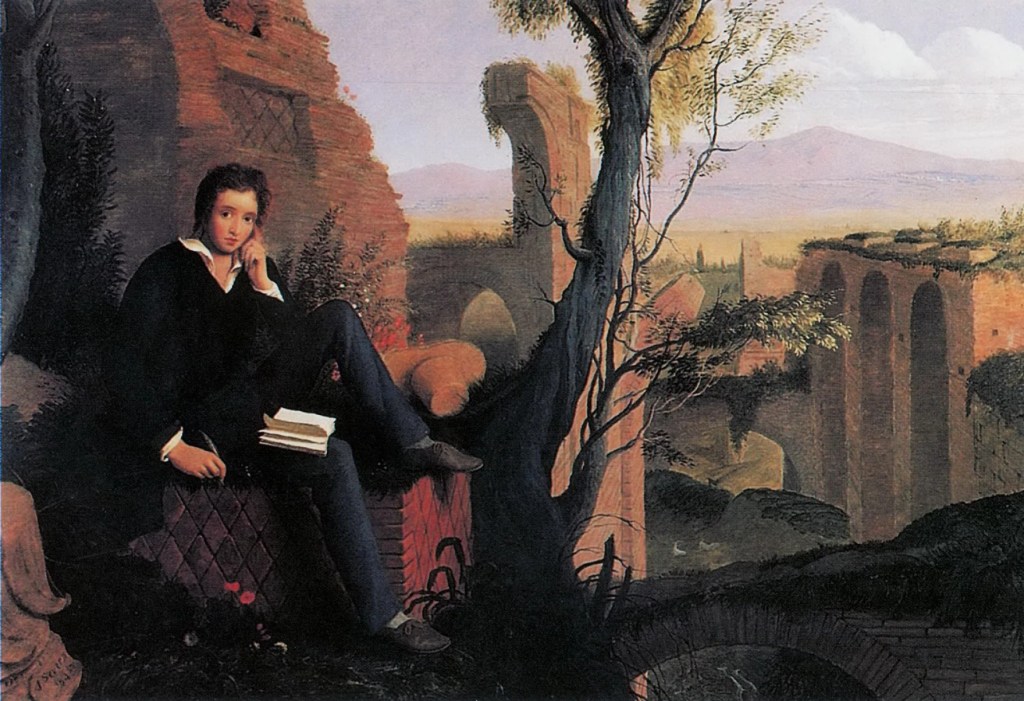
Illustration: Joseph Severn’s portrait of Percy Bysshe Shelley, in Wikimedia. The radical 19th century poet practiced the politics of the plate. For Shelley and other liberals of his day, keeping sugar out of tea was a political statement against slavery.
From worship and tenderness to profanity. Two poems becoming one through the contrapuntal technique.
Quatorzain I: Secrecy.
Solemn prayers fill the empty church; hallow’d songs arise from pews of birch.
Midnights are when angels fill the halls— neither flaw nor sin to weight their calls— right where Heaven’s ardent mercy falls. Yes, Amen, and God, they sing aloud, earnest praises proudly thus avowed, bless’d by secrecy’s embrace and shroud.
Only God may hear them. Only he knows the meaning of their cry and plea. Yet-unknown and his alone to see, choirs outbreathe a psalm when no one’s near as an offering at last sincere, echoed up in majesty and fear.
Quatorzain II: In Sacred Places.
Caressing, smiling, both confiding, enamored dreamers kiss in hiding. In sacred places coinciding, grotesque to Earth, they birth a treasure, humanity devoid of measure, melodic in its throes of pleasure.
Secure’s the love away from judges— revealed to none who touch begrudges, observes the bruising lips and smudges— liturgical in eyes’ occlusion. Neglect has borne them disillusion, religion out of shared seclusion.
Nocturnal lovers taste affection seduced by solitude. Perfection.
Contrapuntal: Secrecy in Sacred Places.
Solemn prayers fill the empty church; Caressing, smiling, both confiding, Hallow’d songs arise from pews of birch.
Enamored dreamers kiss in hiding. Midnights are when angels fill the halls— In sacred places coinciding,
Neither flaw nor sin to weight their calls— Grotesque to Earth, they birth a treasure, Right where Heaven’s ardent mercy falls.
Humanity devoid of measure, Yes, Amen, and God, they sing aloud, Melodic in its throes of pleasure.
Earnest praises proudly thus avowed, Sincere’s the love away from judges— Bless’d by secrecy’s embrace and shroud.
Revealed to none who touch begrudges, Only God may hear them. Only he Observes the birth of bruising smudges—
Knows the meaning of their cry and plea. Liturgical within seclusion. Yet-unknown and his alone to see,
Neglect has borne them disillusion— Choirs outbreathe a psalm when no one’s near Religion out of shared seclusion.
Asan offering at last sincere, Nocturnal lovers taste affection, Echoed up in majesty and fear. ’ Seduced by solitude. Perfection.
*****
Brooklyn Crane writes:
This God-Forsaken Contrapuntal!
Contrapuntal poetry seems complicated, and it actually is. Merging lines and meanings can be quite tricky! However, I’ve read several of them either composed of poems which barely hold up on their own or too short enough to be manageable, and in response to this, I obviously went over the top. Let’s see everything you can do by blending two poems together!
A contrapuntal text is the result of the intercalary arrangement of two separate pieces of writing which creates a hidden meaning.
When I prepared to pitch the idea of writing a complex-as-all-hell contrapuntal to my friend and fellow writer Narcisse Tardif, the very first thought that came to mind was that of how most contrapuntal poetry out there simply isn’t formal at all. I mean, who has the time for that? Of course, this being my publication, the name of which is Scheming Rhymes, I naturally had to do something about that. Two questions came out of this train of thought, and these were:
What if it was a contrapuntal between two sonnets?
What if I could produce an acrostic resulting from their intercalation?
If you’ve actually read my poem, you will obviously notice that the sonnets are not sonnets at all—or at least not in the traditional sense of the word. They are indeed quatorzains, as the silly French call the 14-line arrangements that most sonnets adhere to, but the only thing these have in common with them is the couplet of the Shakespearean variant. Undeniably, I could have just written two sonnets. However, it’s never that simple on Scheming Rhymes, and you’re here for it. We’ll get there in a bit.
Regarding the acrostic, yes—there’s a reason for the italicized start of every line. Why did I do this? I just wanted to leave a signature in this poem. Here it is!
Fourteen and fourteen from each poem constituting this contrapuntal add up to twenty-eight lines for me to work with. Scheming Rhymes perfectly fills half of that space while Brooklyn Crane sadly leaves me one letter short. Upon this ill-fated realization, I added the S at the end and pretended myself to be a brilliant strategist who can overcome anything with enough delusion. Surely the reader will know that an apostrophe precedes itbecause, you know, the poem is mine.
It is now that we can address the odd rhyme schemes of the quatorzains as, with the previous information in mind, I went ballistic.
“Could I arrange the poems in a way that their merging results in a different form? If so, which form would that be?”
SO! Because I had just recently posted my terza rima composition breakdown, it was freshly in my mind that a possible solution to this conundrum was such a form. I mean, think about it. Terza rima poems work on a formula of 3x + 1 (or 2), so I did 28 minus 1, divided by 3, and I landed on– I KNOW YOU ARE NOT HERE FOR THE MATH! Anyway, I landed on 9 tercets plus 1 loose line, accounting for all twenty-eight verses.
Next was the question of what the rhyme schemes had to be in order to fulfill this crazy dream. Terza rima works on a ABA BCB CDC … YZY Z (or ZZ) scheme, so I superimposed it on the acrostic as follows.
I hope that you are starting to see the way these two bastards came into existence. We now have the structural guidelines for both quatorzains and the resulting terza rima. This would absolutely be enough for a sane person to go about their day. It’s a double quatorzain/terza rima/contrapuntal/acrostic after all.
It was not enough for me, but I will not bore you with the metrical choices made in this poem. It’s explained on the paid-for section of my terza rima post, though.
Oh, yes. This is a shameless plug for my paid subscription. Come on—you already love Scheming Rhymes!
With all of these guardrails to work with, it was finally time to write. It was absolute hell.
But why do this?
The short answer is: because I can, lol. The actual answer, however, is that I do it because it can be done. Scheming Rhymes is all about exploring what we can do to enrich poetry, understanding both the traditions that educate our verse today and the techniques that might innovate its composition tomorrow. This work is not perfect, I’m aware, and there is sure to be someone who executes the planning behind it more expertly, but we ought to encourage writers to challenge themselves and produce beauty through effort, not through simply making poetry easier.
So there you have it. Here’s to more brutal antitheses to free verse poetic prose!
Join the madness—or don’t!
As with all previously explored forms and techniques, I am not here to police you about how you write and what decisions you make. You can make lines vary in syllable count, ditch the rhymes, change the number of lines per stanza, or anything else you want to do. All I intend on this publication is to give you a starting point from which to find your identity as a writer. Here’s the text by Ani Beeler that inspired me to explore this technique using a completely different approach:
Brooklyn Crane: Celebrating human ingenuity in poetry! Writer, advocate, unapologetic rhyme addict, and public enemy of AI content. Subscribe to Scheming Rhymes—read more of my work and learn more about poetry forms and techniques.
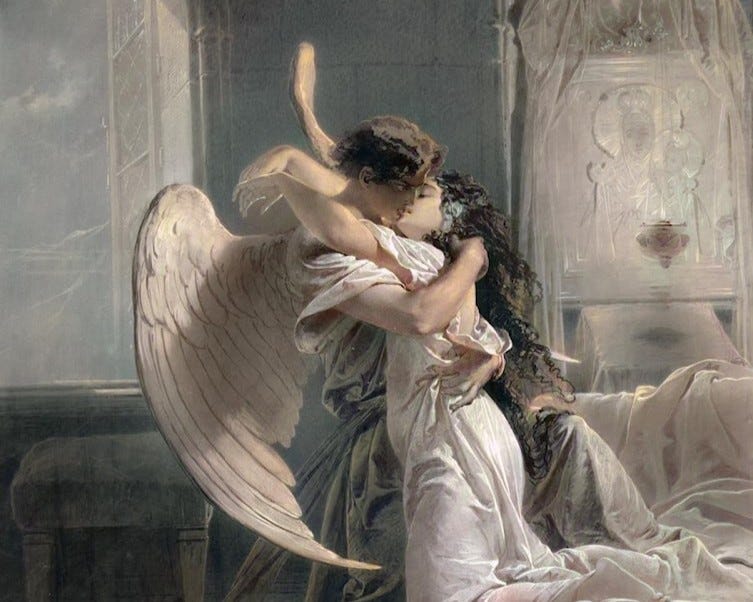
Illustration attributed to Mihály Zichy based on Mikhail Lermontov’s poem The Demon, via Art Renewal Center.
The chain between your ankles clanks upon each creaking stair As you ascend from cellar depths through shadowed drops to where I lie behind my bedroom door. A cartoon ghost, you seem, Come dragging from a TV tale to shamble through my dream Then out the waking end, with chains a-rattling, bones stripped bare.
No doubt you have a story of your own; it isn’t mine, And if you have a role for me it’s one I must decline. I’ve never been a Montresor, a Scrooge is not my style, (I may not lack the malice but I surely lack the guile). I hide no guilt of which a ghost might form the outward sign.
Well, yes, there’ve been some peccadilloes (now you’ve reached the landing), But nothing on the scale I sense your bloody bones demanding. The murders I have dreamed of I have quailed from in the doing, The chances I have missed the only fuel for my rueing. There’s nothing you can lay before the door at which you’re standing.
And yet this door is opening slowly – slowly in you come, Your grin as final as the grave, your empty skull as dumb, Your only sound the rusty crepitation of the chains That drape the fleshless network of your hollowed-out remains. There’s nothing in you – mine the depths your pitted sockets plumb.
And now I grasp your import, and I shake with joy and dread. For what was it that Shakespeare’s Earl, in dark foreboding, said? “Such things” (our present seeds) “become the hatch and brood of time”. And thus I birth the spectre of my destiny in crime. Strike off your chains – my deeds to come will raise you by their dead!
*****
Simon MacCulloch writes: “As Yet Not Come to Life” takes as its starting point an image that terrified me as an infant. It was in a televised, animated adaptation of Dickens’ A Christmas Carol – at one point, the ghost of Marley is shown mounting a staircase towards Scrooge’s room, and we are shown only the skeletal lower legs as they slowly ascend the steps, inhibited by shackles round the ankles. This image became the main focus of my typical childish bedtime fears for a long while afterwards and has never been quite forgotten. I hope to take it to my grave, though not just yet.”
“Simon MacCulloch has published hundreds of poems in a variety of outlets, including literary, academic, genre, humorous and religious publications. He lives in London. His Lovecraftian sonnet sequence, The Eyes of Azathoth, is due from Jackanapes Press in October 2026.
Odysseus, the master home again after long wandering strange lands and seas, contending twenty years with monsters, men, and gods, observed his dog beset with fleas, decrepit, curled upon a pile of dung, ignored, abandoned by a careless world.
Thus lay Argos. Swarms of flies buzzed and swirled around his wasted body. His head hung. His legs lacked strength to stand. But that one voice he knew. A scent he’d always recognize. The man, to guard his beggarly disguise, withheld all signs of care. He had no choice.
The dog’s ears pricked. He feebly wagged his tail. Then knowing that his master had returned he died. Odysseus shed hidden tears. He dared not stroke the dog. Within he burned. This final comrade lost to no avail, and lost forever all those missing years.
***** Richard Meyer writes: “After many decades, I’m reading The Odyssey again, the highly acclaimed translation by Robert Fitzgerald (1961). It won major awards and is considered a classic. Selections from the Fitzgerald translation were in high school English textbooks for years, including the one I used when teaching. I was prompted to revisit The Odyssey after seeing Christopher Nolan’s much talked about recent film adaptation of the ancient epic. The scene with Odysseus and his old dog Argos is one of the well-known episodes in The Odyssey, and a few days ago I had the notion to condense the scene into a modern poem. Most of my poems are written in the new formalism style, using rhyme, meter, and the traditional tools of poetry. In ‘Argos’ I use an irregular rhyme scheme and iambic pentameter meter, with occasional metrical variations for effect.”
‘Argos’ was first published in Facebook.
Richard Meyer, a former English and humanities teacher, lives in Mankato, MN. His book of poems Orbital Paths was a silver medalist winner in the 2016 IBPA Benjamin Franklin Awards. He was awarded the 2012 Robert Frost Farm Prize for his poem “Fieldstone.” His poetry has appeared in a variety of print and online journals and has also received top honors several times in the Great River Shakespeare Festival sonnet contest. He is also the author of Wise Heart, a memoir of his mother Gert who was born in poverty, came of age during the Great Depression, enlisted in the army during World War II, served overseas, achieved the rank of first sergeant, and was awarded the Bronze Star for meritorious service performed during the Battle of the Bulge. Richard’s most recent book is Stumbling Onward, a collection of new and selected poems – and a 2026 revision contains over 50 new poems. His books are available on Amazon.
Richard experimented with AI. He gave it simple tasks. It did them well.
It seemed to him the limit was the sky: give AI any task, it would excel.
He then instructed AI to supply a composition worthy of Purcell.
It did so very well: on the first try it thrilled him with a Purcell that was swell.
A portrait next, and when the paint was dry it could have been the work of Raphael.
“I want a new play by that Shakeseare guy: a Hamlet sequel’s surely bound to sell,”
demanded Richard. Sweet as apple pie, up on the PC screen, Hamlet-Nouvelle,
a faux Shakespearean drama, met his eye. Was this a long-lost play? No one could tell.
*****
Richard Fleming writes: “I’m very positive about AI, in the face of much weeping and squealing from a few other writers of my acquaintance who seem almost paranoid about it. I’ve used ChatGPT for a number of matters, both great and trivial, to great effect. The image, created jointly by myself and ChatGPT, I think works well.”
Richard Fleming is an Irish-born poet and humorist based in Guernsey, a Channel Island between Britain and France. Widely regarded as one of the island’s foremost literary voices, his versatile work blends lyricism, sharp wit, emotional depth, and a strong sense of place. Drawing from his Northern Irish roots and adopted home, his poetry and prose explore love, loss, nostalgia, identity, and modern life. Collections include Strange Journey (2012), held in the National Poetry Library, and Stone Witness (Blue Ormer) featuring the BBC-commissioned title poem. His work can be found on Facebook https://www.facebook.com richard.fleming.92102564/ or Bard at Bay www.redhandwriter.blogspot.com