Succeeding as a poet means you know
you’re nobody. Writing your name in water,
you dissipate, dissolving in the flow.
Succeeding as a poet means you know
you’re planting rows of seedlings in the snow.
Not truth but mere oblivion is Time’s daughter.
Succeeding as a poet means you know.
You’re nobody, writing your name in water.
*****
Susan McLean writes: “This triolet, originally published in Snakeskin, is a tribute to two poets who died almost completely unknown, but who are now considered to be among the greatest poets of the English language: John Keats and Emily Dickinson. When Keats died at the age of 25, he asked that nothing be written on his gravestone except “Here lies One whose Name was writ in Water.” His friends disobeyed his instructions, adding the information “This Grave / contains all that was Mortal, / of a / YOUNG ENGLISH POET, / Who, / on his Death Bed, / in the Bitterness of his Heart, / at the Malicious Power of his Enemies, / Desired / these Words to be engraven on his Tomb Stone / Here lies One / Whose Name was writ in Water / Feb 24th 1821.” They did not include his name. Keats’s letters later made famous his phrase “negative capability,” which he defined as “capable of being in uncertainties, Mysteries, doubts without any irritable reaching after fact & reason.”
Emily Dickinson wrote at least 1775 poems, though only ten were published in her lifetime. Her poem now known as 288 (because she did not title her poems) reads:
I’m Nobody! Who are you?
Are you – Nobody – too?
Then there’s a pair of us!
Don’t tell! they’d advertise – you know!
How dreary – to be – Somebody!
How public – like a Frog –
To tell one’s name – the livelong June –
To an admiring Bog!
Both Dickinson and Keats are now very famous. But it could easily have been otherwise. Sir Francis Bacon once wrote “Truth is the daughter of time, not of authority.” I wish I could believe that a poet’s true value will always be revealed in time. What I know instead is that all poets’ works will be forgotten in time. Succeeding as a poet means that you go on writing anyway, whether or not your writing will ever be appreciated, even if you feel quite certain that it won’t. To lose yourself in the moment of creation is reward enough.“
Susan McLean has two books of poetry, The Best Disguise and The Whetstone Misses the Knife, and one book of translations of Martial, Selected Epigrams. Her poems have appeared in Light, Lighten Up Online, Measure, Able Muse, and elsewhere. She lives in Iowa City, Iowa.
https://www.pw.org/content/susan_mclean
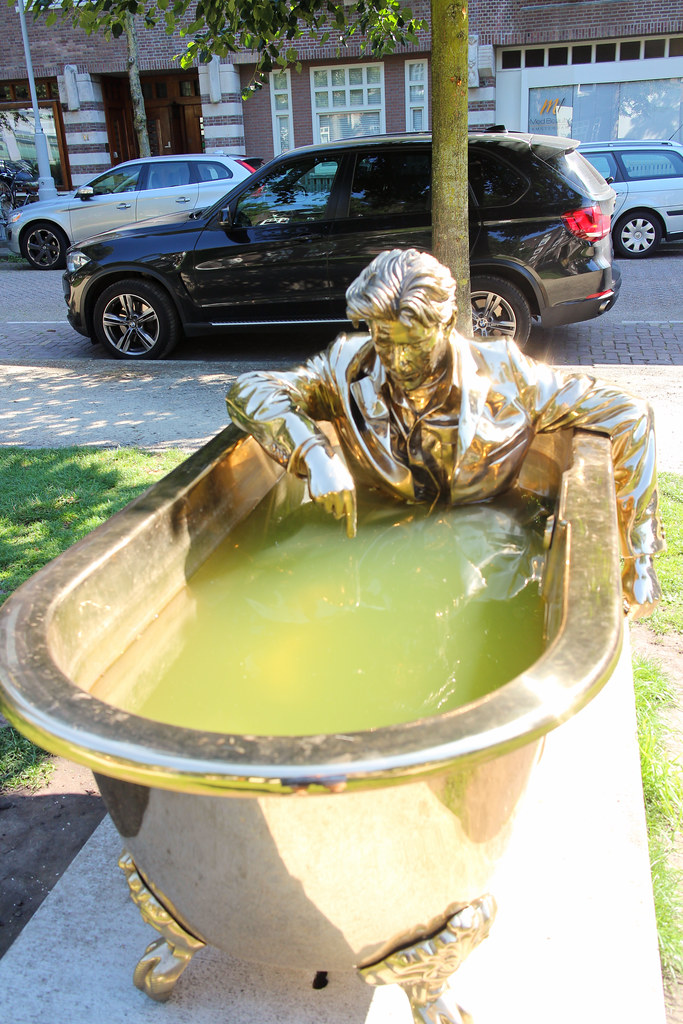
Photo: “Seven bathtubs and a man who writes on water.” by jpmm is licensed under CC BY-NC-ND 2.0.

 Form in Formless Times