Tag Archives: violence

Ed Shacklee, ‘So We Beat Them’

One limped a little, and another had a stammer,
one was cross-eyed, swarthy, and employed atrocious grammar;
so we beat them with a pipe, and then a club, and then a plier,
bending them like pretzels after binding them with wire,
sending trite condolences with tappings of a hammer.

One was far too clever, another drolly thick,
one was hyper, one disfigured by a nervous tic;
so we beat them with a tire iron, then aimed a rolling pin
at tender ribs, boxed their ears, and kicked them in the shin,
pretending we were sorry while we plied the heavy stick.

A fear of heights gripped one; one lived in mother’s cellar;
one, depressed, developed gout and had a pasty pallor;
so we beat them in a mixing bowl till minds were scrambled eggs,
safe and snug at home because we’d manacled their legs,
and lent our ears but didn’t hear their squalls amid the squalor.

One ignored the hoi polloi as they were mouthing curses,
one kept her nose in books and mumbled antiquated verses;
so we beat them with the crucifix, an ankh, and shepherd’s crooks,
painted them like prison walls and hoisted them on hooks,
and pent them on their merry way in gilded, garish hearses:

and when they got to heaven with its lovely rolling beaches,
their uniforms restarched and blanched to white with holy bleaches,
we beat them with a lightning rod, the hand of God, and thunder,
for only strikes against the flint can spark a soul to wonder.
There is no balm in Gilead but serpent oil and leeches.

*****

Ed Shacklee writes: “Trying to write poetry comes from reading the poems of others aloud, I think. It doesn’t seem to matter if you’re smart or eloquent, or not. I started mumbling to myself sometime after coming across William Meredith’s The Wreck of the Thresher, in which a poem ends, ‘There’s flowering, there’s a dark question answered yes.’ I can’t reproduce the experience here, and I doubt anyone can unless they’re as immature, unlettered, and blue as I was back then, but that resonated; the unspoken question that could be any question, the modest, unconditional yes, and the sudden flowering of that line. It shook something till it was almost awake. Arise and walk, I guess you could say. A while later I heard Meredith give a reading, and I regret that I was too tongue-tied in his presence to go up and thank him.”

‘So We Beat Them’ was first published in Rattle, #50 – Winter 2015

Ed Shacklee lives on a boat in the Potomac River. His first collection, “The Blind Loon: A Bestiary,” was published by Able Muse Press.

And for those who like odd information and representations of animals, The Blind Loon: A Bestiary Facebook group is worth joining.

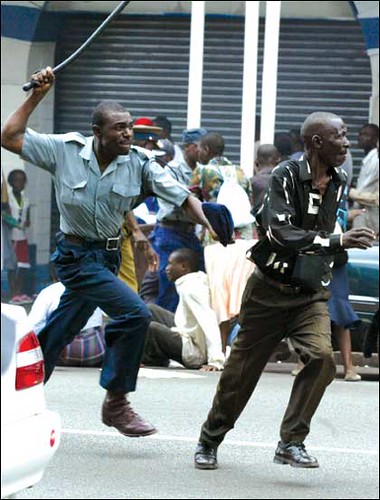
Zimbabwean police beats fleeing protester” by Sokwanele – Zimbabwe is licensed under CC BY-NC-SA 2.0.

Les Brookes, ‘Skipping Song’

Eenie meenie miny mo
Apple orange mango grape
Snap on the news and what da ya know
Looting murder pillage rape

Do what you will you can’t escape
Looting murder pillage rape

Parents who lock their kids away
Binding their eyes and ears with tape
Struggle vainly to keep at bay
Looting murder pillage rape

Yeah lock ’em up they won’t escape
Looting murder pillage rape

We sit like ghouls in front of screens
Watching helpless with mouths agape
As men go mad with war machines
Looting murder pillage rape

Rectangular is now the shape
Of looting murder pillage rape

Darwin showed us time and again
That we’re descended from the ape
But do genetics help explain
Looting murder pillage rape?

Yeah, dig down deep the spade will scrape
On looting murder pillage rape

*****

Les Brookes writes: “The inspiration for this poem came “unbidden”, as Hopkins wrote of his “Terrible” Sonnets. I usually watch the news while having supper and am always struck by the violent contrast between my situation and the howling grief of people, especially parents, in war-torn regions of the world. It therefore seemed appropriate to express this contrast through the innocence of a child’s skipping song.”

‘Skipping Song’ was originally published in Pulsebeat Poetry Journal.

Les Brookes lives in Cambridge UK. He writes poetry and fiction, and his work has appeared on webzines and in anthologies published by Cambridge Writers and Paradise Press. Website: http://www.lesbrookes.com

Illustration: “Skipping rope dance 2021-02-09” by Asanagi is marked with CC0 1.0.

Semi-formal poem: ‘The Viking in Winter’

O it is a wide winter, windy with gales,
Hard, harsh and horizonless, cold,
And I can do nothing more this year
But sharpen the swords, mend the gear,
Mend cloth, patch sails,
Listen to tales told by the old,
Listen to horses stamp in stalls.
Feel the blood in my veins going nowhere,
Feel the river halt, the bay iced in,
The sun brief and thin
The food dried, smoked, salt
And no fresh fruit, fresh meat,
No fresh lands, fresh goods,
No fresh deeds, fresh girls,
No seas running and blood running
And people running and tales running…
For what is the good of inaction
Save to prepare for fresh action;
And what is the good of fresh action
Save for fresh tales;
And what is the good of fresh tales
Save for the glory and the name
And the fame that lives past the death rattle
For the sword singer,
Word winger,
The Bard of Battle?

*****

I feel the same fascinated connection to my Viking ancestors that I feel to my even earlier chimp-like forbears and modern chimp and bonobo cousins. All have social networks, hierarchies, politics, violence and ways of overcoming violence, cherished families, a sense of fairness and ways of cheating. I suspect the Viking gods would be far easier for chimps and bonobos to accept than modern scientific understanding could ever be. I greatly enjoy Vikings, chimps and bonobos, recognise that a lot in me comes from them, and am thankful to have outgrown much of their limitations. (And to neo-Nazis who think they are Vikings, I say this: “You’re not; don’t be so stupid.”)

This rambling semi-formal poem was first published in Snakeskin; thanks, George Simmers!

Icy sea” by piropiro3 is licensed under CC BY 2.0.