Tag Archives: father

Using form: unrefrained Villanelle: Alexis Sears, ‘On Turning Twenty’

One afternoon, my father chose to die.
He was like, See ya later, guys. I think
I understand, since I don’t know if I

can hang, myself. But hang myself? (Don’t try,
they whisper, spooked.) Too young to buy a drink,
but old enough to snatch one from a guy

who says, “I’m married, but–” His twinkling eye
is trained, you know, to tell me with a wink
I’ve made the cut. One hand explores my thigh,

the other fingering a Miller. Why
are men so callous? Nowadays, I sink
beneath the comforter. I’ll never cry

because my lover’s lover’s lovely–Thai,
with toned and skinny limbs, her cheekbones pink
and angular. Ohio girl, a Buckeye.

I’m from a land where bleach blond angels fly.
Beneath the moonlight, friends and I will clink
our cups; my wondrous-child eyes defy
adulthood, till I sip. It’s bitter, dry.

*****

Editor: The poem was originally prefaced with “There are those who suffer in plain sight. – Randall Mann”

Alexis Sears writes: “I wrote this poem on the eve of my 20th birthday; nearly a decade later, I still hold it dear. ‘On Turning 20’ made me realize that what I had to say may have been more meaningful than I’d thought.”

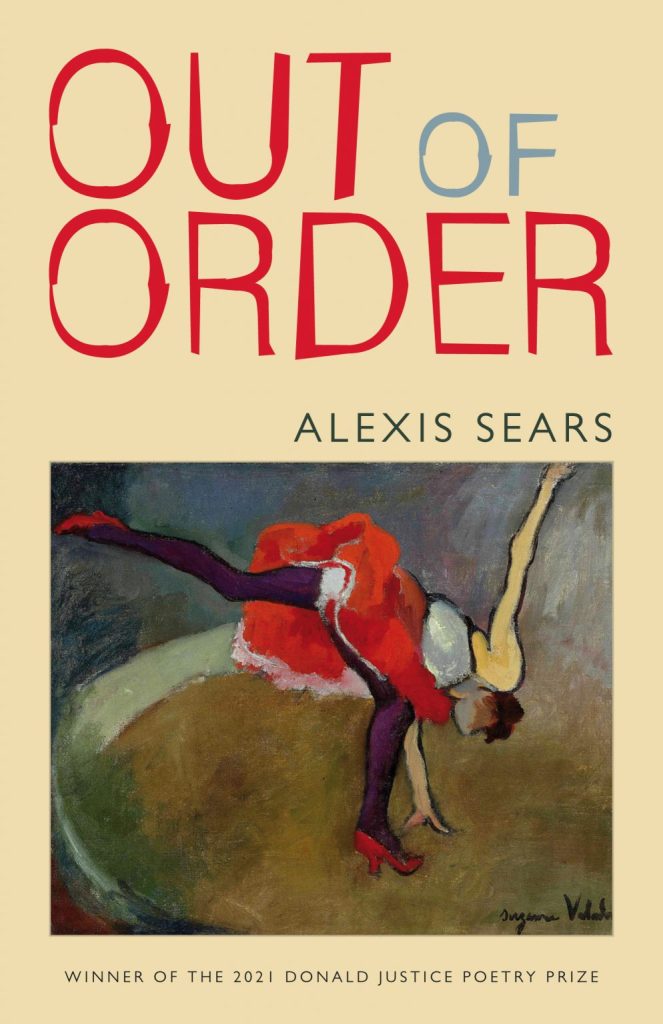
Alexis Sears is the author of Out of Order (in which this poem appears), winner of the 2021 Donald Justice Poetry Prize and the Poetry by the Sea Book Award: Best Book of 2022. Her work appears in Best American Poetry, Poet Lore, Cortland Review, Cimarron Review, Rattle, and elsewhere. She earned her MFA in poetry from the University of Wisconsin-Madison and her BA in Writing Seminars from Johns Hopkins University. Editor-at-Large of the Northwest Review and Contributing Editor of Literary Matters, she lives in Los Angeles.
https://www.alexissears.com/

Quincy R. Lehr, ‘Lines for my father’

I think I owe some kind of explanation
As I grow tired and listless fingers writhe
Above the unpecked keyboard pad. I’m not
Quite out to blame you or your generation
For where I’m at tonight. You paid the tithe
That life exacts. It’s sanctimonious rot
If we deny the pain of paying it–
And our denials never help one bit.

Unlike you, I found myself involved
In protest politics when I was young.
I spouted crap about the working class
While searching for a problem to be solved.
I mocked you then, since stirring tunes are sung
In brayed crescendos, with a blaze of brass
Booming triumphs won against the odds–
Unjust societies and jealous Gods.

You seemed so cautious–tastefully attired
With modest ties and polished wing-tipped shoes,
A cautious, kindly smile that reached your eyes.
A man to be respected, not admired,
Neither adulated nor abused.
Ambitions of an ordinary size
Were often past your reach. A nagging doubt
Set in, and now I know what that’s about.

Tonight, I type these words as it gets late,
And no one calls to beckon me to bed.
I scoffed at what you’d craved–the tenure track,
The slow-accruing pension from the state,
The wife (who left you). Though you’re good and dead
(And at this hour, my eyes are going slack)
And though you cannot answer, I’ll report
–While having to imagine your retort–

That we’re no happier than you, and can’t
Quite seem to sit for tests that you had failed.
Our phones are packed with numbers we won’t call.
The televisions blast a constant rant
That we ignore like letters still unmailed–
Or unconceived. Clichés about a ball
That’s dropped don’t work–or maybe don’t apply.
We never picked it up. I wonder why.

This recognition’s only dawning now
As streetlights speckle glimmers on your urn
Beside my unmade bed, and as I write
These words to you in lieu of sleep. Somehow,
The brays of drunks outside my window turn
Almost comforting, as if the night
Is full of us–insomniac, astray,
And muttering defiance at the day.

*****

Quincy R. Lehr writes: “As for that poem, my father died in 2003, when I was twenty-seven. The content pretty much speaks for itself, I think. I was young, lonely, and frequently drunk when I wrote it.”

Editor’s comment: I admire the technical skill of the poem: the steady iambic pentameter; the abcabcdd rhyme scheme with the final couplet providing a punch; the integrity of the individual stanzas, each patiently laying out a mood, a thought, a situation. And I relate to the young man’s restless, unquiet, unsettled life, and the comparison to his father’s existence, his dismissal of his father’s achievements, his simultaneous recognition of the inevitable connections. It is a satisfying telling of an individual’s unique early life, in the context of the universal discord between generations.

Born in Oklahoma, Quincy R. Lehr is the author of several books of poetry, and his poems and criticism appear widely in venues in North America, Europe, and Australia. His book-length poem ‘Heimat‘ was published in 2014. His most recent books are ‘The Dark Lord of the Tiki Bar‘ (2015) and ‘Near Hits and Lost Classics‘ (2021), a selection of early poems. He lives in Los Angeles.
https://www.amazon.com/Quincy-R.-Lehr/e/B003VMY9AG

Potcake Poet’s Choice: D.A. Prince, “The Window”

D.A. Prince

That was my first job, he said, as we gazed
at the insignificant window. Down
the slate steps, and looking from the raised
salt-pitted pavement, where this end of town
gets hammered by the sea, it looked so small.
But sturdy, strongly-made enough to prove
that here his father fitted him with all
the craftsmanship he’d need. It wouldn’t move
or crumble. Each year he’d return, to see
his work enduring. Then brought me, to know
a detail of our family history
and let this shabby mullioned window show
something inherited – that stone and wood,
well-built, can last a lifetime and go on
drawing the clean light in and doing good.
I think about it often now he’s gone.

D A Prince writes: “Sometimes a poem travels far further than expected. When I wrote ‘The Window’ I felt it was a quiet and, for me, unusually personal poem which would have a limited readership. It was published in South, and the editors subsequently submitted it to the Forward 2020 Anthology. I was pleased they had chosen it but given the cutting-edge nature of the Forward anthologies I never thought it would be selected. After all, it’s formal; that’s not how twenty-first century poetry is. To my astonishment it was selected and included — perhaps a reminder that rhyme and metre are still part of our landscape.”

D A Prince lives in Leicestershire and London. Her first appearances in print were in the weekly competitions in The Spectator and New Statesman (which ceased its competitions in 2016) along with other outlets that hosted light verse. Something closer to ‘proper’ poetry followed, with three pamphlets, followed by a full-length collection, Nearly the Happy Hour, from HappenStance Press in 2008. A second collection, Common Ground, (from the same publisher) followed in 2014 and this won the East Midlands Book Award in 2015. HappenStance published her pamphlet Bookmarks in 2018.
Light verse continues to be an essential part of her writing as a way of honing technical skills while having fun.

http://www.happenstancepress.com