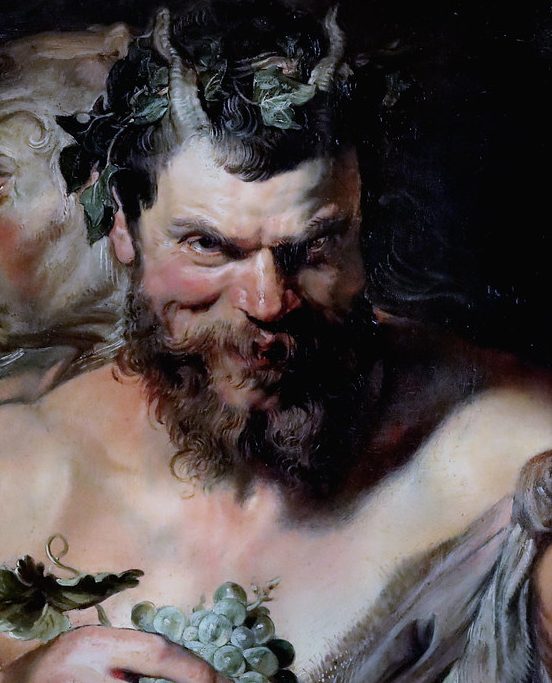
He looked at me as if I ought to know
just who he was
but I did not. I looked away, then so
did he. Alas
I didn’t recognize the Great God Pan
in human form.
I simply thought he was another man.
I felt a warm
gaze inviting me once more. I turned to
see him changed. A
God again, hooves and furry legs, horns grew.
He gestured “Hey?”
I was too dumbstruck to do more than stare.
He shook his curls and sprinted off somewhere.
*****
Juleigh Howard-Hobson writes: “I wrote this when I lived off-grid on ten acres up in rural Washington State.The forest that made up half my property was dark and creepy. The Great God Pan was no more out of place than BigFoot or werewolves. All of which I imagined I saw/heard from time to time (I use italics as I am not absolutely convinced it was all imagination). Nothing out there ever hurt me, so all’s well that ends well–I’ve since moved back to civilization, which is far more frightening in many ways. As for the form–well, that just was how the poem decided to be.”
Juleigh Howard-Hobson’s work can be found in Think Journal, Able Muse, New Verse Review (including this poem), The Deadlands, Autumn Sky Poetry and other venues. She has been nominated for “The Best of the Net”, Pushcart, Elgin & Rhysling Awards. Her latest book is Curses, Black Spells & Hexes (Alien Buddha). A member of the HWA and the SFPA, she lives on the coast of the Pacific Northwest. In a poetically haunted house.
X: poetforest
Photo detail “IMG_4017RBA Peter Paul Rubens 1577-1640 Anvers Deux Satyrs Two Satyrs ca 1619 Munich Alte Pinakothek” by jean louis mazieres is licensed under CC BY-NC-SA 2.0.
 Form in Formless Times