Tag Archives: hunting

Bruce McGuffin, ‘Tunnels’

A snowy field — sun sparkles on the ice —
Devoid of life to those who do not know
That underneath a furtive swarm of mice
Live out their lives in tunnels through the snow.
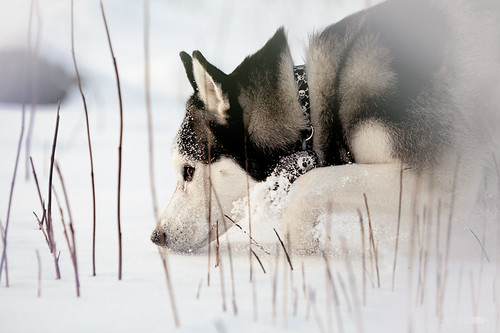
My dog, who finds them out by smell or sound,
Runs snorting through the snow in wriggling glee.
Then back and forth ecstatically he’ll bound
Until some mouse has nowhere left to flee.
For so it goes with mice as well as men,
Those tunnels where we run turn into traps
When forces that are far beyond our ken
Play out their game until our ways collapse.
Do waiting mice envision what impends?
That somewhere up above a canine snout —
Deus ex machina to mice — descends
To pierce the snow and pull those trapped mice out?
Few things in life will make that dog as glad.
The mouse may not rejoice — its life is through.
But whether killing mice is good or bad
Depends completely on your point of view.

*****

Bruce McGuffin writes: “When I was a boy winters were longer, colder, and snowier than they are today, and I had a suitably adapted dog: An 80 pound husky of indeterminate parentage. By which I mean a local ski instructor took his Siberian husky to Alaska one winter and she came home pregnant. We named him Frosty. In my defense I was 7 years old. His favorite pastimes were eating, sleeping outdoors in the snow, and hunting. Dogs roamed free in those days, and he brought home squirrels, mice, and more than one skunk. Frosty also bit the older boy next door after he punched me, which made Frosty The Best Dog Ever.
This poem started out as a paean to The Best Dog Ever, but slipped the leash and went off in a different direction, as poems sometimes do. It turns out that some of my favorite poems are the ones that get away.”

‘Tunnels’ was first published in Better Than Starbucks.

Bruce McGuffin grew up in rural Central NY, where children and dogs ran free through the frozen woodlands in winter, and waded in the creek all summer. It was ok if you like that sort of thing. His graduating class voted him Class Intellect, which was not exactly a compliment. Spurred on by lack of economic opportunity in that region, and the desire to know more people who didn’t think reading books was “weird”, he spent too many years in college then moved to the Boston area and worked for 37 years as an engineer in the field of radio communications. It was fun. Now semi-retired, he lives in Antrim NH with his wife Ann and occasional visits from two children who come for the skiing if not the company. His poetry has appeared in Light, Lighten Up Online, The Asses of Parnassus, Better Than Starbucks, and other journals.

Photo: “Sniffing the Prey” by Emyan is licensed under CC BY-NC-ND 2.0.
Using form: John Beaton, ‘Killing a Coho’

I grip its tail, hammock its back,
and swing its head down with a crack
on rock, then feel its spasms judder
through my hands as, with a shudder,
it stills,
a grand finale that fulfills
some ancient impulse in my mind.

Poking my finger through a gill,
I cause the raker fronds to spill
blood that drip drips as I carry
the silver deadweight of my quarry,
my kill,
toward a tidal pool
the sunset has incarnadined.

My knife begins behind its throat
and blood-clouds billow out and bloat
then seep into an outflow, seaward,
where baitfish burrow in the seaboard
in schools,
their heads in sand, small fools
kidding themselves they’re hard to find.

I slit its stomach. From that sac
their half-digested eyes peer back,
sandlance dumbstruck at being hunted
in shallow flats this prowler haunted,
this fish
whose every feeding flash
signalled flesh to seals behind.

Somewhere nearby a black bear roars;
wolves salivate; an antler gores
a starving cougar; orcas cripple
humpbacks, bite their fins, then grapple
great bulks
till bleeding, savaged hulks
sink; and then there’s humankind.

No kindness here. This salmon swam
full speed to seize my lure then, wham,
became a madcap, hell-for-leather,
death-row inmate on a tether
and fed
the caveman in my head.
This coast is one big hunting blind.

*****

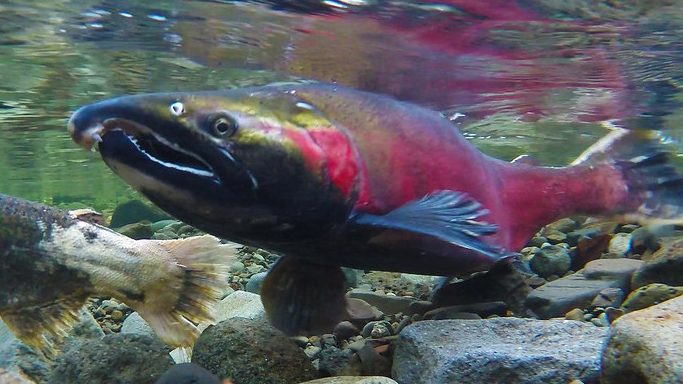
John Beaton writes: “I’m a lifelong fly-fisher but I’ve always had twinges of conscience about hurting and killing fish. Catch-and-release makes me question whether I’m being cruel. But there’s also a part of me that still connects with the beautiful brutality of the eat-or-be-eaten ecosystems in which we live. This poem tries to express that perspective in the context of an actual experience—the catching and killing of a coho salmon off a rocky shoreline near Tofino.

I chose a form to tell the story with some element of shock and violence. Each stanza has seven lines: one and two are tetrameter with masculine rhymes; three and four are also tetrameter but with feminine rhymes to cushion what comes next; five and six are monometer and trimeter respectively with masculine rhymes and these cropped lines set up a sense of surprise and violence; and line seven is tetrameter with a masculine ending that ties the poem together by rhyming with all the other seventh lines.

There’s some justification for killing the coho—the victim is itself a killer. And the turn at the end of the penultimate stanza connects humans with the savagery of the wildlife.

Sometimes you find a ‘eureka’ word—one that fits rhyme, meter, and sense so well you think ‘wow.’ This poem has one I think of that way: incarnadined.”

John Beaton’s metrical poetry has been widely published and has won numerous awards. He recites from memory as a spoken word performer and is author of Leaving Camustianavaig published by Word Galaxy Press, which includes this poem. Raised in the Scottish Highlands, John lives in Qualicum Beach on Vancouver Island.
https://www.john-beaton.com/

Photo: “Coho Spawning on the Salmon River” by BLM Oregon & Washington is licensed under CC BY 2.0.

Using form: Semi-formal: RHL, ‘Hunting’

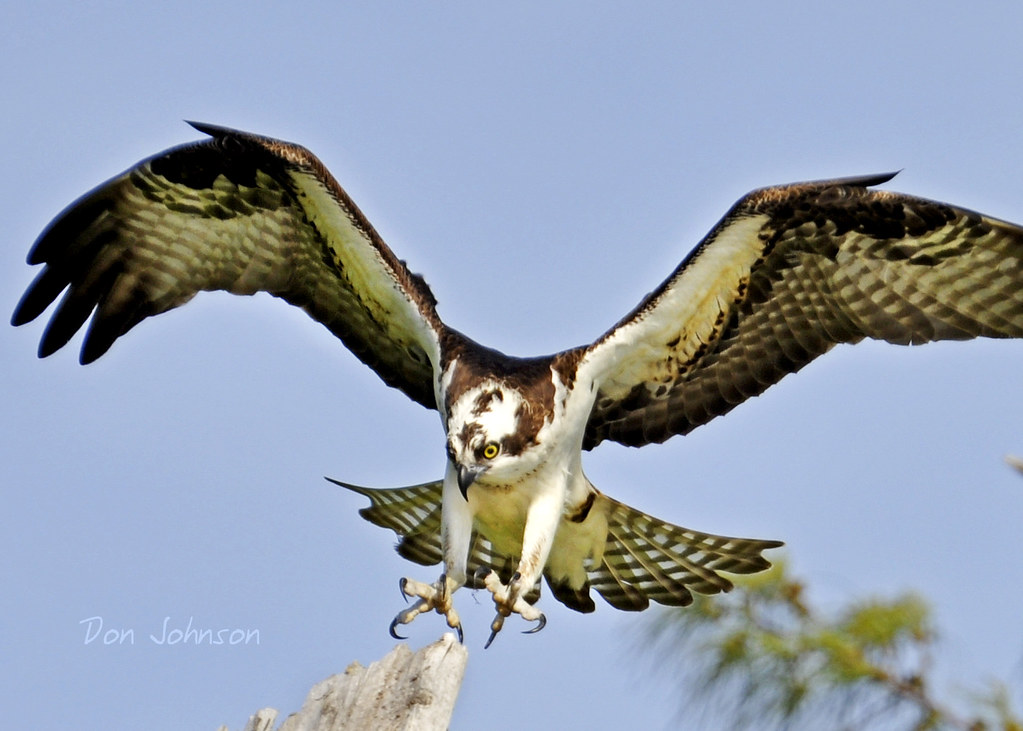
The Osprey splashes, misses, and flies by
skimming the waves, rising, five yards away.
What’s its success rate? Does it care?
The Stingray searches, gliding, mouth to sand
five yards beyond the shallows where I stand.
Its Roomba-work’s its own affair.
The water splishes, burbles random rhythms.
The sun confuses, over-hot, then hidden.
The Oystercatcher calls. The Osprey rocks
on its branch in a casuarina,
flaps down-beach to another.
Along the margins of the shore, alone, each stalks.
They hunt for food
and I hunt them for what they mean, or could.

*****

There are elements of the sonnet about this semi-formal poem: it’s in iambics (though with uneven lengths of line); it has rhyme (though some only slant rhyme, and not patterned); it has 14 lines and a final couplet (though not with a clear volta where you would hope, after the 8th line). But I think the disjointed nature of the poem, its stop-and-go lines of different length, is suitable for the nature of the hunt: the searching, the sudden swoop, the pause, the restarting. In that sense the form is appropriate for the subject matter, and therefore good. It may be that I was too lazy to beat the whole thing into pentameters with a regular rhyme scheme… but it may also be that this was the right place to stop for this particular poem.

‘Hunting’ was originally published in Obsessed With Pipework, and has just been reprinted in Green Ink Poetry (motto: “We Welcome Chaos, Calamity, And The Natural World. Hope Punks & Witches” in their current collection with the theme of ‘Forage’.

Photo: “Osprey” by Mick Thompson1 is licensed under CC BY-NC 2.0.

Poem: ‘Hunting’

The Osprey splashes, misses, and flies by
skimming the waves, rising, five yards away.
What’s its success rate? Does it care?
The Stingray searches, gliding, mouth to sand
five yards beyond the shallows where I stand.
Its Roomba-work’s its own affair.
The water splishes, burbles random rhythms.
The sun confuses, over-hot, then hidden.
The Oystercatcher calls. The Osprey rocks
on its branch in a casuarina,
flaps down-beach to another.
Along the margins of the shore, alone, each stalks.
They hunt for food
and I hunt them for what they mean, or could.

A semi-formal poem: rhymes and slant rhymes, iambic rhythm, but little structure beyond that. I was hunting for a poem about hunting for a poem, and, well, you don’t catch everything you want every time…

Published recently in the British periodical ‘Obsessed With Pipework‘ – thank you, Charles Johnson!

“Osprey landing_9566” by Don Johnson 395 is licensed under CC BY-ND 2.0

Review: “A Joy Proposed” by T.H. White

‘A Joy Proposed’ is a nice, somewhat strange, assembly of 57 often derivative poems from across the life of T.H. White. Many of the pieces were written in Ireland where White lived as a Conscientious Objector throughout the Second World War. His love of the countryside and his previous experiences as a schoolmaster (including at Stowe, a boarding school in rural Buckinghamshire with 600 acres of grounds) shine through in the constant juxtaposition of poems about game birds, dogs and landscapes alongside anger and bitterness about innocent lives lost to war.

The style varies from extreme simplicity, as in ‘A Choirboy Singing’:

Know not, but sigh.
Think not, but die.
Hope not, but high
Ache against ill.

to outpourings evocative of Whitman or Hopkins, as in ‘A Dray Horse’:

Meek Hercules – passion of arched power bowed in titanic affection,
Docile though vanquishing, stout-limber in vastness, plunging and spurning thy road –
Tauten thy traces, triumph past me, take thy shattering direction
Through misty Glasgow, dragging in a tremendous beer-waggon thy cobble-thundering load.

His pessimism, or perhaps mere sadness, at the human condition comes through again and again in the sense of the young lives he has been educating that will now be thrown away:

When I look at your comely head
And the long fingers delicately live
And the bright life born to be dead
And the happy blood to be shed
(…)
I die within me. And I curse
The witless fate of man without all cure.
Music I curse, and verse,
And beauty worse,
And every thing that helps us to endure.

… but mitigated always by his love of Nature, both hunting (as in kestrels and dogs he owned) and hunted (as in game birds he shot).

White is primarily known for his ‘Once and Future King‘ retelling of the Arthurian legends, and those novels soon went to stage and screen as the musical ‘Camelot’ and the Disney animation ‘The Sword in the Stone’. If it wasn’t for those novels, his other novels would probably be forgotten today and his poetry would be unknown. It isn’t great poetry, and yet I have read it and reread it. He was a writer and with it he was lonely, alcoholic, bitter, witty, learned, compassionate, and alive to the natural world. All of that comes through in these verses, with his self-awareness of who he was and what he was achieving. As he wrote in ‘Lines Cut on the Cottage Window’:

A bitter heart lay here and yet
It was not bitter to the bone.
It made what Time does not unmake
All hopeful, and alone.