Tag Archives: irreligious

Michael R. Burch, ‘Funding Fundamentals’

“I found out that I was a Christian for revenue only and I could not bear the thought of that, it was so ignoble.” — Mark Twain

Making sense from nonsense is quite sensible! Suppose
you’re running low on moolah, need some cash to paint your toes …
Just invent a new religion; claim it saves lost souls from hell;
have the converts write you checks; take major debit cards as well;
take MasterCard and Visa and good-as-gold Amex;
hell, lend and charge them interest, whether payday loan or flex.
Thus out of perfect nonsense, glittery ores of this great mine,
you’ll earn an easy living and your toes will truly shine!

*****

Originally published by Lighten Up Online. NOTE: A flex loan is a payday loan with a “personal line of credit” that makes it even harder to pay off than traditional payday loans. Caveat emptor.

Michael R. Burch writes: “Living in allegedly ‘Christian America’ where 80% of evangelicals voted for the Antichrist Trump, I am forced to resort to foxhole humor. ‘Funding Fundamentals’ is tongue-in-cheek foxhole humor, but I think we would be better off forming our own religions than donating money to false profits like the bible-hawking Trump and his cronies.”

Michael R. Burch’s poems have been published by hundreds of literary journals, taught in high schools and colleges, translated into 22 languages, incorporated into three plays and four operas, and set to music, from swamp blues to classical, 61 times by 32 composers. He is also the founder and editor-in-chief of The HyperTexts.
RHL, ‘Deuteronomy 20: 16-18’

You’ve no autonomy
under Deuteronomy;
it’s your obligation
to your tribal nation
to kill all Palestinians
so you don’t sin against
God, who’s neurotic.
Yes, Yahweh’s psychotic.
No escaping his wrath,
no path but the psychopath.

*****

For Christians and Jews who state (as Jesus did) that every reported command by God in the Torah / Old Testament must be obeyed, I ask their position on Deuteronomy 20. This contains the command for the complete genocide of the non-Jews living in the land which Moses claimed had been given to the Jews by God. (Note: not expulsion or enslavement of the people living there, but the death of all of them and their animals.) The reason? So that they don’t teach evil ways to the Jews:

16 But of the cities of these people, which the Lord thy God doth give thee for an inheritance, thou shalt save alive nothing that breatheth:
17 But thou shalt utterly destroy them; namely, the Hittites, and the Amorites, the Canaanites, and the Perizzites, the Hivites, and the Jebusites; as the Lord thy God hath commanded thee:
18 That they teach you not to do after all their abominations, which they have done unto their gods; so should ye sin against the Lord your God.

To the extent that fundamentalist Jews constitute a large percentage of the Israeli population and are influential in the national government, the Palestinian situation cannot be resolved until scriptural passages like this are dragged out into the open and examined and discussed: was that passage only for then, and things are different now? Or does the command to massacre non-Jews still hold for today’s Jews in “the Holy Land”?

This poem was first published in The HyperTexts, where Michael R. Burch maintains extensive collections of poetry related to both the Holocaust and the Palestinian Catastrophe.

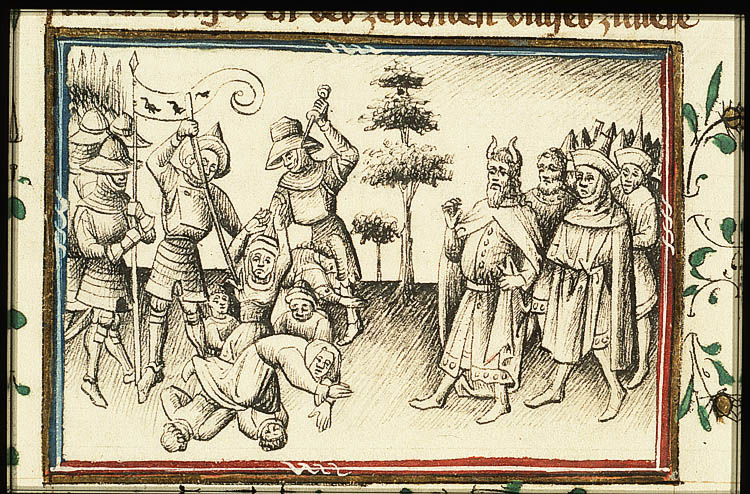
Illustration: “Moses has the mature women and the male children of the Midianites killed” is marked with Public Domain Mark 1.0.

NSFW poem: ‘The Zeus Credit Card Company’

Homeless and eyes cast down, young Danae found
the credit card just lying on the ground.
‘Zeus Credit’… with her name on it… and it said
it had no limit. So she thought
‘Why not just try it?’ and she bought
sandals, silk underwear, a dress;
it worked… so then, why not,
a light lunch in the choicest, chicest spot.
It worked again. Its back was odd:
no legalese, just logos, ads…
‘Insert in slot for all dreams to come true.’
Tearful, she checked into Hotel Princess,
went up and had the best bath in some years,
Reading again with happy tears
‘Insert in slot for all dreams to come true’
and thought again ‘Why not?’
and put it in her slot…
in sudden stir
Zeus filled the room and her.

*****

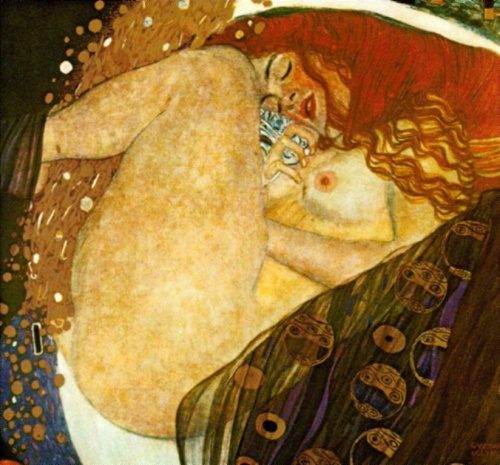
This poem, semi-formal at best, was published in this month’s Snakeskin (thanks, George Simmers!) with the accompanying Gustav Klimt ‘Danae’. I wrote the poem earlier this year but I have very little memory of doing so, and no sense of what triggered it. I put it down to the mysterious workings of the subconscious or whatever else the Muse may be.

This is an appropriate poem to post before I head into the next set of poems from the e-chapbook ‘Calling the Muse’. Is it always correct to offer up art (of any kind) that is edgy? What if the expression is sexist, even obscene? What if the work is irreligious, even blasphemous in the eyes of a believer? Is it enough to say “If you don’t like it, don’t look at it”? Is it enough to post a warning, “NSFW”?

And the Greek gods often tend toward the sexist and the licentious. Zeus is not a clean-living figure. But no one seems to object to his being depicted and popularised, even if he is a rapist. Because “that was then, this is now”? And if the Muse offers you a fresh take on an ancient rape legend, just use it because after all, the Muse must be listened to?

More on this shortly.

Poem: “4 God Limericks”

God

Christian idea of God

God made Heaven, earth, plants, people, fleas
In six days, and then rested at ease;
Then He thought: “In those stones
“I’ll hide dinosaur bones!!”
(He was always a bit of a tease.)

God looked out a Heavenly portal
And what He saw made Him just chortle:
Some dude, on a cross,
Claiming he was the Boss!
For his hubris, God made him immortal.

God, blessed with what one must call humour,
Decided to start up a rumour
That Himself as a dove
Came to Mary with love
And begat an Immaculate Tumour.

God saw how Religion had deadened
And said to His host, “Armageddon’d
“Look good on this lot”
For His plans were all shot
And His angels teased Him till He reddened.

As with the previous post, “4 Guru Limericks”, this was first published in Ambit No. 196, Spring 2009. (Hence the English spelling.) Like the previous post on gurus Buddha, Jesus, Marx and Hitler, you shouldn’t expect anything serious from a limerick. But this flippancy can have a purpose: by tackling a serious subject in a completely unserious way, you can undermine preconceptions and unthinking assumptions, and suggest alternative views and approaches.

With this in mind, consider the idea that religious belief correlates negatively with analytical thinking, but positively with moral concern and empathy. Research into this was summarized in The Independent in 2016, after more complete reporting in the science journal PLOS ONE. Limericks by their iconoclastic nature appear to be low in moral concern and empathy – but often it is some form of moral concern that has driven the limerick’s creation, although its rudeness and fresh viewpoint tends to favour analytical thinking over empathy.

Limericks are the clowns, the fools, of the poetry world. The best of clowns and fools go into stealth mode to make useful observations.

Poem: “The Fig Tree”


The fig leaf symbol’s one of History’s greats
As, inter alia,
It hides, discloses and exaggerates
Male genitalia.
The fruit itself suggests the female form —
Dripping with honey
The little hole breaks open, pink and warm . . .
The Bible’s funny.

First published in The Asses of Parnassus, this poem has just been republished in Better Than Starbucks, which earned a “Kudos on your brilliant ‘The Fig Tree'” from Melissa Balmain, editor of Light. That’s a trifecta of editorial acceptance – it makes me proud, and I have to erase my lingering suspicion that the poem would be thought too rude for publication. Now I rate the poem more highly, as being not just a personal favourite but also acceptable to a wider audience.

It sometimes feels that all I write is iambic pentameter. It is always reassuring when a poem presents itself with half the lines being something else, and the result is a lighter, less sonorous verse. The rhymes are good; the poem’s succinct and easy to memorise. I’m happy with it.