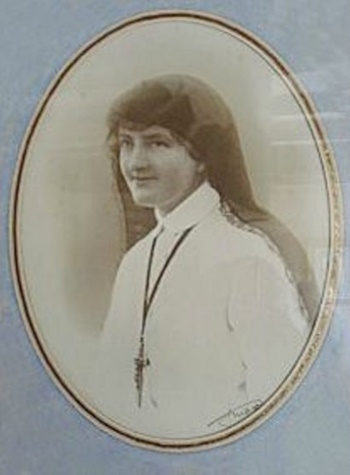
Claire Ferchaud (fer-SHO) was a young French shepherdess and mystic who became a modern-day Joan of Arc during World War I, campaigning to add the image of the Sacred Heart to the French flag. Though her proposal was ultimately rejected as a merely symbolic gesture, it was taken seriously and honored by the distinguished General Ferdinand Foch, who became Supreme Commander of Allied Forces.
Fearlessly, peerlessly, Claire the clairvoyant one pushed a proposal that fizzled, although
Foch the preeminent generalissimo said, “Let’s all try it—and not just Ferchaud.”
*****
Alex Steelsmith writes: “I tend to read widely and randomly, but ‘Clairevoyance’ didn’t come about in the usual way. Another double dactyl I had written, about the French mystic Marthe Robin, appeared in the previous issue of Snakeskin. In an email exchange I had with Snakeskin editor George Simmers about that poem, he happened to mention Claire Ferchaud, another fascinating Frenchwoman that Marthe brought to mind. I thought it would be a fun challenge to see if I could come up with one about Claire. That’s when I looked into her story and the pun leaped out for the last line of the poem. It felt a bit irreverent to be lightly punning on the name of someone who presumably was very serious and wouldn’t have been especially amused. In any case, I have George to thank for giving me the idea for the subject of the poem.”
Alex Steelsmith’s writing has appeared in USA Today, The Washington Post, The Spectator, Light, Snakeskin, Lighten Up Online, and other venues. He has been a Light featured poet, and a Pushcart Prize and Best of the Net nominee. More of his writing – and his artwork – is at http://www.alexsteelsmith.com/
On an asteroid there was an alien artefact. If such it was… a droid… I’ve no idea, in fact. Its metal (leg?) seemed (deployed?) and so I touched it, but responses lacked.
Once there were women; once I was a man (touching a leg then always brought response) before the search for life and light began to change me into this dark renaissance. The teacup storms on which I’ve tossed, when she or I have bitched and bossed till all the loves I’d ever marked were all the women that I’ve lost. They chose the certainty of Dark over the uncertainty of Light.
The joys of life are what’s uncertain: hopes of what’s behind the curtain, knowing the results will grate of things that you anticipate, knowing your life could be wrecked by what you never could expect. And though you think you’re circumspect, you can’t deflect, inspect, collect. Knowing the harvest is unknown with crops that grew from deeds you’d sown, while all your greatest hopes and dreams will be exceeded by the future’s smallest gleams.
Because change never stops, you find what matters is never really known. You may get verbal assurance of your future status, but was it “throne” or “thrown”? The only certainty would be if, offered immortality, you feared what such an altered world would lose, would save, and chose instead to go into the Dark with furnace no less dark than the grave wherein there lies no risk of further blight. Most people choose the Certainty of Dark over the Uncertainty of Light.
But we who strive to stay alive long enough for rejuvenation hope, hope only, we will thrive, post-humans in a re-Creation, unknowing what our ape-based genes will do with power dominance, with war, with sex, Earth mined and undermined, but glad to take the chance. How else can we see scenes of how it all turns out — destroyed? refined? — unless we scrape through, level up with wounds and scars and watch a world we love and leave behind? So at last I am here, between the stars, transiting the darkness of the Void, the empty galaxy’s apparent night, chanting the mantra that keeps spirits buoyed: Let there be Post-Humanity’s own light!
Between the spiral arms in the near-void there’s still thin light of distant galaxy and star, still specks of dust, rarely an asteroid. Earth left (millennia in old Earth years ago), I cross the dark immortally, beyond, afar, through what is darkness only to Earth-eyes which myriad wavelengths up and down can’t know, but which I now apprize. Light here abounds, and boundlessly surrounds, astounds.
Take the smallness from slight, take the bad from the blight, take the fear out of flight and you’re left with the light, the light, the light. We stumble from dark caves of night into day, trying not to tumble; our parents the dark; post-humans the light; ourselves just the stumble.
*****
This poem (published in this week’s Bewildering Stories) is a response to conversations in which people have expressed pessimism about the value of life extension, rejuvenation, cryonic preservation and resuscitation… anything beyond the certainties of a clear end to life after a normal lifespan. “How will you… why would you… what if they… you won’t understand… you won’t have…” Ah, but everyone who has immigrated into a foreign culture has done this: had to learn a new language in order to find a job and start making friends and find out how everything works. Some of us are comfortable doing this; some people aren’t. I’ll take the uncertainty, and enjoy its discomforts… because it’s just so interesting!
God is two brothers, one dark and one light, Riding out Time in a tiny ship; Half day and half night gives little room; God knows that a rose, red rose or white, Is a rose is a rose is a bud is a bloom Is brown blown petals and a drying hip; And the length of Time’s budding, blowing park Walk the arm-linked arguers, Light and Dark.
I wrote this poem in Morocco in my 20s, after an encounter with some of the herbs they grow there. As an aside, I don’t necessarily believe or subscribe to the things I write in my poems – they are just expressions of thoughts, moods, landscapes, overheard conversations or whatever. That said, I still like this poem: I find it simultaneously all-embracing and meaningless, and that’s OK. Apparently my recital of it, while pulling dying petals off a rose bush, captivated a young lady at the beginning of our friendship… and we’ve now been together for 31 years.