Take a mountain. Scale the pink-arsed flanks of it, limb over limb. Find Poseidon. Extract from him a wave and a horse’s hoof. Pluck a tree; kill the grip of it by showing it your thoughts. Make your peace with the grave. Eat apples, all of them. Taste in them the sin of being a woman. Let that smack you in the gut, you deserve it. Straddle the equator. Suck up its spin, take it with you; feel your body snapping shut. Learn to count each breath as an act of sedition. Pull the lungs from a sleeping leopard. Be a speck. Be a planet. Be a long-dead apparition. Stuff a storm into your patch pocket, huge and wet, but tell no one. Invent two new ways of shucking a heart from a blown glass moon. Find a man. Fuck him.
*****
Nina Parmenter writes: “This poem (first published by Atrium Poetry) was written in an online workshop in response to the prompt “a spell”. I wanted my spell to be impossible, to reflect the ineffability of motherhood, but I also wanted to talk about how the act of giving birth puts us right on the threshold of life and death. I felt that some kind of form was right for a spell, but needed the poem to feel raw rather than singy-songy, so I chose this unmetered sonnet form. The last line was really a happy accident; I wrote the penultimate line (which originally ended with sucking, not shucking!) and then thought, “What rhymes with sucking?… OH.”
Nina Parmenter‘s first collection “Split, Twist Apocalypse” is published by Indigo Dreams. Her work has appeared in Snakeskin, Light, Allegro, Raceme, Honest Ulsterman, The Lyric and Potcake Chapbooks ‘Houses and Homes Forever’. Her home, work and family are in Wiltshire. https://ninaparmenter.com/
When your mother has grown old, And you have grown older When what used to be easy and effortless Has now become a burden to her,
When her dear, faithful eyes no longer see life as they once did, When her tired feet don’t want to carry her any more while walking. –
Then give her your arm to support, Accompany her with pleasure – The hour is coming. When you, weeping, Must accompany her on her last walk!
And if she asks you a question, then give her an answer. And if she asks again, then answer! And if she asks yet again, answer again, Not impatiently, but with gentle calm.
And if she cannot understand you properly Explain her everything happily. The hour will come, the bitter hour, When her mouth asks no more.
Wenn deine Mutter alt geworden / Und älter du geworden bist Wenn ihr, was früher leicht und mühelos / Nunmehr zur Last geworden ist, Wenn ihre lieben, treuen Augen / Nicht mehr, wie einst, ins Leben seh’n Wenn ihre müd’ gewordnen Füße / Sie nicht mehr tragen woll’n beim Gehen. – Dann reiche ihr den Arm zur Stütze, / Geleite sie mit froher Lust – Die Stunde kommt. Da du sie weinend / Zum letzten Gang begleiten musst! Und fragt sie dich, so gib ihr Antwort. / Und fragt sie wieder, sprich auch du! Und fragt sie noch mehr, steh ihr Rede, / Nicht ungestüm, in sanfter Ruh! Und kann sie dich nicht recht verstehen, / Erklär’ ihr alles froh bewegt. Die Stunde kommt, die bitt’re Stunde, / Da dich ihr Mund nach nichts mehr fragt!
*****
This poem is actually from Georg Runsky (pen name of Karl Wilhelm August Georg Runschke). It appeared in 1906 under the title “Habe Geduld!” in his book “Blüthen des Herzens”.
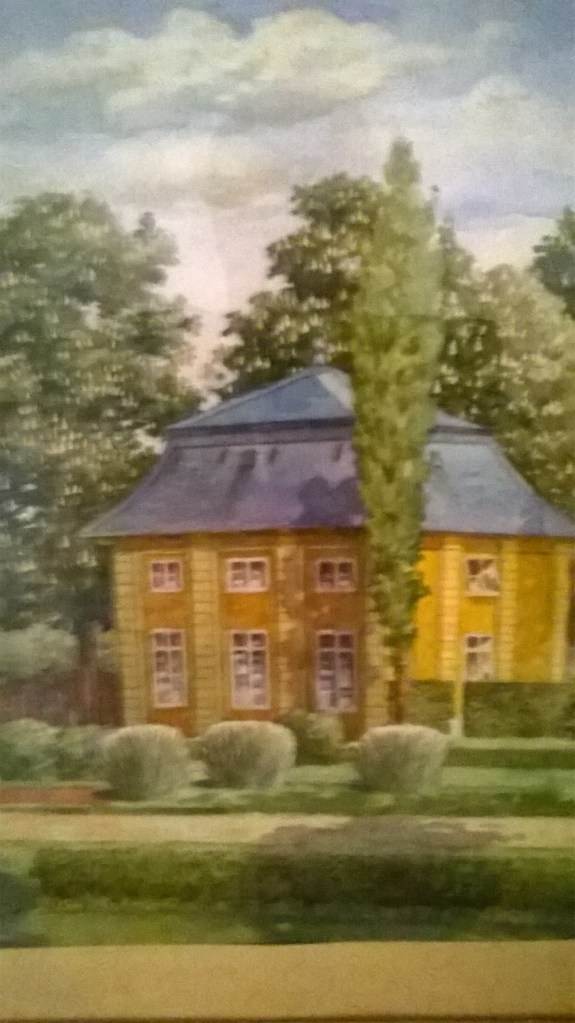
Rightwing groups have claimed that it is a 1923 poem by Hitler about his mother Klara Hitler who had died in 1907. He seems to have loved her very deeply… but he was a painter, not a poet. His mother had been cared for by the Jewish Doctor Eduard Bloch, and Hitler painted the picture above of the doctor’s house in 1913. So what? So Hitler was a Malignant Narcissist like an unfortunate number of powerful modern politicians and businesspeople. That doesn’t mean that he wasn’t capable of love or artistic impulses; you can have them and still be a narcissist. People who insist that there is pure evil in the world (whether Nazism or Judaism) are themselves a lot of the problem. Personally, I have a lot of difficulty with both Nazism and Judaism (and Communism and Christianity, and anyone who insists they are Right and they Know because their Leader or their Book says so), but I also have family and friends of all those persuasions. I don’t respect them for their authoritarian tendencies, but I also don’t think they are pure evil. The demonising of people who you disagree with or fear or are jealous of, that’s the start of the problem. We’re all people, and people are apes after all. Some people are stupid, some are intelligent but uneducated, some are sick, some have genetic defects, some were badly raised, some are sociopaths… then study them, try to make them better human beings, and in the meantime make sure they don’t have access to guns. Thank you. Rant over.
Amidst a sere Midwestern winter night December 1917, she’s born, A staunch Germanic woman’s child. Bedight In dearth and loss, she learns too young to mourn A mother’s death. She knows a woman must Prepare the meals, evoke good cheer, and thrust Her bitter tears inside where no one sees. She weds a Coast Guard vet and oversees His household — bears three girls, subsists on grace. And steadfast ‘til succumbing to disease, Upon her own, she wears her mother’s face.
Unwanted infant hurtles toward the light In 1944, her mam too worn And poor to greet her daughter with delight. The wealthy gent who claims the babe has sworn To sate her whims, exchange her doubts for trust. But Virgin-named, she’s Snake incarnate, trussed In greed. She flaunts her swindling expertise, Yet knows that costly baubles won’t unfreeze Her heart, or fill an absent mother’s space. And void, despite full coffers overseas, Upon her own, she wears her mother’s face.
She’s born in 1945, clasped tight Within her mother’s arms. And ne’er forlorn, This nurtured daughter dreams she’ll wed a knight Who’ll grant her nuptial bliss, and — fast foresworn To loyalty — a doe-eyed child who’ll just Love her. When falseness renders faith to dust And pregnant prayers produce no guarantees, She nonetheless adheres to memories Of Mother’s happy tales. She weighs her case, Then smiling, phones adoption agencies. Upon her own, she wears her mother’s face.
From birth, a target of her small town’s spite, She sprints through cornfields, fleeing bullies’ scorn, Hurled stones, and taunts of “freak”! Wisconsinite In ragtag 1980s garb, she’s borne Her share of tyranny. Her heart’s robust Enough to weather gibes, but grief’s the gust She can’t withstand. At forty-one, she frees Herself and downs the sleeping pills that squeeze Her breath away. Her mother deems her base Look odd, but with some rouge — an eyebrow tweeze — Upon her own, she wears her mother’s face.
Abandoned infant left upon a white Korean orphanage’s stoop, she’s shorn Of roots upon her trans-Pacific flight To Heartland serendipity. She’s torn Between identities, but must adjust: Refute all claims of foreignness. Nonplussed, Her heart aligns to these: Wisconsin cheese And apple pie. She’d always deemed “Chinese” A slight, but now she sees each buried trace Of her within her children’s eyes. And pleased, Upon her own, she wears her mother’s face.
A steadfast matron, serpent quick to tease, She’s part Korean, one-eighth Japanese, Idealist, rebel geek without a place — My post-millennial, she’s all of these. Upon her own, she wears her mother’s face.
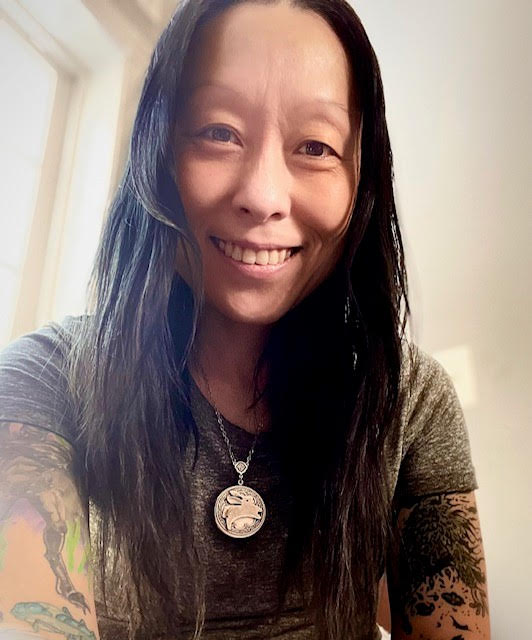
Mindy Watson writes: “I’m probably most proud of this chant royal titled ‘Her Mother’s Face’ that narratively links the most influential women in my life, ultimately culminating in my daughter’s overall connection to her (mostly unknown) maternal lineage. It was an unconventional topic for me (as my go-to inspirations are normally bugs, science, mythology, etc. and I’ve a hard-wired aversion to delving into my lost cultural roots—Midwestern U.S. white Protestant upbringing and all that), but it just intuitively sprang from the 11-line stanza/repeated refrain/converging envoi-type structure. Humorously, the poem’s impetus was a poet e-friend of mine mentioning that this form (I’d never heard of) was the most difficult he’d ever tried and hadn’t ever conquered—so of course I took that as a dare/challenge, lol… but I ended up unexpectedly enjoying the composition process (and reminiscing about a few souls lost too soon. Also I disagree with my friend—I personally think pantoums are among the most vexing forms…”
Mindy Watson is a formal verse poet and federal writer who holds an MA in Nonfiction Writing from Johns Hopkins University. Her poetry has appeared in venues including Snakeskin, Think Journal, the Poetry Porch (where ‘Her Mother’s Face’ was first published, April 2018), Orchards Poetry Journal, Better Than Starbucks, Eastern Structures, the Quarterday Review, and Star*Line. She’s also appeared in Sampson Low’s Potcake Poets: Form in Formless Times chapbook series and the Science Fiction and Fantasy Association’s 2019 Dwarf Stars Anthology. You may read her work at: https://mindywatson.wixsite.com/poetryprosesite.
 Form in Formless Times