Tag Archives: nonce forms

RHL, ‘Privelitch’

Some suffer from a travel itch
but I call that a snivel glitch
I only want to travel rich
and love it: it’s my privelitch.
O privelitch, o privelitch!

I only go to schools most rich,
(and only eat foods superrich),
then college has to be Oxbritch,
for that’s my privelitch.
I love you, love you, bitch!

I wear the robes and coronitch,
I swear by God I’ve found my nitch,
for, be I tubby, tall or titch,
I’ve got my privelitch.
O privelitch, o privelitch,
I love you, love you, bitch!

I never on my class would snitch
(or if I do, it’s just a smitch);
I’m faithful – cept for those I ditch,
for that’s my privelitch.
O privelitch, o privelitch!

I down it nail, I up it stitch,
call me a wizard or a witch,
I’ve got it all, with perfect pitch,
for that’s my privelitch.
I love you, love you, bitch!

My life with none I’d ever switch,
I’m over all, no slightest twitch,
and even when I’m in Death’s ditch
my tomb shouts Privelitch!
O privelitch, o privelitch,
I love you, love you, bitch!

*****

Don’t think I’m unaware of my own privilege: white males with above-average education are a privileged minority in any country. But also you reading this, whoever you are, you are privileged to not be a child in Gaza or any of the other hells that humans make for each other on an otherwise beautiful planet; you are privileged to be alive during this affluent and pivotal time in human history. And of course those who in addition have cultivated a taste for poetry… is there maybe a hint of privilege there?

This poem, like Buccaneer, was recently published in Magma.

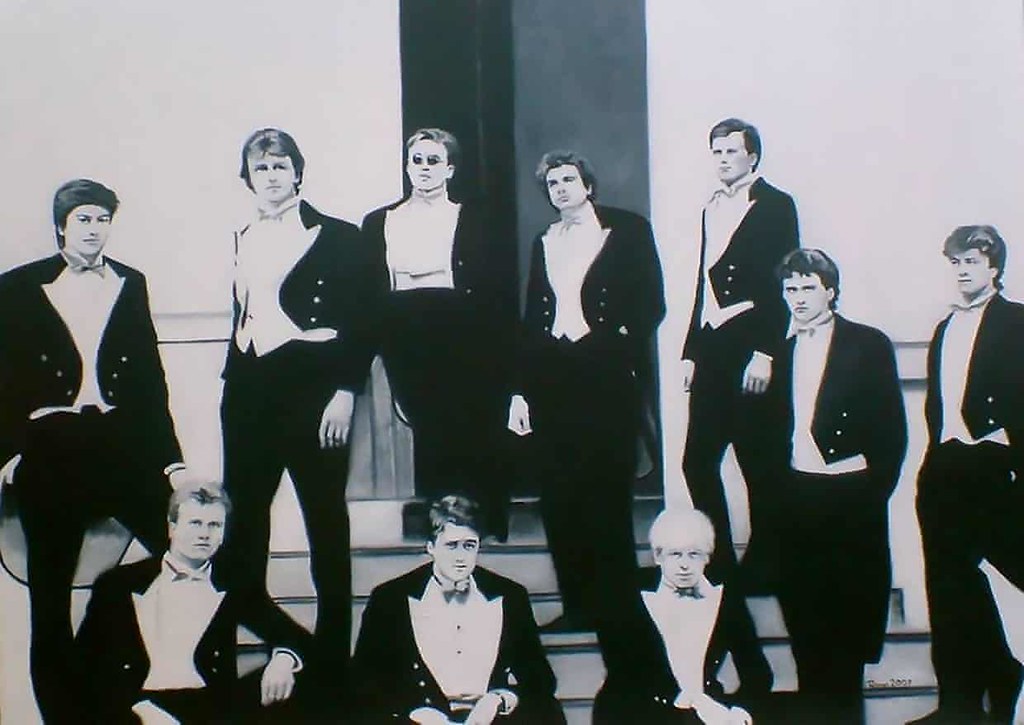
Photo: “General Election Bullingdon Club Members in 1987, including Boris Johnson and David Cameron” by Diego Sideburns is licensed under CC BY-NC-ND 2.0.
Stephen Edgar, ‘Dawn Solo’

First light beside the Murray in Mildura,
Which like a drift of mist pervades
The eucalypt arcades,
A pale caesura

Dividing night and day. Two, three clear notes
To usher in the dawn are heard
From a pied butcherbird,
A phrase that floats

So slowly through the silence-thickened air,
Those notes, like globules labouring
Through honey, almost cling
And linger there.

Or is it that the notes themselves prolong
The time time takes, to make it stand,
Morning both summoned and
Called back by song.

*****

Stephen Edgar writes: “This poem needs little comment, I think. The bird in question is the pied butcherbird, as the poem says, considered by some to have the most beautiful song of any Australian bird. Let me quote some field guides to Australian birds: “superb, slow, flute-like mellow notes”; “song is one of our finest: a varied sequence of pure fluty whistles, sometimes interspersed by throaty warbles”; “fluted, far-carrying notes that seem to reflect the loneliness of its outback haunts”. Perhaps that third quotation best suggests the quality I was trying to capture. The notes seemed to be in slow motion, slowing time. I was attending the Mildura Writers’ Festival. Mildura is on the southern bank of the Murray River in northwestern Victoria. This was the first occasion on which I had heard the pied butcherbird.

“The form is a quatrain rhyming ABBA, with lines progressively shortening from pentameter, though tetrameter, trimeter to dimeter. It was first published in Australian Book Review and then in my twelfth book The Strangest Place: New and Selected Poems (Melbourne, Black Pepper, 2020), which is available on the Black Pepper website.”

Stephen Edgar was born in 1951 in Sydney, where he grew up. From 1971 to 1974 he lived in London and travelled in Europe. On returning to Australia he moved with his then partner to Hobart, Tasmania, where he attended university, reading Classics, and later working in libraries. Although he had begun writing poetry while still at high school, it was in Hobart that he first began writing publishable poems and found his distinctive voice. He became poetry editor of Island Magazine from 1989 to 2004. He returned to Sydney in 2005. He is married to the poet Judith Beveridge.

He has published thirteen full collections: Queuing for the Mudd Club (1985), Ancient Music (1988), Corrupted Treasures (1995), Where the Trees Were (1999), Lost in the Foreground(2003), Other Summers (2006), History of the Day (2006), The Red Sea: New and Selected Poems (2012), Eldershaw (2013), Exhibits of the Sun (2014), Transparencies (2017), The Strangest Place: New and Selected Poems (2020) and Ghosts of Paradise (2023). A small chapbook, Midnight to Dawn, came out in 2025, and a new collection, Imaginary Archive,will be published in late 2025. His website is www.stephenedgar.com.au, on which publication details of his books, and where they can be purchased, are given.

He was awarded the Australian Prime Minister’s Award for Poetry in 2021 for The Strangest Place.

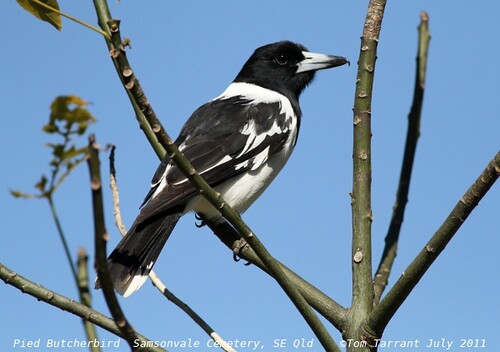
Photo: “Pied Butcherbird (Cracticus nigrogularis)” by aviceda is licensed under CC BY-NC-SA 2.0.

Nonce form: Aaron Poochigian, ‘Reunion Show’

Remember rage the way we used to love it
and what mad masks we wore when we began.
Think of the shrieking eagle on our van,
the decal, with its wings aflame
and our prophetic name,
The Downward Spiral,
the viral
expansion of it,
the perks and packed arenas
before the groupies got between us,
the label dropped us, and the fad wound down.

Boys, since this bar is in a nowhere town
let’s pound out, with our amps cranked up to ten,
sincerer tribute to the angry art
than we could handle at our start.
The blasphemy we hurled
against the world
back then
was out of season.
Now we have damned good reason
to smash things up like ruined men,
and all my lyrics will be from the heart.

*****

Aaron Poochigian writes: “I played in punk bands in high school and college and wrote that poem after I had gone all-in on poetry. I imagined what it would be like to get back together with my former band-mates at a later age. ‘Reunion Show’ is one of the first poems in which I let the nonce form discover itself with various line lengths and rhyme scheme. I tried to just let it all come together. Here is another later one like that: https://newcriterion.com/article/happy-birthday-herod/

‘Reunion Show’ was first published in The Dark Horse.

Aaron Poochigian earned a PhD in Classics from the University of Minnesota and an MFA in Poetry from Columbia University. His latest poetry collection, American Divine, the winner of the Richard Wilbur Award, came out in 2021. He has published numerous translations with Penguin Classics and W.W. Norton. His work has appeared in such publications as Best American Poetry, The Paris Review and Poetry.
aaronpoochigian.com
americandivine.net

Twitter: @Poochigian
Facebook: Aaron Poochigian
Instagram: aaronpoochigian

Photo: “Saxon Blondie 08.03.2019 Fotografías para iRock ______________ #multienfoque #picoftheday #photography #photo #photographer #photooftheday #nofilter #sinfiltro #instapic #instacool #wacken #woa #rock #show #alemania #festival #metal #rock #saxon #nibb” by ISENGARD is licensed under CC BY-NC-ND 2.0.
Weekend read: Using form: Nonce form: Benjamin Cannicott Shavitz, ‘The Subway 2023’

“I just need help,” the homeless man announces to the train
And, somehow, to himself as well.
And everybody cares,
Though no one makes a move.

“I just need help.” He mumble-shouts again his one refrain.
And everybody sees his hell,
Despite our downward stares.
But how can we improve

His plight when I still can’t afford both surgery and food,
And you live drowned in college debt
And she just froze her eggs
For when the rent hikes stop?

“I just need help,” he tries once more. Our eyes stay navel-glued.
We want to fill his need and yet
Just what’s the help he begs
For? Should we call a cop?

We know the way that that has gone before.
We know he’d simply suffer even more.
We know he’s not what cops are really for.
We hope we’re wrong, but we just see no choice,
Except to steel our ears against his voice
And, staidly silent, mourn inside
As though he had already died.

*****

‘The Subway 2023’ was first published in The Lyric. Benjamin Cannnicott Shavitz writes:

  1. The entire poem is in iambs. 
  2. Every line rhymes with at least one other line.
  3. In the first four stanzas, the rhyme scheme is ABCDABCD repeated twice. 
  4. In each of the first four stanzas, the line lengths are as follows: line 1: seven feet; line 2: four feet; line 3: three feet; line 4: three feet. 
  5. In the last stanza, the rhyme scheme is AAABBCC. 
  6. In the last stanza, the line lengths are as follows: lines 1-5: five feet each, lines 6-7: four feet each. 
  7. Points (3)-(6) create a pattern in which any lines that rhyme are of the same length as each other. 

    “Some background about my approach to form:
    I received my PhD in linguistics last year and I have been using my knowledge of language structure and the math background I have from my undergraduate engineering studies to innovate and sometimes re-conceptualize form in poetry. As I’m sure you know, the past century has seen a massive decline in knowledge of how form works in general. What you may be less aware of is that that same period has seen major developments in linguistics that can be brought in to expand our understanding of form. Most people know nothing about form anymore and the few people who do are working with an understanding that, while based on a lot of sound information, would benefit from being updated by the last century’s developments in linguistics research. There is an expansive future for formal verse ahead of us if we not only revive interest in form but also recognize that we are still learning about it. Form is not just tradition. It is an aspect of nature and there is a lot more we haven’t done with it yet. There is an essay in the back of two of my books that deals with the way formal verse and its history have been mischaracterized by proponents of free verse, I have developed a short course for teaching formal verse writing from a linguistically informed perspective, and I hope to use my academic knowledge (and credentials) to provide further support for the revival and expansion of formal verse in the future.”

Benjamin Cannicott Shavitz is a writer and linguistics scholar whose studies in language have led him to a great enthusiasm for formal poetry. He lives in Manhattan, New York City and received his PhD in linguistics from the Graduate Center at The City University of New York. He has published two collections of his own poetry (Levities and Gravities), as well as an anthology of poems by New York City poets from throughout history (Songs of Excelsior). His work has also been published in The Lyric, The Fib Review, and the journal of The Society of Classical Poets. See www.kingsfieldendeavors.com/writing for links to his writing. 

Photo: “Homeless in the subway” by phrenologist is licensed under CC BY-NC 2.0.

Using form: John Beaton, ‘Legacy’ (excerpt)

Inside his penthouse office
he views his Inuit artwork,
carvings from a culture
reduced to buy-and-hold,
then scans the evening city,
his bar chart on the skyline
where real estate has grown his stake
but cost him bonds he’s had to break –
he hadn’t meant to so forsake
his parents. They looked old

that day outside the croft house
when cowed farewells were murmured
as cattle lowed in wind blasts
keening from the sea.
His mother and his father
stood waving from the porch step;
next year she’d crack her pelvic bone,
when winter iced that slab of stone,
and never walk again. I’ll phone,
and he was history.

(…)

He downs his drink and glances
again at his computer –
an email from a neighbour:
Your father died last night.
He’d lately gotten thinner
and seldom had a fire on –
what little peat he had was soft.
Some things of yours are in the loft
so mind them when you sell the croft.

The city lights are bright;

he turns again and faces
his metamorphic sculptures
of walruses in soapstone
that never will break free
from rock that locks the sea waves –
past fused against the future.
Another gin? That’s six. Or eight?
So be it. Clarity’s too late.
His real estate’s no real estate –
he’s left his legacy.

*****

John Beaton writes: “This is a composite. Elements of it are taken from my life but I’ve borrowed significantly from the trajectories of others, especially some of my father’s contemporaries who left Camustianavaig physically but never in their hearts. There are also aspects of the lives of some people I’ve known in business. 

I worked out the form so that each stanza would start out steadily and rhythmically for six trimeter lines then build pace for three rhymed tetrameter lines and rein to a halt with a single trimeter line that has a masculine rhyme with line four. Even though they limit word-choices, I thought feminine endings for the first three lines and lines five and six were worth it for the rhythm. And I like how they form a sort of rhyme and closure gradient with lines four and seven to ten.”

John Beaton’s metrical poetry has been widely published and has won numerous awards. He recites from memory as a spoken word performer and is author of Leaving Camustianavaig published by Word Galaxy Press, which includes this poem. Raised in the Scottish Highlands, John lives in Qualicum Beach on Vancouver Island.
https://www.john-beaton.com/

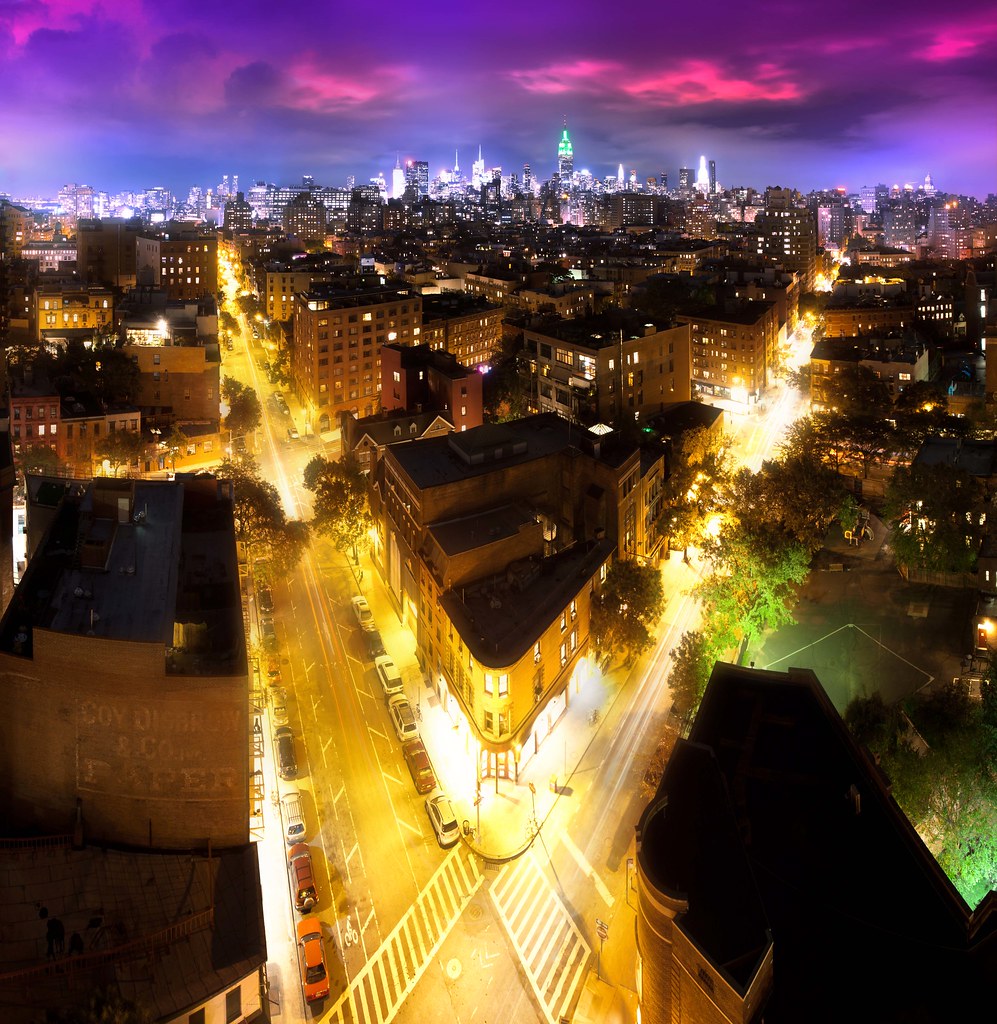
Photo: “‘V for Vendetta’, United States, New York, New York City, West Village, Skyline View” by WanderingtheWorld (www.ChrisFord.com) is licensed under CC BY-NC 2.0.

Poem: ‘And, If I Could’

And, if I could, I’d sing my love with unicorns in chains of flowers,
With endless oceans greyly battering by misty moors,
With joyful hunting dogs with muddy paws,
With soft spring showers –
With anything eternal, wistful, happy, sad.
But all my dogs inside are snapping, yapping, mad,
My showers are wintry, my sea-shores are lined
With unkind tourists drinking bourbon,
And unicorns are dead, and flowers suburban.

And, if I could, I’d steal my love on midnight horse and overseas,
To city-sacking buccaneering round the reckless earth,
Settle at last to farm some quiet firth:
Goats, orchards, bees;
Explosive starts, wild-beating hearts, and peace at last.
But ungeared fantasies spin lies torn from the past:
I’m a slum-quarter city-sprouting weed,
My planted seeds die in deserted gardens,
My wandering’s my weak will; and my heart hardens.

And, if I could, I’d love my love with wayside flowers, fresh fruit, a kiss,
With secondhand-in-hand shops’ dazzling, puzzling oddities,
With evening at the theater or a fair,
With wordless stare,
With dreams and smiles, and laughter at my foolishness.
But all my city streets are drizzle and drains, not bliss;
Traipsing to shows and shops is soul-destroying,
And, toying with my rural lie,
Commitment-scared, I flee the searching Eye.

And, if I could, I’d give my love all children, chosen and our own:
Their love – their moody silences – their smiles like wind and sun –
Their seashell searching – riots – sense of fun –
Pregnant to grown
We’d share kaleidoscope Life’s spectrum-brilliant rays.
But I drift unfamiliar down decaying days
Where trees are concrete and the ground is stone,
Bemoan I knew but left that love…
And, if I could, you know I’d have my love.

*****

This is a poem from my 20s, when I was more skilled at the creation of nonce forms. Formal poetry was essentially unpublishable at the time; decades later, this poem has just been published in David Stephenson’s Pulsebeat Poetry Journal.

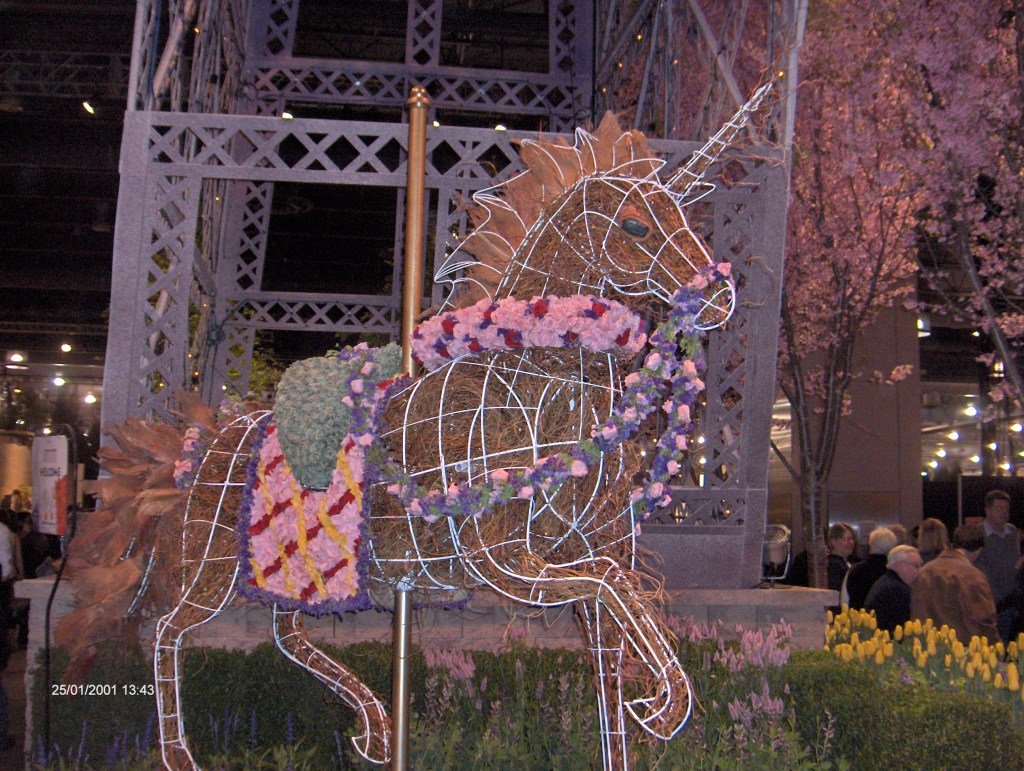
File:Philadelphia Flower Show 2011 Unicorn of flowers HPIM4354.jpg” by Mary Mark Ockerbloom is licensed under CC BY-SA 4.0.