Tag Archives: peace

Johnny Longfellow, ‘Epitaph’

If you’re dead, an’ ya’ ain’t on a mantle,
Then ya’ go in a hole in the groun’.
From a slab to a coffin, ya’ don’t move very often.
When you’re dead you’re jus’ lyin’ aroun’. 

If you’re dead, an’ you’re hauled to a graveyard,
A few fam’ly ‘n’ friends might arrive,
An’ the buzzards ‘ll buzz up above ya’ because
When you’re dead you’re no longer alive.

If you’re dead, there’ll be those who hol’ Judgment—
Say your Soul is in Heaven or Hell;
But Whatever is True (an’ regardless o’ you)
When you’re dead, that’s their story to tell.

If you’re dead . . . well, ain’t none o’ that matters.
It’s the livin’ who toss in the dirt.
What remains goes to rot. An’ though like it or not
When you’re dead ya’ don’t feel any hurt.

*****

Johnny writes: “Inspired—in part, at least—by my interest in gravestones of the Colonial era, ‘Epitaph’ utilizes a second person voice. A tip of the hat, if you will, to the ‘As I am now, so you must be’ subgenre of epitaph, wherein the dead address the living to forewarn of Death’s inevitability. Seven stanzas too long at one point, I chopped it down to four. Reason being, the three stanzas I rather begrudgingly removed were written in a confessional mode that conflicted not just with the second person voice, but also with the Everyman vibe that I began sensing the Muse actually desired from me, along with greater brevity. Having made such cuts, I shelved the piece, thinking I’d revisit it in the future with a fresh(er) set of eyes. But then, a recent, troubling news event and its subsequent media fallout brought ‘Epitaph’ to the forefront of my mind. So, on a whim, I posted the abridged version on Facebook. To my pleasant surprise, that led to Robin querying me about its availability, and ultimately, its appearance here at Form in Formless Times.”

Johnny Longfellow is a poet from Massachusetts. His work has appeared in The Five-Two, The Literary Hatchet, Misery Tourism, Punk Noir, and other fine literary venues. You can learn more about both him and his work at Heeeeeeere’s Johnny . . . Longfellow, that is.

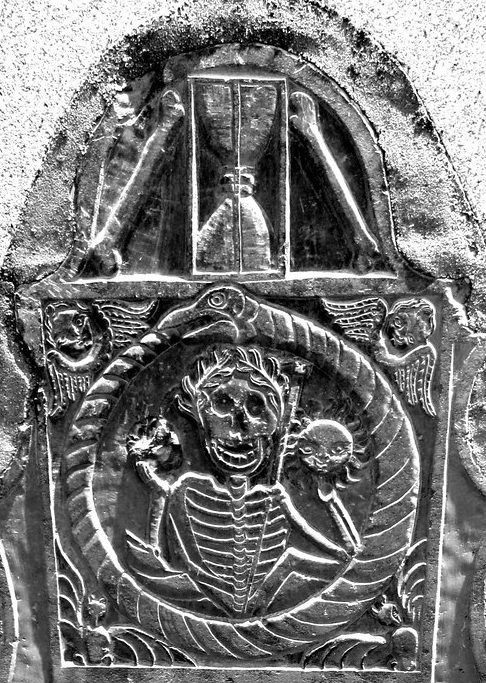
Photo: “Susanna Jayne” by In Memoriam: Mr. Ducke is licensed under CC BY-NC 2.0.

https://newenglandfolklore.blogspot.com/2022/03/the-grave-of-susanna-jayne-bats-angels.html

Richard Fleming, ‘In Grace’

The present is arcane and strange
and any recollection left
of what has happened in the past
is vague and liable to change.
Of future plans, he is bereft,
for nothing now is hard and fast.

They give him multicoloured pens
and paper, as one might a child.
Familiar voices interweave.
He sees, through a distorting lens,
people who wept, people who smiled,
that, one by one, stood up to leave.

He is content. He lives in grace.
What matter if the moments blur,
if his nocturnal thoughts are grim?
He has escaped himself: his face,
a kind of absence in the mirror,
comforts and somehow pleases him.

*****

Richard Fleming writes: “Getting old is like exploring new territory without a map: nothing prepares you for the subtle changes in body and mind. Is a moment of forgetfulness just that, or an early indication of approching dementia? We cannot know what strange highways a decaying brain takes us down but I like to think that they might lead to a place of contentment, where the burdens of age are laid down and replaced by some measure of contentment. That’s what I’ve tried to capture in this poem.”

Richard Fleming is an Irish-born poet (and humorist) currently living in Guernsey, a small island midway between Britain and France. His work has appeared in various magazines, most recently Snakeskin, Bewildering Stories, Lighten Up Online, the Taj Mahal Review and the Potcake Chapbook ‘Lost Love’, and has been broadcast on BBC radio. He has performed at several literary festivals and his latest collection of verse, Stone Witness, features the titular poem commissioned by the BBC for National Poetry Day. He writes in various genres and can be found at www.redhandwriter.blogspot.com or Facebook https://www.facebook.com/richard.fleming.92102564/

Photo: Richard Fleming post

Tom Vaughan, ‘On the Twilight Mountains’ (Jeremiah 13:16)

On the twilight mountains
leopards change their spots
distributing their cast-off coats
to helpworthy have-nots –

lions and lambs and lynx lie down
and tell each other tales
of how at sea the seals now go
for walks with killer whales –

lovers linger hand in hand
promising to be
truthful, faithful, thoughtful, kind,
supportive company –

and peace seems deep and peace seems long
until the morning sun
wakes us from our ancient dream
like a starter gun.

*****

Tom Vaughan writes: “The poem (published in Snakeskin 316, April 2024) is among several inspired by my current reading of Robert Alter’s magnificent – and magnificently thought-provoking – translation of the Hebrew Bible. However gloomy the concluding stanza, and however accurately that gloom may reflect the violence and slaughter always at the heart of the world, I hope the poem also catches some of the equally permanent and however illusory yearning for things to be otherwise.”

Tom Vaughan is not the real name of a poet whose previous publications include a novel and two poetry pamphlets (A Sampler, 2010, and Envoy, 2013, both published by HappenStance). His poems have been published in a range of poetry magazines, including several of the Potcake Chapbooks:
Careers and Other Catastrophes
Familes and Other Fiascoes
Strip Down
Houses and Homes Forever
Travels and Travails.
He currently lives in Brittany.
https://tomvaughan.website

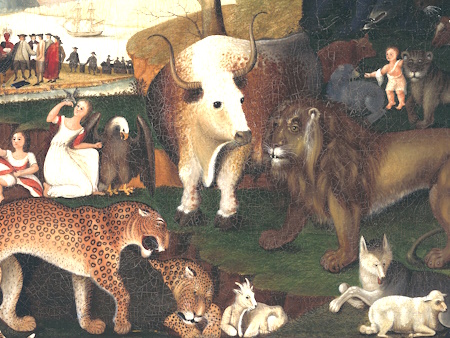
Illustration: ‘The Peaceable Kingdom’ by Edward Hicks, via Snakeskin

Using form: Couplets: Maryann Corbett, ‘Fugue in October’

Baroque chamber ensemble and homeless encampment, Saint Paul

Perfect: the singers, strings, and keyboards. Perfect
Bruised sky above the tents of the squatters’ district
the little jewel-box church, its bright acoustic
calm in the year’s last mildness, the only music
softened a little in the candles’ lighting,
the mumbling underpass. The wind. No fighting
for this is God’s mind, woven of harmonies
for once. Tonight, for once, no one ODs—
and our souls thread through the flame of the vigil lamp
someone got lucky at the entrance ramp
as we hold, hold to Monteverdi’s line
(panhandling, on this warm day, with a sign)
and stop our breath until the last string dies
and parcels out his manna of salty fries
in the last great chord of his Beatus vir
while sirens wail some sorrow, far from here.

*****

Editor’s comments: “In case it isn’t clear from whatever device you are reading this on, each couplet here is comprised of a line about a musical ensemble in a church followed by a line about a homeless encampment under a highway. You can read it straight through as a soft-voiced line followed by a harsher one; or you can read every other line in one voice and the remaining lines in a different voice; either way, you are blending two very different aspects of city life into a larger, richer picture of community sharing, whether in glamour or squalor. This is an unusual and remarkably effective use of rhymed couplets of iambic pentameter.
The contrast built into the poem, and the skill with which it was done, made it a natural poem for inclusion in the ‘City! Oh City!‘ Potcake chapbook. It first appeared in Measure Review; and is included in the collection In Code.

Maryann Corbett writes: “Events that trigger a poem need not be as simultaneous as the poem makes them seem. The choral concert in this poem took place on a subzero night during the Christmas season; the rise of homeless encampments occurred at a warmer time of year–but both could be happening in my city at any time, and they probably still are.”

Maryann Corbett earned a doctorate in English from the University of Minnesota in 1981 and expected to be teaching Beowulf and Chaucer and the history of the English language. Instead, she spent almost thirty-five years working for the Office of the Revisor of Statutes of the Minnesota Legislature, helping attorneys to write in plain English and coordinating the creating of finding aids for the law. She returned to writing poetry after thirty years away from the craft in 2005 and is now the author of two chapbooks, five full-length collections already published, and a forthcoming book. Her fifth book, In Code, contains the poems about her years with the Revisor’s Office. Her work has won the Willis Barnstone Translation Prize, has appeared in many journals on both sides of the Atlantic, and is included in anthologies like Measure for Measure: An Anthology of Poetic Meters and The Best American Poetry 2018.

Her web page: http://maryanncorbett.com

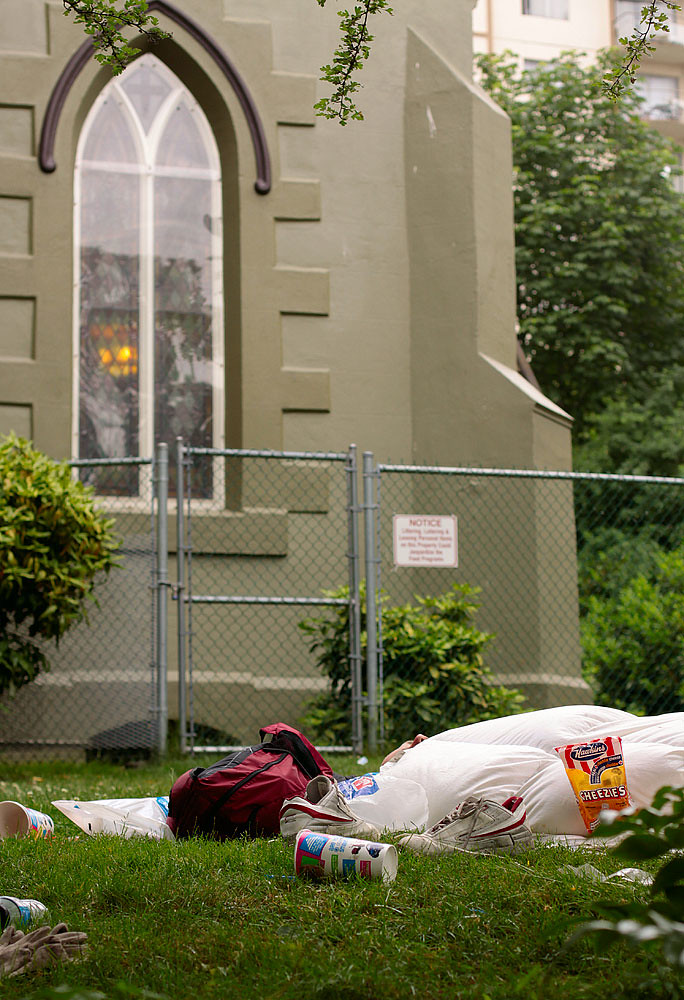
Photo: “sleeping on the rock of ages” by waferboard is licensed under CC BY 2.0.