Dear poets, I know that you hunger for meaning, and that is why you reflect on how faith questions life. (…) Poetry is open; it throws you into another realm.
In light of this personal experience, today I would like to share some thoughts with you on the importance of your service.
The first thing I want to express is this: you are eyes that see and dream. Not only do you see, but you also dream. A person who has lost the ability to dream lacks poetry, and life without poetry does not work. We humans yearn for a new world that we may never fully see with our own eyes, yet we desire it, seek it, and dream of it. A Latin American writer once said that we have two eyes: one of flesh and the other of glass. With the eye of flesh, we see what is before us; with the eye of glass, we see what we dream. Woe to us if we stop dreaming—woe to us! (…) Indeed, poetry does not speak of reality from abstract principles but rather by listening to reality itself: work, love, death, and all the little and great things that fill life. Yours is — to quote Paul Claudel — an “eye that listens.” (…)
I would also like to say a second thing: you are the voice of human anxieties. Often, these anxieties are buried deep within the heart. You know well that artistic inspiration is not only comforting but also unsettling because it presents both the beautiful realities of life and the tragic ones. Art is the fertile ground where the “polar oppositions” of reality — as Romano Guardini called them — are expressed, always requiring a creative and flexible language capable of conveying powerful messages and visions. For example, consider when Dostoevsky, in The Brothers Karamazov, tells the story of a little boy, the son of a servant, who throws a stone and hits one of his master’s dogs. The master then sets all the dogs on the boy. He runs, trying to escape the fury of the pack, but ultimately, he is torn apart under the satisfied gaze of the general and the desperate eyes of his mother.
This scene has tremendous artistic and political power: it speaks to the reality of yesterday and today, of wars, social conflicts, and our personal selfishness. It is just one poetic passage that challenges us. And I’m not only referring to the social critique in that passage. I speak of the tensions of the soul, the complexity of decisions, the contradictions of existence. There are things in life that, at times, we can’t even understand or find the right words for: this is your fertile ground, your field of action. (…)
That is what I want to ask of you today as well: go beyond the closed and defined borders, be creative, do not domesticate your anxieties or those of humanity. I fear this process of taming because it stifles creativity, it stifles poetry. With the words of poetry, gather the restless desires that inhabit the human heart so they do not grow cold or die out. This work allows the Spirit to act, creating harmony amidst the tensions and contradictions of human life, keeping the fire of good passions alive, and contributing to the growth of beauty in all its forms, beauty that is expressed precisely through the richness of the arts.
This is your work as poets: to give life, to give form, to give words to all that human beings live, feel, dream, and suffer, creating harmony and beauty. It is a work that can also help us better understand God as the great “poet” of humanity. Will you face criticism? That’s okay, bear the weight of criticism while also learning from it. But never stop being original, creative. Never lose the wonder of being alive.
So, eyes that dream, voices of human anxieties; and therefore, you also have a great responsibility. And what is it? It’s the third thing I want to say: you are among those who shape our imagination. Your work has an impact on the spiritual imagination of the people of our time. Today, we need the genius of a new language, powerful stories, and images. (…)
Dear poets, thank you for your service. Continue dreaming, questioning, imagining words and visions that help us understand the mystery of human life and guide our societies toward beauty and universal fraternity.
Help us open our imagination so that it transcends the narrow confines of the self and opens up to the entire reality, with all its facets, thus becoming open to the holy mystery of God. Move forward, without tiring, with creativity and courage!
I bless you.
*****
The above is a substantial excerpt from the letter Pope Francis wrote for the book ‘Verses to God: An Anthology of Religious Poetry‘ (published by Crocetti Editore), curated by Davide Brullo, Fr. Antonio Spadaro, and Nicola Crocetti. The letter is given in full in the Vatican News.
The Economist’s obituary for Pope Francis states he insisted on: “no papal cape or red slippers, just a plain white cassock and his ordinary black shoes. (…) No crest-embellished dinner plates, no new pectoral cross; he kept the iron-plated one he had worn, from 1998, as archbishop of Buenos Aires. No 12-room apartment in the Vatican, but a two-room suite in the guests’ hostel, and meals in the dining room with everyone else. “We’ll see how long it lasts,” said one aide, uncomfortable. It lasted until he died; for in Buenos Aires, after all, he had cooked his own meals and travelled by bus. (…) In Buenos Aires he was called the “Slum Bishop” for insisting that he, and his priests, should go out in the streets and on the margins. (…) He made a point of reaching out, feeding hundreds of homeless with pizza at the Vatican and adopting several families of Syrian refugees.”
So, sympathy for the homeless, and refugees… and poets. There’s a spiritual resonance to that grouping!
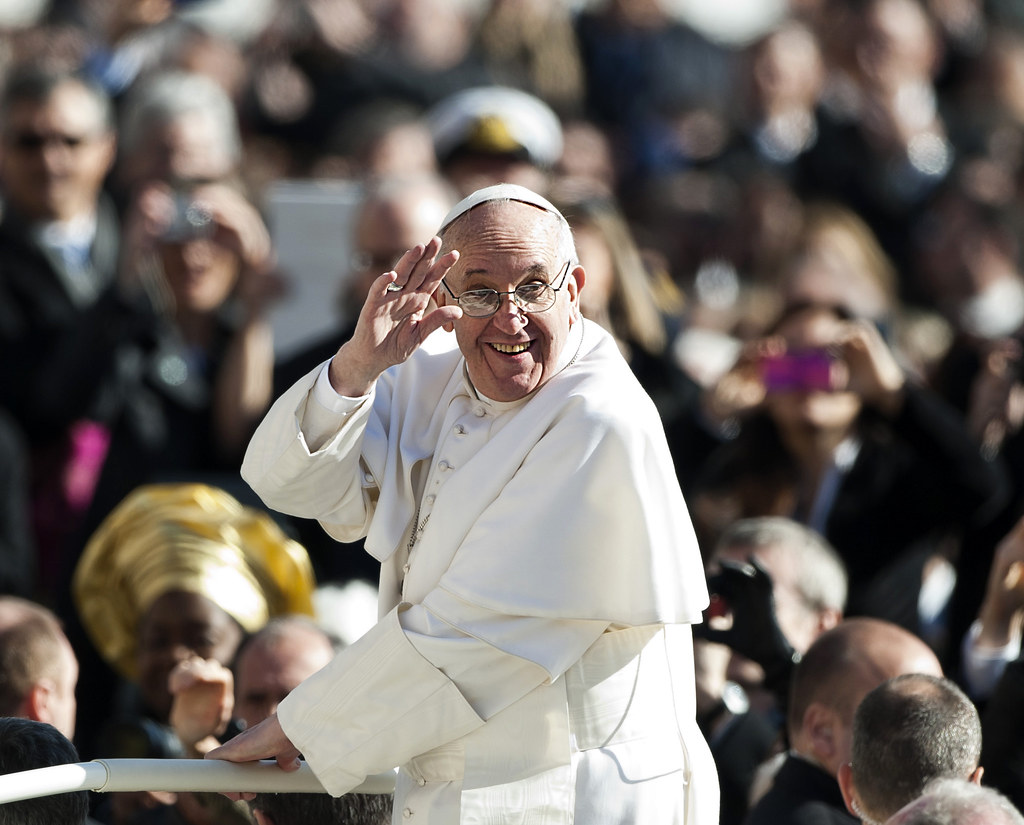
Photo: “The Inauguration Mass For Pope Francis” by Catholic Church (England and Wales) is licensed under CC BY-NC-SA 2.0.
 Form in Formless Times