Tag Archives: reading

Marcus Bales, ‘Rule Number One’

For Linda, who said it first

 If you’re going to have a reading
then no matter where you are
for a minimum of breeding
you have got to have a bar.

You will fill up all the seating,
they will come from near and far,
if the best part of your greeting
is “Why, yes we have a bar!”

But the evening will be fleeting
even if you’ve booked a star
when it’s alcohol they’re needing
and you do not have a bar.

They will freeze in scanty heating
and they’ll swelter till they char
if you advertise by leading
with the fact you have a bar.

Though it’s raining or it’s sleeting
if you offer them a jar
they’ll be aleing, beering, meading,
and absinthing at the bar.

But when poetry starts bleeding
out of every scab and scar
all you’ll see is me retreating
if you haven’t got a bar.

*****

Marcus Bales writes: “For an interesting while I had an art gallery in a downtown mall in Cleveland. The mall rules said it had to be open on Saturdays — when there was no mall traffic and so no real reason to be open. So I held the Every Saturday at Noon in the Galleria Poetry Reading. Dramatically unsuccessful at first it eventually found its audience and we had a good time. But in talking about why, serving only coffee, Linda pointed out that if we could serve alcohol attendance would improve. Since it was an art gallery, and there is a tradition in art galleries of serving wine at openings, I changed the title to the Poetry Reading Art Opening and said wine and coffee would be available in limited quantities. That did the trick. It quickly became the best-attended poetry reading in the city, any day, any time. Then the authorities got wind of it and someone from the city visited and pointed out gently that while it was a tradition to serve wine at art openings in art galleries, it is technically illegal by state law, even if it is free, and they cited the appropriate code. In the end it didn’t matter much, since even the most successful poetry readings count their audiences in the low-to-mid-tens of people, and by then people had got in the habit of Saturday At Noon, and kept coming anyway even after we stopped serving wine. But the idea for the poem had formed.” 

Not much is known about Marcus Bales except that he lives and works in Cleveland, Ohio, and that his work has not been published in Poetry or The New Yorker. However his ‘51 Poems‘ (which includes the above) is available from Amazon. He has been published in several of the Potcake Chapbooks – Form in Formless Times.

Photo: “Open Bar” by Trevor Benedict – MrEcho is licensed under CC BY-NC-ND 2.0.
Weekend read and listen: RHL, 3 audio + text poems

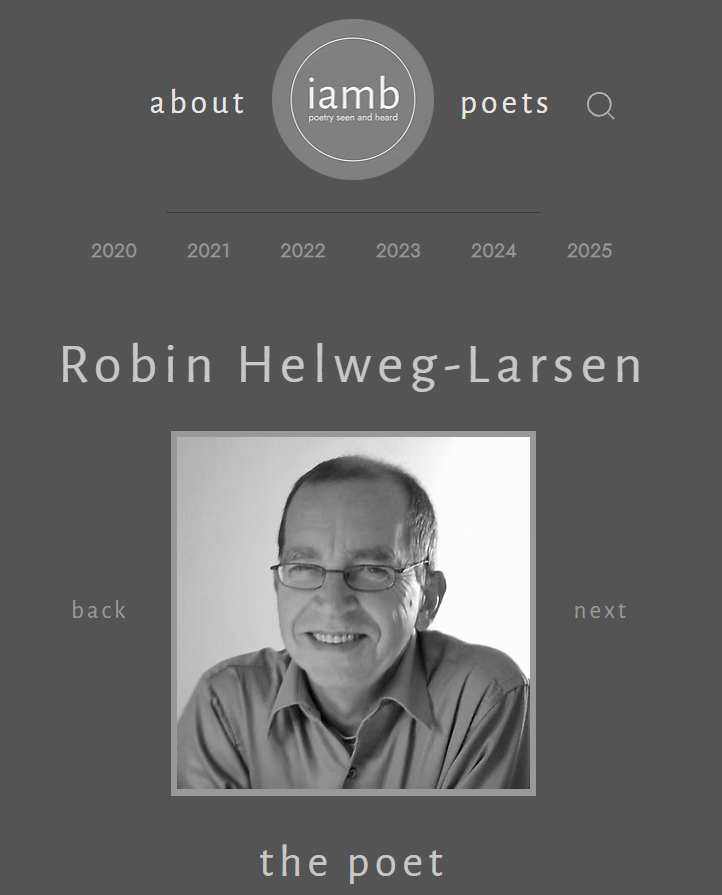
iamb – poetry seen and heard” is the creation of Mark Antony Owen, showcasing poets with their readings of three of their poems. Begun in 2021, Mark describes his project as “part library of poets, part quarterly journal, iamb is where established and emerging talents are showcased side by side. Not just their words, but their readings of them. Expect new poems, every three months, free to your device of choice.”

Accompanied by an out-of-date photograph, three of my poems are available here. They are not among my most recent work, but they are favourites and I chose them for their very different moods, themes, and forms: ‘Camelot at Dusk’, ‘Old Sailors’, and ‘This Ape I Am’. And their use of form sets them apart from all the other poems in this 21st ‘wave’ of iamb. I can’t decide if I am stuck in the past, or write in the style of the only verse that has a chance of being remembered in 100 years. But maybe that’s not an either/or – maybe only verse that is rooted in the historical rhythms of the language will last. So I suspect.

Auditions will reopen in September for next year’s waves.

Resources: Goodreads

Goodreads’ stated mission is to help people find and share books they love, and to improve the process of reading and learning throughout the world. (That was crafted before they were bought by Amazon, so their mission may have a somewhat more mercenary aspect these days.) Founder Otis Chandler got the idea when looking at a friend’s bookshelf, and wishing there was a way to share discoveries and opinions of books online. Launched in January of 2007, by December it had 650,000 members–clearly it was on to something! And by the end of 2019 (i.e. pre-Covid) it had 90 million members, a number that can only have grown since then.

It’s a place where you can spend your time in a variety of ways: making shelves of the books you’ve read, sorting them by topic, giving them 1 to 5 stars, writing reviews of them… Developing a list of friends to follow or to share reviews with, joining a group with topics that you like, using the site to find books you are likely to enjoy… Setting a goal of how many books to read in the coming year, and having Goodreads track your progress, praising you or nagging you depending on whether you’re ahead of schedule or behind.

More completely, “Goodreads,” says Wikipedia, “is an American social cataloging website that allows individuals to search its database of books, annotations, quotes, and reviews. Users can sign up and register books to generate library catalogs and reading lists. They can also create their own groups of book suggestions, surveys, polls, blogs, and discussions.”

Because my main reading these days is formal poetry (of course–though leavened with Simenon, Le Guin and thick works of history) I have been looking to see what kind of poetry groups operate in Goodreads. I only found one of formal verse, with half a dozen members, and dormant for over a year. So I have started a new one called ‘Formal Verse – Mostly’. If you, reading this, are interested in reading, writing or discussing formal poetry, old or new, your own or that of others, then consider joining us.

But even if you don’t want to be that active, don’t want to join a group, Goodreads still offers a range of benefits for all readers. I’ve been reading more each year for the last few years, largely thanks to the Reading Challenge and being nagged when (as now) I’m behind schedule.

Photo: “My Books” by Jennerally is licensed under CC BY-NC-ND 2.0

Potcake Poet’s Choice: Susan McLean, ‘A Woman of a Certain Age’

I read more slowly now, because I read
between the lines.  The heroes of my youth,
who gave their lives for justice, art, or truth
(consumed with purpose, driven to succeed),
now seem like puppets pulled by strings of need,
while those who died unknown (except by those
they fed, taught, nursed through illness, mended clothes
and cared for) doled out grace unmixed with greed.

A quilt, a tablecloth she hand-crocheted,
some tips for making piecrust, kneading dough,
the memory of a gumdrop tree she made—
small things of use, of beauty, of delight
are what they leave when they have left our sight.
Don’t tell me what such gifts are worth.   I know.

Susan McLean writes: “This poem was inspired by reading that people read more slowly as they get older, because everything they read reminds them of something else. As I thought about that, I also thought about the people I would have called the ones I admired the most, and about the people I actually loved most and why I loved them. The former were mainly men, which made me realize that the lives of women (until recently) have often been invisible in the world and have left no written record. What they leave instead is the impact they have had on those around them, and little things they have said and done and made. My maternal grandmother and my mother are both unseen presences in this poem. My life has been very different from theirs, with opportunities they never had. But that does not mean that I value less what they did.”

Susan McLean grew up in Oxon Hill, Maryland, attended Harvard University and Rutgers University, and taught English for thirty years at Southwest Minnesota State University. She has published two books of poetry, The Best Disguise and The Whetstone Misses the Knife, and one book of translations of the Latin poet Martial, Selected Epigrams. She lives in Iowa City, Iowa.

https://www.pw.org/directory/writers/susan_mclean