Tag Archives: remembering

Sonnet: Gail White, ‘A Visit on All Saints Day’

Hello. I’ve brought your favorite flowers again.
How is going under there, my dead?
On this side, we’re no better off than when
you walked beside us. (Yes, I know I said
the same last year.) The human race is not
improvable. Ask any saint you meet.
We’ve gone to war again without a thought.
Our leaders shuffle bribes, our heroes cheat.
Your children haven’t turned out awfully well,
but who expected it? You’re not to blame.
They’ll manage, and nobody burns in hell.
Goodbye for now. I’m always glad I came.
I make no promises about next year,
but one way or another, I’ll be here.

*****

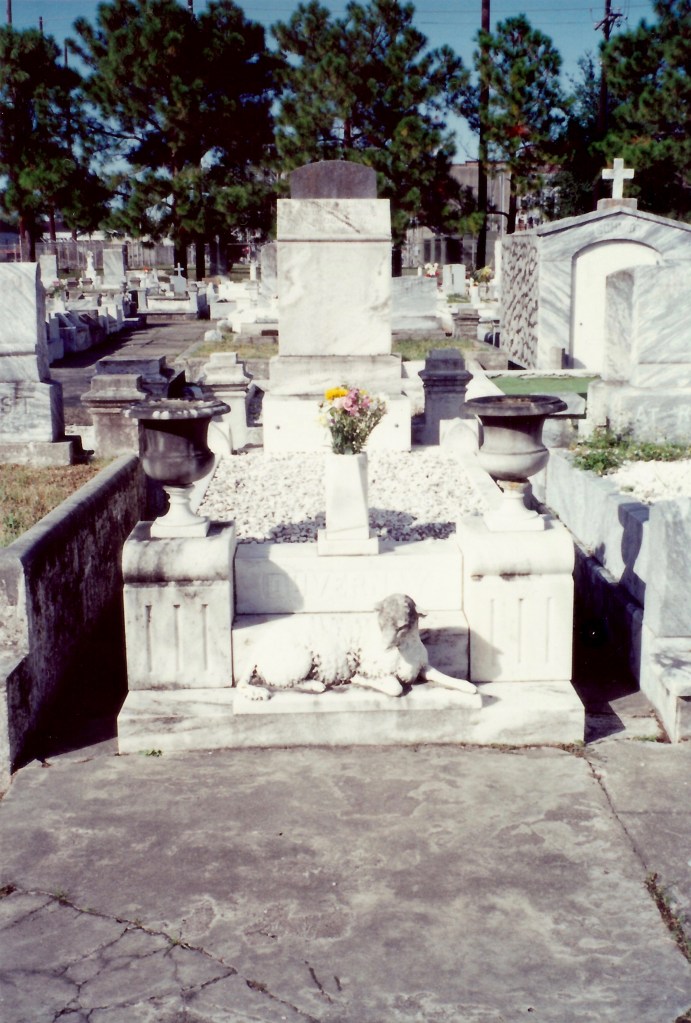
Gail White writes: “I wrote this while living in New Orleans, where the dead are buried above ground (mostly) because the city is below sea level.  All Saints Day is still a big deal, when the family tomb gets a new coat of whitewash and flowers are placed on every grave.  It’s time to reflect on family and faith and our all ending up in the same place, as I’ve tried to do here.”

Gail White is the resident poet and cat lady of Breaux Bridge, Louisiana. Her books ASPERITY STREET and CATECHISM are available on Amazon. She is a contributing editor to Light Poetry Magazine. “Tourist in India” won the Howard Nemerov Sonnet Award for 2013. Her poems have appeared in the Potcake Chapbooks ‘Tourists and Cannibals’, ‘Rogues and Roses’, ‘Families and Other Fiascoes’, ‘Strip Down’ and ‘Lost Love’. ‘A Visit on All Saints Day’ was originally published in Mezzo Cammin, and collected in her chapbook, ‘Sonnets in a Hostile World‘, also available on Amazon.

Photo: “New Orleans Cemetery DUVERHAY tomb” by Infrogmation of New Orleans is licensed under CC BY-SA 4.0.

Quincy R. Lehr, ‘Lines for my father’

I think I owe some kind of explanation
As I grow tired and listless fingers writhe
Above the unpecked keyboard pad. I’m not
Quite out to blame you or your generation
For where I’m at tonight. You paid the tithe
That life exacts. It’s sanctimonious rot
If we deny the pain of paying it–
And our denials never help one bit.

Unlike you, I found myself involved
In protest politics when I was young.
I spouted crap about the working class
While searching for a problem to be solved.
I mocked you then, since stirring tunes are sung
In brayed crescendos, with a blaze of brass
Booming triumphs won against the odds–
Unjust societies and jealous Gods.

You seemed so cautious–tastefully attired
With modest ties and polished wing-tipped shoes,
A cautious, kindly smile that reached your eyes.
A man to be respected, not admired,
Neither adulated nor abused.
Ambitions of an ordinary size
Were often past your reach. A nagging doubt
Set in, and now I know what that’s about.

Tonight, I type these words as it gets late,
And no one calls to beckon me to bed.
I scoffed at what you’d craved–the tenure track,
The slow-accruing pension from the state,
The wife (who left you). Though you’re good and dead
(And at this hour, my eyes are going slack)
And though you cannot answer, I’ll report
–While having to imagine your retort–

That we’re no happier than you, and can’t
Quite seem to sit for tests that you had failed.
Our phones are packed with numbers we won’t call.
The televisions blast a constant rant
That we ignore like letters still unmailed–
Or unconceived. Clichés about a ball
That’s dropped don’t work–or maybe don’t apply.
We never picked it up. I wonder why.

This recognition’s only dawning now
As streetlights speckle glimmers on your urn
Beside my unmade bed, and as I write
These words to you in lieu of sleep. Somehow,
The brays of drunks outside my window turn
Almost comforting, as if the night
Is full of us–insomniac, astray,
And muttering defiance at the day.

*****

Quincy R. Lehr writes: “As for that poem, my father died in 2003, when I was twenty-seven. The content pretty much speaks for itself, I think. I was young, lonely, and frequently drunk when I wrote it.”

Editor’s comment: I admire the technical skill of the poem: the steady iambic pentameter; the abcabcdd rhyme scheme with the final couplet providing a punch; the integrity of the individual stanzas, each patiently laying out a mood, a thought, a situation. And I relate to the young man’s restless, unquiet, unsettled life, and the comparison to his father’s existence, his dismissal of his father’s achievements, his simultaneous recognition of the inevitable connections. It is a satisfying telling of an individual’s unique early life, in the context of the universal discord between generations.

Born in Oklahoma, Quincy R. Lehr is the author of several books of poetry, and his poems and criticism appear widely in venues in North America, Europe, and Australia. His book-length poem ‘Heimat‘ was published in 2014. His most recent books are ‘The Dark Lord of the Tiki Bar‘ (2015) and ‘Near Hits and Lost Classics‘ (2021), a selection of early poems. He lives in Los Angeles.
https://www.amazon.com/Quincy-R.-Lehr/e/B003VMY9AG

Michael R. Burch: ‘For All That I Remembered’

For all that I remembered, I forgot
her name, her face, the reason that we loved …
and yet I hold her close within my thought:
I feel the burnished weight of auburn hair
that fell across her face, the apricot
clean scent of her shampoo, the way she glowed
so palely in the moonlight, angel-wan.

The memory of her gathers like a flood
and bears me to that night, that only night,
when she and I were one, and if I could …
I’d reach to her this time and, smiling, brush
the hair out of her eyes, and hold intact
each feature, each impression. Love is such
a threadbare sort of magic, it is gone
before we recognize it. I would crush

my lips to hers to hold their memory,
if not more tightly, less elusively.

*****

Michael R. Burch writes: “For All That I Remembered” is one of my personal favorites and one of a number of poems I have written about the transience of memory, along with “The Effects of Memory,” “Violets,” “Moments,” “Distances,” “Redolence,” “Vacuum,” “Afterglow” “Memento Mori” and “Remembrance.” “For All That I Remembered” has been published by The Raintown Review, Boston Poetry Magazine, la luce che non muore (Italy), The Eclectic Muse (Canada), Kritya (India), Jewish Letter (Russia), Gostinaya (in a Russian translation by Yelena Dubrovin), Freshet, Orchards Poetry, Poetry Life & Times, Sonnetto Poesia (Canada), Trinacria, The New Formalist and Pennsylvania Review.”

Michael R. Burch is an American poet who lives in Nashville, Tennessee with his wife Beth and two outrageously spoiled puppies. Burch’s poems, translations, essays, articles, reviews, short stories, epigrams, quotes, puns, jokes and letters have appeared more than 7,000 times in publications which include TIME, USA Today, The Hindu, BBC Radio 3, CNN.com, Daily Kos, The Washington Post and hundreds of literary journals, websites and blogs. Burch is also the founder and editor-in-chief of The HyperTexts, a former columnist for the Nashville City Paper, and, according to Google’s rankings, a relevant online publisher of poems about the Holocaust, Hiroshima, the Trail of Tears, Darfur, Gaza and the Palestinian Nakba. Burch’s poetry has been taught in high schools and universities, translated into fifteen languages, incorporated into three plays and two operas, set to music by twenty composers, recited or otherwise employed in more than forty YouTube videos, and used to provide book titles to two other authors. To read the best poems of Mike Burch in his own opinion, with his comments, please click here: Michael R. Burch Best Poems.

Memory” by Kris Krug is licensed under CC BY-NC-ND 2.0.