Tag Archives: school

William Walters, ‘Interdisciplinary Indiscipline’

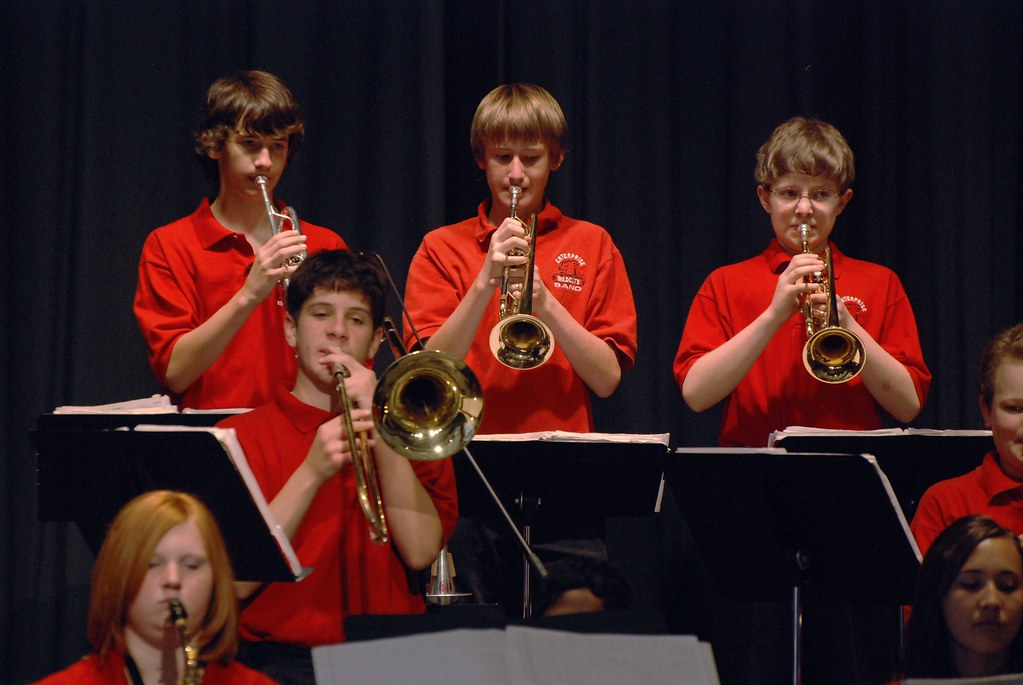
A lifetime ago, back in seventh-grade band,
“The Bullwhip” had all us kids pledge to expand
Our goals for our music.  He went on to ask us
To double our time spent in personal practice.
The girls—mostly woodwinds—were eager to please;
Ol’ Bullwhip could always control them with ease.
We boys on the trumpets and trombones, however,
Were harder to handle—we thought we were clever.
We readily signed when the sheet came around—
Exploited a loophole that one of us found.
Response to the ask had just turned on a dime,
And some even wrote that they’d triple their time!
Now no one could say that we out and out lied.
A math rule we’d learned was defense on our side:
Go multiply zero as much as you will—
The answer you come to remains zero still.

*****

William Walters “This poem tells a true story about an early class with our respected and beloved school band director, a colorful character who wore cowboy boots and carried a bullwhip around on his hip and actually went by the nickname “Bullwhip.”  A remarkable educator, he managed to be strict and demanding and patient and caring and encouraging all at the same time and, by our high school years, had us rural Southwest Kansas kids whipped into shape—figuratively, not literally—and disciplined to be an excellent marching band that competed very well against the big schools from Wichita, Topeka, Kansas City, and the like when we travelled back east for contests.  We had only about 170 students total in our high school, and we always had over 80 in the band!  Bullwhip certainly knew how to run a music program, and he gave our sleepy little town something to be proud of!     

“As far as the meter of the poem is concerned—it’s technically some kind of hendecasyllabic meter with hypercatalexis in a couple of the distichs.  But I didn’t really think much about rigid adherence to any form; I just went with what seemed to flow and what sounded good to me.”

‘Interdisciplinary Indiscipline’ was first published in Allegro.

William Walters has been a professor of English and linguistics at Rock Valley College, in Rockford, Illinois, for the past thirty-seven years.  He played trombone in many music groups in high school and college, and he’s a bass trombonist in a college/community band even now.

Photo: “Enterprise Middle School band plays for White Bluffs Center Tea Party” by Scott Butner is licensed under CC BY-NC-ND 2.0.

Susan McLean, ‘High School Pride’

Sleek in their strength and beauty, haughty, lithe,
prowling alone or stalking in a pack,
they cut down herds of victims like a scythe,
then search for fresh meat, never looking back.
The world is theirs, and all the grazers in it.
They cull the weak, the callow, the unwary.
The pack itself can change at any minute,
for all alliances are temporary.

How fine to be the hunters, not the prey,
to ambush, wound, or take down all they see!
While we, their hapless quarry, would contrive
to be as cruel and merciless as they
if we could share in their ascendancy—
not noticing how few of them survive.

*****

Susan McLean writes: “High school can be as harsh as any nature documentary in demonstrating Darwinian survival of the fittest. It is a time when popularity and fitting in can seem all-important, and when those at the top of the social hierarchy often take pleasure in harassing or snubbing those below. Two scientific studies gave the impetus for this poem. One was a study of apex predators such as lions, which showed that despite their power and ferocity, they had a surprisingly high mortality rate. The other was a study of people who were unpopular in high school, which found that later in life they tended to be happier and better adjusted than those who had been popular in high school. The whole concept of “high school pride,” which stoked artificial rivalries between schools that were then played out on the battlefield of sports and other competitions, was part of a mentality that endorsed winning and belittled losers.

“This sonnet first appeared in the online journal 14 by 14, and later was published in my second poetry book, The Whetstone Misses the Knife. The octave follows the pattern of an English sonnet, with quatrains rhymed in alternating lines: ABABCDCD. But the sestet switches to the less predictable rhyme scheme of the Italian sonnet: in this case, EFGEFG. The surprises of the rhyme scheme are meant to mirror the surprises in the twists of the conclusion.”

Susan McLean has two books of poetry, The Best Disguise and The Whetstone Misses the Knife, and one book of translations of Martial, Selected Epigrams. Her poems have appeared in Light, Lighten Up Online, Measure, Able Muse, and elsewhere. She lives in Iowa City, Iowa.
https://www.pw.org/content/susan_mclean

Photo: “Clique” by San Diego Shooter is licensed under CC BY-NC-ND 2.0.