Lion-Eating Poet in the Stone Den is crafted entirely from the syllable “shi,” distinguished only by tonal variation, yet it still conveys a complete and coherent story in Chinese. The poem was originally written by Hu Mingfu (胡明复) and published by linguist Yuen Ren Chao in Volume 11 of The Chinese Students’s Monthly in 1916.[2][3] It was then refined by Yuen Ren Chao in the 1930s for demonstrative purposes in his lectures.
In Chinese:
“Shi Shì shí shĩ shĩ”
Shíshì shishì Shi Shì, shì shi, shì shí shí shĩ.
Shì shíshí shì shì shì shĩ.
Shí shí, shì shí shi shì shì.
Shì shí, shì Shi Shì shì shì.
Shì shì shì shí shĩ, shì shĩ shì, shĩ shì shí shĩ shìshì.
Shì shí shì shí shi shi, shì shíshì.
Shíshì shĩ, Shì shĩ shì shì shíshì.
Shíshì shì, Shì shĩ shì shí shì shí shĩ.
Shí shí, shĩ shí shì shí shĩ shĩ, shí shí shí shĩ shĩ.
Shì shì shì shì.
English Translation:
In a stone den lived a poet named Shi, who loved lions and had resolved to eat 10 lions.
He often went to the market to look for lions.
At 10 o’clock, 10 lions had just arrived at the market.
At that moment, Shi also arrived at the market.
He saw those 10 lions and, using his arrows, slayed them.
He brought the bodies of the 10 lions back to the stone den.
The stone den was damp, so he asked his servants to wipe it clean.
After it was cleaned, he tried to eat the 10 lions.
When he began eating, he realized that those 10 lions were actually 10 stone lion statues.
Try to explain this matter.
*****
If you chase this odd poem down in more detail, you will find arguments about the original poet’s intent, and the subsequent modifications by Yuen Ren Chao (who apparently claimed full ownership), and which language is appropriate for it, and more, in Wikipedia and elsewhere. I leave you with a long excerpt from pinyin.info:
“Yuen Ren Chao was the leader of the group that designed National Romanization. He knew that National Romanization (Guóyǔ Luómǎzì) could only write “modern vernacular Chinese,” and not Classical Chinese. In order to demonstrate this point he playfully wrote a classical essay consisting entirely of “homophones” entitled “Record of Mr. Shi Eating Lions.” The whole essay is copied as follows:
Shi2 shi4 shi1shi4 Shi1 shi4 shi4 shi1, shi4 shi2 shi2 shi1. Shi4 shi2shi2 shi4 shi4 shi4 shi1. Shi2 shi2, shi4 shi4 shi4, shi4 shi2 shi* shi1 shi4 shi4. Shi4 shi2, shi4 shi4 shi4 shi2 shi1, shi3 shi2 shi2 shi3 shi4, shi3 shi4 shi2 shi1 shi4shi4. Shi4 shi2 shi4 shi2 shi1 shi1 shi4 shi2 shi4. Shi2 shi4 shi1, shi3 shi4 shi4 shi3 shi2 shi4. Shi2 shi4 shi4. Shi4 shi3 shi4 shi2 shi4 shi2 shi1 shi1. Shi2 shi2, shi3 shi4 shi4 shi2 shi* shi1 shi1 shi2 shi2 shi* shi2 shi1 shi1. Shi4 shi2, shi4 shi3 shi4 shi4 shi4shi2. Shi4 shi4 shi4 shi4.” (The original article had no punctuation.) (* The character 硕 shuò, meaning huge, was pronounced as shí in the past.)
The vernacular translation of this essay is:
Shítou wūzi lǐ xìng Shī de shīrén xǐhuan chī shīzi, tā juéxīn yào chīdiào 10 tóu shīzi. Tā shíshí dào shìchǎng shàngqu kàn shīzi. Shí diǎn zhōng, tā dào shìchǎng, gānghǎo 10 tóu zhuàngdà de shīzi láidào shìchǎng. Zhè shíhou, tā kàn le zhè 10 tóu shīzi, yīkào 10 zhī shítou zuò de jiàn, bǎ zhè 10 tóu shīzi shāsǐ. Tā jiǎn qǐ zhè 10 tóu shīzi de shītǐ, huídào shítou wūzi lǐ qù. Shítou wūzi cháoshī. Tā jiào shìzhě mǒgān shítou wūzi. Shítou wūzi mǒgān le, tā kāishǐ chángshì chī zhè 10 tóu shīzi de shītǐ. Chī de shíhou, cái zhīdào zhè 10 tóu zhuàngdà de shīzi de shītǐ, shíjì shì 10 tóu zhuàngdà de shítou shīzi de shītǐ. Zhè shíhou, tā cái míngbai zhè jiàn shì de zhēnxiàng. Qǐng nǐ jiěshì, zhè shì zěnme huíshì?
The English translation of the essay is:
Mr. Shi, a poet who lived in a stone house, liked to eat lions. He vowed to eat ten lions. He often went to the market to look at lions. At ten o’clock, he went to the market, (and) just then ten large lions (also) came to the market. At that time, he saw these ten lions. Relying on the power of ten arrows with stone tips, he caused the ten lions to pass away. He picked up the bodies of the ten lions and went back to his stone house. The stone house was damp, so he told his servant to try and wipe it (dry). After the house had been wiped (dry), he began to try to eat the bodies of the ten lions. As he was eating, he realized that the bodies of the ten large lions were actually bodies of ten large stone lions. Only then did he understand the real situation. Can (you) explain what happened? (Translated by Victor H. Mair)
The point is that, if Chao’s classical essay were written in Hanyu Pinyin, everything would be shi and naturally no one could read and understand it. In other words, it is a kind of tour de force tongue twister. Even if it were written in characters, people still would not be able to understand it when it is read aloud. There are people who use this (playful) piece (that is forced and unnatural even in Classical Chinese) to oppose Hanyu Pinyin. They have completely misunderstood Yuen Ren Chao’s original intention!”
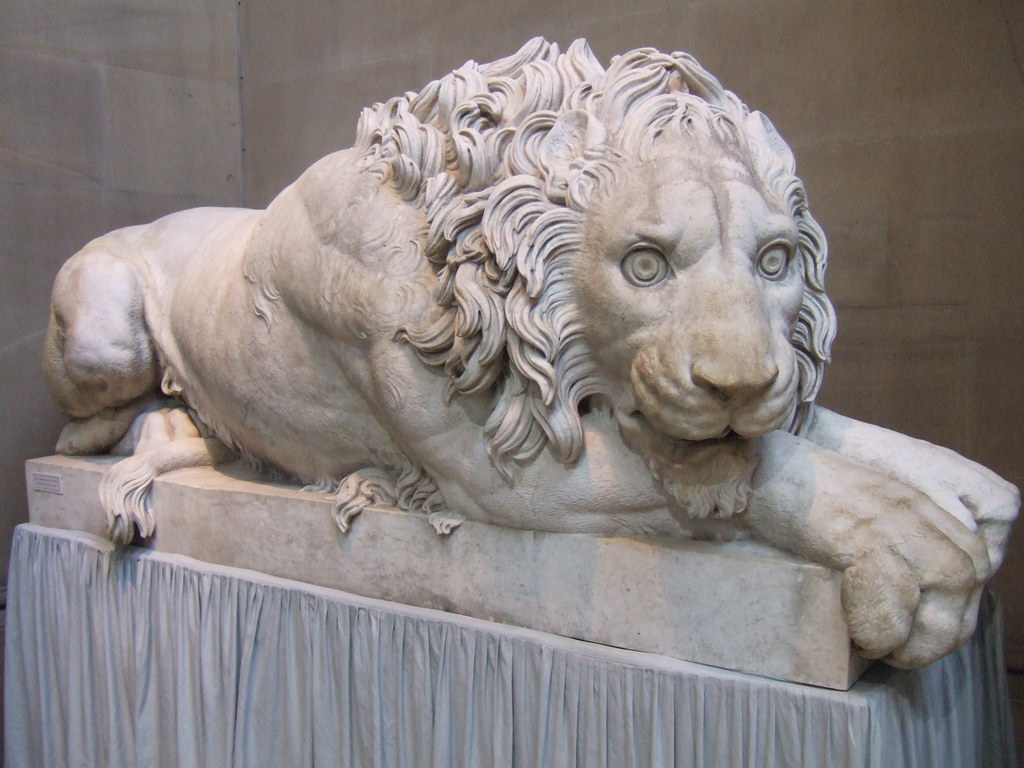
“Stone lion” by Ben Sutherland is licensed under CC BY 2.0.