Tag Archives: short poems

Short poem: Richard Fleming, ‘Now’

The future’s inconceivable.
The past is irretrievable.
So all we have is now: that’s it,
yet half the time we miss that bit.

*****

Richard Fleming writes: “Four short lines, two rhyming couplets, succinct, hopefully not preachy, just something that we need to take to heart and not forget.”

Richard Fleming is an Irish-born poet (and humorist) currently living in Guernsey, a small island midway between Britain and France. His work has appeared in various magazines, most recently Snakeskin, Bewildering Stories, Lighten Up Online, the Taj Mahal Review and the Potcake Chapbook ‘Lost Love’, and has been broadcast on BBC radio. He has performed at several literary festivals and his latest collection of verse, Stone Witness, features the titular poem commissioned by the BBC for National Poetry Day. He writes in various genres and can be found at www.redhandwriter.blogspot.com or Facebook https://www.facebook.com/richard.fleming.92102564/

Photo from Richard Fleming

Unforgettable nonsense: Samuel Wilberforce, ‘If I Were a Cassowary’

If I were a cassowary
On the plains of Timbuctoo
I would eat a missionary,
Cassock, bands, and hymn-book too.

*****

Yes, cassowaries are from Australia and New Guinea, and Timbuktu is in Africa… but so what? The rhymes are too good to ignore. ‘Bands’, btw, refers to the pseudo-necktie thingies that priest-types and lawyer-types affect in some countries – little cloth flaps, plural because you wear two of them.

The probable author is Bishop Samuel “Soapy Sam” Wilberforce, best known nowadays for debating  Thomas Henry Huxley on evolution in 1860. Huxley (Aldous Huxley’s grandfather) was commonly referred to as ‘Darwin’s bulldog’. Wilberforce is remembered for his question as to whether it was through his grandmother or his grandfather that Huxley considered himself descended from a monkey. Huxley is said to have replied that he would not be ashamed to have a monkey for his ancestor, but he would be ashamed to be connected with a man who used his great gifts to obscure the truth.  Apparently everyone enjoyed the debate, and they all went off happily to dinner together afterwards.

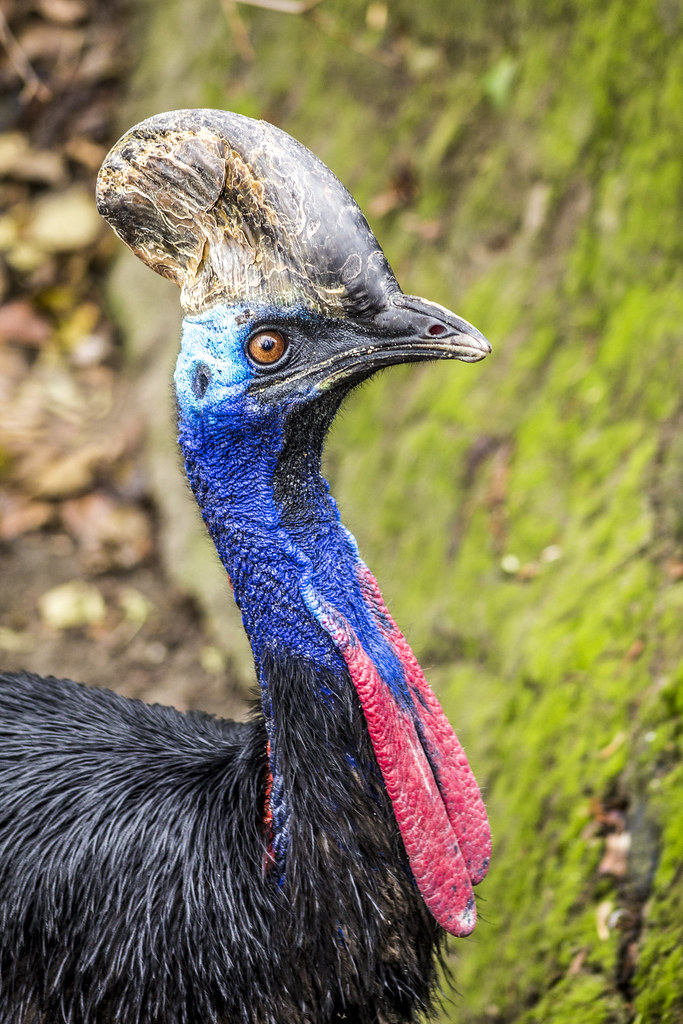
Cassowaries are more formidable than either Wilberforce or Huxley. Standing over six feet tall, capable of running at 30 mph (and good swimmers in rivers and sea), and able to leap and strike chest-high with razor-sharp 5-inch talons, they are omnivores not to be confronted. Yes, they might well eat a missionary. Also, the cassowary’s bands are more impressive.

Photo: “Cassowary at the Budapest zoo” by brenkee is marked with CC0 1.0.

Short poem: Amit Majmudar, ‘Charmed Life’

Destiny blessed me. Kismet kissed me.
Accident aimed, but the meteor missed me.
Fate did me favors. Luck had my back
For a leisurely picnic between the tracks.
Joy was a contract I printed and inked.
How could I know
In the mountaintop snow
Nemesis tiptoed behind me and winked?

*****

‘Charmed Life’ appeared in Literary Matters, and also in The Best American Poetry 2024, selected by Mary Jo Salter. That BAP volume carries Amit Majmudar’s statement on the poem in the back matter:

“Count no man lucky until he is dead,” said Solon, a lawgiver in ancient Greece. You never know when a friendly universe might turn on you: The monthlong dry cough that turns out to be a lung mass, the backache that turns out to be a bone met; a quick trip in the car to get bread and bananas that takes a left at the light into lifelong quadriplegia. Just days before that catastrophe: A wedding, or a book deal, or a Disney trip with the kids…. It’s not a tightly enforced law, but things do tend to cancel out when it comes to good luck and bad luck, good times and bad times. (At least that holds for those of us who crowd the middle of the luck distribution; certainly some people at either extreme have only one sort of luck in abundance.)

This dashed-off charm of a poem, ‘Charmed Life,’ reflects that sense of yin and yang, of scooping slop and caviar with the same spoon. The speaker plays life on easy mode until that turn at the end, but the first word of the last line embeds the idea. “Nemesis” comes from the Greek for giving someone what they deserve, and before that, from the Indo-European root *nem-, which means “distribute.” Everyone deserves hell yeah and oh no in roughly equal measures. And for the most part, that is what we get.

*****

Amit Majmudar is a poet, novelist, essayist, and translator. He works as a diagnostic nuclear radiologist in Westerville, Ohio, where he lives with his wife and three children. Recent books include Twin A: A Memoir (Slant Books, 2023), The Great Game: Essays on Poetics (Acre Books, 2024), and the hybrid work Three Metamorphoses (Orison Books, 2025). More information at www.amitmajmudar.com

Photo: “Nemesis Roman goddess of retribution Marble 150 CE” by mharrsch is licensed under CC BY 2.0.


Short poem: RHL, ‘Tease’

I feel good that you want it;
you know it’s under there;
it makes me feel important
but I don’t like your stare.

I wear enough to hide it
though all around is bare;
it’s treasure, ’cos you want it;
who you are, I don’t care.

*****

This poem was first published in Rat’s Ass Review (as are many politically incorrect poems), Fall/Winter 2024 – thanks, Roderick Bates!

Photo: “Lustful model teasing on a boat in a bikini.” by @yakobusan Jakob Montrasio is licensed under CC BY 2.0.

Short poem: RHL, ‘Neanderthals’

Watch how the status of the poor
Neanderthals will rise
when we admit we thank them for
red hair, white skin, blue eyes.

*****

“All non-Africans today may have a roughly equal proportion of Neanderthal DNA, but some of the most visible physical traits appear to have been inherited especially by modern Europeans, and northern Europeans in particular. Here is a list of traits that distinguished Neanderthals from Homo sapiens, but that you could also have inherited if you are of European or Western Eurasian descent.

  • Rufosity : i.e. having red hair, or brown hair with red pigments, or natural freckles.
  • Fair skin, hair and eyes : Neanderthals are believed to have had blue or green eyes, as well as fair skin and light hair. Having spent 300,000 years in northern latitudes, five times longer than Homo sapiens, it is only natural that Neanderthals should have developed these adaptive traits first.”

I skipped 11 traits to get to these two. If you want the whole list, they’re at https://www.eupedia.com/europe/neanderthal_facts_and_myths.shtml

I’m just amused, of course, by the chance to label famously red-white-and-blue flag-waving countries as Neanderthals: the US, UK, France, Netherlands, and Russia… (as well as many other less historically aggressive countries around the world).

This poem was first published in Rat’s Ass Review (as are many politically incorrect poems), Fall/Winter 2024 – thanks, Roderick Bates!

Image: ChatGPT from RHL prompt

Using form: Short poem: Helena Nelson, ‘Duel’

Your false self says to my true self, Hate.
My true self says to your false self, No.

Your false self says to my false self, Shit.
My false self says to your false self, Go.

Your true self says to my false self, Love.
My false self says to your true self, Late.

Late, too late, too late, too late.
My true self sings to your true self, Wait.

*****

Helena Nelson writes: “I can’t explain this easily. It’s both simple and obscure, like a sealed box holding the idea of opposition: a duel between two people, a duet; dual positions. Then there’s the idea of a two-sided self: the true or authentic self versus the manipulative side, the side that does deliberate damage. I don’t even believe in ‘the true self’; but I do in this poem. And I recognise a dispute where one person (especially if for some reason acting from twisted emotion) can push another to come back from that same position, even when they don’t want to. From experience, I’ve known this. The rhyming words trace the development. The slant rhyme between Hate and Shit, for me, has a dark twist. Hate is powerful but Shit is horrible. Late is potentially the last word. The poem could end there, but it doesn’t. Each of these two people summons a ‘true self’. Each dismisses the ‘false’. ‘Late, too late, too late, too late’ is the line that breaks the pattern. No direct speech in that line, perhaps because it’s not a spoken statement but a feeling experienced by both. For me, there’s intense sadness at this point, and the shadow of death too, and because of this—just in time—true speaks to true. Only seventy words in the whole thing but most repeated several times. If you go by unique usage, fifteen words in total. It reminds me of one of R. D. Laings’ Knots. The switch from ‘says’ to ‘sings’ at the end? Yes—significant.”

Helena Nelson runs HappenStance Press (now winding down) and also writes poems, one of which is ‘Duel’. It was originally published in PN Review, collected in Plot and Counter-Plot, Shoestring Press, 2010, and was reprinted in the Potcake Chapbook ‘Lost Love’. Her most recent collection is Pearls (The Complete Mr and Mrs Philpott Poems). She reviews widely and is Consulting Editor for The Friday Poem.

Photo: “Argument” by helena_perez_garcia is licensed under CC BY-NC-ND 2.0.

Semi-formal: Annie Fisher, ‘Today I’ll be a Slug’

I’ll flow
slug-slow,
go naked
(naked’s fine).
My only mission
is to glisten.
Watch me shine.

*****

Annie Fisher writes: “I wrote the slug poem a year ago when I was on a writing retreat on the island of Iona in the Inner Hebrides. I was writing all sorts of other stuff on the retreat and that little poem popped into my head during a free-writing morning splurge. I guess the idea of slowing down, going with the flow, being true to oneself and letting one’s inner radiance shine is very much in keeping with the vibe of Iona, but it wasn’t a conscious thing.
I do love short poems. I’ve had others published on Snakeskin, including:

SONG THRUSH, MAY MORNING

Bird at my window, early, early,
Something to say, to say, to say,
This morning will not come again,
Make the most of today today.

That poem plays with the fact that the song thrush repeats its song. I sometimes sing it with some friends as a round using a tune we wrote. Here’s one other from the Snakeskin archive which I’m rather fond of:

GRANNY ON THE NAUGHTY STEP

Granny sits on the Naughty Step
Thinks about what she has done
Wishes she’d been a bit naughtier
It might have been fun…”

Annie Fisher’s background is in primary education, initially as a teacher and later as an English adviser. Now semi-retired she writes poetry for both adults and children and sometimes works as a storyteller in schools. She has had two pamphlets published with HappenStance Press: (2016) and (2020), and is due to have another pamphlet published in the next couple of months with Mariscat Press. It will be called ‘Missing the Man Next Door’. She is a member of Fire River Poets in Taunton, Somerset and a regular contributor to The Friday Poem https://thefridaypoem.com/annie-fisher/

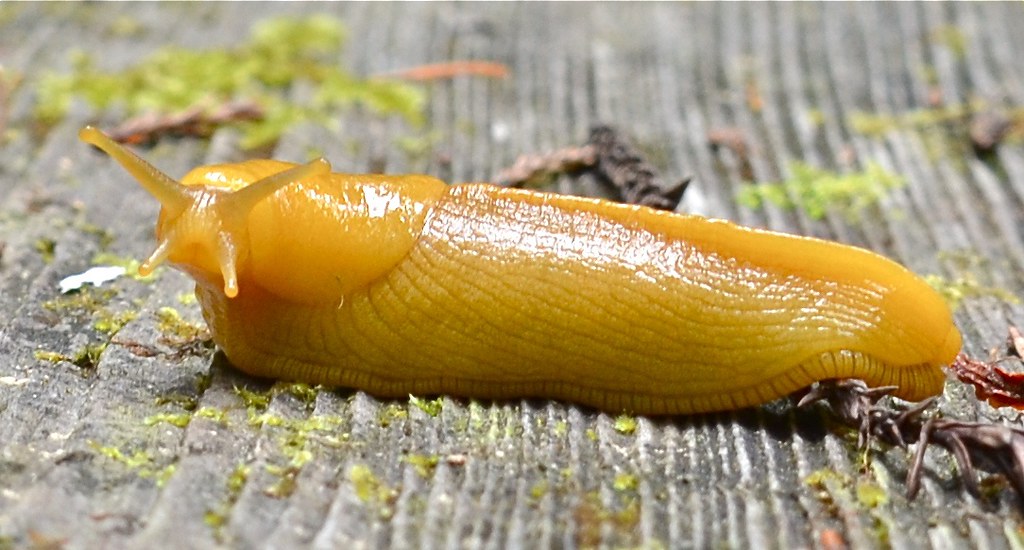
Photo: “Banana Slug – A Series” by goingslo is licensed under CC BY-NC-ND 2.0.

Short poem: RHL, ‘Pithy’

His words are witty,
with a twist.
He says they’re “pithy”;
note the lisp.

*****

This is one of my three short poems published in the current Rat’s Ass Review – thanks, Roderick Bates – where the good and the rude, the mocking and shocking, all coexist harmoniously.

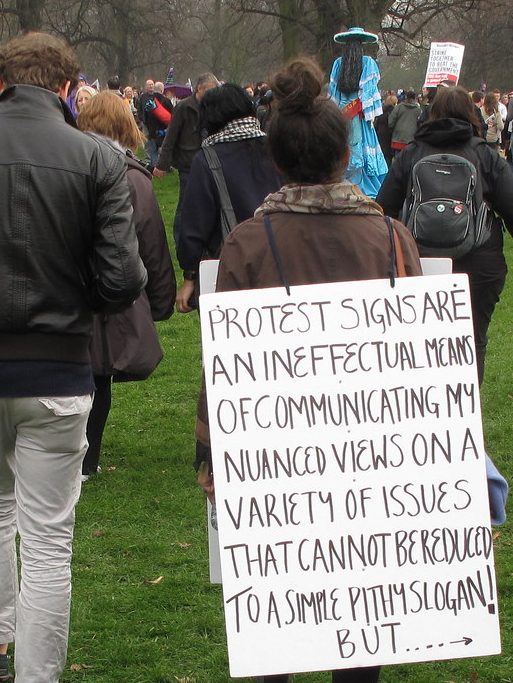
Photo: “Protest signs are an ineffectual means of communicating my nuanced views on a variety of issues that cannot be reduced to a simple pithy slogan!” by duncan is licensed under CC BY-NC 2.0.

Short poem: RHL, ‘God – pfft!’

All the things God could do,
all the things he doesn’t:
stop earthquakes and disease,
world war between first cousins…
Complaints at God may seem
rashly impertinent–
But so what? Life shows God
clearly omnimpotent.

*****

Not much to say about my rude little poems, except that a lot of them get published in Rat’s Ass Review, whose Spring/Summer issue has just (optimistically) been published – thanks, Roderick Bates! And also, well, I guess I was proud of the poem’s last word, though I’m definitely not the first person to think of it.

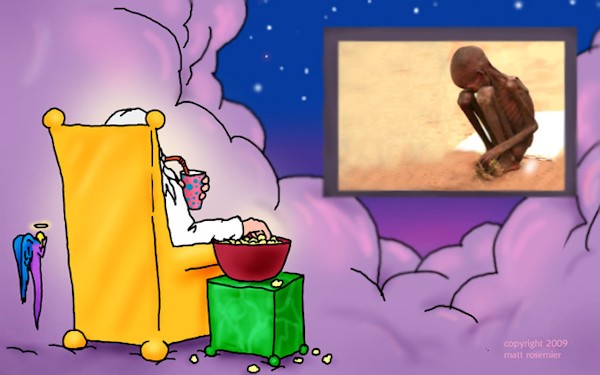
Cartoon: Matt Rosemier

Short poem: Richard Fleming, ‘The Clock Collector’

He didn’t hurry, took his time
to gradually collect the clocks:
large clocks, small clocks, clocks with a chime,
he gathered stocks of ticks’n tocks
time-pieces, chronographs, all gold,
he harvested them like a crop.
He hoped to put his life on hold
but time, unmeasured, did not stop.

*****

Richard Fleming writes: “I think I was just playing with rhyme on this one. That it says something serious was an unexpected bonus.”

Richard Fleming is an Irish-born poet (and humorist) currently living in Guernsey, a small island midway between Britain and France. His work has appeared in various magazines, most recently Snakeskin, Bewildering Stories, Lighten Up Online, the Taj Mahal Review and the Potcake Chapbook ‘Lost Love’, and has been broadcast on BBC radio. He has performed at several literary festivals and his latest collection of verse, Stone Witness, features the titular poem commissioned by the BBC for National Poetry Day. He writes in various genres and can be found at www.redhandwriter.blogspot.com or Facebook https://www.facebook.com/richard.fleming.92102564/