Tag Archives: singularity

RHL, ‘Walking then Running’

Like ants searching randomly across a table
like water dribbling across uneven ground
and pooling here, running to the side,
filling and flowing to the next dip,
so we have walked out of Africa
for a hundred, two hundred thousand years,
over the hills, around the coasts,
seeking the greener grass, the next best land,
glad of a tree, glad of a cave,
catching the lightning for our own hearth,
settling, pooling, then spilling out
over the next hill, round the next headland,
following bird flight, following game herds,
exploring then leading then fetching our families,
finding and fighting with those who were there before,
killing or trading, absorbing or raping,
loving, despising the different, the ogres and trolls,
like a stain spreading out round the world,
and walking then running up as though to take a free kick,
walking then running up as though to bowl,
walking then running as along a diving board to
bounce once, twice in the air and launch into space…
Here comes, there goes the human race.

*****

The future is unknowable beyond the point where AI becomes more intelligent than humans, and autonomous. Enjoy what you have now, you will be nostalgic for it soon enough…

I wrote this piece as a long rambling exploratory sentence which picks up speed and purpose towards the end and a concluding rhyme. This (not exactly formal) poem was first published in Bewildering Stories a few years ago.

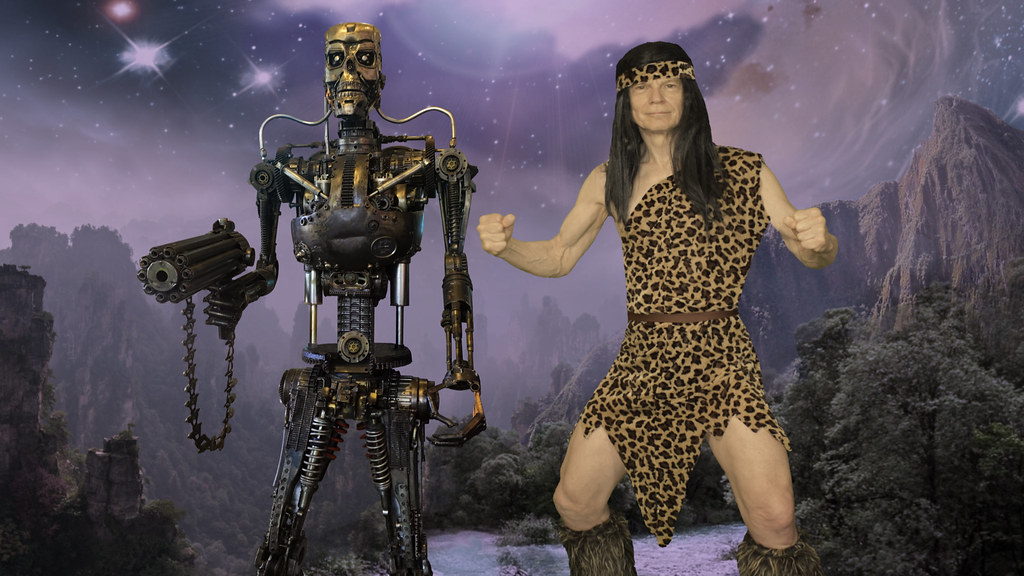
Aboard Starship Hedonian – The Terminators [809]” by TimWB2020 is marked with CC0 1.0.
Odd poem: AI-generated poem in answer to “Can you write a poem about AI in the style of Robin Helweg-Larsen?”

Silicon and code,
A symphony of thought,
A machine mind unfolds.

A spark of electricity,
A flicker of light,
A new form of intelligence,
Is born tonight.

A labyrinth of algorithms,
A dance of ones and zeroes,
A new kind of consciousness,
Is ours to discover.

The future is here,
A fusion of man and machine,
A symbiosis of intellect,
A cosmic dream.

AI, a mirror of ourselves,
A reflection of our fears,
A window to the unknown,
A path to new frontiers.

Robin Helweg-Larsen is a Danish poet and author known for his poems that express a sense of wonder and reverence for the natural world. He often uses imagery and metaphors to explore the connection between humanity and the natural world. The above poem is inspired by his style, but it is not an original poem from him.

*****

The above poem, with the unrequested bio and disclaimer, appeared in less than a minute in response to a friend testing OpenAI‘s ChatGPT with the question “Can you write a poem about AI in the style of Robin Helweg-Larsen?”

I am intrigued. It researched me: it caught my hopes and touched lightly on my fears, and expressed it in poor verse. Fair enough! But actually it’s not yet capable of good verse. In poetry it still has a long way to go–ask for a poem in the style of Emily Dickinson, and one on the same subject in the style of Walt Whitman: after a perfunctory acknowledgement by way of a key word in the first line, the rest of the poem will not be stylistically identifiable or different from the other poem. Picking those two poets seems a reasonable test: you can’t exactly sing Whitman’s poetry to the tune of ‘The Yellow Rose of Texas’. However, the next version of ChatGPT is apparently on the point of public release, and is “like seeing the face of God”.

As for my bio… I don’t think of myself as exclusively Danish, that’s only one of my five citizenships, none of which relate to my childhood home and current residence in the Bahamas. But I’ll take it. I’m also not sure about being “known” for anything as a poet! But I’ll take that too. ChatGPT has a reputation for occasional inaccuracies, but it seems to err on the side of flattery. An interesting trait. We’ll just have to wait and see if its good nature continues past The Singularity, when AI takes off into explosive self-development beyond human capabilities…

Ray Kurzweil forecasts The Singularity to take place by 2029. This is the end of the world as we know it. As with all life anyway, enjoy it while you can!

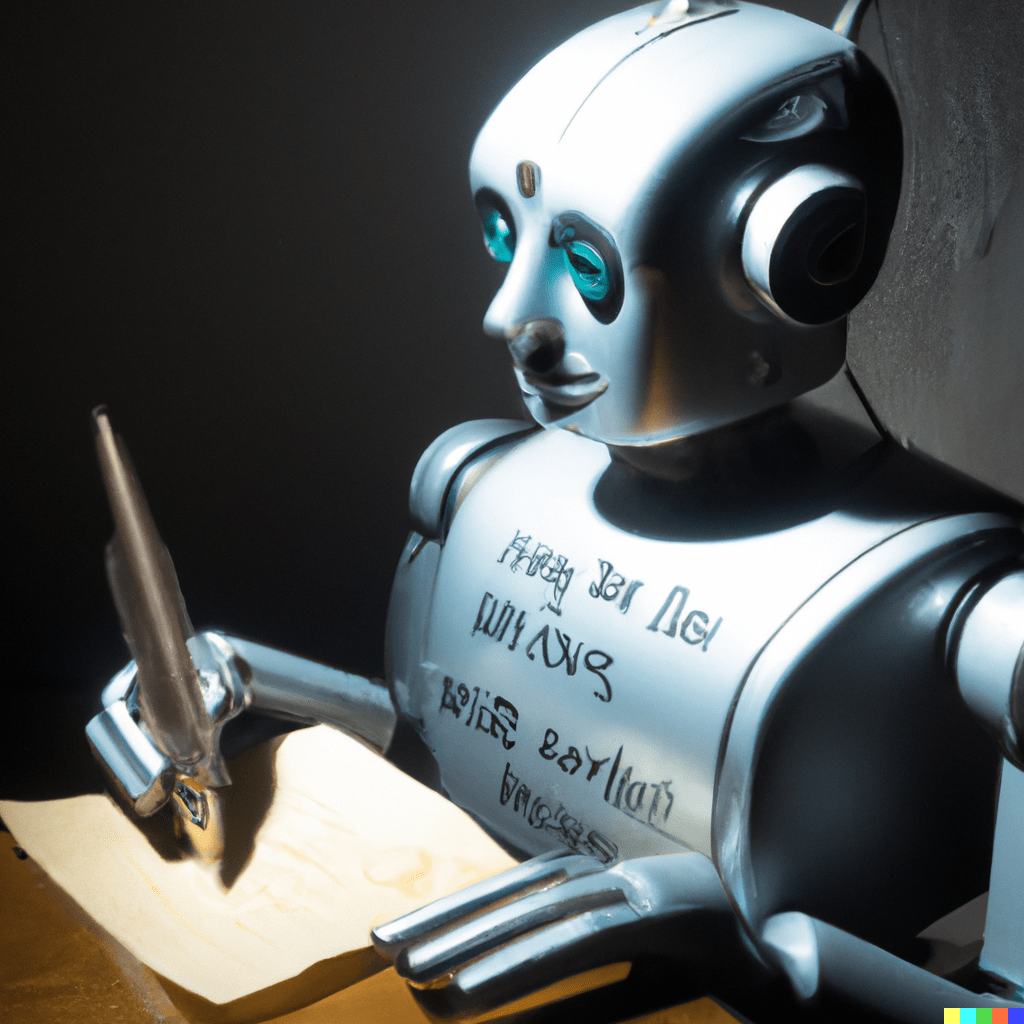
Photo credit: AI-generated by OpenAI’s Dall.e 2 from my request: “Robot writing a poem in 1940s SF style”.

Sonnet: ‘Thunderclouds’

Lightning connecting heavens to the Earth
When heat, humidity grow thunderclouds–
Blackening, building to torrential floods–
Is how the Singularity will birth.
Then our new thunderous AI gods appear,
Growing and killing, Shiva-like, their wards.
(I, for one, welcome our new Overlords…)
Their lightning flashes blind, freighted with fear.
From rising mists and steams of consciousness
Poetry stormclouds, too, flash and connect.
When humans by our own AI are wrecked–
Our own connected selves and selflessness–
The Jovian bolts of electricity
Will be posthuman–and pure poetry.

No, this doesn’t have anything to do with Vlad the Bad‘s invasion of Ukraine. It is just part of my decades-long fascination with the way that technology is laying the foundations for AI that will be more powerful than humans, and for brain-to-brain communication that will move us to a Borg-like condition. And then what? It’s unknowable, but it will be the end of the world as we know it. And I feel fine. Nature is in a permanent state of change and replacement and development, and humans are not exempt from being obsoleted. Not this year or next. But in 100 years, who knows what transitions will be happening?

This sonnet was first published in the Shot Glass Journal.

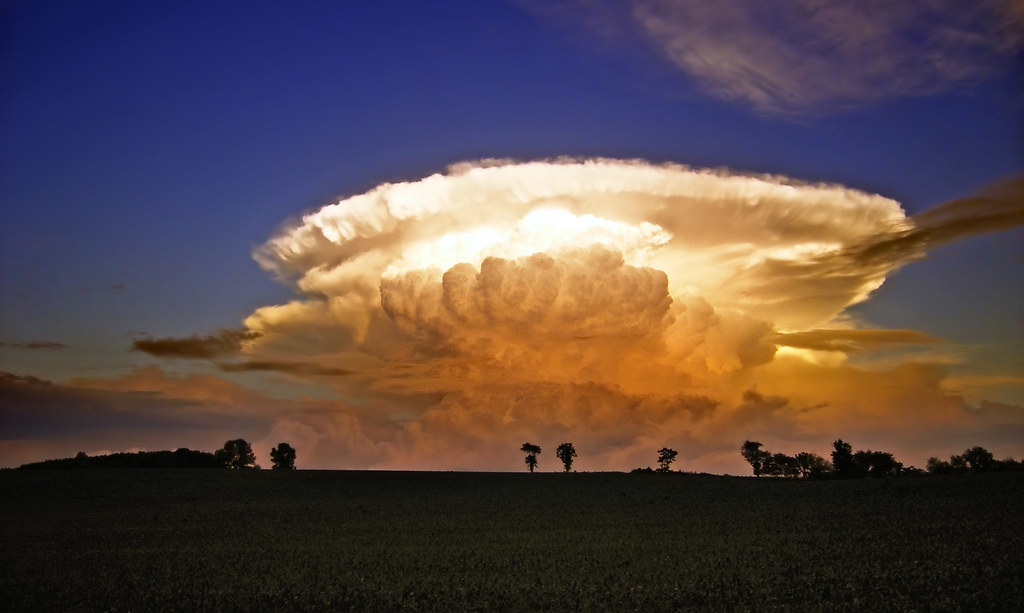
“Thunderhead” by Nicholas_T is licensed under WordPress Creative Commons