Tag Archives: sonnet crown

Sonnet Crown: Amit Majmudar, ‘Recourse’

1.

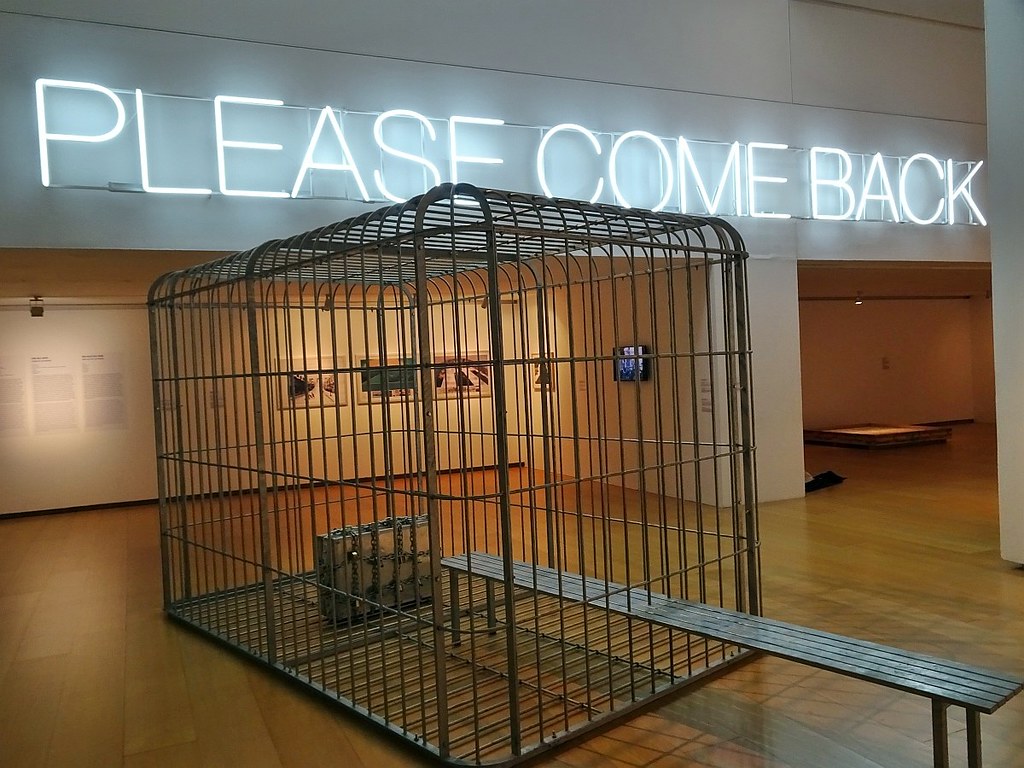
Time, like love, is cyclic. Please come back
to me. I’ll stand here waiting, wanting while
the mare without her rider rounds the track.
I want to weave a crown for you, design
a daisy chain whose threaded stems become
a bracelet that handcuffs your wrist to mine.
My shadow’s gnomon tilts like a sun dial’s.
I know you’re somewhere close. I feel a thrum,
a thrill beneath the stillness of the earth,
the way a woman, days before the birth,
places her husband’s hand on the sea swell
that rises out of her and passes through her,
and, touching so much vastness, he can tell
for all their time as one, he never knew her.

2.

For all our time as one, I never knew you—
but doesn’t learning come from repetition?
I’ll do this better if I do it over.
I’ll know your every need by heart, pursue you
like truth. I’ll learn to be a truthful lover.
I’ll circle back to freshman year and woo you.
No song’s recorded in a single session.
No sinner’s shriven after one confession.
It’s time that grows the pearl. Nacre layers
the sand grain, like a secret in the mouth.
Repentance grows, too—grows by daily prayers
into a faith whose trigger seed was doubt.
I am a pearl diver in your depth.
I never left. I just came up for breath.

3.

I never left, I just came up for breath,
but now I am ready to follow you all the way down.
I’ve read we get euphoric as we drown.
Samsara swirls us under. When we break
the whitecaps for an instant, that is death.
Don’t make us wait to be reborn before
we love again. You know me—I’ll just make
the same mistakes. Or make things even worse.
So what if time’s a circle? Doesn’t mean
we have enough of it. The now we’re in
will never come again. So come again
into my life, and love me sight unseen.
We’re both at sea, and no good at dead reckoning.
A burning town’s the only lighthouse beckoning

4.

Our house of light is burning down. It beckons in
the gloaming. The road I’m roaming is a ring.
All time is circular. We’re only seconds in.
All reasoning is circular. I sing
the seasons all the way around the year.
There was a chemist once whose dream disclosed
benzene’s atomic structure. What appeared
before him was a serpent swallowing
its tail—aroma’s O, ouroboros.
I’m wise at last to what the image knows.
I see my answer now, my big mistake.
A ring! Why couldn’t it have been this clear
back then? I see it best when I’m awake.
I’ve circled back. But there is no one here.

5.

I’ve circled back, but there is no one where
the ring road ends. It ends in newfound ruins,
a shell-flecked nest, a rain-worn blade that bears
a message for us. Who can read the runes?
Nietzsche proclaimed the eternal return
and threw his arms around a bleeding horse
to feel the centuries reversing course.
His gooseflesh rose like spores that pock a fern.
Let vultures circle, only widdershins
above the ring road where I wait alone,
knifing in bark a promise of my own.
I know the ring road ends where it begins.
Time is a circle I can put to use:
a wheel to roll things back, a crown, a noose.

6.

A wheel to roll things back, a crown, a noose:
My own Venn diagram of rings to choose
from. Fill its center up with hourglass sand,
and that’s where Archimedes, kneeling, draws.
This is the Roman siege of Syracuse;
he’s hard at work on time, its shape and laws.
He looks up from a boot. A soldier stands
above him, dripping gladius in hand.
Do not disturb my circles, says the Greek.
The soldier studies them, then runs him through—
and so reveals what Archimedes seeks,
the circle, like a circuit, broken, weeks
and months and centuries and aeons spilling
in slow, concentric circles from the killing.

7.

In slow, concentric circles from the still-pink
narcotic kiss print of the cupping glass,
let your memories ripple outward, killing
the pain I’ve caused you. We are not our past,
though time is cyclic. Cycles can be broken,
souls reborn in this life, sleepers woken.
Not that I can sleep beneath this star.
Horizon, magic circle, boxing ring—
time is the space, the spell, the place we spar,
the dome in which your name is echoing.
It’s where I pray the theory into fact
that love, like time, is cyclic. Please come back.

*****

Amit Majmudar writes: “The sonnet crown is a naturally recursive form of forms. The beginning of each sonnet is also an ending, and vice versa. A candle tilts to light a candle that tilts to light a candle, until the occult circle of flame is complete, and the poet sits inside it, meditating the next line, which may well be the line just written.

“This sonnet crown took, as its subject, the tendency of lovers, or at least their memories, to relapse. “Relapse” means to fall back, etymologically. To fall back in love; to fall back out of love. The sonnets enact through form and content alike the recrudescence of the past. The last line of the overall crown matches the first line of the overall crown. The reappearance of the old pain makes it a crown of thorns.

“I wrote this sonnet crown first line to last. I had never even attempted one before, but I relinquished myself to the music-making. I could do that because I circled around a theme–recursion in love–rather than trying to tell a story or present a philosophical argument or any such prosaic thing. Just pure pursuit of the right sounds. This crown came at the end of a sonnet-writing tear so my hand was in practice, as it were.

“Close readers will notice that the crown is imperfect, however. In the final, truncated sonnet, the speaker makes haste to return to the beginning, to break the process of endless recursion. Accordingly, the rhyme word of the line where the deviation begins is “broken”–and it’s there that the formal pattern–the “cycle”–itself is broken. Broken/woken collapses the separated rhyme sounds into a couplet, with a second couplet to conclude the 12-line ending–a couplet of couplets, the original pair formation and the hoped-for repeat pair formation, embodied in the music of the ending that is, at last, a new beginning. “

*****

Amit Majmudar is a poet, novelist, essayist, and translator. He works as a diagnostic nuclear radiologist in Westerville, Ohio, where he lives with his wife and three children. Recent books include Twin A: A Memoir (Slant Books, 2023), The Great Game: Essays on Poetics (Acre Books, 2024), and the hybrid work Three Metamorphoses (Orison Books, 2025). “Recourse” was first published in Plume Poetry, and will be appearing in Majmudar’s forthcoming collection, Things My Grandmother Said, in early 2026. 
More information at www.amitmajmudar.com

Photo: “0103-IVAM – Please Come Back 05” by gibbix1 is licensed under CC BY-NC 2.0.

Weekend read: Sonnet crown: Barbara Lydecker Crane, ‘Roughly True’

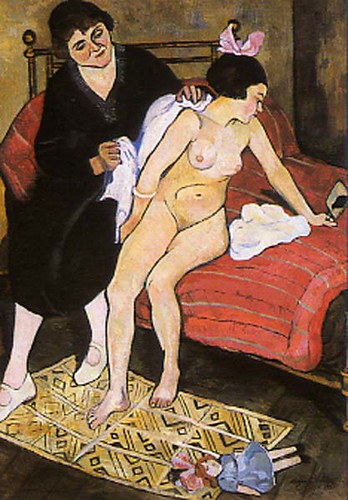
Suzanne Valadon, 1865-1938, Paris

What, you haven’t heard of me, despite
my art and stormy life? There’s much to tell
of pride and bitterness, of bliss and hell—
but not regret. I’ll fill my pen and write.

I was born a bastard. Maman worked,
a laundress, while I’d roam Montmartre, spying 
through café and whorehouse doorways, trying
to snitch some fruit or francs. I laughed and lurked.
With lumps of coal I loved to draw on streets.  
Ditching convent school at puberty,
I learned to earn my way. I felt free
in circus work, curvaceous and petite
and daring on the high trapeze, strong
until I hurt my back—I fell headlong.

That set me back, but new work came along—
also daring, deemed risqué—being painted,
a model for men. Few were sainted . . .
nor was I. I didn’t think it wrong
to give a man some pleasure and to claim
my own. For one artiste I posed unclad
and soon became his favorite lover. I had
his child, and kept my word: I didn’t name
that man on papers with a ‘Father’ line
and kept on working. Maman tended him,
my son, Maurice Utrillo—a pseudonym
so he would not be stigmatized by mine,
that of the saucy urchin shedding clothes—
and budding painter, watching men compose.

I watched the colors bloom as men composed.
Toulouse-Lautrec’s hues, both somber and bright,
would join or jar to make a mood just right.       
He’d talk of wealthy clients and gallery shows
while I could study his techniques with paint. 
He studied me and loved my breasts, my hair,
my thighs, my openness to him. I dared
to love that rich midget with no restraint.
When he refused to marry me, my feigned
suicide didn’t change his mind.  
But what I learned while posing, I combined
with my good eye, instinctive and untrained.
I’d use my wits (and likely my libido)
to paint in oils, with honesty my credo.

I painted nude women by my credo.
When I showed Degas my work, he praised
me with, “Madame, you’re one of us!” That raised
my nerve; like those Montmartre men, I’d show
my art—although I’d wish my name need not
be printed next to ‘woman artist,’ a tag
suggesting Other like a warning flag. 
I’m already Other in my lot    
as Bastard-with-a-Bastard history.
Will I be known for art or just my life
of scandal? I never stayed a bougeois wife,
as two would always tangle into three;
our pacts permitting infidelity
could not prevent one partner’s jealousy.

His cryptic music vented jealousy;
Eric Satie was moody, odd, hysteric—
and amusing, in and out of bed. Eric
and Paul Mousis loved me zealously
and it was bound to chafe, our double link.
Mousis was rich; Satie holed up in one 
squalid room. He slowly came undone
without me to himself—he took to drink
till drink took him. Maurice, by then eighteen,     
also drank. Since he was prone to rage
and smashing things since an early age,
Maman would feed him wine to calm such scenes.
When briefly sober, it was to me he came—
I treasured hearing Maman as my name.

Of course Maurice Utrillo made his name
with me his mother-teacher and his Papa
(I tell you now) Pierre-Auguste Renoir!  
Maurice was barely sane, but all the same,
prolific and successful in his art.
His painter colleague André, with brains and flair,
had tireless desire in our affair;
our turbulent trio could not live apart.
With André as our agent, income flowed— 
I once took fifty children to the circus . . .    
Montmartre beggars crowded round to work us . . .              
we’d help out any artist friend who owed.
The stream of money later dried to drought,
but while it flowed I bloomed by giving out.

Too soon I knew my bloom was giving out—
I missed men’s wide-eyed stares, their swiveled heads.
André, still youthful, strayed to other beds;
Maurice would drink or sit around and pout. 
We three unraveled into separate ways.
Instead of painting nudes I painted flowers;
they didn’t sell but brightened up the hours
of living alone, inviting in malaise,
till I found Gazi. This young, exotic man
takes care of me and listens to my stories,
roughly true—my slights, successes, glories.
I’m seventy-two. I’ll end where I began,
a bastard bitch whose art was bold and right.
My pride and grit leave little room for spite.

*****

Here is what the judge for the 2024 Kim Bridgford Memorial Sonnet Contest wrote:
Praise for the winning sonnet crown: Among a strong group of finalists, “Roughly True” distinguished itself across the board—in form, in voice, in message, in grace. After reading these seven sonnets in the voice of French painter Suzanne Valadon, I felt as if I had just taken short courses in poetic form, meter, rhyme, and art history, all expertly and candidly delivered by the fully realized persona of an accomplished, but overshadowed figure, one exquisitely resurrected here in verse.
~Dan Albergotti, Judge

Barbara Lydecker Crane writes: “I was surprised and thrilled to win this contest, and further pleased that the judge seemed to recognize the same strength of character in Suzanne Valadon that I did. The more I researched her life and work, the more I felt I actually knew this gritty woman a bit, despite our wildly different lives. As I get older I find I am more interested in writing about others than myself. My latest book, You Will Remember Me (Able Muse), is a collection of persona poems about portrait artists and their works. I am currently writing a new series of persona poems, this time about landscape artists and their works. This time, rather than writing all sonnets, each poem takes a different form; but all (so far) are in rhyme and meter. That seems fitting both for older times and for the craft and musicality I strive for, to befit the art that I hope to see with these poems one day, perhaps in a new book. And there is something about writing in form that, to me, is exactly like framing a picture. What a difference that makes; it says “completed,” and adds its own panache to the art.”

Photo: “The Abandoned Doll by Suzanne Valadon-1921” by mary holman is licensed under CC BY-NC-SA 2.0.