Tag Archives: Spectator

Susan McLean, ‘Anagram: A Pallor, An Edge’

Late at night, I saw a glowing,
as if realms beyond our knowing
kindly solace were bestowing.
Could this phantom be my wife?
 
But the gleam, as I drew nearer,
taking form and growing clearer,
was my visage in the mirror,
and the figure held a knife.
 
“Fool,” said I, “your idle dreaming
on some insubstantial seeming
is some demon’s way of scheming
to mislead your soul to hell.

“Melancholy, doom-and-glooming,
pining, horror, guilt, exhuming,
Nevermore and Ulalume-ing –
write your angst out: that could sell.”

*****

Susan McLean writes: “This poem was inspired by a 2019 competition at The Spectator to write a poem in the style of a famous author and to have its title be an anagram of the poet’s name. I was a big fan of the poetry and short stories of Edgar Allan Poe when I was a teen, so I investigated words that I could draw from his name that would have strong associations with his work. Poe married his thirteen-year-old cousin, Virginia Clemm, who died of tuberculosis eleven years later. Many of his poems and stories concern mourning for the death of a beautiful woman, including his most famous poem, “The Raven.” This poem borrows the trochaic meter and some elements of the rhyme scheme of that poem. It also alludes to a number of Poe’s favorite themes, and echoes some of his lines. It was not among the winners at The Spectator, but I later reworked it, and it recently appeared in Lighten Up Online.”

Susan McLean has two books of poetry, The Best Disguise and The Whetstone Misses the Knife, and one book of translations of Martial, Selected Epigrams. Her poems have appeared in Light, Lighten Up Online, Measure, Able Muse, and elsewhere. She lives in Iowa City, Iowa.
https://www.pw.org/content/susan_mclean

Edgar Allan Poe (ilustración off topic)” by El Humilde Fotero del Pánico is licensed under CC BY-NC 2.0.

Weekend read: George Simmers, ‘Hymn’

All things dull and ugly, all creatures gross and squat,
All things vile and tedious, the Lord God made the lot.

He made the sly hyena, the hookworm and the slug,
Your moaning Auntie Margaret and pervy Uncle Doug.

He made that dreary Welshman who so often reads the news,
And he made us, the ragtag lot who worship at St. Hugh’s.

We’re far from high achievers, we don’t have gorgeous bods;
At best you’d call us humdrum, a group of odds and sods.

We’re verging on the useless and we have got a hunch
No deity could think we were a preposessing bunch.

That’s why we’re rarely cheerful, but feel a bit less blue
When thinking how the mighty Lord can be ham-fisted too.

‘Cause frankly we’d be daunted by a more efficient chap.
We feel a lot more comfy with a God who’s slightly crap.

*****

George Simmers writes: “This is a poem that would never have existed had it not been for the Spectator magazine, which each week sets a challenge to its readers, demanding produce a short piece of writing (it might be 16 lines of verse or 150 words of prose) on a particular theme. The task is often a silly one. A couple of years ago the demand was for a hymn beginning ‘All things dull and ugly…’

“Competitive light verse is a tradition that stretches back a long way in Britain. In the early years of the twentieth century Naomi Royde-Smith of the Saturday Westminster Gazette set challenges that were responded to by up-and-coming writers like Rupert Brooke and Rose Macaulay, among others. In the thirties the Weekend Review was notable for its literary competitions, and when that magzine was incorporated into the New Statesman, the comp came with it.

“Those New Statesman competitions became a notable feature of English literary life, producing star writers such as Allan M. Laing, Stanley J. Sharpless, Roger Woddis, E.O. Parrott, Martin Fagg, Bill Greenwell and Basil Ransome-Davies.. look in any good anthology of light verse, and you’ll find glittering examples of some of their work. The Spectator and Punch were later in running competitions that attracted many of the same writers.

“I first entered a New Statesman competition in 1981, earning a pound for a one-line joke. Easy money! I entered a few more, mostly prose, and it was a while before I had a verse winner. Before that my verse writing had been a bit modernist and self-indulgent; no more. To succeed in the comps you need to master rhyme and metre. It’s a great training ground. Wendy Cope, one of the best writers of neat epigrammatic verse today began in New Statesman competitions (Much of her first, and arguably best, book, Making Cocoa for Kingsley Amis, is made up of her competition winners.) At about the same time, D.A. Prince began her competition career, which continues in the Spectator today (and I’m proud to have her as regular poet in Snakeskin.)

“From the thirties to the seventies, the New Statesman was a crucial publication in British culture, with a left-wing front-end but back half that was welcoming to all sorts of attitudes and points of view. A couple of dull editors diminished its appeal and importance in the eighties, but the comps continued to flourish, though in the twenty-first century they mostly seemed to welcome only rather predictable political humour. A few years ago the editor, Jason Cowley arbitrarily cancelled them. I’ve not looked at the magazine since then, but I’m told that it has gone from bad to worse.

“The Spectator, meanwhile, has flourished. My first Spectator winner (which imagined Wordsworth doing a snooker commentary) was in 1983. It was the top winner that week, and in addition to a small cash prize I was sent a very good bottle of wine. Those were the days. At that time the competition was run by James Michie, himself a good poet notable for his translations of Horace and Catullus. His was a generous welcoming personality, and many talents flowered under his watch.

“After him, Lucy Vickery ran the comp for many years, showing good judgement Though when she went away on maternity leave for a while, a substitute was brought in who gave prizes to some very inept stuff. It’s not an easy job. At present Victoria Lane is the adjudicator. I like her, because she has awarded me a good few prizes. Others may have grumbled.

“The Spectator competition is today just about the only forum for light verse in Britain. While the respectable poetry outlets have mostly given up on traditional rhyme and metre (Have you ever tried to read the stuff printed in the heavily subsidised Poetry Review?) the Spectator comp still demands well-formed and witty verse. Bill Greenwell and Basil Ransome-Davies are still star turns, and they have been joined by Adrian Fry, Janine Beacham, Sylvia Fairley, Chris O’Carroll and others.

” ‘All things dull and ugly…’ was a task that appealed to me, because I’ve always been struck by the way church congregations can make even sprightly tunes like ‘All Things Bright and Beautiful’ sound really drab and tedious. The ‘dreary Welshman’ is Huw Edwards, a BBC news-reader whom I had always found obnoxious, especially when toadying to the Royals. I’m rather proud of having had a dig at him in this poem, which pre-dates his fall from grace when he was dismissed after his appalling taste in pornography was discovered.”

George Simmers used to be a teacher; when he retired he then amused himself by researching a Ph.D. on the prose literature of the Great War. He now spends his time pottering about, walking his dog and writing a fair bit of verse. He is currently obsessed by the poetry of Catullus, and may be issuing a volume of translations within the next year or so. He has edited Snakeskin since 1995. It is probably the oldest-established poetry zine on the Internet. His work appears in several Potcake Chapbooks, and his recent diverse collection is ‘Old and Bookish‘. ‘

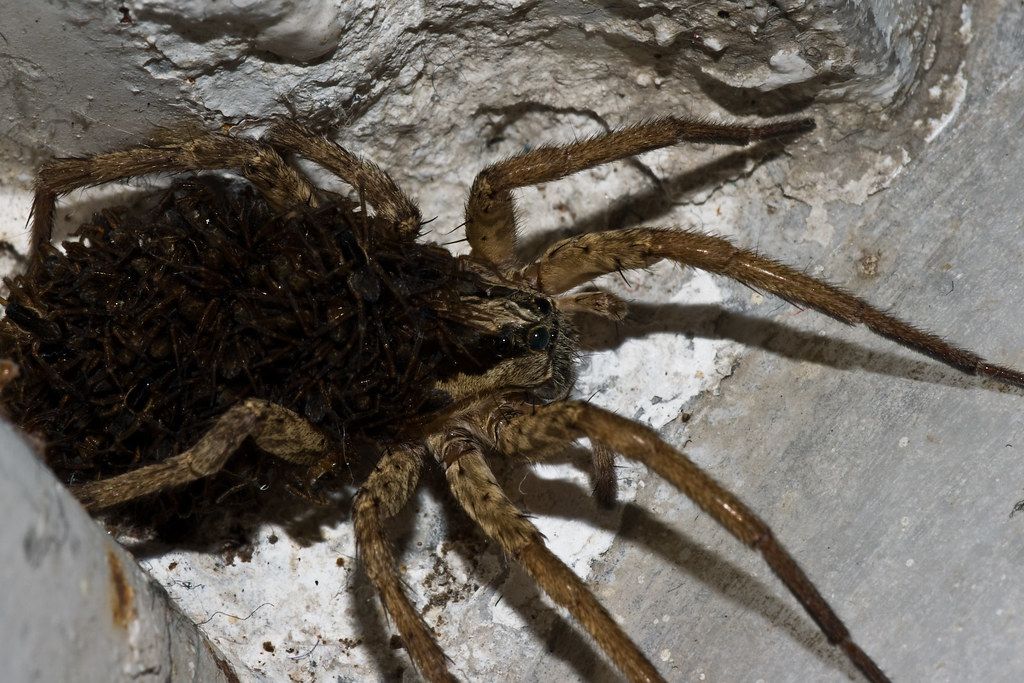
Photo: “Mother Spider” by agelakis is licensed under CC BY-NC-SA 2.0.

Odd poem: Parody of a Self-Parody of a Self-Parody: Melissa Balmain, ‘How Unpleasant to Meet Mrs. Hughes’

From the files of Sylvia Plath

How unpleasant to meet Mrs. Hughes,
Who’s so thoroughly, willfully odd.
It’s a wonder Ted happened to choose
Such a creature. (He’s rather a god.)

Her lipstick is always a mess.
She’ll go on for an hour or three
About Nazis or bees—as you’d guess,
This does not get her asked out to tea.

Her headbands aren’t quite comme il faut.
(They’re a match for her queer Yankee frocks.)
She knows more than a lady should know
Of low-voltage electrical shocks.

Come to think of it, lately she’s been
More appalling than ever before.
She looks sullen and terribly thin;
If you knock, she won’t answer the door.

Her complexion grows whiter and whiter.
She wears the most horrible shoes.
You can certainly tell she’s a writer.
How unpleasant to meet Mrs. Hughes!

*****

Melissa Balmain writes: “I believe this one started when a contest—probably in The Spectator—called for poems riffing on Edward Lear’s self-mocking ‘How Pleasant to Know Mr. Lear’ (and T.S. Eliot’s equally self-mocking parody of it). I found it funny and sad to imagine Sylvia Plath writing about how her English neighbors might see her. The poem was published in Mezzo Cammin.”

Melissa Balmain’s third poetry collection, Satan Talks to His Therapist, is available from Paul Dry Books (and from all the usual retail empires). Balmain is the editor-in-chief of Light, America’s longest-running journal of light verse, and has been a member of the University of Rochester’s English Department since 2010.

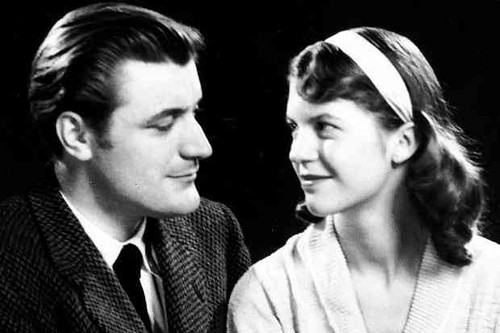
Photo: “TED HUGHES AND SYLVIA PLATH” by summonedbyfells is licensed under CC BY 2.0.

Susan McLean, ‘Morbid Interest’

How unpleasant to meet Mr. Poe.
It gives a young lady a chill
when, just as she’s saying hello,
he asks if she’s lately been ill.

It was mid-afternoon, yet he seemed
to be tipsy or mildly sedated.
How oddly his mournful eyes gleamed
when he heard that we might be related.

He muttered some rhymes for my name,
saying nothing could be more inspiring
to a poet desirous of fame
than the sight of young beauties expiring.

Then he asked if I had a bad cough
or a semi-conversable crow.
I informed him of where to get off.
How unpleasant to meet Mr. Poe.

*****

Susan McLean writes: “In my teens, I was a big fan of Edgar Allan Poe‘s short stories and poetry. I loved his eerie subjects and crooning, incantatory lines. I memorized his poem ‘To Helen,’ and I parodied his iconic ‘The Raven.’ But in grad school, I read his essay ‘The Philosophy of Composition,’ in which he wrote that “the death . . . of a beautiful woman is unquestionably the most poetical topic in the world.” Hmmm. At that moment, it occurred to me that all of those dead women of his stories and poems might be less an outpouring of personal grief and more a product of an agenda. Years later, when responding to a challenge from the British journal The Spectator to write a poem modeled on Edward Lear’s ‘How pleasant to know Mr. Lear‘ but about another author, I imagined how Poe might seem to a young woman being introduced to him.
This poem, which was originally published in Light Quarterly, was later reprinted in Per
Contra
and in my second poetry book, The Whetstone Misses the Knife.”

Susan McLean has two books of poetry, The Best Disguise and The Whetstone Misses the Knife, and one book of translations of Martial, Selected Epigrams. Her poems have appeared in Light, Lighten Up Online, Measure, Able Muse, and elsewhere. She lives in Iowa City, Iowa.
https://www.pw.org/content/susan_mclean

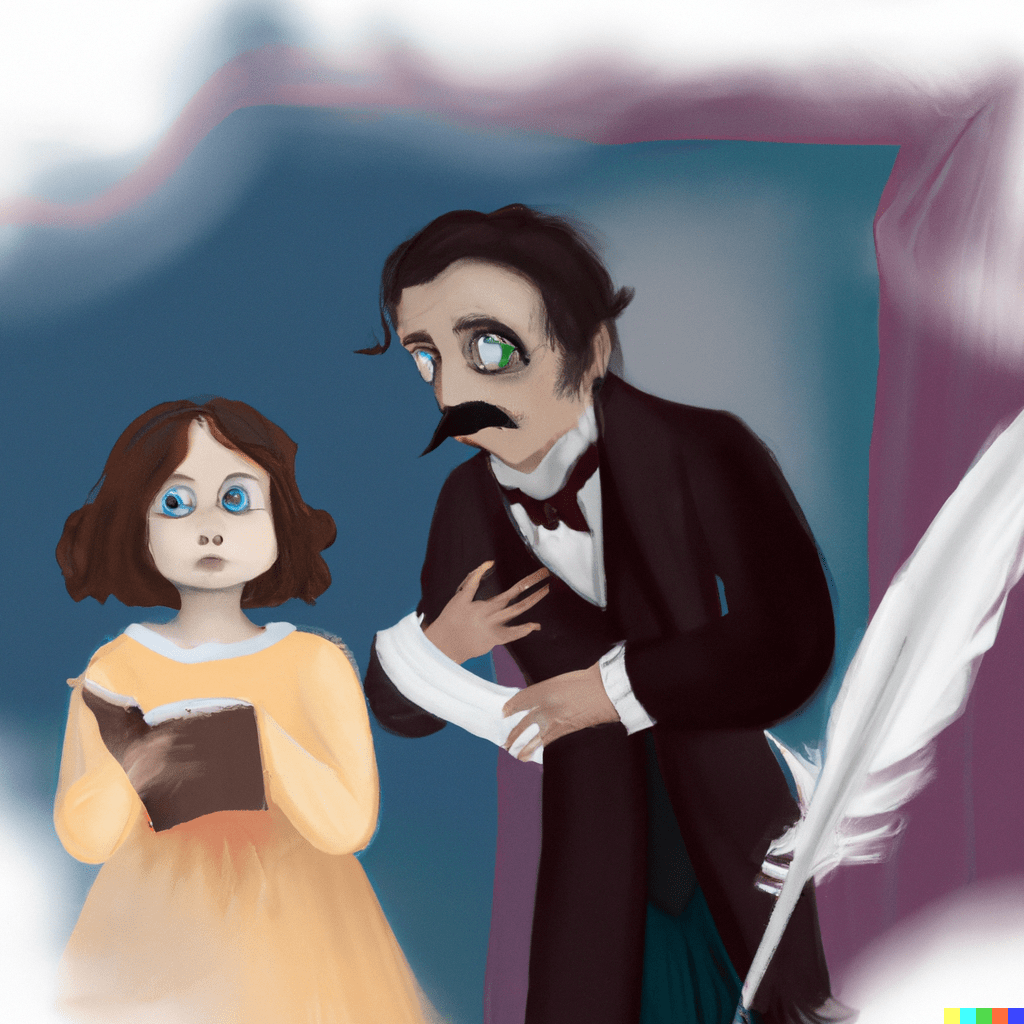
Illustration: DALL-E

Susan McLean, ‘Rules for Love’

Don’t wear make-up, ever. Don’t act girly.
Don’t collect shoes or shop until you drop.
If your hair is straight, don’t make it curly.
Don’t play dumb or play his games. Don’t stop
reading or saying what you think. Don’t flatter.
Don’t claim that you love football if you don’t.
Don’t sidestep. Don’t pretend it doesn’t matter
if he puts down your friends or if he won’t
do his fair share of housework. Do your best
to give your talents scope and free his own.
Grill steaks; eat chocolate. This is not a test.
If he won’t love you, you’ll do fine alone.
Sex is a bonus. Give as good as you get,
but make it clear you don’t intend to marry.
Love what you have, and what you don’t, forget.

These worked for me. (Your own results may vary.)

*****

Susan McLean writes: “This poem got its start in answer to a contest at the magazine The Spectator in the UK for a poem about “rules for love.” The words rules and love don’t normally go together, because love is something that often seems to break all the rules. Yet most people have their own mental set of requirements for love, which they will not easily set aside, as well as an internalized list of dos and don’ts that they think are the way to achieve love. I found it entertaining to try to pin down some of mine, knowing that each person will have a different list. How often women run into articles in women’s magazines that purport to tell them exactly how to find lasting love! This poem tries to be funny by saying the sorts of things that would never appear in those articles. It was not among the winners at The Spectator, but it was a lot of fun to write. Trying to pin down one’s own rules for love produces an indirect self-portrait. The poem first appeared in my second book, The Whetstone Misses the Knife.”

Susan McLean has two books of poetry, The Best Disguise and The Whetstone Misses the Knife, and one book of translations of Martial, Selected Epigrams. Her poems have appeared in Light, Lighten Up Online, Measure, Able Muse, and elsewhere. She lives in Iowa City, Iowa.
https://www.pw.org/content/susan_mclean

Photo: “love rules” by hmmlargeart is licensed under CC BY-NC-ND 2.0.