Tag Archives: speculative fiction

Sonnet: RHL, ‘An Observation’

If particles only exist as waves,
precipitating out only when measured, seen,
till then just ghostly, nebulous, roughed-in…
If that’s the way the universe behaves,
then who’s to say the moons of Jupiter
existed before Galileo scoped
them out? Our simple world had coped,
pre-Hubbell, without needing to infer
a billion galaxies. Again, if things
newly observed are different than before,
then things that once were real are real no more,
especially nebulous, wave-form, with wings,
hence dragons, fairies, elves all now seem odd…
and angels, demons, giants, ghosts… and God.

*****

This sonnet was recently published in Bewildering Stories (thanks, Don Webb), and seems to have touched a chord with that issue’s theme of esse est percipi; so it leads off that week’s questions in the magazine:

  1. In Robin Helweg-Larsen’s An Observation:
    1. George Berkeley’s philosophy of Idealism is based upon the principle: “To be is to be perceived.” How does the theory of Quantum Physics support the principle of perception? Or does it?
    2. The poem concludes by listing a number of supernatural beings whose reality is implicitly denied as long as they have not been perceived. How does “God” differ — by definition — from the others in the list?
    3. By whom or what must something be perceived in order to exist? And how does a perception take place?

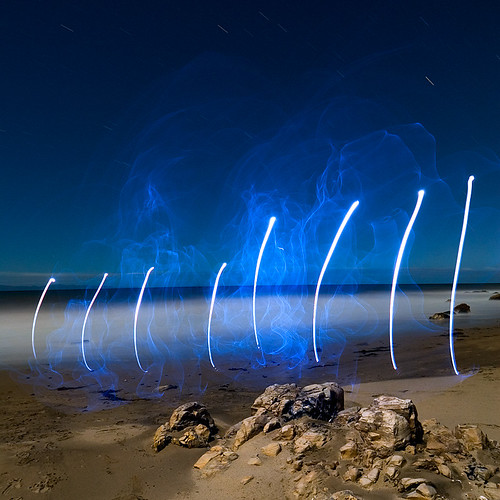
Photo: “Nebulous in Blue” by Toby Keller / Burnblue is licensed under CC BY-NC-SA 2.0.
Semi-formal: RHL, ‘Terminal’

Christian culture’s crucifixation
nails us to our seats as, station by station,
we travel the trammelled line
until we find
that terminal
more primal.

The humanstrain’s end-of-line stop
is Ragnarok.
Everyone please disembark
into the dark–
no light, no map.
Mind the Ginnungagap.

*****

This is as close as I get to religion: existential uncertainty. I’m a Militant Agnostic: “I don’t know… and neither do you!” Yet this attitude is apparently compatible with religion, being not that different from Eliot’s ‘East Coker‘:
O dark dark dark. They all go into the dark,
The vacant interstellar spaces, the vacant into the vacant,
The captains, merchant bankers, eminent men of letters

(…)
I said to my soul, be still, and let the dark come upon you
Which shall be the darkness of God.

But Christianity? I think not. Altogether too unlikely, with so many impossibilities packed into such a small understanding of the cosmos. We don’t know where we are headed, not just as individuals with finite lives, but as a species that is simultaneously developing space travel and genetic modifications… the possibilities are endless and the future, dark as well as light, is unknowable.

The poem is semi-formal with its loose iambics and paired rhymes or slant rhymes, but no structure beyond its natural flow. It was originally published in the Experimental section of a 2019 issue of Better Than Starbucks, and republished as part of work being spotlighted in The HyperTexts in August 2024.

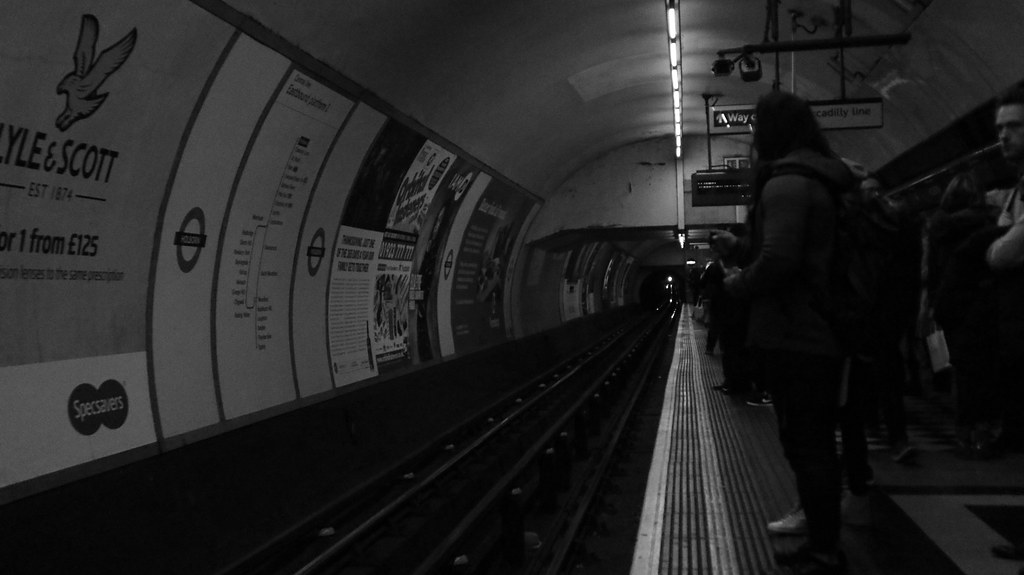
Photo: “London Holborn tube station in Black and White effect” by Patrick Cannon Tax Barrister is licensed under CC BY 2.0.

Sonnet: ‘Ultimate Control’ (from the series ‘Voices from the Future’)

If you’ve the aptitude and love the role,
the Army’s always been the place to be.
Rise in the ranks, absorbing strategy:
coordinate, consolidate, control.
And what a blessing when those new implants
gave mind-to-mind awareness… and command.
Like the unthinking fingers on your hand
you can maneuver thousands with a glance.
The battle then’s to see what you can wrest
from other leaders, fighting mind-to-mind;
you have to grow, or you get left behind:
can you control ten million, like the best?
Of would-be kings there’s never been a dearth…
will it be only one who rules all Earth?

*****

This sonnet has just been published in Pulsebeat Poetry Journal’s 3rd issue (thanks, David Stephenson!) It is one of a series written in response to a comment from Maryann Corbett (a brilliant formalist poet) about the bleakness of my vision of the future. Well, she’s a Christian, so she has a totally different take on humanity’s future from my irreligious SF-infused speculations. Another sonnet in the series, ‘Exiled Leader‘, was published by Star*Line.

I don’t find it bleak to think that there will be unprecedented individual and planetary disruptions. I’m not distressed at the thought of humans being supplanted some posthuman higher intelligence. Should the earliest rat-like mammals of 145 million years ago be upset to learn that their human descendants build cities and kill any rats they find in them? Should they identify only with the familiar rats and wish that evolution had stopped there, or instead be proud that they have also developed into humans (and dogs, and whales, etc)?

For myself, life is a wild ride, and I long to see where it will take humans in a hundred or in a thousand years. Because of the current revolutions in genomics, robotics, AI and nanotechnology, I doubt we can reasonably forecast even a hundred years into the future. We can speculate all we like but once we merge a human with AI, create a cyborg, all bets are off.

20120401 – Hand – IMG_2898” by Nicola since 1972 is licensed under CC BY-NC-ND 2.0.

Poetry Resources: Bewildering Stories. Poem: “When at the End”

Bewildering Stories is a weekly magazine of sf and speculative fiction (mostly) and poetry (some), created and managed by Don Webb and half a dozen others. Because it does a Quarterly Review and an Annual Review of the editor’s choice, it produces about 47 issues a year of original material (or predominantly original – it allows previously published material). It is now coming up on issue number 800. I’ll leave it to you to figure out how long it has been in existence… for an online magazine, it is truly venerable.

I often have a poem in Bewildering Stories, and this week is no exception: “When at the End – Wishful Thinking“:

“When at the end of life we who by swords, axes, cleavers
go as heroes to Valhalla, the rest go to Hel.”

“When at the end of life we the true believers
go as saints to Heaven, the rest go to Hell.”

“Our memory is all that we are.
When at the end of life we are remembered,
we still exist for as long as our memory lasts.
Remember us! We are no more than memories of our pasts.”

When, at the end, the helmet of this life is lifted away,
the Virtual Reality of “human” fades to grey,
will you find yourself in a world fresh, rich and deep,
an environment more meaningful, truer, greater?
(And is it somewhere you go even now, in sleep?)
Surely behind the simulation must be a Simulator.

It accepts formal and informal verse, being more concerned with the speculative nature of the ideas than with an aesthetic preference. The poem above is pretty much a sonnet, though the scansion is uneven, the rhyme scheme unorthodox and the rhymes themselves iffy (beginning with rhyming Hel with Hell). So not a very aesthetic product, but full of speculation – which is the priority.

The editorial board is diverse, Don being based in Canada but drawing on others in the UK and US. Submissions of course can come from anywhere. And another nice thing that Don does is to include “Challenge questions” about a number of the pieces in each issue. The answers from readers are not typically shared, but it is a nice way of provoking more thought.

Altogether a worthwhile magazine for poets as well as fiction writers.