Tag Archives: suicide

Using form: unrefrained Villanelle: Alexis Sears, ‘On Turning Twenty’

One afternoon, my father chose to die.
He was like, See ya later, guys. I think
I understand, since I don’t know if I

can hang, myself. But hang myself? (Don’t try,
they whisper, spooked.) Too young to buy a drink,
but old enough to snatch one from a guy

who says, “I’m married, but–” His twinkling eye
is trained, you know, to tell me with a wink
I’ve made the cut. One hand explores my thigh,

the other fingering a Miller. Why
are men so callous? Nowadays, I sink
beneath the comforter. I’ll never cry

because my lover’s lover’s lovely–Thai,
with toned and skinny limbs, her cheekbones pink
and angular. Ohio girl, a Buckeye.

I’m from a land where bleach blond angels fly.
Beneath the moonlight, friends and I will clink
our cups; my wondrous-child eyes defy
adulthood, till I sip. It’s bitter, dry.

*****

Editor: The poem was originally prefaced with “There are those who suffer in plain sight. – Randall Mann”

Alexis Sears writes: “I wrote this poem on the eve of my 20th birthday; nearly a decade later, I still hold it dear. ‘On Turning 20’ made me realize that what I had to say may have been more meaningful than I’d thought.”

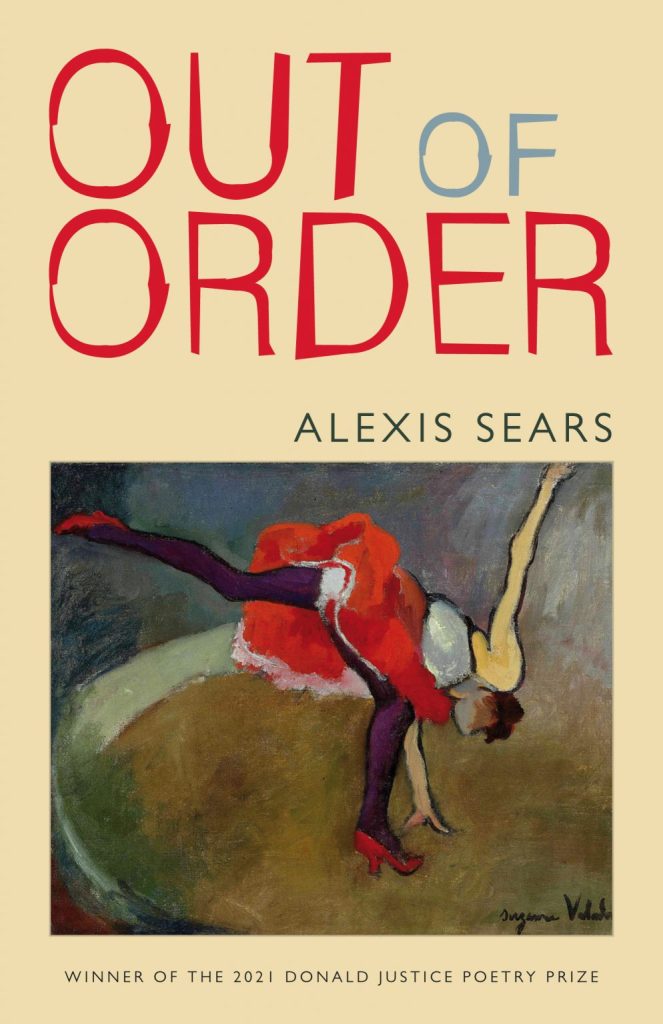
Alexis Sears is the author of Out of Order (in which this poem appears), winner of the 2021 Donald Justice Poetry Prize and the Poetry by the Sea Book Award: Best Book of 2022. Her work appears in Best American Poetry, Poet Lore, Cortland Review, Cimarron Review, Rattle, and elsewhere. She earned her MFA in poetry from the University of Wisconsin-Madison and her BA in Writing Seminars from Johns Hopkins University. Editor-at-Large of the Northwest Review and Contributing Editor of Literary Matters, she lives in Los Angeles.
https://www.alexissears.com/
Odd poem: Abraham Lincoln, ‘The Suicide’s Soliloquy’

Here where the lonely hooting owl
Sends forth his midnight moans,
Fierce wolves shall o’er my carcase growl
Or buzzards pick my bones.

No fellow-man shall learn my fate,
Or where my ashes lie;
Unless by beasts drawn round their bait,
Or by the ravens’ cry.

Yes! I’ve resolved the deed to do,
And this the place to do it:
This heart I’ll rush a dagger through,
Though I in hell should rue it!

Hell! What is hell to one like me
Who pleasures never knew;
By friends consigned to misery
By hope deserted too?

To ease me of this power to think,
That through my bosom raves,
I’ll headlong leap from hell’s high brink,
And wallow in its waves.

Though devils yell, and burning chains
May waken long regret;
Their frightful screams, and piercing pains,
Will help me to forget.

Yes! I’m prepared, through endless night,
To take that fiery berth!
Think not with tales of hell to fright
Me, who am damn’d on earth!

Sweet steel! come forth from out your sheath,
And glist’ning, speak your powers;
Rip up the organs of my breath,
And draw my blood in showers!

I strike! It quivers in that heart
Which drives me to this end;
I draw and kiss the bloody dart,
My last—my only friend!

This poem was published anonymously in the April 25, 1838 edition of The Sangamo Journal of Springfield, Illinois, under this introduction: “The following lines were said to have been found near the bones of a man supposed to have committed suicide, in a deep forest, on the Flat Branch of the Sangamon, sometime ago.” For various reasons it is now commonly assumed that this is the poem that Lincoln’s friend Joshua Speed told Lincoln’s biographer William Herndon about, a poem that the President had written on suicide as he struggled through a period of deep depression.

A full discussion of the identification of the poem with Lincoln can be found in the magazine Shenandoah, and I happily quote their assessment of Lincoln’s merits as a poet:

The poem is similar to other mortality poems of the period, though even more melodramatic than most (the last stanza, in which the speaker continues to narrate his feelings after he has stabbed himself through the heart, is particularly painful). Aside from the historical curiosity of its authorship, the piece—with its glamourizing of suicide and its overwrought morbidity—does little to distinguish itself from other amateur poetry in the school of Poe.

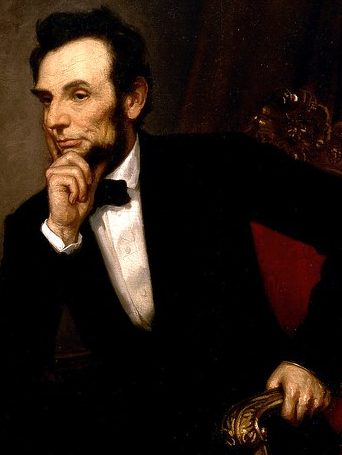
Photo: “16 Abraham Lincoln” by US Department of State is marked with CC PDM 1.0

Political poems: Byron on Castlereagh

Posterity will ne’er survey
a Nobler grave than this:
Here lie the bones of Castlereagh:
Stop, traveller, and p*** !

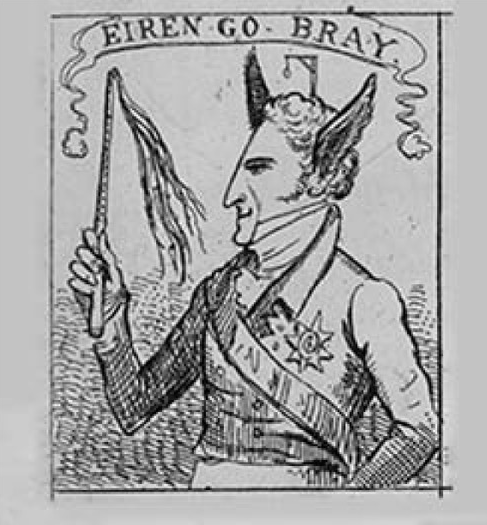
Robert Stewart, Viscount Castlereagh (which rhymes with “pray”, if you choose to have that, rather than “piss”, as the last word of Byron’s little poem) was an Anglo-Irish politician who managed to make himself throughly hated.

Though generally in favour of concessions to the Irish he did not support Catholic Emancipation from the discrimination and civil disabilities they suffered under as disenfranchised second-class citizens. He took the lead in suppressing the Irish Rebellion of 1798; he advocated leniency to the common people but had leaders executed – including a Presbyterian minister who had canvassed for him in an election. From 1812 to 1822 he was the British Foreign Secretary, instrumental in managing the alliance that defeated Napoleon; and then at the Congress of Vienna, with the conservative Bourbons back on the throne of France, he advocated leniency for France and non-intervention by the UK in European affairs – which was seen as siding with the repressive Eastern European powers. This is from the ‘Dedication’ to Byron’s ‘Don Juan’:

Cold-blooded, smooth-faced, placid miscreant
Dabbling its sleek young hands in Erin’s gore,
And thus for wider carnage taught to pant,
Transferred to gorge upon a sister shore
The vulgarest tool that Tyranny could want,
With just enough of talent, and no more,
To lengthen fetters by another fixed,
And offer poison long already mixed.

Castlereagh’s suicide in 1822 further occasioned this from Byron:

Oh, Castlereagh! thou art a patriot now;
Cato died for his country, so didst thou:
He perish’d rather than see Rome en­slaved,
Thou cutt’ st thy throat that Britain may be saved!
So Castlereagh has cut his throat!–The worst
Of this is, – that his own was not the first.
So He has cut his throat at last!–He! Who?
The man who cut his country’s long ago.