Tag Archives: The Rotary Dial

Marcus Bales, ‘Suddenly’

Suddenly the kids, the car,
the house, the spouse, the local bar,
the work, have made you what you are.
What doesn’t chill you makes you fonder.

Should you stay or should you go?
The thrill you’re looking for, you know,
could be right here at home, although
what doesn’t thrill you makes you wander.

If, avoiding common truth,
you dye your hair and act uncouth,
will you find your misplaced youth –
really, will you if you’re blonder?

It doesn’t matter if you’re strong
or if you sing a pretty song,
something, and it won’t be long,
will come to kill you, here or yonder.

You’re human in the human fray,
and choose among the shades of grey.
No matter if you go or stay
what might fulfill you makes you ponder.

*****

Marcus Bales writes: “This is a little more than a decade old, back when I still had a full time job. There is something looming in a life about a full time job that’s hard to escape entirely even when you’re determined to try. Must have been a bad day on the sales floor.

“This is one of those poems where a rhythm enters my mind and won’t go away until I put words to it. Of course it already HAD words to it, but I couldn’t use those. So after one quatrain it became a challenge to see how many of that refrain rhythm it was possible to make sense with. That’s actually sort of freeing, because once that becomes the challenge, it opens the poem, for me anyway, to using the randomness of the rhyme words, as they arise, to drive each stanza’s, and thus the whole poem’s, sensibility. This is a good example of how the aleatory dice of rhyme can be used to open up opportunities to say things I wouldn’t have thought of to say at all without having to work toward the rhyme word. This can be very bad for a poem, of course — one of the main ways to judge poems in meter and rhyme is on how hard it is to tell whether the poet was using the rhyme words that way or not. The goal, of course, in almost all rhyme, is to delicately decorate the poem rather than for it to be clear that the poet was merely chasing a rhyme. And when there’s a rhyming refrain line the danger is extreme.

“I remember being pretty happy with it at the time. I do like the way something seems to loom over the narrator, pressing him onward through his meditation, and providing, I hope, the reason that meditation is needed.”

‘Suddenly’ was first published in The Rotary Dial, which is now offline… but this issue, the Best of 2015, is at https://midnightlanegalleryii.wordpress.com/wp-content/uploads/2014/10/7c8e9-december15.pdf

Not much is known about Marcus Bales, except he lives and works in Cleveland, Ohio, USA, and his work has not appeared in Poetry or The New Yorker. His latest book is 51 Poems; reviews and information at http://tinyurl.com/jo8ek3r

Photo: “Decisions decisions ..” by monkeywing is licensed under CC BY 2.0.

Ballade variant: Johnny Longfellow, ‘Like Normal People Do’


Ya’ ever wanna go someplace?
I mean…jus’ disappear.
Leave ev’rythin’. But, leave no trace.
Git your ass out o’ here
To somewhere – could be far or near –
Where you’re no longer you.
Where you can dwell, year after year,
Like normal people do.

Ya’ ever stare at your own face
But still can’t see it clear? –
Ya’ struggle hard jus’ keepin’ pace,
While neighbors, they all steer
‘Tween college, marriage, an’ career,
‘Til – somehow coastin’ through –
They barbeque, an’ drink col’ beer
Like normal people do…

Ya’ ever think they won that race,
But still, fall prey to fear
Them dreams ‘n’ rainbows they all chase,
Once gone, won’t reappear?
Or, do they jus’ choke back each tear
As one beer turns to two,
Findin’ it’s Hell to persevere
Like normal people do?

Ya’ see? You ain’t the first to veer
Off course. That much is true.
Or, last to lose all you hol’ dear
Like normal people do.

*****

First published in The Rotary Dial, Issue 34, December 2015 – best dial poems of 2015

Johnny Longfellow writes: “I’ve discussed the personal circumstances that partially inspired this poem in interviews at the Talk with Me podcast and at the now defunct Sonnetarium, both of which can be linked to in the bio below. So, I’ll just note here, the poem was written roughly six months after a heavy bout of depression. During said bout, I inadvertently stumbled upon The Geographies of Missing People website, hosted by Glasgow University, wherein I took special interest in their Stories of Missing Experience page. Listening to those mashed-up accounts of people who’d elected to go voluntarily missing was profoundly helpful to me during a dark period in my life. With that, I can only recommend to anyone going through a similar period in their own lives that they consider listening to those accounts. For, I can confidently say they helped inspire in me more than just a poem.”

Johnny Longfellow is a poet from Massachusetts. His work has appeared in The Five-Two, The Literary Hatchet, Misery Tourism, Punk Noir, and other fine literary venues, with more work forthcoming in Form in Formless Times. You can learn more about both him and his poetry at Heeeeeeere’s Johnny . . . Longfellow, that is.   

Photo: “Missing Persons” by ChiralJon is licensed under CC BY 2.0.

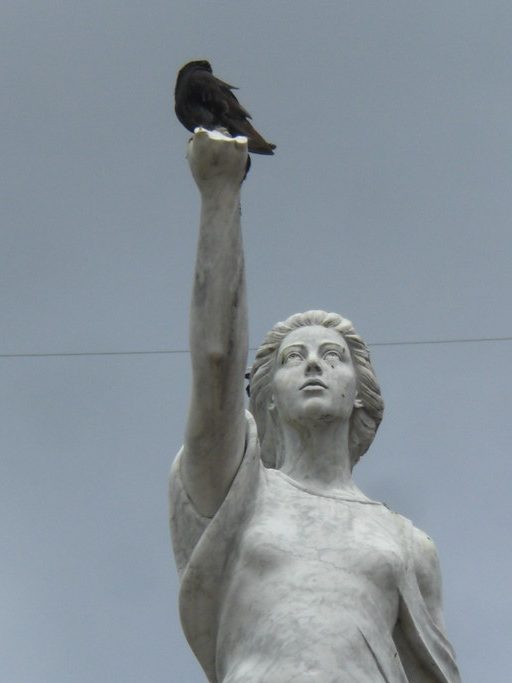
Melissa Balmain, ‘Bird in the Hand’

It doesn’t caw or hunt or fly.
It can’t peck anybody’s eye,
or even grow a single lousy feather.
One-clawed, no match for any tom,
it’s stranded on a leafless palm,
regardless of the season, time or weather.

Yet what’s the bird that, all alone,
sticks up for you when gibes have flown
and you don’t care to verbalize or linger;
when someone’s mocked you to your face
or cut you off or swiped your space –
what bird? The one that moonlights as a finger.

*****

Melissa Balmain writes: “I’m pretty sure this would have been the Sphinx’s riddle if she had guarded the Brooklyn Bridge.”

‘Bird in the Hand’ was first published in The Rotary Dial and is collected in Walking in on People © Melissa Balmain, 2014. Used by permission of Able Muse Press.

Melissa Balmain’s third poetry collection, Satan Talks to His Therapist, is available from Paul Dry Books (and from all the usual retail empires). Balmain is the editor-in-chief of Light, America’s longest-running journal of light verse, and has been a member of the University of Rochester’s English Department since 2010. She will teach a three-day workshop on comic poetry at the Poetry by the Sea conference in Madison, CT, in May 2024.

Photo: “A bird in hand” by Whatsername? is licensed under CC BY-SA 2.0.

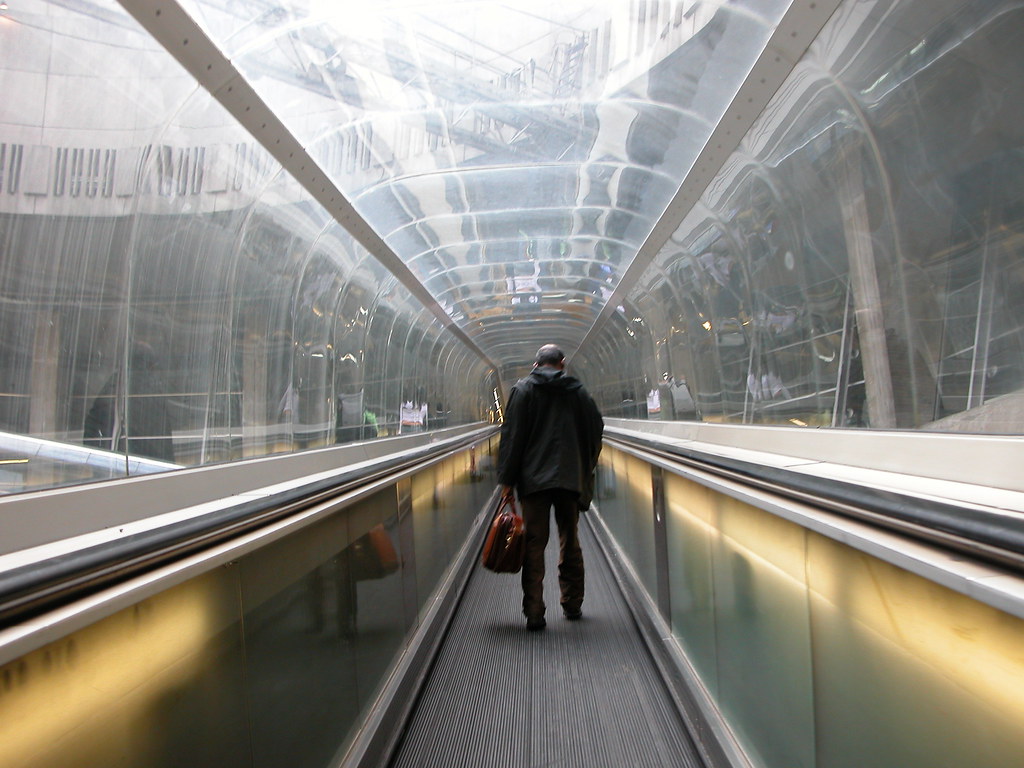
Poem: ‘The Future as CDG Terminal 1’

The future is a long low passage,
Whitewashed, undulating,
A moving forward-flowing track,
No chance of going back.

The future has no message,
Its ads are guides only to the past,
Misleaders, redesignposts,
Echoes, undefined ghosts.

The future is travelled without presage,
Always onward, none comes back.
Predestination without destination.
Stationary or walking, you’ve no final station.

The future goes on until you get off.
I won’t. I will not to get off.

This poem (set in Charles de Gaulle airport’s people-mover) is halfway to being a sonnet: it has three sets of four lines and a final couplet, and its lines are not far from being tetrameters or pentameters. But the rhyme scheme is idiosyncratic: abcc adee afgg hh. But even that is being kind: the last couplet doesn’t rhyme, it just repeats its end words.

And yet, mishmash though it is, it was published in The Rotary Dial, Canada’s leading formal poetry publication for the few years of its incandescent life. So perhaps it is at least semi-formal poetry.

“sba-cdg85” by dsearls is licensed under CC BY 2.0