a bored and haughty wife, now sidelined and abeyed,
half-pivoting within a flood-tide of brocade,
smiles at the black-skinned boy who bears her dress’s train.
final tercet of the French sonnet “The Dogaressa” by
José-Maria de Heredia (1842–1905)
Veneto, black-skinned boys, and trains:
	displaced by devastation,
young Africans with pluck and brains
	revive that combination.
They search these railcars for remains
	of others’ dislocation,
like gleaners seeking fallen grains —
	a task of desperation.

Before each stop, the train brakes grind.
	We pause. We recommence.
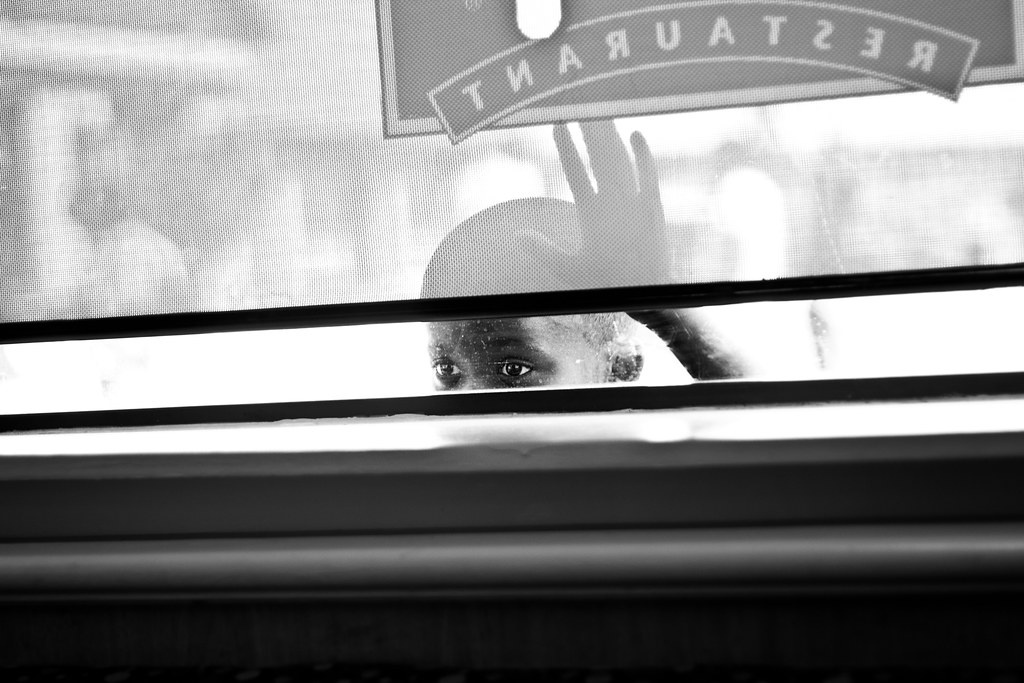
A boy appears, as if assigned.
	His scrutiny’s intense.
He scans for objects left behind
	through lack of care or sense.
(I guess. I’ve yet to see one find
	a bit of recompense.)

We stop. We go. The scene repeats,
	on every train we’ve taken.
The boy surveys the floors and seats
	for anything forsaken,
and — empty-handed still — retreats,
	his eagerness unshaken.
I’ve seen his clones on city streets.
	What trades do they partake in?

Some hold out cups to beg, although
	we blind, deaf crowds move on.
(They tug our heart- and purse-strings, so
	we play automaton.)
Some boys this age get pimped, I know.
	Some pilfer things to pawn.
The train brakes shriek. We stop. We go.
	Our boy’s come back. He’s gone.

He’s trapped in this recurrent dream.
	I feel I’m trapped here, too.
The other passengers don’t seem
	to see him passing through,
except a few who show extreme
	contempt (as I construe
their narrowed eyes’ attentive gleam).
	That, too, is déjà vu.

“A zodiac of sorts,” I muse:
	The Wailing One. The Doors.
The Kid who seeks what others lose.
	The Gaggle that ignores.
The Watchdog ready to accuse
	young scapegoats it abhors.
And I, the Poet, prone to use
	portentous metaphors.

Again, these constellations wheel.
	Again, I contemplate
commuters’ faces, which reveal
	obliviousness or hate.
Another horrifying squeal.
	Another hurried wait.
Another search. How must he feel,
	this boy, about his fate?

Though circumstances brought him here,
	not slavers, is he free?
He scrambles just to live, it’s clear,
	although he ought to be
in school. He’ll be no engineer.
	No teacher. No M.D.
Survival is his life’s career,
	decides society.

I think what lives my children lead.
	I think of things I’ve read.
The long-dead voices that I heed.
	The headlines in my head.
The decadence. The waste. The greed.
	The desperate. The dead.
What choice was smooth-faced Ganymede
	presented with instead?

He rode to immortality,
	but did he have a say?
Consent’s a triviality
	to gods, some might inveigh,
and rape’s a technicality
	(defined the ancient way),
and pederasts’ carnality
	had stricter rules of play.

I know. But circumstances tore
	that kid from loved ones’ care
to Mount Olympus, where he bore
	the things that slave-boys bear.
And bears them still, forevermore.
	No beard, no death, can spare
young Ganymede, exploited for
	eternity up there.

No, no, he’s fortunate, insist
	some authors. He’s adored.
Complimented. Cuddled. Kissed.
	Ambrosia’s his reward
for having topped the favorites list
	of such a lofty lord.
The death we mortals face, he missed.
	That shouldn’t be ignored.

A palace slave is nonetheless
	a slave, and can’t decline
a burden, though it might oppress:
	a massive cup of wine;
the heavy train of someone’s dress
	who thinks herself divine;
the weight of knowing each caress
	means mainly “This is mine.”

The dogaressa eyes her toy.
	Her property. Her pet.
Some see in him what might destroy
	stability — a threat.
But I behold a human boy
	ensnared in power’s net.
What games his owner might enjoy
	will fuck him up, I bet.

But maybe I misjudge her smile.
	I view it through the prism
of factors I must reconcile,
	like French conservatism,
a splash of Afrophobic bile,
	and anti-feminism.
Perhaps she’s not a pedophile.
	(Forgive my skepticism.)

Perhaps she smiles because she’s kind
	(though labeled “bored” and “haughty”).
Perhaps the lady’s too refined
	to have a thought that’s naughty.
The dots connected in my mind
	to Ganymede are dotty,
perhaps. To me, though, they’re combined.
	These points are not staccati:

Aquarius, the catamite
	within the Zodiac;
a twisted queen who claims the right
	to toy with pawns; this black —
and therefore foreign — youngster’s plight,
	forever circling back
in search of luck. These trains unite
	on thought’s recursive track.

He’s African. He’s Syrian.
	He’s Phrygian. He’s Rom.
He’s Asian. He’s Nigerian.
	He’s white, but can’t go home.
His bedroom is empyrean:
	its roof is heaven’s dome.
His cup’s part full, in theory. In
	it? Coins. It’s styrofoam.

He’s Ganymede, collectively,
	yet every clone’s unique.
They all seem doomed to tragedy,
	but don’t mistake mystique
and myth for how things have to be.
	Inertia’s prospect’s bleak,
but railroad cars and history
	change course with friction’s shriek.

He’s made it to the Occident.
	(Let’s pause now to salute
ourselves, and our enlightenment.)
	His homeland tried to shoot
and starve him. He should be content
	he didn’t drown en route.
He’s lucky! Don’t misrepresent
	the fact he’s destitute.

Some myths should really be revised.
	Some fictions should appall.
When those who claim they’re civilized
	spew racist vitriol,
and orphaned kids are demonized
	by oligarchs, we all
should spot the pattern, unsurprised.
	The writing’s on the wall.

The doorway yawns. I stiffly rise
	on travel-swollen feet.
At noon, I crossed the Bridge of Sighs;
	my daytrip’s now complete.
The train goes on, with one surprise —
	a monetary treat
for hopeful, homeless, hungry eyes —
	between one wall and seat.
*****
“In 2016, while an estimated 363,348 refugees and other migrants successfully crossed the Mediterranean to reach Europe, an additional 5,136 people who attempted that journey were either confirmed drowned or reported missing (Source) — still a record now, ten years later.
“New installments of that ongoing tragedy were generating some of ‘the headlines in my head’ (Stanza 9, Line 4) in the summer of 2016, when I accompanied my mother on a 10-day Mediterranean cruise. We arrived in Padua a few days early so we could adjust to jet lag, and from there we made day trips by train to Ravenna and Venice before our cruise began.
“During our day in Venice, I was startled by the profusion of Moretto- or Blackamoor-themed luxury items I kept coming across, all gold-adorned: Jewelry. Doorknobs. Lamps. Tables. Atlas-like figures supporting architectural features. On the 9pm train back to our hotel in Padua, I pondered this centuries-old fascination with Blackness among Venetians of great wealth. My mind had just wandered to the little Black boy at the end of Heredia’s sonnet “The Dogaressa” when, as if on cue, a very dark-skinned African immigrant of about ten years old arrived for the first of his many hurried inspections of our train car.
“For the decade it took me to finish and find a home for ‘Ganymede in Northeast Italy (Veneto),’ that child has kept returning to my thoughts. Perhaps now he will haunt others’ thoughts, too.
“I am very grateful to David Stephenson for publishing this long poem in Pulsebeat Poetry Journal and to my fellow workshoppers at Eratosphere for telling me what wasn’t working in two earlier drafts over the years.”
*****
Julie Steiner is the pseudonym of a recovering classicist in San Diego, California. Her original poetry and verse translations from Italian, Spanish, French, Latin, and Greek have appeared in many venues — most recently, Light, Lighten Up Online, Literary Matters, The New Verse News, and The Ekphrastic Review. For links to some of these poems, visit her Substack, Off-Piste on Mount Parnassus (offpisteonmountp.substack.com).


 Form in Formless Times