Tag Archives: immortality

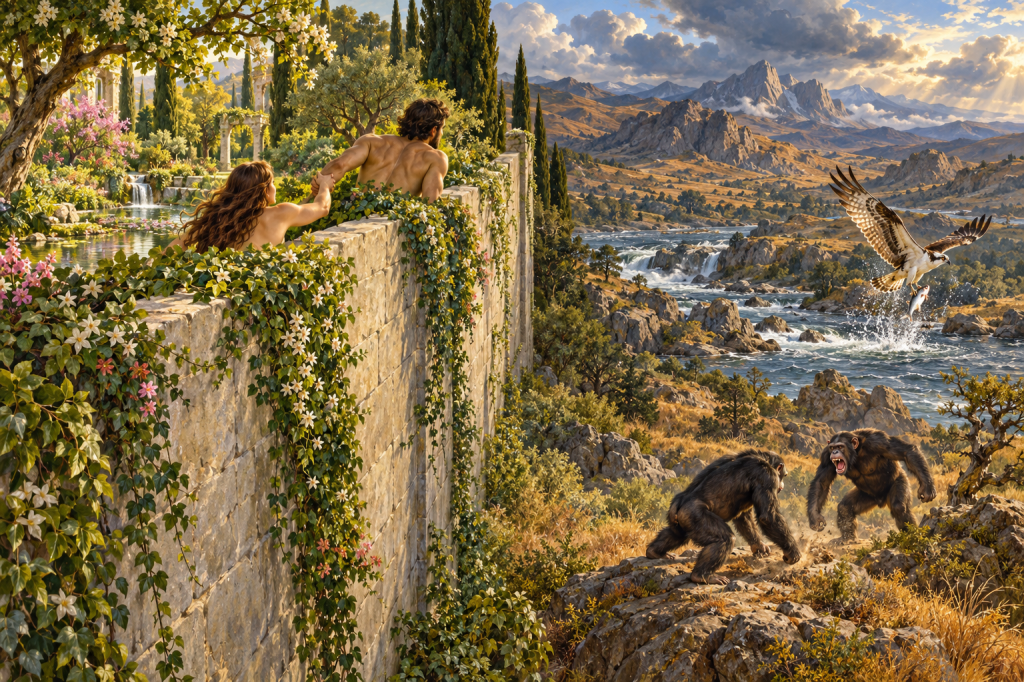
Sonnet: Amit Majmudar, ‘If Eve and Adam Never Fell’


it doesn’t mean two shlubs like you and me
would be in Eden with them. God knows I
am partial to a slice of apple pie
and grew up filching off a neighbor’s tree
the peaches he intended for his nieces.
How many generations would the ruse
have lasted? Theologians float their theses,
but sin’s a firecracker with a fuse

that heaven’s ghostly glow can light as well
as any spark that fountained out of hell.
Can’t speak for you, though I suspect I do,
I’d grow so bored, I’d climb the wall with you:
A derring-duo, deathlessness-defying,
we’d sneak out into all that lively dying.

*****

Amit Majmudar writes: “If Eve and Adam Never Fell” continues a long tradition for me. For a reason unknown to me, I have written obsessively for decades about the fall from the garden of Eden, in fact by sheer volume of work it comes in third behind the Ramayana story and the 1947 Partition of India among my recurrent themes. “Subtle Anatomy,” for example, is one of my first ever published poems, way back in 1999:

Subtle Anatomy
by Amit Majmudar

An arm is the spine of an angel wing,
cracked at the elbow. Webbed for gliding once,
we could leap off of cliff or bridge or tower
and saw no problem with a leap of faith.
What happened to it? Ask the suicide.
After the battle in heaven, the good angels,
precursors to the Turks who shamed their captives,
carved and carted off those wings—atrocious—
a mound of wings more chilling than a mound
of skulls: in this case, the contributors
could watch the ground tumor swell. So you see
we have some angel in us, even if
it’s the bedeviled kind, stripped of its wings
like a drunk pilot, out of service.

Before Eve met the serpent, she was fleshier
than even Rubens’s palette could stomach
and spineless, literally. The serpent
dove in her through the nest-hole anus
until the scorpion-stinger coccyx
slurped in too, and she sheathed him whole.
He straightened her, the breath in a balloon,
into this human posture of rebellion,
this upright and bipedal challenge.
Settled, the serpent sent nerves everywhere,
claiming each inch of her with senses.
Not with an apple but an apple’s taste
the serpent ruined her, fossilizing
to the vertebral column. So you see
we have some devil in us too
and dead center at that
commanding everything.

previously published in The Journal of the AMA

*****

Amit Majmudar’s recent books include Twin A: A Memoir (Slant Books, 2023), The Great Game: Essays on Poetics (Acre Books, 2024), the hybrid work Three Metamorphoses (Orison Books, 2025), and Things My Grandmother Said: Poems (Knopf, 2026). His forthcoming book is a novel, Cervantes in Chains (Slant Books, 2027).

‘If Eve and Adam Never Fell’ was first published in The Sonneteer

Illustration: RHL and GPT-6 Astra Light
RHL, ‘Cold Immortality’

The candle, blown out, still retains a spark;
Nor is it burnt up, though the room is dark.
No one cares. Its job is done.

But sparks could still rekindle into flame
Or stubs, restrung, redipped, refill its frame.
But not both things together.

Yet if the candle could keep sparks in wick,
We’d keep it live, remake it long and thick…
Continuous, unsevered.

Like Lincoln’s axe, whose haft’s been replaced thrice,
And the steel axe head changed out once or twice…
Same axe? Or stupid-clever?

Then keep some spark alive when I have ‘died’;
Freeze, then unfreeze, rebuild. No homicide
Of brain cells lost forever.

Come on, cryonics, sign me up, for one.
That’s immortality’s first step begun.
I would outlive the sun.

*****

I love this life, and am always interested to see how things are going to play out. Not interested in dying, but I’ve been fascinated by issues of death and extended lifespans since at least my teens; have been signed up with the Cryonics Institute for the last 30 years. Now with the rapidly increasing developments through AI, I hope we all soon reach the point where every additional year you live increases your life expectancy by more than one year, i.e. Longevity Escape Velocity. It’s coming, folks – hang on!

‘Cold Immortality’ was first published in a recent Bewildering Stories. Don Webb changed the title from just ‘Immortality’ – I’m not sure how much the addition of the word “cold” shifts the thrust of the poem… Certainly, cryonics is just an ambulance to the future, second-best to getting there unscathed.

“the beginning is nigh” by Adam Rummer is licensed under CC BY-NC-SA 2.0.

My own favourites: Sonnet: RHL, ‘Death Will Be Harsher Now’

Death will be harsher now, as, year by year,
we solve the clues of immortality:
emotions sink to animality
as false hopes tighten screws of desperate fear.
Hormone control will make age disappear—
after false starts, most horrible to see—
but those already old must beg to be
frozen for the genetic engineer.
While war, starvation, pipe Earth’s gruesome jigs,
successful businessmen will fight to gain
some dead teen’s body, to transplant their brain,
the already-old beg to be guinea-pigs.
Children, look back, hear our despairing cry:
we bred immortals, but we had to die!

*****

I wrote this poem on 3 January 1982 – twenty years before I began to get poems published. (Formal verse was an almost absolute no-no in late 20th century magazines… although consistently taught and highly praised in schools and universities, of course.) It was finally published in Ambit in October 2007 – the magazine started and managed for 50 years by Martin Bax and the stomping ground of J.G. Ballard, Ralph Steadman, Carol Ann Duffy, etc.

In April 2018 the poem was reprinted in Bewildering Stories, an online weekly headquartered in Guelph, Ontario; and in 2024 I accepted Maryann Corbett‘s suggestion to change the title and first line and instead of “harder” use the word “harsher”… the earlier word incorrectly suggesting that we might be finding it more difficult to achieve death.

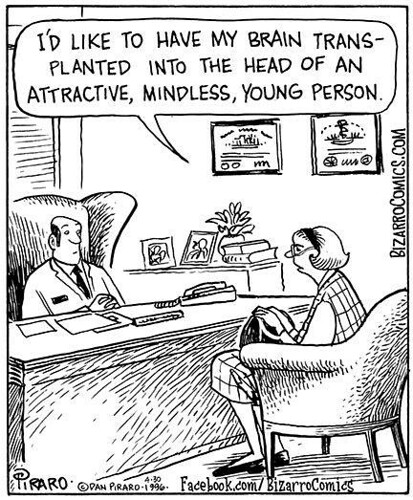
The ideas behind the poem were not new to science fiction, but were less common in formal verse. The ideas continue to inch their way towards reality; continue to be explored in popular culture (Piraro, Futurama…); and in the last 44 years I have continued to explore SF and existential themes in verse.


Cartoon: “piraro brain transplant” by Dreaming in the deep south is licensed under CC BY 2.0.

Sonnet: Matthew Buckley Smith, ‘Youth’

I miss believing that I’ll never die,
Or is it that there won’t be a tomorrow?
Both lines work out about the same: deny
The day you’ll have to pay back what you borrow.
It used to be I never went to bed
A second night with any girl I found.
No breakfast in those days–a smoke instead,
Then out the door before she came around.
Last night I passed a toppled garbage bin,
Its liner sagging with a rat’s remains.
He sank a little when I squinted in
And seemed embarrassed by his greedy pains.
And so much like a man, the way he sat
Still in his death, and so much like a rat.

*****

Matthew Buckley Smith writes: “I wrote most of Dirge” (his first book of verse, winner of the 2011 Able Muse Book Award. – Ed.) “in a summer. I was wading through a bad depression, and having written almost nothing but free verse to that point, I set myself the challenge of writing one sonnet a day for the rest of the summer. ‘Youth’ is a survivor of that experiment, written while walking late at night through the campus of Johns Hopkins on the way to the apartment of the woman who is now my wife.”

Matthew Buckley Smith is the author of Midlife (Measure, 2024) and Dirge for an Imaginary World (Able Muse, 2012). He hosts the poetry podcast SLEERICKETS and serves as Poetry Editor of Literary Matters.
https://www.matthewbuckleysmith.com/

Photo: “rats” by Lance McCord is licensed under CC BY-NC-SA 2.0.

Short poem: ‘Into the Cryonics Dewar’

We had no destination ever, from birth,
save into the ultimate ocean, or ultimate fire, or ultimate earth.
Now we have not quite so ultimate ice.
For now, it will have to suffice.

The chance of reanimation from cryonic suspension may be small, but still greater than the chance of reanimation after cremation or burial in land or at sea. And I guess we now have a fifth option – ending up off-planet, adrift in space. But in effect that will be a variant on “not-quite-so-ultimate ice”. In space you’d end up near Absolute Zero, as with cryonics – but whereas with cryonics there is the miniscule hope of eventual reanimation, in space your ultimate fate would be that of all space debris: drifting for millions of years until burning up into a star or planet, or getting sucked into a black hole.

Life, death, quite fascinating. Not many options for changing the outcome, though various billionaires are throwing some of their money at the search for immortality, as people have done since at least the time of the pharaohs and early Chinese emperors. And why not? think it’s “just science fiction”? For thousands of years we used to dream we could fly to the moon, and that happened eventually…

This poem was originally published in Snakeskin #274, July 2020. Thanks, George Simmers!

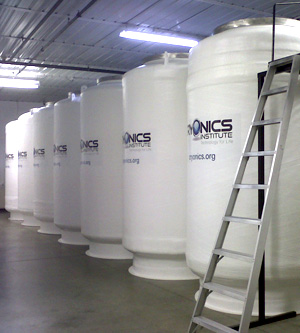
Photo: cryonics.org

Short poem: ‘Life Extension’

Religion leers
“Join me, or you face death”
And History jeers
“Inevitable death”,
But Science still adheres
To schemes to postpone death…
The path of a 1000 years
Starts with a single breath.

It’s interesting to speculate how long it will take before humans can start regenerating enough key pieces of our ageing and failing bodies that we can uncap our lifespan. A matter of decades rather than centuries, I think–but not soon enough for me, I fear.

The last sentence of the poem riffs on the Chinese saying attributed to Lao Tzu (also rendered as Laozi and Lao-Tze) that “The journey of a thousand miles starts with a single step.”

The poem was originally published in Bewildering Stories, a weekly of speculative writing of all types, edited by a multinational team but headquartered in Guelph, Ontario.

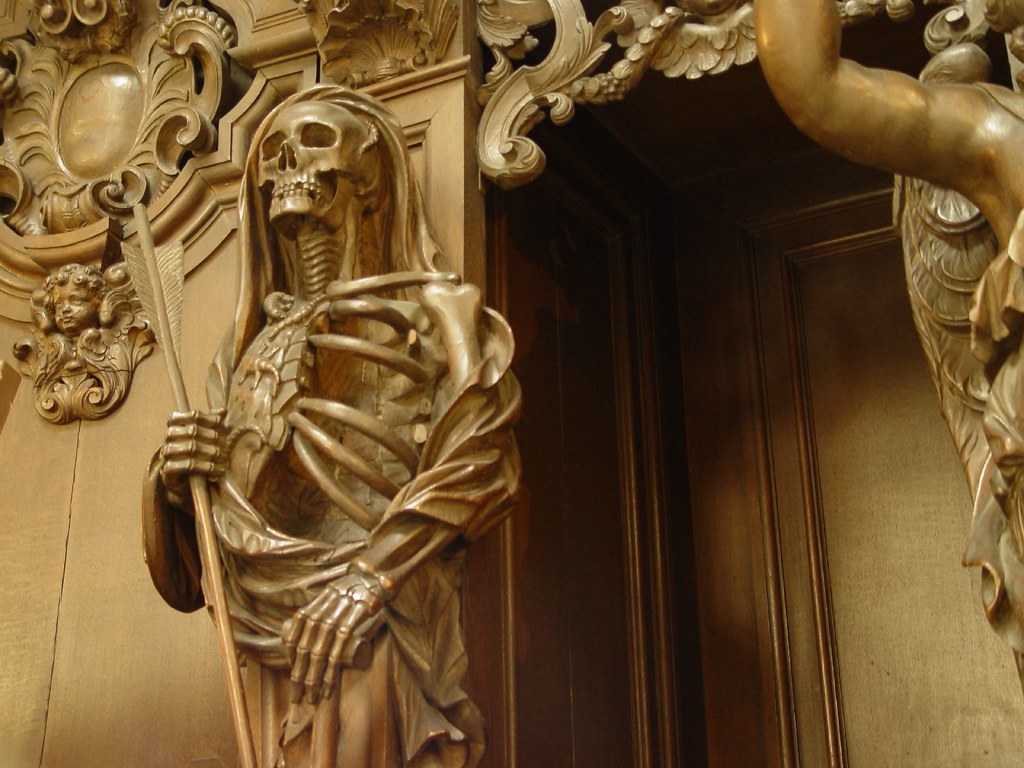
Photo: “Death” by Andrea Kirkby is licensed under CC BY-NC 2.0

Poem: ‘What Lasts?’

Munch’s Scream fades, and the Taliban
blow up the grandest statues that they can.
Safer are spoken treasures of the mind:
poems and songs outlast objects that rust,
or bust, or slowly crumble into dust.
Until from cave or dig comes some strange find…
but when Lascaux and Willendorf were young,
what was recited, or what songs were sung?

As regards “immortal” works of art… anything that is still respected in a hundred years is pretty good, anything still talked about after a couple of thousand years is doing very well… Songs and poems can manage that length of time, especially if connected a religion or other social ritual; but there is very little oral survival beyond that, and the survival of physical artifacts from tens of thousands of years ago is of the luckiest, perhaps of the lost or the most overlooked, not necessarily the best.

How wonderful if in the future we can recapture sounds from the Stone Age! At present there is no way to see how it could ever be done. But at least we have a few cave paintings and small carvings…

This poem was just published a short while ago in The Asses of Parnassus. Thanks, Brooke Clark!

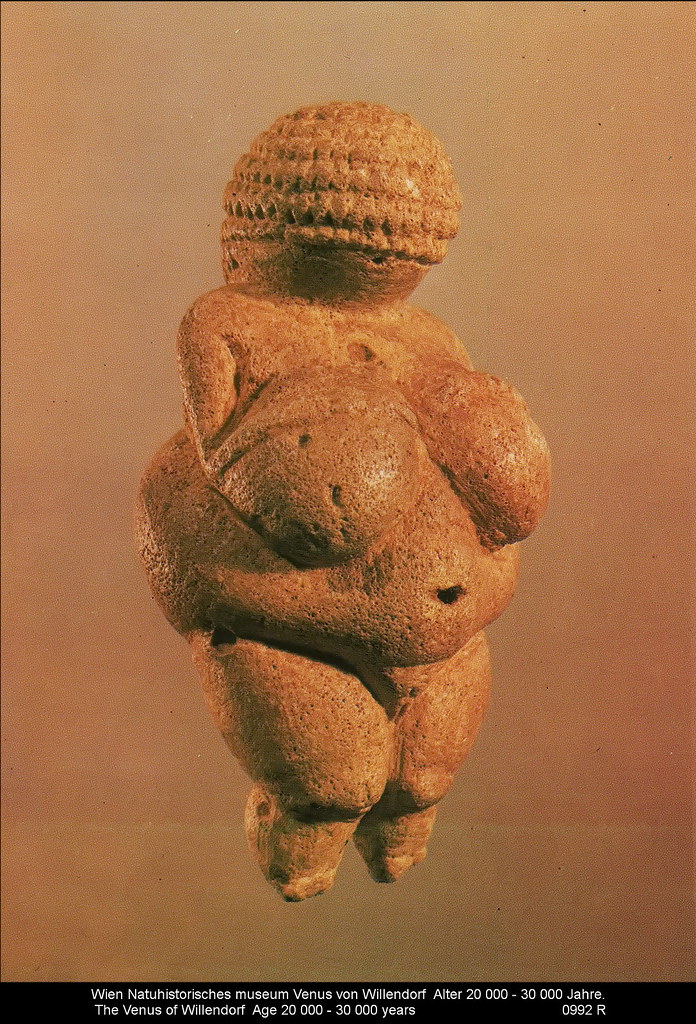
“Austria. Wien Naturhistorisches museum Venus von Willendorf. Die Venus von Willendorf ist eine Venusfigurine aus der jüngeren Altsteinzeit (Jungpaläolithikum), dem Gravettien, und ist als Österreichs bekanntestes Fundstück heute im Naturhistorischen Museum” by Morton1905 is licensed under CC BY-NC-ND 2.0

Sonnet: ‘Irritated Muse’

My muse is angered by my Covid cares –
“You worry if the shops have food and beer,
and what a Zoom attendee rightly wears!
You’re just as mortal as you were last year,
and wrote of life and death, sickness and health.
Well, now’s an actual existential crisis!
Think family and friends, the world, your self…
forget the shopping and the product prices!
You’ll die; the question’s When. The only tool
for immortality is me, that clear?
You should be writing poetry, you fool!
This is your chance. Focus on me.” (Yes, dear.)
“Respect me as your muse: I’m not your shill.
If you can’t write a poem, write your will.”

This sonnet has just been published in Allegro in the UK, edited by Sally Long. The magazine comes out twice a year, one issue themed and the other open. It focuses on formal verse, but on a long continuum between fully formal and free.

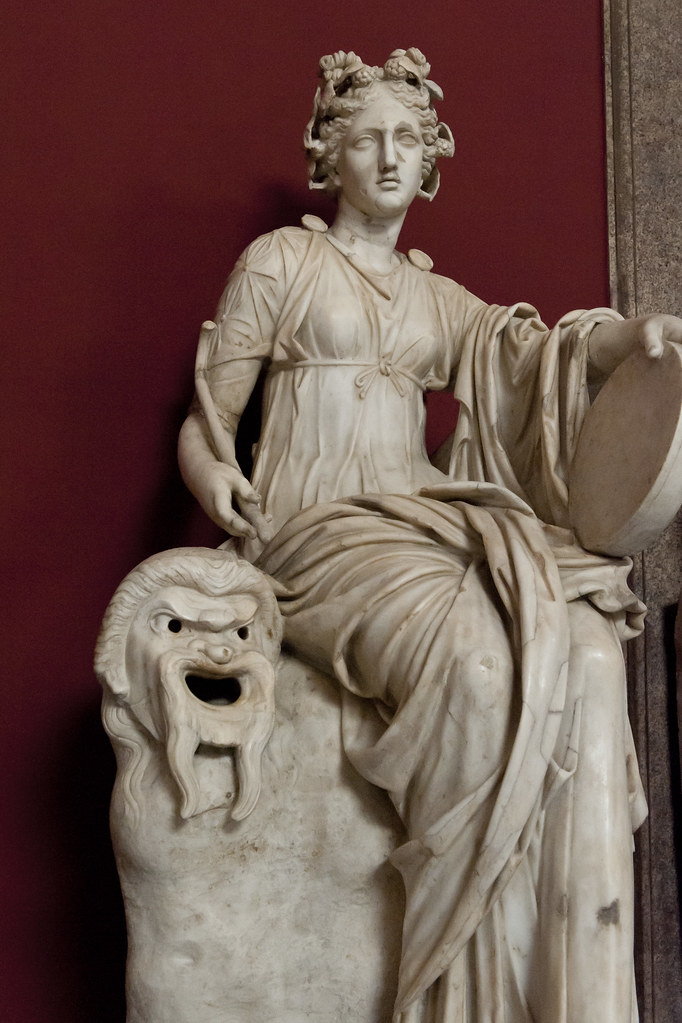
Photo: “Thalia, Muse of comedy.” by Egisto Sani is licensed under CC BY-NC-SA 2.0

Poem: “The Train Will Stop”

“The train will stop for ten minutes at the next station.
If you wish to make this your annual vacation,
please reboard in nine minutes.” The travellers gaze
at the countryside slowing past, consider ways
to take more than nine minutes for a break
but, looking down a slight curve in the track,
see no way to get out and back
nor a real reason they should take
the risk. The train will go…
and what else do they know?
They’ll stay till dropped
at some end stop.
Descend.
The end.

This little piece of existential angst appears in the current Bewildering Stories. It was written, submitted and accepted long before the current Covid-19 crisis came along, which it in no way relates to. In fact, in the awareness that we are all mortal and that everyone’s journey will have an end stop regardless, you might even say this suggests that in the Grand Scheme of Things the Covid-19 situation is trivial. The bigger issue is: eventually we all die. A solution to that would be far more dramatic than a successful Coronavirus vaccine.

Technically? Not a tightly formed poem – the initial lines are straggly, but as they shorten they tighten into iambics. The rhymes too are erratic, mostly in couplets but not quite. Not a perfect poem. Flippantly you could ask, In the Grand Scheme of Things and in the present circumstances, why should this matter? And the answer is, The level of artistic quality always matters; ultimately, it’s the most you can hope to achieve and be remembered by.

Sonnet: “Body Modding”

It starts with teeth, for even the healthiest:
Fillings put in, and “extra” teeth pulled out
Or realigned, the whole jaw moved about,
New faces for the kids of the wealthiest.
Tonsils, appendix, out. The stealthiest
Inject, use pills, every fluid reroute
With tourniquets, with tampons, condoms… flout
Flow, through to adult nappies. Atheist
As Science makes us with creative powers,
We add pumps, implants, radio, wires, chips,
Casually as tattoos, replacement hips;
Graft patchwork skin from humans, pigs, plants, flowers,
Joined in flamboyant Frankensteinish suture,
Racing against decay to cyborg future.

Like most of my sonnets, this was first published in Snakeskin. And like most of my sonnets, it has an existential theme. Ever since I was in high school (Stowe, a traditional British “public school” i.e. private school) and lost my belief in that Anglican school’s religion, I’ve been writing poetry about life and death. It’s a fascinating subject for those who are able to accept that death is inescapable except in religious fantasies, and science fiction, and the dreams of scientists out on the furthest limbs. Death may have proved universal so far, but so have the stories of the search for immortality in all the world’s cultures. Striving against death is part of what makes us human. And success will involve becoming something other than the humans that we are today.