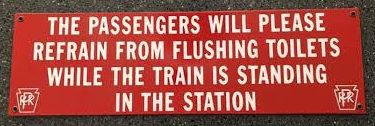
Passengers will please refrain
from flushing toilets while the train
is standing in the station.
*****
It is my (perhaps flawed) understanding that this particular wording originated in the UK. Signs instructing passengers to refrain from flushing toilets while at a station were widely used in the UK throughout the mid-20th century, specifically from the nationalization of British Railways in 1948 through the 1960s. The signs were a standard fixture in passenger carriages, typically made of cast iron or enamel for durability. The signs began to disappear as British Rail modernized its signage in 1965, and gradually replaced older rolling stock with newer models.
At the time these signs were posted, British trains utilized a “hopper” or “direct discharge” system: toilets consisted of a simple chute or a water-flushed system that emptied human waste directly onto the railway tracks. Because waste dropped straight down, flushing while stationary at a station would deposit raw sewage directly onto the platform-side tracks, creating severe hygiene and odor issues for passengers and staff. Although the first retention tanks (which hold waste for later disposal) were introduced in 1981, the transition away from “hopper” toilets was slow. As recently as 2018, approximately 10% of British train carriages still discharged waste onto tracks, with the practice only largely being eliminated by 2023 after significant government and industry pressure.
It is not known which railway employee successfully created and implemented the phrasing—”Passengers will please refrain from flushing toilets while the train is standing in the station”. Perhaps they did it surreptitiously, anonymously; but the catchy rhythm and rhyme became so ubiquitous that it was set to the tune of Dvořák’s Humoresque No. 7 and became a popular piece of cultural folklore in both the UK and US.
Supreme Court Justice William O. Douglas and Yale law professor Thurman Arnold take full credit for the “Bawdy Song.” In his autobiography, Go East, Young Man (pp. 171–72), Douglas notes, “Thurman and I got the idea of putting these memorable words to music, and Thurman quickly came up with the musical refrain from Humoresque.” Here is an incomplete version of that work:
“Passengers will please refrain
From flushing toilets while the train
Is in the station. Darling, I love you!
We encourage constipation
While the train is in the station
Moonlight always makes me think of you.
If the woman’s room be taken,
Never feel the least forsaken,
Never show a sign of sad defeat.
Try the men’s room in the hall,
And if some man has had the call,
He’ll courteously relinquish you his seat.
If these efforts all are vain,
Then simply break a window pane-
This novel method used by very few.
We go strolling through the park
Goosing statues in the dark,
If Sherman’s horse can take it, why can’t you?”

 Form in Formless Times