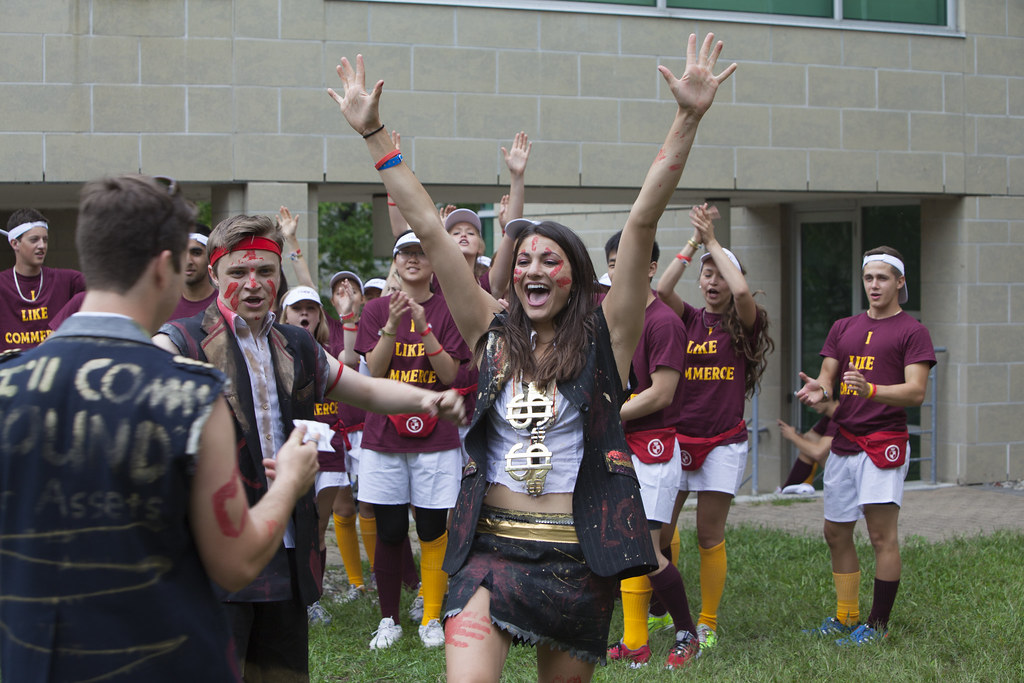
If, in the midst of this elated day,
someone took him aside with the stern warning,
Most of your life will not be like this morning,
he’d never hear it. How–while fountains play
beside clipped lawns and walkways arched with green
maples that move to stipple white and gold
on paths he and his harried parents have strolled
laden for move-in–how could he hear? He’s seen
Arcadia now, where classical facades
put a straight face on tanglements of thought,
and edgy spears of light and color, wrought
in steel and glass, look daggers at the gods.
The whole week’s strewn with glittering temptations
and parti-colored parties for the eyes:
gown-sleeves aflap like tropical butterflies,
professors float along in convocations.
Some one of them, someday, and over a drink,
will show him grittier visions: Rumor. Snark.
Administrative bloat. Nowhere to park.
How only summers bless you with time to think.
How even the mind’s beauties fester, vexed
by deadlines, balky software, budget hassle.
How research builds its turreted air-castle,
gorgeous for one day, rubble on the next.
But here, today, does anybody give
a bleep for realness? Let us cleave to form,
leaving him to his roommate and his dorm
and whispering, Here’s the poison. Drink and live.
*****
Maryann Corbett writes: “A few years ago, I happened to be on the campus of a nearby university on move-in day during freshman orientation week. It was an experience that gave me poem-provoking nostalgia.
“Orientation week is an institution I know well; I’ve lived my own college orientation and each of my children’s, and I’ve worked as a university staffer conducting such events. Freshman orientations usually take place in the week before classes begin in the fall and before other students return to campus. They’re meant to give new students everything they need to settle in and become part of the university community.
“But in addition to practicalities like moving young people into their dormitories — and dealing with parents’ emotional goodbyes — orientations will always involve hype and hoopla. Beautiful campuses are part of that hoopla, part of the seduction of academe. There will also be welcoming events that overpraise what students have achieved just by being admitted, tours that overpraise the campus’s buildings and amenities, and academic convocations with professors in full regalia delivering speeches that overpraise everything about the academic world.
“How true is all this as a picture of the scholarly life? I’ve been close enough to the facts of that life to know that the picture needs some correcting pessimism. The poem offers that but says it can wait. Let’s let the students fall in love with the vision before we tell them the truth.”
Maryann Corbett earned a doctorate in English from the University of Minnesota in 1981 and expected to be teaching Beowulf and Chaucer and the history of the English language. Instead, she spent almost thirty-five years working for the Office of the Revisor of Statutes of the Minnesota Legislature, helping attorneys to write in plain English and coordinating the creation of finding aids for the law. She returned to writing poetry after thirty years away from the craft in 2005 and is now the author of two chapbooks and six full-length collections, most recently The O in the Air (Franciscan U. Press, 2023). Her work has won the Willis Barnstone Translation Prize and the Richard Wilbur Award, has appeared in many journals on both sides of the Atlantic, and is included in anthologies like Measure for Measure: An Anthology of Poetic Meters and The Best American Poetry. ‘An Orientation’ is from her collection In Code.
Photo: “Orientation week” by queensu is licensed under CC BY-NC-ND 2.0.
 Form in Formless Times