Monthly Archives: July 2025

Villanelle variation: James B. Nicola, ‘My MFA’

I thought I’d go and get my MFA
since college never taught me how to write.
It’s not that I had anything to say;
 
I needed somehow, though, to spend the day
and, existentially I guess, the night
as well. So I went for an MFA
 
in Creative Writing. I did OK,
creatively. My grammar was a fright,
and there was nothing that I had to say,
 
but you got extra points for this. The way
you said squat was what mattered. Outasite, 
I thought, which, when I got my MFA,
 
I didn’t know was not a word. But stay,
they’d said, you can’t create if you’re uptight.
There is no wrong or right. And who’s to say
 
that parts of speech, or lie in lieu of lay,
or topic sentences, are not a blight
on Creativity? What could I say?
I’d paid a lot to get my MFA.

*****

James B. Nicola writes: “Purists take note. ‘My MFA‘ is not quite a villanelle, since the repeated lines vary so much. I suppose Elizabeth Bishop started the ball rolling with ‘(Write it!)’ in the last line of her now-famous villanelle (or is it?) ‘One Art.’ Like her, I am originally from Worcester, Massachusetts; perhaps that explains our consaguinity.”

James B. Nicola’s poetry has appeared internationally in Acumen, erbacce, Cannon’s  Mouth, RecusantSnakeskinThe South, Orbis, and Poetry Wales (UK);  Innisfree and  Interpreter’s House (Ireland); Poetry Salzburg (Austria), mgversion2>datura (France);  Gradiva (Italy); EgoPHobia (Romania); the Istanbul Review (Turkey); Sand and The Transnational (Germany), in the latter of which his work appears in German translation;  Harvests of the New Millennium (India); Kathmandu Tribune (Nepal); and Samjoko (Korea). His eight full-length collections (2014-2023) include most recently Fires of Heaven: Poems of Faith and Sense, Turns & Twists, and Natural Tendencies. His nonfiction book Playing the Audience won a Choice magazine award.

‘My MFA’ was originally published in the current Lighten Up Online

Photo: “creative-writing-ideas Atlanta GA” by agilemktg1 is licensed under CC BY 2.0.
RHL, ‘On a Modern “Poem”’

The thoughts are fresh, the images are good;
the style is clean, the tone both wise and terse;
the whole thing would be memorable, it would…
if only it had been expressed in verse.

*****

I’m always embarrassed if I have an idea for a poem, and I fail to find an expression of it in rhyme as well as rhythm. That’s because, of the hundreds of poems or pieces of poems in my head, all but a tiny handful are remembered because they are expressed in verse. You can remember the gist of an idea on the strength of the idea; but if you want to remember its exact expression, word for word, it’s far easier if it’s in verse. For this purpose, blank verse is better than prose; but rhymed verse is superior.

You may have lots of partial memories of Winnie the Pooh from childhood – the Hundred Acre Wood, Eeyore’s moans and groans – but actual word-for-word memory is likely to attach to the few snippets of verse in the book, such as:
Isn’t it funny
How a bear likes honey.
Buzz! Buzz! Buzz!
I wonder why he does?

My little gripe above was originally published in Light earlier this year.

Photo: “Al declaims” by jovike is licensed under CC BY-NC 2.0.

Julia Griffin: Translation: ‘C.P. Cavafy’s Waiting For The Barbarians’

Why are we here in the agora, say?

We’ve got the Barbarians coming today.

Why are the senators resting their jaws?
Why don’t they legislate?  What about laws?

We’ve got the Barbarians coming today.
Nobody knows how it’s going to play;
If any legislate, it will be they.

Why is our Emperor out of his bed,
Sitting in state at the gate there instead,
Wearing a gorgeous great crown on his head?

We’ve got the Barbarians coming today.
They must be met in an elegant way:
Greeting their chieftain, the Emperor’s goal
Is to award him an exquisite scroll,
Giving him titles to make his eyes roll.

Why do our consuls and praetors appear
Dressed to the nines in their purplest gear?
Why are there amethysts all up their arms,
Emeralds everywhere, greener than palms?
What are those fabulous sceptres they hold,
Fancily fashioned in silver and gold?

We’ve got the Barbarians coming today.
This sort of thing’s their idea of cachet.

Why are our orators keeping us waiting,
Not, as per usual, loudly orating?

We’ve got the Barbarians coming today.
Oratory bores them.  They like a display.

Why does it suddenly seem such a mess?
Why the confusion, the seriousness?
Why is there emptiness now in the square?
Why the pervasively secretive air?

Not one of them came, and the day is now done.
People are saying the war has been won;
Hence there are no more Barbarians.  None.

No more Barbarians – what shall we do?
I’ve not come up with an answer yet.  
                                                         You?

*****

Julia Griffin writes: “I’ve always loved Cavafy’s ‘Waiting for the Barbarians’ and had the thought that it would go well into rhyme.  This somehow necessitated changing the ending a little…” Her translation appears in the current Lighten Up Online.

See also the Wikipedia article, https://en.wikipedia.org/wiki/Waiting_for_the_Barbarians_(poem)

Julia Griffin lives in south-east Georgia/ south-east England. She has published in Light, LUPO, Mezzo Cammin, and some other places, though Poetry and The New Yorker indicate that they would rather publish Marcus Bales than her. Much more of her poetry can be found through this link in Light.

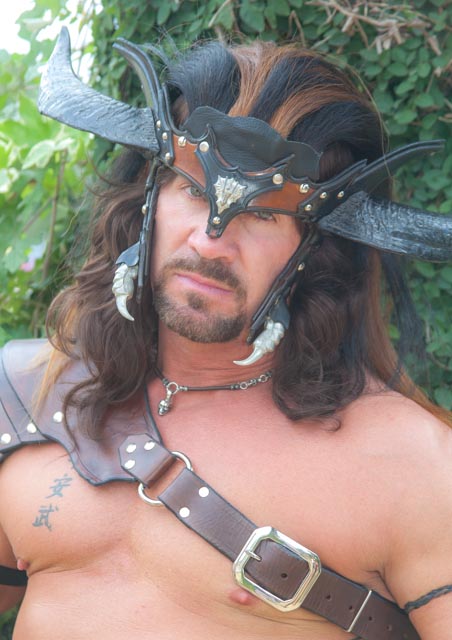
Photo: “Barbarian looking but a real cool dude (8197985443)” by Frank Kovalchek from Anchorage, Alaska, USA is licensed under CC BY 2.0.

Helena (“Nell”) Nelson, ‘Separation’

i

Mrs Philpott goes to bed alone.
The clock in the hall ticks on.
Philpott turns to cut glass, then stone.

All the things we do to be loved,
all of them pointless.
The clock ticks on.

Nothing but moonlight dawns.
The distance from downstairs
to upstairs yawns.

Philpott sags and snoozes alone
in the wishing chair,
in the wishing air.

All the things we do to be loved –
in the night they slip far away.
It will never be day.

The clock ticks on
as well it may.

ii

She wakes first. He has not slept
in the chair all night.

At first light
he has crept

into the bed on the other side.
He will not (cannot) say it, but

everything about him is sorry –
only half of him is under the duvet

and his eyes aren’t really shut.
She pulls the covers over them both and he falls

into a sleep as deep and sound
as a lost child who has wandered far out of sight

(while his mother calls and calls and calls)
and is finally found.

*****

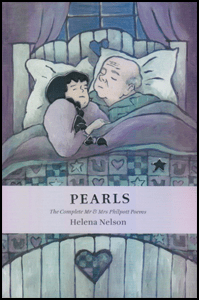
This poem is one of over 80 in Helena Nelson’s ‘Pearls – the Complete Mr & Mrs Philpott Poems’. Starting with poems of the end of their first marriages, it tracks their decades-long second marriage through (as the blurb says) “dreams, anxieties and needs – even sudden spurts of happiness – despite the rainy holidays, arguments and illness. The ordinariness of their love is magical and miraculous. Because ordinary love is a kind of miracle.”

People talk about “novels in verse” but those often don’t capture the poetry of verse. This is definitely a novel in poetry, and the most rereadable novel I’ve come across in a long time.

Helena Nelson writes: “happy that you like Pearls. I made it as well as I could, but it largely came unasked for. I don’t think I have anything to say about it.”

Helena Nelson runs HappenStance Press (now winding down) and also writes poems. Her most recent collection is Pearls (The Complete Mr and Mrs Philpott Poems). She reviews widely and is Consulting Editor for The Friday Poem.

Sonnet: Gail White, ‘Moving’

How difficult it is to move,
Even from simple place to place.
How hard to pack the books, to shove
The cat into its carrying case.
How hard to sit in Airportland
Through one more endless flight delay
While Trebizond or Samarkand
Wait half a universe away.
How hard to get the papers filed
That separate you from your past,
Newly and legally enisled.  
And yet, and yet my father’s last
Great journey out of self to shade –
How easily and quickly made.  

*****

Gail White writes: “I admit I love this one.  I’ve experienced all of it except the change of citizenship – the trials of moving house, the frustrations of airline travel – and my father’s easy transition, just lying down and quietly going on his way.  It turned into a sonnet before I even thought about it.”

First published in The Formalist.

Gail White lives in the Louisiana bayou country with her husband and cats. Her latest chapbook, Paper Cuts, is available on Amazon, along with her books Asperity Street and Catechism. She appears in a number of anthologies, including two Pocket Poetry chapbooks and Nasty Women Poets. She enjoys being a contributing editor to Light Poetry Magazine. Her dream is to live in Oxfordshire, but failing that, almost any place in Western Europe would do.

EEEEEK! CHAOS.” by confidence, comely. is licensed under CC BY-NC 2.0.

Nonce form: Stephen Edgar, ‘In Search of Time to Come’

There’s not much noise above the sputtering fire.
They don’t speak much.
The children are settling to a private croon,
Though the baby whimpers, palping blindly to clutch
At a breast. Farther back, picked out by a
Final index finger of the sun, someone squats.
They’ll be changing their abode quite soon,
No doubt.
The time requires a tacit finishing touch,
From women working at rough pots
And men scraping a hide to peg it out.

This mood, this life, is like a circle, turning
Always back
On itself: expectation interlocking
Ritual; impulse to novelty, for lack
Of its not yet invented learning,
Subsiding again to things that they take pleasure from.
A hum. A mother’s body rocking,
They are, you would say, at home.

Only the cave mouth, that changeable screen,
Opens a gap
In the circumference; and when the light
Is gone, they have no words by which to trap,
Or the notions by which words could mean,
What that black window’s showing for them to detect,
As they look, perplexed, into the night
And stare,
Then turn towards each other’s bodies to tap
Their comfort. Someone, they suspect,
Is out there; and they’re right. We are out there.

*****

Stephen Edgar writes: “I can no longer remember the specific circumstances which gave rise to this poem, but it was possibly some television documentary about ancient hominins. As Philip Larkin said in a rather different context, “Truly, though our element is time,/ We are not suited to the long perspectives/ Open at each instant of our lives.” The vertiginous gulf of time between ourselves and our earliest ancestors is a subject that has always fascinated me, and I have written other poems dealing with it; indeed, my next book opens with a poem on a similar theme. The difference with In Search of Time to Come is the notion of these ancient humans attempting to peer forward into the deep future, rather than modern humans gazing back into the deep past.

“The poem is metrical with full rhyme. The stanza form, for stanzas one and three, is one of my own devising, with varying line lengths and complex rhyme scheme. Stanza two varies the pattern, breaking off after eight lines, with a slight adjustment to the rhyme scheme. Why? I can’t remember; it was a spontaneous idea that occurred to me in the writing.

As far as I can remember, this poem had no magazine publication and first appeared in my second book Ancient Music (Sydney, Angus & Robertson, 1988), which is out of print. It has been republished in The Strangest Place: New and Selected Poems (Melbourne, Black Pepper, 2020), which is available on the Black Pepper website.”

Stephen Edgar was born in 1951 in Sydney, where he grew up. From 1971 to 1974 he lived in London and travelled in Europe. On returning to Australia he moved with his then partner to Hobart, Tasmania, where he attended university, reading Classics, and later working in libraries. Although he had begun writing poetry while still at high school, it was in Hobart that he first began writing publishable poems and found his distinctive voice. He became poetry editor of Island Magazine from 1989 to 2004. He returned to Sydney in 2005. He is married to the poet Judith Beveridge.

He has published thirteen full collections: Queuing for the Mudd Club (1985), Ancient Music (1988), Corrupted Treasures (1995), Where the Trees Were (1999), Lost in the Foreground(2003), Other Summers (2006), History of the Day (2006), The Red Sea: New and Selected Poems (2012), Eldershaw (2013), Exhibits of the Sun (2014), Transparencies (2017), The Strangest Place: New and Selected Poems (2020) and Ghosts of Paradise (2023). A small chapbook, Midnight to Dawn, came out in 2025, and a new collection, Imaginary Archive,will be published in late 2025. His website is www.stephenedgar.com.au, on which publication details of his books, and where they can be purchased, are given.

He was awarded the Australian Prime Minister’s Award for Poetry in 2021 for The Strangest Place.

Photo: “Leave the door open!” by In Memoriam: VernsPics is licensed under CC BY-NC-ND 2.0.

Marcus Bales, ‘Rule Number One’

For Linda, who said it first

 If you’re going to have a reading
then no matter where you are
for a minimum of breeding
you have got to have a bar.

You will fill up all the seating,
they will come from near and far,
if the best part of your greeting
is “Why, yes we have a bar!”

But the evening will be fleeting
even if you’ve booked a star
when it’s alcohol they’re needing
and you do not have a bar.

They will freeze in scanty heating
and they’ll swelter till they char
if you advertise by leading
with the fact you have a bar.

Though it’s raining or it’s sleeting
if you offer them a jar
they’ll be aleing, beering, meading,
and absinthing at the bar.

But when poetry starts bleeding
out of every scab and scar
all you’ll see is me retreating
if you haven’t got a bar.

*****

Marcus Bales writes: “For an interesting while I had an art gallery in a downtown mall in Cleveland. The mall rules said it had to be open on Saturdays — when there was no mall traffic and so no real reason to be open. So I held the Every Saturday at Noon in the Galleria Poetry Reading. Dramatically unsuccessful at first it eventually found its audience and we had a good time. But in talking about why, serving only coffee, Linda pointed out that if we could serve alcohol attendance would improve. Since it was an art gallery, and there is a tradition in art galleries of serving wine at openings, I changed the title to the Poetry Reading Art Opening and said wine and coffee would be available in limited quantities. That did the trick. It quickly became the best-attended poetry reading in the city, any day, any time. Then the authorities got wind of it and someone from the city visited and pointed out gently that while it was a tradition to serve wine at art openings in art galleries, it is technically illegal by state law, even if it is free, and they cited the appropriate code. In the end it didn’t matter much, since even the most successful poetry readings count their audiences in the low-to-mid-tens of people, and by then people had got in the habit of Saturday At Noon, and kept coming anyway even after we stopped serving wine. But the idea for the poem had formed.” 

Not much is known about Marcus Bales except that he lives and works in Cleveland, Ohio, and that his work has not been published in Poetry or The New Yorker. However his ‘51 Poems‘ (which includes the above) is available from Amazon. He has been published in several of the Potcake Chapbooks – Form in Formless Times.

Photo: “Open Bar” by Trevor Benedict – MrEcho is licensed under CC BY-NC-ND 2.0.