Category Archives: Potcake Poet

Using form: Short poem: Helena Nelson, ‘Duel’

Your false self says to my true self, Hate.
My true self says to your false self, No.

Your false self says to my false self, Shit.
My false self says to your false self, Go.

Your true self says to my false self, Love.
My false self says to your true self, Late.

Late, too late, too late, too late.
My true self sings to your true self, Wait.

*****

Helena Nelson writes: “I can’t explain this easily. It’s both simple and obscure, like a sealed box holding the idea of opposition: a duel between two people, a duet; dual positions. Then there’s the idea of a two-sided self: the true or authentic self versus the manipulative side, the side that does deliberate damage. I don’t even believe in ‘the true self’; but I do in this poem. And I recognise a dispute where one person (especially if for some reason acting from twisted emotion) can push another to come back from that same position, even when they don’t want to. From experience, I’ve known this. The rhyming words trace the development. The slant rhyme between Hate and Shit, for me, has a dark twist. Hate is powerful but Shit is horrible. Late is potentially the last word. The poem could end there, but it doesn’t. Each of these two people summons a ‘true self’. Each dismisses the ‘false’. ‘Late, too late, too late, too late’ is the line that breaks the pattern. No direct speech in that line, perhaps because it’s not a spoken statement but a feeling experienced by both. For me, there’s intense sadness at this point, and the shadow of death too, and because of this—just in time—true speaks to true. Only seventy words in the whole thing but most repeated several times. If you go by unique usage, fifteen words in total. It reminds me of one of R. D. Laings’ Knots. The switch from ‘says’ to ‘sings’ at the end? Yes—significant.”

Helena Nelson runs HappenStance Press (now winding down) and also writes poems, one of which is ‘Duel’. It was originally published in PN Review, collected in Plot and Counter-Plot, Shoestring Press, 2010, and was reprinted in the Potcake Chapbook ‘Lost Love’. Her most recent collection is Pearls (The Complete Mr and Mrs Philpott Poems). She reviews widely and is Consulting Editor for The Friday Poem.

Photo: “Argument” by helena_perez_garcia is licensed under CC BY-NC-ND 2.0.
Weekend read: Quincy R. Lehr, ‘Thud!’

There’s thudding from the floor above that never seems to stop.
I’m trying to sleep, or waiting for the other shoe to drop
as midnight clomps toward 2 AM and hours of darkness dwindle
into the gray of going to work. This rent’s a fucking swindle.

Where’s my damn connection gone? The internet’s too slow.
Get me Jobs or get me Gates. Those bastards need to know.

I called her on a Friday, and we swore that we would meet.
I hailed a taxi, ended up along a different street —
similarly named, but swathed in layers of graffiti.
A drip of sweat ran down my neck; the air was cold and sleety.

Where’s that old-time romance gone? Who will sigh and blubber
over at hers at 3 AM with a lavatory rubber?

I saw a TV talking head while ordering a bagel
who talked about the budget mess — but then he quoted Hegel
about the end of history. Some Weltschmerz is okay,
but save it for the pop songs, man, and don’t get in the way.

Where’s my hometown paper gone? The owner’s on the run
from ranters on the blogosphere. Something must be done.

He met my eyes and shook my hand, and though you wouldn’t know it,
that jerk-off in a business suit calls himself a poet/
critic/impresario and manages quite well.
He smiled and quoted Dante, but I only thought of Hell.

Where’ve our tortured artists gone, Catullus or Syd Barrett?
Chasing after the latest grant and following the carrot.

The upstairs stomps are quicker now and spreading to the hall.
My head’s beneath the pillow. Damn it — won’t she ever call?
I half hope that she’s safe in bed and blithely fast asleep,
but fantasize her all alone and looking up mid-weep.

Where’s the just comeuppance gone? What happened to bad karma?
It got renamed and bottled up and bought out by Big Pharma.

There’s violence in the movies, and there’s violence on TV;
there’s violence on the city streets…. Fuck off! Don’t talk to me!
There’s anger in the headlines, and there’s fury in the verse
spat out at downtown open mikes. I don’t know whom to curse.

Where’ve the old-time standards gone? The censors look forlorn
from hip hop, emo, techno, goth. What happened to the porn?

Times Square’s gone all Disneyfied. The red-light district’s blue.
Godspeed to all you chicks with dicks, and hello, Scooby-Doo.
Farewell, Adult Emporium! You’re now a clothing store,
maybe a Planet Hollywood — and God knows which sucks more.

Where’s my filthy city gone? They smothered it in bleach,
hired a doorman, raised the rent, and placed it out of reach.

What’s to blame? Is it our greed or lack of common sense?
Is it violence in our past, or just incompetence?
Perhaps it’s economic or the crush of circumstance.
Or was it just a thwarted wish to get into her pants?

Where’s that upstairs thumping gone? The silence settles deep
into the still and humid air. I still can’t get to sleep.

*****

Quincy R. Lehr writes: “Thud! is a New York City madsong, with gentrification, insomnia, political decay, and urban loneliness mixing together in a sort of minestrone soup of misery that is also, I think, pretty funny.”

Born in Oklahoma, Quincy R. Lehr is the author of several books of poetry, and his poems and criticism appear widely in venues in North America, Europe, and Australia. ‘Thud!‘ was first published in Measure and was reprinted in the Potcake Chapbook ‘City! Oh City!‘ His book-length poem ‘Heimat‘ was published in 2014. His most recent books are ‘The Dark Lord of the Tiki Bar‘ (2015) and ‘Near Hits and Lost Classics‘ (2021), a selection of early poems. He lives in Los Angeles.
https://www.amazon.com/Quincy-R.-Lehr/e/B003VMY9AG

Photo: “sleepless” by ebrkut is licensed under CC BY-ND 2.0.

Brian Allgar, ‘Genesis’

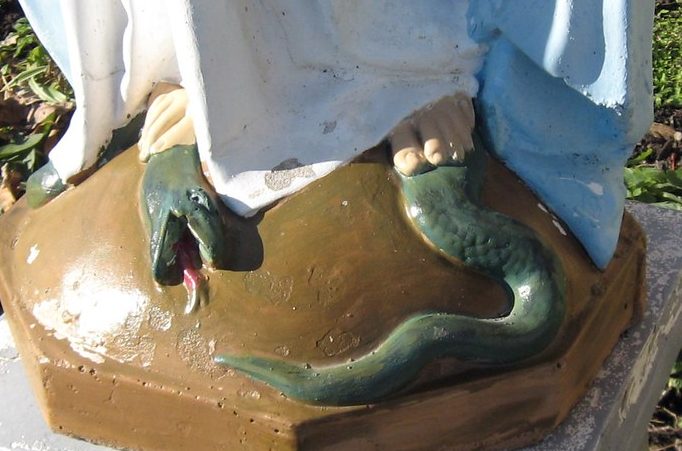
One sunny morning, strolling in my garden,
I stumbled, and my foot crushed something’s head.
“Me dammit!” I exclaimed, “I beg your pardon”,
Looked down, and saw my Serpent lying dead.
 
Now this was most vexatious, for I’d planned
That this poor snake would implement my scheme
To give my little friends a helping hand,
And lead them gently from their childish dream.
 
The Serpent was supposed to tempt the couple
With luscious fruit that Eden’s trees bedecks;
My chosen agent, sinuous and supple,
Would lead the pair to knowledge – and to sex.
 
Omniscience can have its limitations,
And even Godly schemes may gang agley.
I’d once envisaged teeming populations,
But this, perhaps, was better, in its way.
 
No Spanish Inquisition, no Crusades,
No slaves, and no Industrial Revolution,
No mining sites where once were leafy glades,
No factory chimneys belching out pollution.
 
No nation-states, no border wars to settle,
No Holocaust, no tribal genocide,
No Rap, no Hip-Hop, Punk or Heavy Metal,
No hamburgers with coleslaw on the side.
 
No guns, no bullets, no demented shooters,
Since nothing could be made, except of wood;
No mobile phones (thank Me!) and no computers …
I looked on all of this, and found it good.
 
Yet what of those who should have lived hereafter?
No Homer, Shakespeare, Mozart, Botticelli?
No P. G. Wodehouse? (I was fond of laughter,
Though, being God, I didn’t have a belly).
 
Descendants all, but only if they had ’em.
(No Michelangelo, no Sistine Chapel?)
My mind made up, I called to Eve and Adam:
“I wondered if you’d care to try an apple?”

*****

Brian Allgar writes: “As a devout atheist, I felt it my duty to shed some light on the truth behind the Creation myth.”

Brian Allgar was born a mere 22 months before Adolf Hitler committed suicide, although no causal connection between the two events has ever been firmly established. Despite having lived in Paris since 1982, he remains immutably English. He started entering humorous competitions in 1967, but took a 35-year break, finally re-emerging in 2011 as a kind of Rip Van Winkle of the literary competition world. He also drinks malt whisky and writes music, which may explain his fondness for Mendelssohn’s Scottish Symphony.

He is the author of “The Ayterzedd: A Bestiary of (mostly) Alien Beings” and “An Answer from the Past, being the story of Rasselas and Figaro”, both available from Kelsay Books and Amazon.

Photo: “Mary’s Feet” by elycefeliz is licensed under CC BY-NC-ND 2.0.
Edmund Conti, ‘Two’s Company’

Sweet are the uses of divinity
And sweeter yet in keeping us engrossed
Is the simple complex concept of the trinity
The Father, Son and Holy Ghost.

Is making sense of Them too much a bother?
Is there any way to master Three-in-One?
The son, the Holy Ghost and Father,
The Holy Ghost, the Father and the Son.

I use this ancient form, the cranky sonnet
To crank out my aberrant Dunciad
And what evolves from overthinking on it:
The Spook, the Kid and–dare I say it?–Dad.

It’s true that poems are made by fools like me
But only God can make himself a three.

*****

Edmund Conti writes: “I wasn’t going to get into any interpretations of the Trinity. Just noting that scholars writing about it don’t shed much light. So I decided to shed my own. Somewhere along the line I may have gone a little overboard. (Pray for me.) I think my cranky sonnet has its own rhyme scheme, not one from the books. Meanwhile I’ve forgotten what ”Dunciad” means except that it was a good rhyme word. Forgetting all that, I guess this whole thing was inspired by Joyce Kilmer’s memorable last line.”

Edmund Conti has recent poems published in Light, Lighten-Up Online, The Lyric, The Asses of Parnassus, newversenews, Verse-Virtual and Open Arts Forum. His book of poems, Just So You Know, released by Kelsay Books
https://www.amazon.com/Just-You-Know-Edmund-Conti/dp/1947465899/
was followed by That Shakespeherian Rag, also from Kelsay
https://kelsaybooks.com/products/that-shakespeherian-ragHis poems have appeared in several Potcake Chapbooks: Tourists and Cannibals
Rogues and Roses
Families and Other Fiascoes
Wordplayful
all available from Sampson Low Publishers

Photo: “Father, Son & Holy Ghost” by elston is licensed under CC BY-NC-ND 2.0.

Edmund Conti, ‘The Straight Skinny’

To say that only I am fat,
To say that I am only fat,
To say only that I am fat,
To only say that I am fat,
Is not to say, however, that
They equally are definitive.

One statement says fat’s mine alone,
One says no other trait I own,
One just has a plaintive tone,
And–overlooked and overblown–
One just splits the infinitive.

*****

Edmund Conti writes: “I guess this began with the observation that ‘only I am fat’ and ‘I am only fat’ have different meanings depending on the placement of one word. Which made me wonder if placing ‘only’ in other parts of the sentence would change it again. Which it did. Why did I use ‘fat’ as a trait? Well, it’s an easy rhyme and people can relate to it—in themselves or others. Also, it gave me a good excuse for the title.
I thought writing the second stanza would be trickier, but the rhymes just fell into place. And noticing the split infinitive and using it saved the poem. Assuming it was worth saving.”

Edmund Conti has recent poems published in Light, Lighten-Up Online, The Lyric, The Asses of Parnassus, newversenews, Verse-Virtual and Open Arts Forum. His book of poems, Just So You Know, released by Kelsay Books
https://www.amazon.com/Just-You-Know-Edmund-Conti/dp/1947465899/
was followed by That Shakespeherian Rag, also from Kelsay
https://kelsaybooks.com/products/that-shakespeherian-rag

His poems have appeared in several Potcake Chapbooks:

Tourists and Cannibals
Rogues and Roses
Families and Other Fiascoes
Wordplayful
all available from Sampson Low Publishers

Photo: “Why Am I So Fat?” by morroelsie is licensed under CC BY-NC 2.0.

Maryann Corbett, ‘Dissonance’

We dress ourselves
from the Goodwill store
since Art has kept us
genteelly poor
and we laugh together
at how we’ve slummed
amid vocalises
and arias hummed
and the mirth for both of us
seemed sincere
so I joked, where others
would overhear,
about our finds
in the plaids and prints

and saw you wince.

*****

Maryann Corbett writes: “Perhaps every poem that seems to portray one small moment is really a goulash of hundreds of moments. That’s certainly true of ‘Dissonance‘. There really was a friend who was a fellow singer, fellow poet, and fellow fan of the bargains to be found in charity shops. And there really was an awkward moment when I misjudged her feelings about artistic penury, a penury I’d escaped in a very un-artistic job. But folded into the writing of the poem were all my student years, years when I was much younger, much poorer, and much more in solidarity with friends still following their dreams.”

Dissonance‘ was first published in Mezzo Cammin, and gave its name to a 2009 chapbook collection published by Scienter Press.

Maryann Corbett earned a doctorate in English from the University of Minnesota in 1981 and expected to be teaching Beowulf and Chaucer and the history of the English language. Instead, she spent almost thirty-five years working for the Office of the Revisor of Statutes of the Minnesota Legislature, helping attorneys to write in plain English and coordinating the creation of finding aids for the law. She returned to writing poetry after thirty years away from the craft in 2005 and is now the author of two chapbooks and five full-length collections. Her work has won the Willis Barnstone Translation Prize and the Richard Wilbur Award, has appeared in many journals on both sides of the Atlantic, and is included in anthologies like Measure for Measure: An Anthology of Poetic Meters and The Best American Poetry. Her sixth book, The O in the Air, is forthcoming from Franciscan University Press.

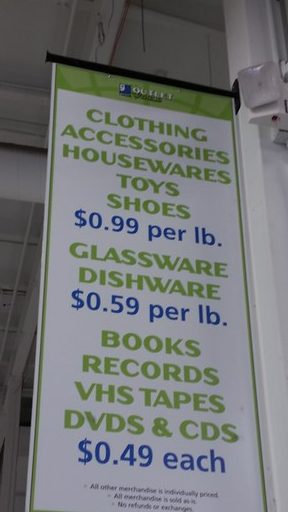
Photo: “Goodwill outlet store” by sparr0 is licensed under CC BY-SA 2.0.

Max Gutmann, ‘A Letter Home’

One flat fall evening, as an undergrad,
I left the library to mail a letter
and at the mailbox had
a stirring–-I don’t know what else to call it,
but I felt certain, drifting back
on brittle leaves, surrounded by the gray,
this was my life–-a feeling new,
whole, deeply and vibratingly unstrange.

Back at the carrel, where my books still lay,
I sat some time immersed there in that moment:
me, having walked away
from books for some slight, distant human contact,
returning through the coming winter
to my small space. It struck me as both sad
and right; young as I was, I knew
it wasn’t something I would ever change.

*****

Max Gutmann writes: “Though it takes the perspective of an older man looking back, ‘A Letter Home‘ was written shortly after the experience it shares, years before I wrote any other verse (aside from some limericks); the drive to record the experience as a poem had nothing to do with habit. I couldn’t have anticipated that the “distant human contact” in my life would come to include a community of writers with whom I’ve only ever exchanged words on a screen (a community you do a lot to nourish, Robin. Thank you.)”

A Letter Home‘ was first published in the Pulsebeat Poetry Journal.

Max Gutmann has worked as, among other things, a stage manager, a journalist, a teacher, an editor, a clerk, a factory worker, a community service officer, the business manager of an improv troupe, and a performer in a Daffy Duck costume. Occasionally, he has even earned money writing plays and poems.

Photo: “McAllen mailbox” by Drpoulette is licensed under CC BY-NC-SA 2.0.

Using form: choice of metre: John Beaton, ‘Request for a Dance’

Step with me, float with me, over the floor;
weave with me, waltz with me, out through the door;
slide to the deck where the crowdedness clears;
glide through the garden and tear off your fears.

Step with me, sneak with me, down to the lake,
onto its waters; the mirror won’t break;
lilt in a ball gown of luminous mist;
twirl till you’re breathless and need to be kissed.

Step with me, skim with me, let yourself go,
dazzling and dizzy, then flowingly slow;
whirl till our swirls make a maelstrom of night;
pass through the portal from here to delight.

Step with me, sway with me, feel yourself swing,
hammocked on rhythms of hearts on the wing;
move to the measures of seasons and years;
sweep to that island where time disappears.

Step with me, slip with me, up to its crypt,
quaff a last laugh from the pleasures we’ve sipped;
curtsey and smile at a parting of hands
joined in this dancing by two wedding bands.

*****

John Beaton writes: “Inspired by Richard Wilbur’s beautiful ‘For C,’ and by my own marriage, I wanted to write a poem about lifelong love. For the beginning, a wedding dance came to mind and that expanded into an extended metaphor. The theme needed a form that danced the reader along.
I adopted a four-line stanza rhymed aabb with the meter of each line being a form of dactylic tetrameter: DA-da-da, DA-da.da, DA-da-da, DA. To kick off each stanza dancingly, I used near-repetition in the first two dactyls. Then a lot of alliteration and internal rhyme help it swirl along.
The poem develops the dance into a shared lifelong experience, one that must end but does so with a sense of fulfilment and beauty. I’ve recited it at weddings.”

John Beaton’s metrical poetry has been widely published and has won numerous awards. He recites from memory as a spoken word performer and is author of Leaving Camustianavaig published by Word Galaxy Press. Raised in the Scottish Highlands, John lives in Qualicum Beach on Vancouver Island.
https://www.john-beaton.com/

Photo: “Wedding Dance” by DonnaBoley is licensed under CC BY 2.0.

Using form: villanelle: Melissa Balmain, ‘Villain Elle’

Whenever I wake up and don’t feel well,
I like to read a women’s magazine.
I know that I can count on Vogue or Elle,

Cosmo or Glamour, Self or Mademoiselle,
instead of pills, elixirs or caffeine,
whenever I wake up and don’t feel well.

Page Eight has bathing suits that look just swell
if you’re six foot and live on Lean Cuisine.
I know that I can count on Vogue or Elle.

Page Nine’s a list of “wardrobe musts” that sell
at reasonable prices—for a queen.
Whenever I wake up and don’t feel well,

Page Ten says how to age, yet stay a belle.
The photo? It’s a model of eighteen.
I know that I can count on Vogue or Elle

to make my time in bed such living hell,
I’m out of there in sixty seconds clean.
Whenever I wake up and don’t feel well,
I know that I can count on Vogue or Elle.

*****

Editor: The villanelle is a highly structured poem, its two key lines rhyming and repeating several times. One of its challenges is to make each repetition fresh and interesting, either by developing and deepening the context, or by varying the repeated lines slightly or, as with this one, by having the same words resonate differently. Here “I know that I can count on” gives an initial impression of a favourable attitude to women’s magazines, but at the end the words show total disgust. This ‘Villain Elle‘ is typical of Balmain’s twists and puns and absolute control of form.

Melissa Balmain edits Light, America’s longest-running journal of light verse. Her poems and prose have appeared widely in the US and UK. She’s the author of the full-length poetry collection Walking in on People (Able Muse Press), chosen by X.J. Kennedy for the Able Muse Book Award, and the shorter, illustrated The Witch Demands a Retraction: Fairy-Tale Reboots for Adults (Humorist Books). Her next full-length collection, Satan Talks to His Therapist, is due out in fall 2023.

‘Villain Elle‘ is from Walking in on People © Melissa Balmain, 2014. Used by permission of Able Muse Press.

Photo: “304/365 – 8/8/2011” by GabrielaP93 is licensed under CC BY 2.0.

Using form: Ballade: Marcus Bales, ‘Scary Home-Life’ (for GTZ)

Get up, get out, and get away–I went
as early as I could to leave one vile
exposure for another. School. It meant
escape from home at least a little while,
not long enough, and trading family guile
for reading sullen peers and teacher spin,
except for you, beside me on the aisle–
I was the girl with the scary home-life and bad skin.

I was first to homeroom every day.
And how did Mr Romo ever know
that half a sausage sandwich was the way
a skinny girl survived. He’d always go
“Good morning,” handing me a half as though
that half were mine and we were somehow kin;
I’d nod my thanks and sit in the back row–
I was the girl with the scary home-life, and bad skin.

And you, who sat beside me, always kind
to me, and always kind of sassy tough
to other kids who other years combined
to make me almost miserable enough
to stay at home, from you I learned to bluff
my inner fear, to fake a cocky grin,
and start to walk as if it wasn’t rough
to be the girl with the scary home-life, and bad skin.

L’envoi
Yeah, it was you and Mr Romo, in the end,
who gave me things that I could not begin
to pay you back for, so even I’d befriend
the girl with the scary home-life, and bad skin.

*****

Marcus Bales writes: “I have a modest file of poems that have got me unfriended, blocked, or banned by people or publications, for one reason or another. Sometimes, as in this case, the reason is unknown to me. 

“Back in the old days when I was a working salesman at the sort of retail store where it takes an hour or two to walk around the store with your salesperson and discuss wants and needs and preferences, it is often the case that the customer gets comfortable enough to tell things about themselves or their lives that they might hesitate to repeat without canny encouragement. Here, a vivacious and attractive young couple were moving in together and needed furniture and a bed. They were excited, and money was not an issue. It turned out the young woman had been an officer in the Marines or the Army — I forget which at this distance — in one of the rougher, tougher units, and I admired her for having the stuff to lead in that mise en scene. She recounted that she had felt driven to it by a harrowing early family life, complete with the sort of acne that is every teen’s nightmare. A scary home-life and bad skin was her description of it. After the sale was completed I wrote most of this poem in the break room in the back, after climbing on the table to turn off the Muzak speaker so I could think. 

“I discovered she had friended me on Facebook and had written some nice things about me at the store, which was very nice of her. Of course even back then I was posting my poems on Facebook, and posted this one, without her name, but with her initials. All the details are entirely fictional. I made them all up, except for that one line. She blocked me right away.”

Editor’s note: a ballade is a very suitable form for this poem, with iambics for thoughtful mood, claustrophobically restricted rhyme scheme, steady refrain, and final summation addressed to a superior person. From the Wikipedia entry ‘Ballade (forme fixe)‘: “The ballade as a verse form typically consists of three eight-line stanzas, each with a consistent metre and a particular rhyme scheme. The last line in the stanza is a refrain. The stanzas are often followed by a four-line concluding stanza (an envoi) usually addressed to a prince. The rhyme scheme is therefore usually ababbcbC ababbcbC ababbcbC bcbC, where the capital C is a refrain.”

Not much is known about Marcus Bales except that he lives and works in Cleveland, Ohio, and that his work has not been published in Poetry or The New Yorker. However his ’51 Poems’ is available from Amazon. He has been published in several of the Potcake Chapbooks (‘Form in Formless Times’).

Photo: “skinny girl” by Villegación is licensed under CC BY-NC-SA 2.0.