Category Archives: political poem

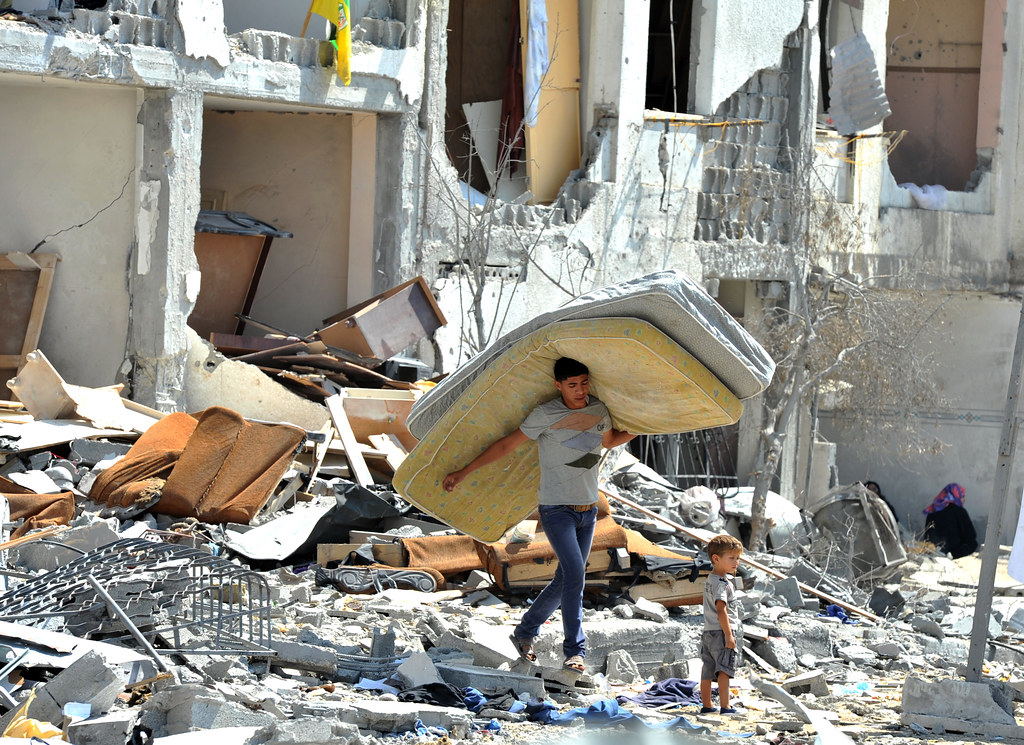
Melissa Balmain, ‘Fatal Mistakes’

The pill you’re sure is good for you,
the mole you think you can neglect,
the ache you blame on winter flu:
it’s always what you least expect.

The mat that pads your shower floor,
the flight you take from home, direct,
the car that’s never stalled before:
it’s always what you least expect.

The oddly coiffed New York tycoon
whom no one ever would elect
because he’s nutty as a loon . . .
it’s always what you least expect.

from Satan Talks to His Therapist, by Melissa Balmain (Paul Dry Books, 2023).

Melissa Balmain writes: “In light-verse workshops, writers are sometimes surprised when I suggest trying forms that weren’t designed for funny stuff (unlike, say, limericks or double dactyls). But comic poets can get a lot of mileage out of “serious” forms, from sonnets to sestinas–especially if their humor tends to skew dark. For anxious or obsessive topics, I’m often drawn to repeating forms like the villanelle, rondeau, or (in this case) the kyrielle. The challenge lies in finding ways to surprise the reader even though they know the line that’s coming.”

Melissa Balmain’s third poetry collection, Satan Talks to His Therapist, is available from Paul Dry Books (and from all the usual retail empires). Balmain is the editor-in-chief of Light, America’s longest-running journal of light verse, and has been a member of the University of Rochester’s English Department since 2010. She is a recovering mime.

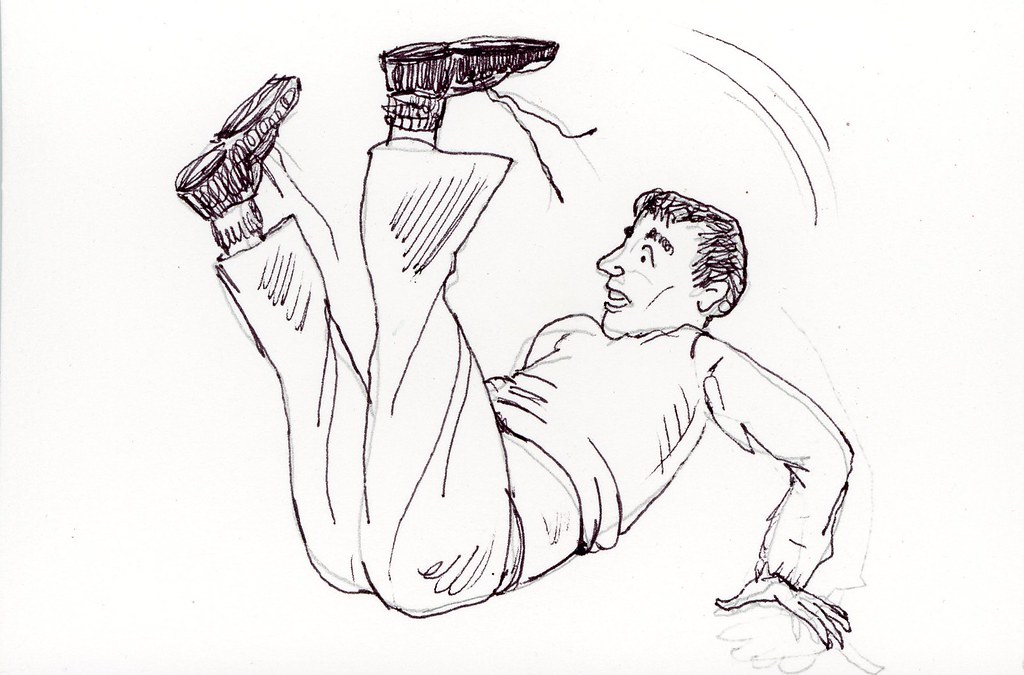
Pratfall” by Life Imitates Doodles is licensed under CC BY-NC-ND 2.0.
Donald Trump’s favourite poem: ‘The Snake’ by Oscar Brown Jr.

On her way to work one morning
Down the path ‘longside the lake
A tender-hearted woman saw a poor half-frozen snake
His pretty colored skin had been all frosted with the dew
“Oh well,” she cried, “I’ll take you in and I’ll take care of you”
“Take me in, tender woman
Take me in, for heaven’s sake
Take me in, tender woman,” sighed the snake

She wrapped him up all cozy in a comforter of silk
And laid him by thе fireside with some honеy and some milk
She hurried home from work that night, and soon as she arrived
She found that pretty snake she’d taken in had been revived
“Take me in, tender woman
Take me in, for heaven’s sake
Take me in, tender woman,” sighed the snake

She clutched him to her bosom, “You’re so beautiful,” she cried
“But if I hadn’t brought you in, by now you might have died”
She stroked his pretty skin again and kissed and held him tight
Instead of saying thanks, that snake gave her a vicious bite
“Take me in, tender woman
Take me in, for heaven’s sake
Take me in, tender woman,” sighed the snake

“I saved you,” cried the woman
“And you’ve bitten me, but why?
And you know your bite is poisonous and now I’m gonna die”
“Oh shut up, silly woman,” said the reptile with a grin
“You knew damn well I was a snake before you took me in”
“Take me in, tender woman
Take me in, for heaven’s sake
Take me in, tender woman,” sighed the snake
“Take me in, tender woman,” sighed the snake

*****

Donald Trump has repeatedly read this poem in his political rallies as a way of attacking immigrants and the US Government’s immigration policies. The ironies are endless:
– that two of Trump’s wives are themselves immigrants (the current one having a very sketchy background as a “model”);
– that Trump always fails to credit Oscar Brown Jr as the song’s author, consistently naming Al Wilson instead;
– that Oscar Brown was a civil rights activist and for ten years a member of the Communist Party (he left when he decided he was “too black to be red”);
– that the song’s message, a variant on one of Aesop’s Fables, is that kindness can be betrayed;
– that Oscar Brown’s daughters have sent Trump cease-and-desist letters because Trump’s message is antithetical to all their father stood for;
– and as one of the daughters said on CNN, “the elephant in the room is that Trump is the living embodiment of the snake that my father wrote about in that song.

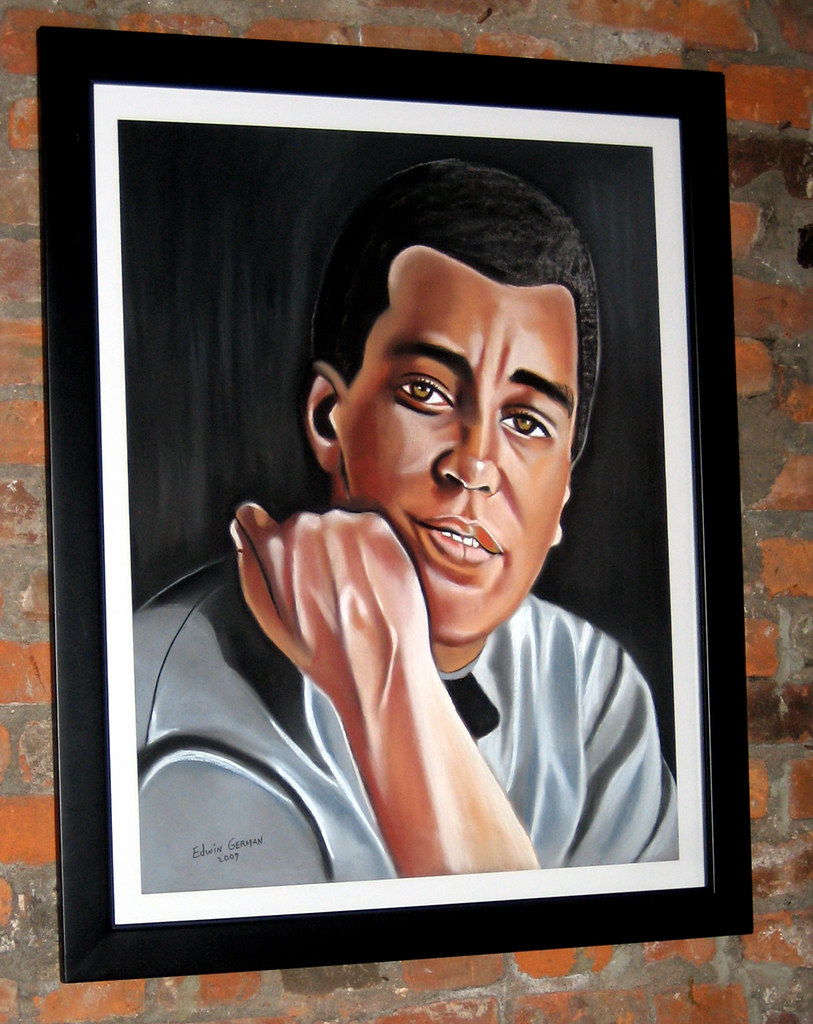
Photo: “JAZZ: Portrait of Oscar Brown, Jr.” by Professor Bop is licensed under CC BY-NC-ND 2.0. (Note: the portrait is by Edwin German.)
Joe Biden’s favourite poem: Seamus Heaney, ‘The Cure of Troy’

Human beings suffer
They torture one another,
They get hurt and get hard.
No poem or play or song
Can fully right a wrong
Inflicted and endured.

The innocent in gaols
Beat on their bars together.
A hunger-striker’s father
Stands in the graveyard dumb.
The police widow in veils
Faints at the funeral home.

History says, Don’t hope
On this side of the grave…
But then, once in a lifetime
The longed-for tidal wave
Of justice can rise up,
And hope and history rhyme.

So hope for a great sea-change
On the far side of revenge.
Believe that a further shore
Is reachable from here.
Believe in miracles
And cures and healing wells.

Call miracle self-healing:
The utter, self-revealing
Double-take of feeling.
If there’s fire on the mountain
Or lightning and storm
And a god speaks from the sky

That means someone is hearing
The outcry and the birth-cry
Of new life at its term.
It means once in a lifetime
That justice can rise up
And hope and history rhyme.

*****

US President Joe Biden frequently quotes poets: Yeats and, especially, Heaney; often with the disclaimer that he doesn’t quote Irish poets because of his Irish heritage, but because Ireland has the best poets. And from the poem above, the verse that particularly resonates with him is:
History says, Don’t hope
On this side of the grave…
But then, once in a lifetime
The longed-for tidal wave
Of justice can rise up,
And hope and history rhyme.

Joe Biden may not be perfect, but it is reassuring to have an American President with at least some commitment to Justice… and the sensibility of reinforcing it through the memorisation of poetry.

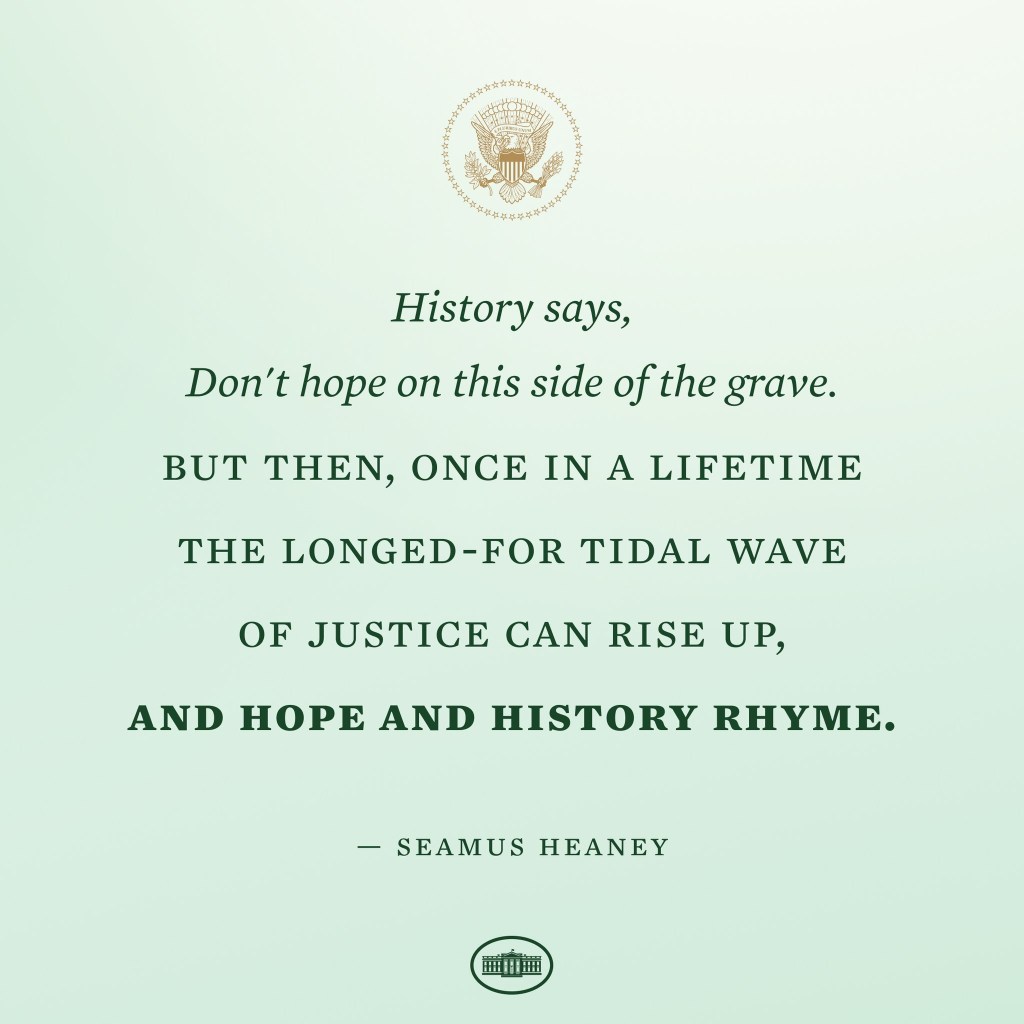
Photo: Joe Biden’s White House Facebook post for St. Patrick’s Day 2022.

Margaret Thatcher’s favourite poem: Charles Mackay, ‘No Enemies’

You have no enemies, you say?
Alas! my friend, the boast is poor;
He who has mingled in the fray
Of duty, that the brave endure,
Must have made foes! If you have none,
Small is the work that you have done.
You’ve hit no traitor on the hip,
You’ve dashed no cup from perjured lip,
You’ve never turned the wrong to right,
You’ve been a coward in the fight.

*****

I’m no fan of the excessive and unproductive trickle-down economics of Margaret Thatcher, other than to say that I’m also no fan of the excessive and unproductive Union bureaucracy that she came to fight. (That just means I’m a centrist, and centrists often have a hard time in Two-party First-past-the-post electoral systems. FPTP encourages dividing the country into Us and Them, and making everything a fight. I think Proportional Representation allows for more constructive government relationships.)

As reported in The Independent, in the docudrama ‘The Crown’, Margaret Thatcher fires half of her cabinet because of their “lack of grit as a consequence of their privilege and entitlement”. In response, Queen Elizabeth tells Thatcher that she’s playing a “dangerous game” making so many enemies, to which the prime minister replies that she is “comfortable” with having enemies, and she then recites Scottish poet Charles Mackay’s ‘No Enemies’. Mackay was a 19th century poet and journalist, now best remembered for his ‘Extraordinary Popular Delusions and the Madness of Crowds‘.

In real life, Thatcher was very fond of the poem, with a 2019 BBC documentary revealing that she kept it on her desk.

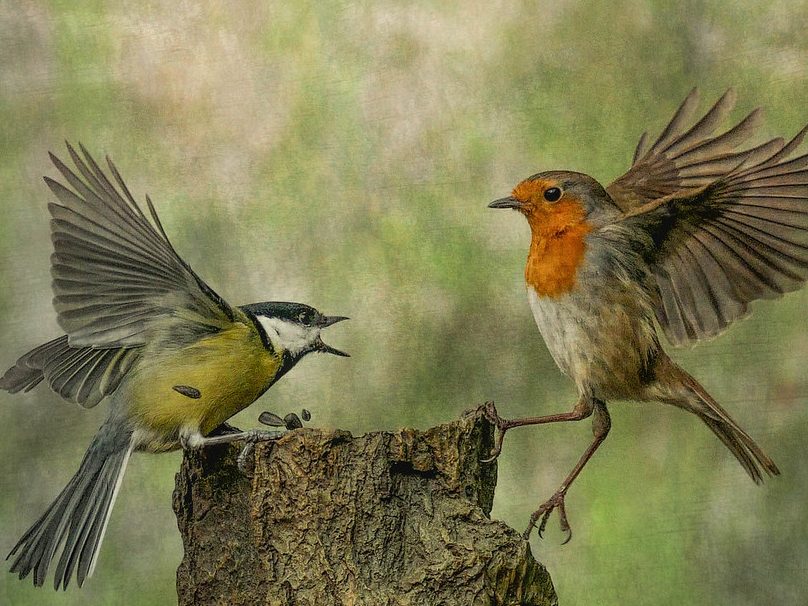
Food fight.” by Free the Image is licensed under CC BY 2.0.

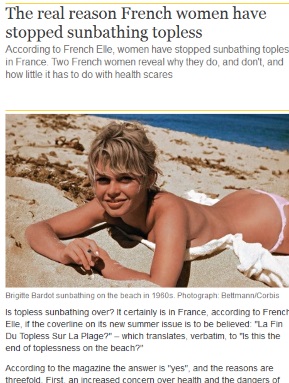
Conor Kelly, ‘On Reading the Guardian News Item: France falls out of love with topless sunbathing’

Now planes are falling from the sky
brought down by bombs or storms of sand
and bodies flying through the air,
incinerated where they land.
Now drones are flying over towns
and villages where families lie
scattered upon the blood-dimmed earth
rent by a missile from on high.
 
    In times like these, it’s good to know
    successors to Brigitte Bardot,
    whose breasts were often on display,
    are covering up in Saint-Tropez.
 
Now children on a blood-strewn yard
lie dying in a UN school
and learn, too late, that modern war
is subject to no human rule.
Now girls asleep in their school dorm
are woken, kidnapped, taken deep
into impenetrable land
while parents, friends and teachers weep.
 
    At times like this it’s good to know
    what may be à la mode, although
    French women think it is passé
    to bare their breasts in Saint-Tropez.
 
Now drive-by shootings in the hood
leave strangers dying, one by one,
and children other children kill
when they discover Daddy’s gun.
Now vigilantes late at night
who stand their ground while they patrol
can shoot the mad, the drunk, the strange,
disdaining talk of gun-control.
 
    At times like this it’s good to know
    bikini tops are now on show
    as toplessness is now risqué
    upon the beach at Saint Tropez.
 
Now new and old diseases take
their toll on those who try to cure
the sad, the suffering, the sick,
when each prognosis is unsure.
Now chemists working in a lab
and patients undergoing trials
are seeking what alleviates
from what are merely fads, lifestyles.
 
    At times like this it’s good to know
    that suntanned breasts no longer glow
    and fashion fans are now au fait
    with what is chic at Saint Tropez.

*****

Conor Kelly writes: “Tragedy and comedy, war and peaceful sunbathing, gunshots and film shoots, dead bodies and bare bodies, vigilantes and voyeurs, the consequential and the chic, the chemical and the comical, the bad and the fad; this poem is based on a fundamental contrast between the fatal depravities of the modern world as outlined in the longer stanzas and changing trends in body images as outlined in the refrain. Despite the serious subject matter, it is not to be taken too seriously. The poem was originally published in the September 2014 issue of Snakeskin (https://www.snakeskinpoetry.co.uk/210topless.html)”

Conor Kelly was born in Dublin and spent his adult life teaching in a school in the city. He now lives in Western Shore, Nova Scotia from where he runs his twitter (X) site, @poemtoday, dedicated to the short poem. He has had poems printed in Irish, British, American, Canadian and Mexican magazines. He was shortlisted for a Hennessy New Irish Writers award. At the ceremony one of the judges, Fay Weldon, asked him, “Where are you in these poems?”  He is still asking himself that same question.

https://www.instagram.com/conorkelly.poems/

Photo: from Snakeskin

Weekend read: Duncan Gillies MacLaurin, ‘The Real Pity’

No, Wilfred, I never
believed your endeavour
was more than a clever display.
Did you think you could rescue
the boys in the mess queue,
or – no less grotesque – you’d betray
your comrades by opting to stay
in shock in Craiglockhart’s sick bay?
Naive pretence
is no defence
for senseless sacrifice.
Admit it, you
were stupid to
ignore Sassoon’s advice
and blithely return to the fray,
quite deaf to the price you would pay.

You based your decision
on lack of a vision
and fear of derision combined.
You went back to that battle
where kids died “as cattle”
to leave tittle-tattle behind,
regardless of what you might find.
No doubt you were out of your mind!
Or, more exact,
you lacked all tact.
Death was not your “chum”.
One week passed,
and then, at last,
the Armistice had come.
You thought you were helping mankind.
Your nerves were so numb you were blind.

The telegram telling
the news reached your dwelling
as people were yelling “Hooray!”
You were inconsequential
despite your potential.
What did you essentially say?
“Was it for this the clay…?”
Whose drum did you dumbly obey?
You grew obsessed
with your new quest;
it made you big and bold.
Was it fulfilled
when you were killed,
just twenty-five years old?
I have to report with dismay
there’s no lack of soldiers today.

*****

The following is an explanatory essay by Duncan Gillies MacLaurin, entitled ‘Owen, Sassoon, Barker and Me’:

If anything might rouse him now
The kind old sun will know.

– from Wilfred Owen’s sonnet, “Futility

It would have been late 1976 or early 1977 when my English teacher, Peter MacDonald, introduced me, a 14-year-old Scottish public schoolboy, to Wilfred Owen. Pixie, as he was called by the boys, had hardly given us the gist of Owen’s life, death, and poetry, when I found myself pole-axed. I hadn’t got my head around the fact that Owen chose to return to fight in the war that he was denouncing in his poetry even though serious shellshock exempted him from service, when I was told that he was killed just one week before the Armistice. It was too much for me.

Reciting Wilfred Owen’s sonnet “Futility” in chapel a few weeks later, I sensed in poetry an alternative to the spiritual life I had known hitherto. Not that I reacted immediately. I didn’t begin writing poetry until I was 20. And it was not until late 1989 that I returned to the poet whose fate had hit me so hard.

It started the way it sometimes does, with a couple of lines scribbled down just before bedtime. The lines were: “If your heart is your legend,/ if your pen is your weapon…” The next day I sat down with my guitar and put the lines to a tune. Although I hadn’t had Wilfred Owen in my thoughts, I found that the piece was to be about him. A year later, “Letter to a Dead Poet” was published in The Dolphin Newsletter, an internal journal of the English Department at Aarhus University, Denmark.

Letter to a Dead Poet

Hey Wilfred Owen,
where were you going
when you got blown away?
Had your heart been your legend,
had your pen been your weapon,
had your conscience elected to stay
watching the sparrows play,
you might have been here today.
I don’t believe your sacrifice
was generous or free;
the fact you paid the highest price
betrayed “Futility”:
“Was it for this the clay…?”
What were you trying to say?

What use are the laurels?
What use are the morals
in all of your quarrels combined?
You went back to that battle
where kids died “as cattle”
to leave tittle-tattle behind
and claimed you were just being kind.
You must have been out of your mind!
And when at last your blood was spilled
Death was not your friend;
one week after you were killed,
the War was at an end.
How could you be so blind?
What were you hoping to find?

My English literature professor, Donald Hannah, who specialised in WWI poetry, was full of praise.

In 2008 (by chance the year Donald Hannah died) I started revising the piece, enlisting the help of other poets on a couple of online workshops. In the process I became even more critical of Wilfred Owen, and people were saying things like: “If he wasn’t already dead there’s a fair chance this would finish him off.” Even my wife, a novelist and investigative journalist, disliked my revisions. One poet, Janet Kenny, was sympathetic though. She commented:

You must have known that this would upset everybody. Owen is so beautiful and
touches us in the deepest way. But I admire the courage this must have taken. It reminds me of Edward Bond’s “First World War Poets”:

You went to the front like sheep
And bleated at the pity of it
In academies that smell of abattoirs
Your poems are still being studied
You turned the earth to mud
Yet complain you drowned in it
Your generals were dug in at the rear
Degenerates drunk on brandy and prayer
You saw the front—and only bleated
The pity!
You survived
Did you burn your general’s houses?
Loot the new millionaires?
No, you found new excuses
You’d lost an arm or your legs
You sat by the empty fire
And hummed music hall songs
Why did your generals send you away to die?
They saw a Great War coming
Between masters and workers
In their own land
So they herded you over the cliffs to be rid of you
How they hated you while you lived!
How they wept over you once you were dead!
What did you fight for?
A new world?
No — an old world already in ruins!
Your children?
Millions of children died
Because you fought for your enemies
And not against them!
We will not forget!
We will not forgive!


I just wanted to show that there was at least one other naughty boy. I love the poems of Wilfred Owen. I seriously like your poem. It would be impossible to imitate his voice (and
unacceptable) but the irreverence IMO hits the correct note. Your poem is deliberately
“vulgar” and unpretentious and is all the more telling for that reason.


(From the online workshop, Eratosphere, 2008, quoted with Janet Kenny’s permission)

Thus encouraged, I persevered, and in 2012 my new version was published in the newly-founded poetry e-zine, Angle. One of the editors was Janet Kenny.

The Real Pity

No, Wilfred, I never
believed your endeavour
was more than a clever display.
Did you think you could rescue
the boys in the mess queue,
or – no less grotesque – you’d betray
your comrades by opting to stay
in shock in Craiglockhart’s sick bay?
Naive pretence
is no defence
for senseless sacrifice.
Admit it, you
were stupid to
ignore Sassoon’s advice
and blithely return to the fray,
quite deaf to the price you would pay.

You based your decision
on lack of a vision
and fear of derision combined.
You went back to that battle
where kids died “as cattle”
to leave tittle-tattle behind,
regardless of what you might find.
No doubt you were out of your mind!
Or, more exact,
you lacked all tact.
Death was not your “chum”.
One week passed,
and then, at last,
the Armistice had come.
You thought you were helping mankind.
Your nerves were so numb you were blind.

The telegram telling
the news reached your dwelling
as people were yelling “Hooray!”
You were inconsequential
despite your potential.
What did you essentially say?
“Was it for this the clay…?”
Whose drum did you dumbly obey?
You grew obsessed
with your new quest;
it made you big and bold.
Was it fulfilled
when you were killed,
just twenty-five years old?
I have to report with dismay
there’s no lack of soldiers today.

The two lines that inspired the piece are gone, yet the sentiment they express is still its backbone. My new title is a reference to something Owen wrote in a preface to a posthumous collection of his poetry: “My subject is War and the pity of War. The Poetry is in the pity.”

A significant new element in the latest version is the fact that Owen’s mother received the dreaded telegram just as the church bells in Shrewsbury were ringing out in celebration of the Armistice.

The alleged advice from Siegfried Sassoon in the first stanza is undocumented. It was an idea that came from reading about their relationship in Pat Barker’s historical novel, Regeneration (Viking Press, 1991), which is centred around the humane treatment that Owen, Sassoon and others received from the man in charge at Craiglockhart, Dr Rivers. Sassoon was at Craiglockhart (in Edinburgh) because his declaration proclaiming the futility of the war had been read aloud in Parliament. Sassoon wasn’t ill, but the government didn’t know what else to do with this war hero turned pacifist. Owen and Sassoon became good friends, and they had a lot in common. They were both homosexual and both strongly ambivalent about the war. Sassoon, the seasoned poet, recognised Owen’s budding poetical talent and helped him with it. There is no doubt that it was a case of hero worship on Owen’s part. Even though they would not allow themselves to refuse to go back to the front, because they saw it as their duty, on a personal level they would not have wanted each other to have to return. While Sassoon’s return to the front was merely the result of a mature adult’s battle with his own conscience, Owen was a damaged young man who should never have been allowed to return. I have imagined that Sassoon told Owen that he (Owen) didn’t need to return to the front, but that Owen chose to follow his hero’s example rather than his advice. Sassoon grieved bitterly over Owen’s death and claimed he would never be “able to accept that disappearance philosophically”. (Siegfried’s Journey, Faber and
Faber, 1945, p. 72)

In an interview with critic Rob Nixon in 1992 Barker talks about issues that were central for the two poets:
Barker: Yes, it is about various forms of courage. What’s impressive about Sassoon’s courage actually is not just the obvious thing that it takes a lot of courage to get decorated, and that it takes a lot of courage to protest against the war, so he’s being brave in two distinct ways. In fact, it’s a much deeper form of courage than that because—partly because of his sexual makeup—he had a very deep need, I think, to be visibly tough and heroic and hypermasculine and prove he could do it. The bravest thing he does, it seems to me, is to deny that psychological need in order to protest against the war.
Nixon: I think one of the great strengths of the novel is the way it deals with the complexity of the condition of the pacifist-warrior rather than simply taking head-on the question “Is war good or bad?” It’s not an ethical book in that narrow, straightforward sense, but ethical by staging the dilemmas of that condition.
Barker: It’s not an antiwar book in the very simple sense that I was afraid it might seem at the beginning. Not that it isn’t an antiwar book: it is. But you can’t set up things like the Somme or Passchendaele and use them as an Aunt Sally, because nobody thinks the Somme and Passchendaele were a good idea. So in a sense what we appear to be arguing about is never ever going to be what they [the characters] are actually arguing about, which is a much deeper question of honor, I think. “Honor” is another old-fashioned word like “heroism”, but it’s very much a key word in the book.
p.7 of “An Interview with Pat Barker” in Contemporary Literature 45.1 (2004)

The ethos of the committed pacifist scorns mere personal safety. Both Owen and Sassoon returned to the War despite their opposition to it. Yet Barker also points to the ambivalence of the positions the two poets held:
Barker: …part of the paradox of Sassoon’s position and, indeed, of Wilfred Owen’s, is that they are simultaneously condemning the war wholeheartedly and claiming for the combatant a very special, superior, and unique form of knowledge, which they are quite implicitly saying is valuable. That you cannot know what we know, and what unites us is something you cannot enter.
(Ibid., p.8)

Barker later states the ambivalence the two men felt even more baldly. She is also astute in her assessment of the class privileges they enjoyed despite their pacifism:
Barker: On the one hand, you’ve got the war poets telling everybody the horrors as vividly as they can. But at the same time, in both Owen’s and Sassoon’s cases, refusing to say the other truth, which is that a lot of it those two particular men enjoyed. So you get an alternative area of silence developing, and that interests me.
The other thing that interests me is how in the second year of the war you had the increased persecution of the pacifists and the increased persecution of homosexuals. There were two very, very nasty campaigns going on. A lot of state spying of a very nasty kind. There was one poor woman, Alice Wheeldon, who was sent to prison with ten years’ hard labor because a police spy alleged that she had plotted to kill Lloyd George by sticking a curare-tipped blowdart up through his shoe. This was a woman who kept a second-hand clothes shop in Leicester. And she got ten years’ hard labor. Unlike Sassoon, you see, who didn’t get sent to prison. You need to be working class and a woman to actually get yourself sent there.
(Ibid., p.19)

What spurred me to write this piece? As is often the case, it was the combination of two factors. On the one hand, my own public-school background meant that I was able to identify with and feel sympathy for Wilfred Owen. On the other hand, I wanted to condemn the elitist culture and stiff-upper-lip ethos that sent an excellent poet to an early grave.

Duncan Gillies MacLaurin, 4th November 2018

*****

Duncan Gillies MacLaurin is a Scottish poet who was born in Glasgow in 1962. He studied Classics at Oxford, left without a degree, and spent two years busking in the streets of Europe. He met a Danish writer, Ann Bilde, in Italy in 1986 and went to live in Denmark, where he teaches English and Latin. His collection of 51 sonnets, I Sing the Sonnet (2017), is online at Snakeskin. He blogs here.

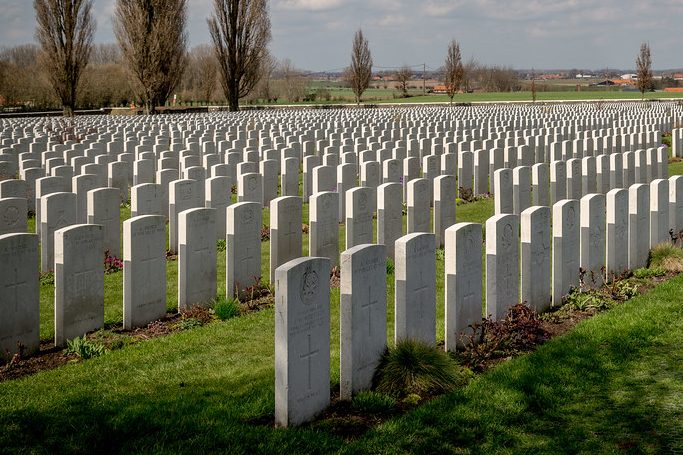
Photo: “Tyne Cot WW1 Cemetery” by PapaPiper is licensed under CC BY-ND 2.0.

RHL, ‘On Disrespecting Ancestors’

I disrespect my ancestors fighting in wars,
Europeans fighting Europeans, blame without cause;
my English grandfather killed fighting the Germans,
my Danish uncle executed for killing with Germans,
my earlier German ancestors fighting the French,
my French ancestors fighting (and marrying) the English…
and the cause of the wars always indefensibly wrong.
Why should anyone glorify them in song?
Pride, greed and stupidity – these are the drivers of war.
I turn my back on all of them, stand on the sea shore,
marvel at wind and wave, at sun, moon and stars,
despising, ignoring, forgetting their idiot wars.

*****

I’m so sick of Putin, Netanyahu… and Bush Jr, Dick Cheney, Tony Blair… war criminals, the lot of them. But they’re the products of our genetic makeup as social animals, dividing everything into “us” and “them”, and then through crafty hysteria and massively organised mob violence, grabbing everything they can for themselves.

Anyway, this semi-incoherent rant of a poem was published in the current Amsterdam Quarterly, and editor Bryan R. Monte wanted one change in my submission: to change the last line’s “ape-idiot wars” to “their idiot wars”. As usual, I acquiesced. Also as usual, I’m not sure whether it is a good suggestion or not. Apes figure in a lot of my verse, as being an underlying reality of humans, essential to acknowledge, equally essential to try to control. In the context of my other work, I think I prefer “ape-idiot”.

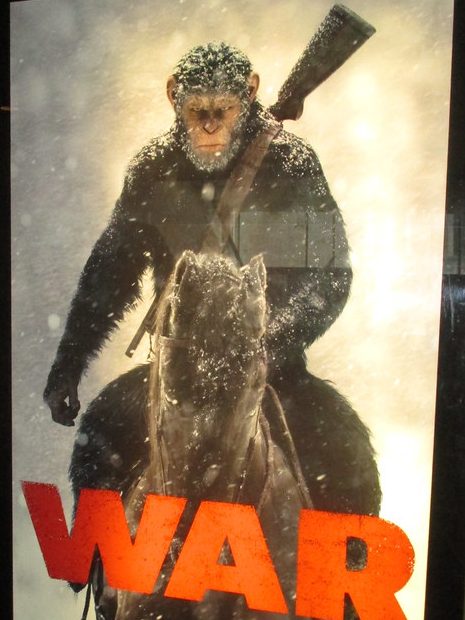
Photo: “War of the Planet of the Apes Poster 2671” by Brechtbug is licensed under CC BY-NC-ND 2.0.
Political poem: George Simmers, ‘Navalny’

In memory of Alexei Navalny, killed at the IK-3 penal colony,
16 February, 2024.

1.
Rough and chivvying cold winds blow
The helpless dead leaves to and fro.
Leaves have no say in where they go
But we’re alive so can say no –
Let us praise those men who show
Resistance to the easy flow.

2.
Navalny, prisoner in the snow,
In numbing twenty-eight below,
Has paid the price for saying no;
He’s gone the way we feared he’d go.

That’s Putin, making sure all know
That retribution comes in tow
For those who won’t go with the flow.
‘All dissidents will finish so,’
The message is: ‘Go with the flow,
Or you too could end on Death Row.’

I imagine his warders: Did they know
A twinge of guilt at this, or show
Regret or shame? I doubt it. No –
Why should men let a conscience grow
When they can just go with the flow?
When life is so much easier so,
When every television show,
The papers and the radio
All radiate a conformist glow
Incessantly, so all men know
Life’s comfier with the status quo.
It’s only awkward sods say no,
Go their own way, not with the flow.
Those have a dangerous row to hoe,
And who can blame the average Joe
For on the whole deciding: ‘No,
That’s not for me. I’d rather toe
The line, collect my wages, know
I’m safe and needn’t undergo
What brave men have to suffer. No,
Go with the flow, go with the flow.’

3.
In Moscow brave girls risk a blow
By laying flowers in the snow
To honour him for saying ‘No’.
Brave girls. I admire them so.

*****

George Simmers writes: “This poem began because our local Arts Festival announced its theme as ‘Flow’. Which made me grumble a bit: was I supposed to write stuff about how nice it was that rivers flowed? Not my style. But then I thought about people who go against the flow by saying ‘No!’ and that suggested a subject and a rhyme scheme. It was only after I’d scribbled a few possible lines that I came across a photo of young women in Moscow placing flowers in the snow as tributes to the murdered Russian dissident, Alexei Navalny. In some towns, such protestors had been arrested or beaten up by the police.

“It’s thirty-odd years since I visited Russia. That was at the time of perestroika and hopefulness. We had a contact in Moscow who took us to see the sights, including the Arbat, a popular meeting- place. He said: ‘Can we stop and talk here for a few minutes? I ask because a few years ago If I had been seen here in conversation with a foreigner, I should have been arrested.’ Freedom was precious then, but repression returned.

“Navalny was a lawyer who campaigned against the corruption endemic in Russian political life. In 2020 he was poisoned with Novichok (probably by the Federal Security Service) ; after hospital treatment in Berlin that saved his life, he returned to Russia, even though he knew of the dangers. He was immediately arrested, and ended up in an Arctic Circle corrective colony. The exact circumstances of his death still remain unclear, but while in prison he had suffered from malnourishment and mistreatment.

“Writing this poem I remember Auden’s words: ‘Poetry makes nothing happen.’ Auden pointed out that political poems make the writer feel better, but have no positive effect in the real world. He was right, as usual, which is why I mostly avoid writing poems about politics. But I don’t really see this as a poem about Navalny. I could have chosen to write about Alan Bates and his twenty-five year battle for justice for postmasters, or about Kathleen Stock and others, who opposed the dangerous ideology of the Tavistock clinic. Going against the flow matters everywhere, not just Russia. The form is monorhyme, mostly because that’s how the poem started, and it wasn’t too difficult to keep going. Monorhyme is easier than it looks, so long as you choose the right rhyme word to start with. Don’t try it with ‘month’ or ‘silver’.

“Nalvalny’s death made a news splash in February, but since then more recent horrors have displaced it on the news pages. So maybe this poem will do a little good as a reminder of a brave man. Thank you for re-blogging it.”

The poem will be part of the film ‘Wordflow’ (a film by John Coombes with a soundtrack of stories and poems by Holmfirth Writers’ Group in a continuous showing from 10am-4pm), presented at the Holmfirth Arts Festival in Yorkshire on Sunday, June 16th, upstairs at the ‘Nowhere’ bistro, Norridge Bottom, Holmfirth, HD9 7BB.

George Simmers used to be a teacher; now he spends much of his time researching literature written during and after the First World War. He has edited Snakeskin since 1995. It is probably the oldest-established poetry zine on the Internet. His work appears in several Potcake Chapbooks, and his recent diverse collection is ‘Old and Bookish’.

Using form: SF sonnet: RHL, ‘On a Dead Spaceship’

On a dead spaceship drifting round a star,
the trapped inhabitants are born and die.
The engineers’ broad privileges lie
in engine room and solar panel power.
The fruit and vegetables and protein co-ops
are run by farmers with genetics skills:
the products of their dirt and careful kills
help service trade between the several groups.
Others — musicians, architects — can skip
along the paths of interlinking webs.
Beyond these gated pods that the rich carve
for their own selves (but still within the ship),
in useless parts, are born the lackluck plebs.
Heard but ignored, they just hunt rats or starve.

*****

This sonnet was republished in Bewildering Stories in April 2024 – original publication had been in Star*Line five years previously. I find something very satisfying about using a formal sonnet structure to express science fiction and speculative fiction ideas – the ideas are by nature open-ended, unconstrained, and it feels good to tie them down as in a neat package with a bow on top. Topiary.

As for what political comments can be read into the poem, read away!

Photo: “Deepstar 2071 at Io” by FlyingSinger is licensed under CC BY 2.0.

Tom Vaughan, ‘The Great and the Good’

Why sing of the lives
of the fortunate few
whose gong-heavy entries
weigh down Who’s Who ?

They’re smug on their summits
and on Footsie Boards,
Permanent Secretaries
or rotund Law Lords;

generals, merchant bankers,
Top Brass at the Beeb,
dons, doctors, bishops. . .
You can spot the breed

by their ability
blind obedience to claim
from drudges and drivers
and shy, single, tame

PAs who sacrifice
lonely weekends
to type bland speeches
for skimpy stipends.

O don’t be deceived
by the Great and the Good –
you’re a rung on their ladder
on their fire, wood,

grain for their harvest,
a wheel on their car,
corpse on their D-Day,
night for their star.

*****

Tom Vaughan writes: I’ve long been fascinated by the phrase ‘the Great and the Good’, having reached the conclusion during long years of government service that the great cannot generally also be good, given the demands of the exercise of power. But I am also intrigued by the loyalty such people can inspire, and the longing for leaders that reflects, despite the advice given by my favourite political commentator, Bob Dylan, in Subterranean Homesick Blues – ‘Don’t follow leaders/Watch the parkin’ meters’.”

‘The Great and the Good’ was first published in Snakeskin 265, October 2019.

Tom Vaughan is not the real name of a poet whose previous publications include a novel and two poetry pamphlets (A Sampler, 2010, and Envoy, 2013, both published by HappenStance). His poems have been published in a range of poetry magazines, including several of the Potcake Chapbooks:
Careers and Other Catastrophes
Familes and Other Fiascoes
Strip Down
Houses and Homes Forever
Travels and Travails.
He currently lives in Brittany.
https://tomvaughan.website

Photo: “MPs and House of Commons officials stand in the House of Lords chamber at the opposite end to the throne, the bar, to listen to the Queen’s Speech” by UK Parliament is licensed under CC BY-NC 2.0.