Category Archives: Robin Helweg-Larsen

Sonnet: RHL, ‘An Observation’

If particles only exist as waves,
precipitating out only when measured, seen,
till then just ghostly, nebulous, roughed-in…
If that’s the way the universe behaves,
then who’s to say the moons of Jupiter
existed before Galileo scoped
them out? Our simple world had coped,
pre-Hubbell, without needing to infer
a billion galaxies. Again, if things
newly observed are different than before,
then things that once were real are real no more,
especially nebulous, wave-form, with wings,
hence dragons, fairies, elves all now seem odd…
and angels, demons, giants, ghosts… and God.

*****

This sonnet was recently published in Bewildering Stories (thanks, Don Webb), and seems to have touched a chord with that issue’s theme of esse est percipi; so it leads off that week’s questions in the magazine:

  1. In Robin Helweg-Larsen’s An Observation:
    1. George Berkeley’s philosophy of Idealism is based upon the principle: “To be is to be perceived.” How does the theory of Quantum Physics support the principle of perception? Or does it?
    2. The poem concludes by listing a number of supernatural beings whose reality is implicitly denied as long as they have not been perceived. How does “God” differ — by definition — from the others in the list?
    3. By whom or what must something be perceived in order to exist? And how does a perception take place?

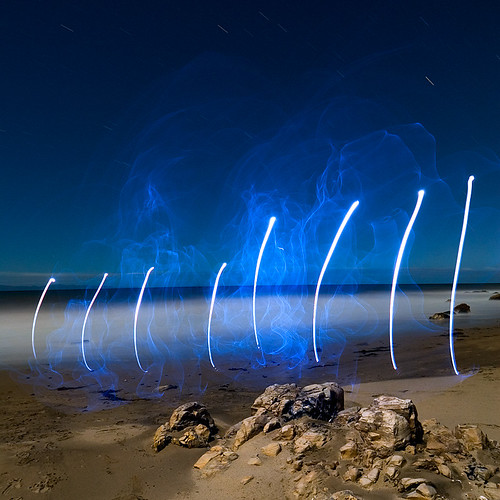
Photo: “Nebulous in Blue” by Toby Keller / Burnblue is licensed under CC BY-NC-SA 2.0.
RHL, ‘In the Spring’

In the spring, an old man’s fancy
ruefully reviews his youth;
thinks of girls both past and present,
wonders can he hide time’s truth.

His always googly gardening eyes
all ever which ways scan and glower
at the bud-bursting blossoming girls
exploding in their flower of power.

What is this green and noisy growth
that’s flourishing, fresh and unkempt?
Old’s good, so’s young… could one be both?
O Fates! from fate make me exempt!

*****

‘In the Spring’ was published in Bewildering Stories, an online weekly of Speculative Fiction, Poetry, Art, etc. Thanks, Don Webb!

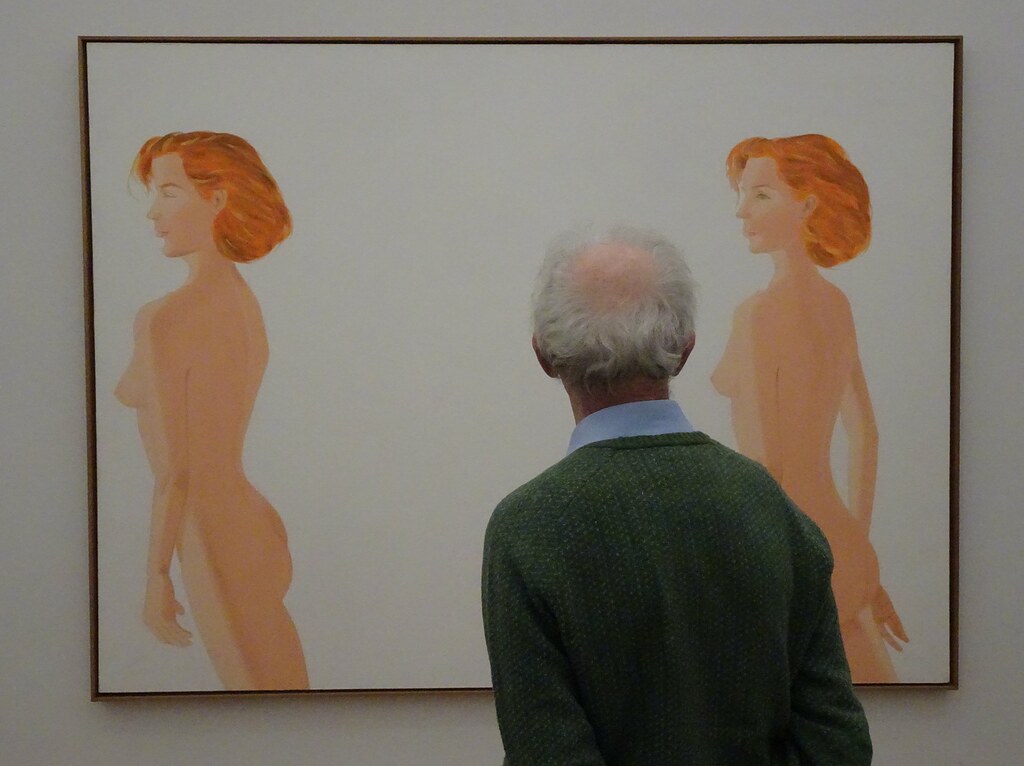
at the museum” by derpunk is licensed under CC BY-NC-SA 2.0.
RHL, ‘Raised by Expatriates’

When I was young, best thing I’d seen
was Morgan’s fort gone under green
in jungled Panama.
The only flags in forests there
were what leaf-cutting ants could bear:
for planet’s anima.

I touched skulls resting in plain view
in empty deserts in Peru:
mud walls stood rainlessly.
I sailed on seas beyond all land,
stood with a sloth, yes, hand in hand,
saw men drink sugared sea.

I learned to bodysurf in waves;
I climbed cliffs, and saw bats in caves,
saw beaches of pink sand.
Result? I always loved to roam
but nowhere lets me call it home,
All lands are not my land.

Some places I’m a citizen
but never been a denizen;
with others, the reverse:
the places that I’ve lived in most
ignore me like an unseen ghost,
foreign, vague-skinned, perverse.

The wind has blown me since my birth,
my home is nowhere on the earth,
from place to place I roam.
My parentage determined that
my citizenship’s “Expatriate”…
so… everywhere is home.

*****

Not all my poems are autobiographical, even if first-person. This one is. It was published recently in the Amsterdam Quarterly (thanks, Bryan R. Monte!)

Short poem: RHL, ‘Brave Crab’

The little land crab stands right in the road,
Waving his big red claw.
Almost hit by a car rushing past –
Another, then one more.
The little crab stands fearless and alone,
He just won’t back away
And all the other crabs beside the road
Call out “¡Olé! ¡Olé!”

*****

This little poem was recently published in Rue Scribe, “an online journal for small literature”. Thanks, Eric Luthi!

We’re just coming up to the time of year when there are big crabs crawling in the bush (and getting taken by people for food), followed by lots of little crabs crossing the road (and the ones that get hit by cars becoming food for birds).

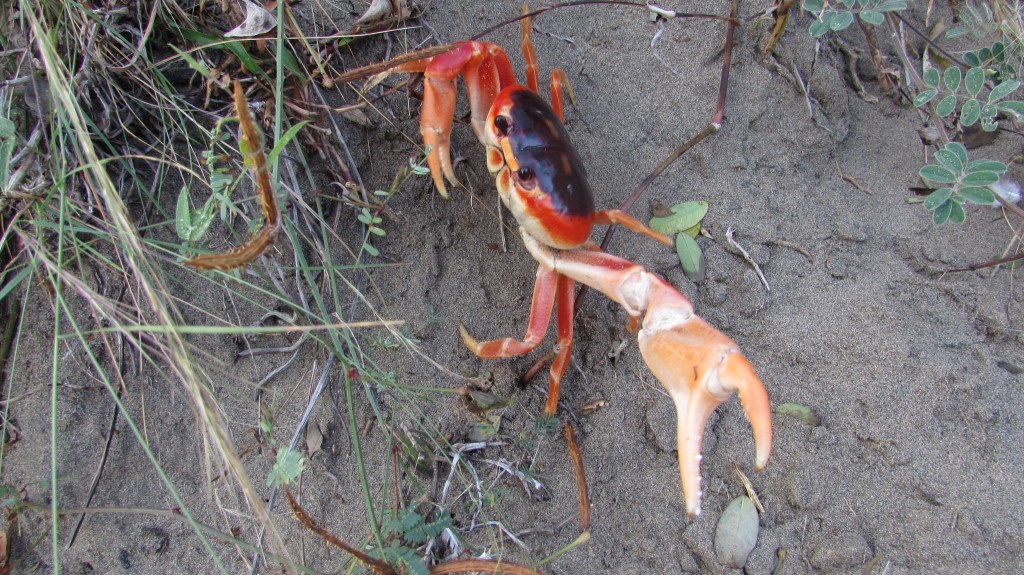
Photo: “bermuda land crab, blackback land crab, black land crab, common land crab, orange halloweenkrabbe, red land crab, rote landkrabbe, schwarze landkrabbe” by La Mancha en Movimiento is licensed under CC BY-NC 4.0.

Weekend read and listen: RHL, 3 audio + text poems

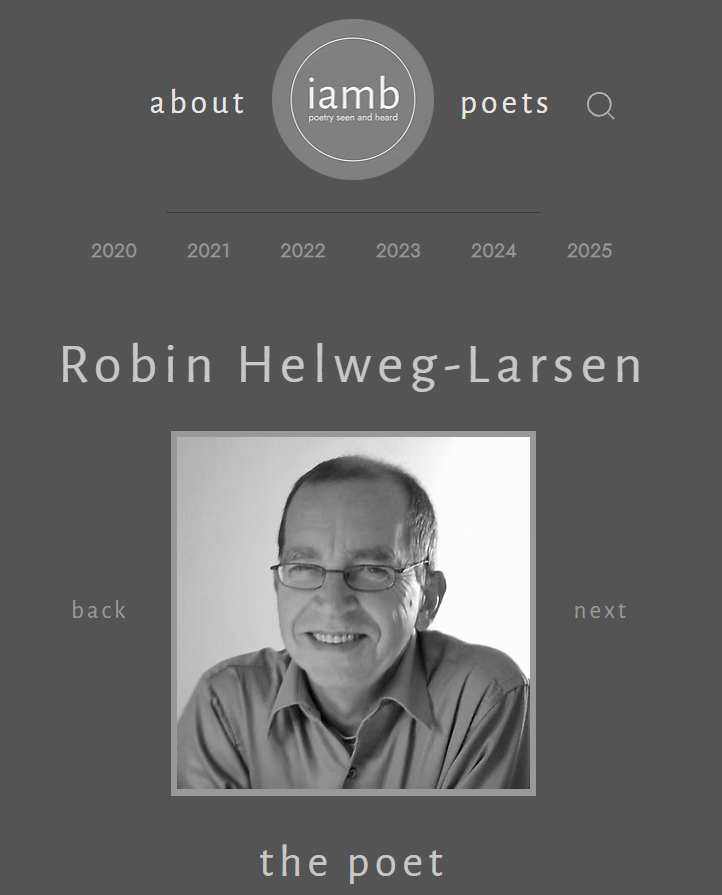
iamb – poetry seen and heard” is the creation of Mark Antony Owen, showcasing poets with their readings of three of their poems. Begun in 2021, Mark describes his project as “part library of poets, part quarterly journal, iamb is where established and emerging talents are showcased side by side. Not just their words, but their readings of them. Expect new poems, every three months, free to your device of choice.”

Accompanied by an out-of-date photograph, three of my poems are available here. They are not among my most recent work, but they are favourites and I chose them for their very different moods, themes, and forms: ‘Camelot at Dusk’, ‘Old Sailors’, and ‘This Ape I Am’. And their use of form sets them apart from all the other poems in this 21st ‘wave’ of iamb. I can’t decide if I am stuck in the past, or write in the style of the only verse that has a chance of being remembered in 100 years. But maybe that’s not an either/or – maybe only verse that is rooted in the historical rhythms of the language will last. So I suspect.

Auditions will reopen in September for next year’s waves.

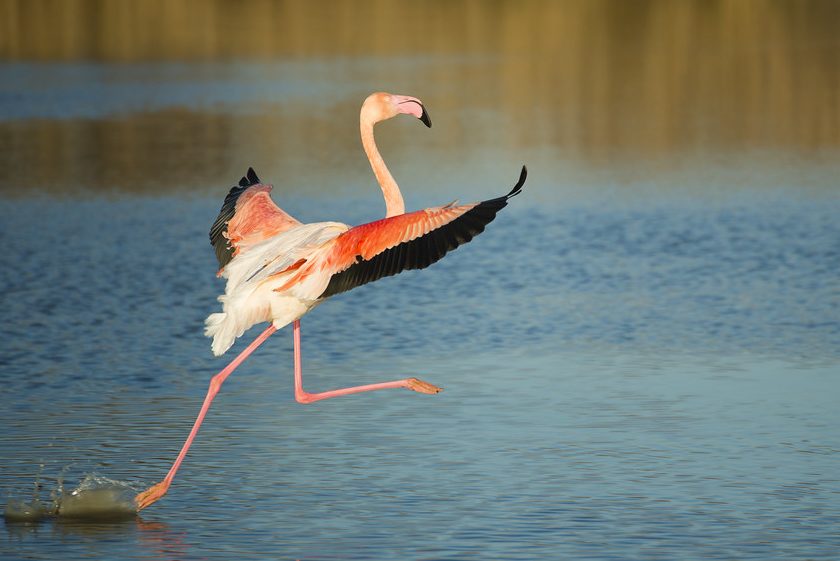
Short poem: RHL, ‘Flamingo’

As annuals at their lives’ ends flower in beds,
blossom and ripen into yellows and reds
as Earth throws scarlet to the day’s end skies –
so the flamingo trying to fly, pounding along
the surface of the water, pink wings flapping, pink feet slapping,
ungainly straining desperate, then sudden rise,
its work rewarded: scarlet, pink, black, strong,
suddenly graceful, airborne . . . and then gone.

*****

This short poem was recently published in Lighten Up Online after the editor’s careful query “Could I just check that Ls 5 and 6, which seem to have six beats unlike the others, are intentionally reflecting the awkwardness of the flamingo’s take-off?” Indeed, and I’m glad that it came across that way – thanks, Jerome Betts!

The current Lighten Up Online is a particularly good issue, with many poems far superior to my poor struggling flamingo.

France – Flamingo Landing 04/25/16 Explored” by Benjamin PREYRE Photography is licensed under CC BY-NC-ND 2.0.

Breaking my own rules: RHL, ‘Tropic Full Moon’

Under the midnight moon, the high garden’s outlined palms
Wait. The sky round the white moon
Is blue. And the clouds in the blue sky
Are white. And the shadows in the white clouds
Are blue. Below, offshore,
Where three green islands lay in daylight’s blue sea,
Tonight in the moon’s silver sea lie four black islands
And one, gliding imperceptibly north,
Is the black shadow of a white cloud in the blue sky.
Gone are the golden butterflies from the pink hibiscus,
Gone are the orange Monarchs from the purple bougainvillaea;
Black lizards hunt black insects through black flowers of black bushes.
The palms are black against the blue,
Complex silhouettes of simple forms,
Bending bowed fronds towards the moon –
To the white Moon in her blue sky.

*****

I’m always embarrassed in writing or sharing “poetry” that lacks form. But oh well. There are still things in it I enjoy. This one was published in Abraxas.

Photo: “Full moon eve” by John & Mel Kots is licensed under CC BY-NC-ND 2.0.

Sonnet: RHL, ‘Atavistic’

Just past the new development’s array,
beyond the parking lot, the flowers, the fence,
the land becomes uneven, falls away
into an area of no pretence,
abandoned cars, some rocks, some weeds, a bog.
Here are drawn children and eccentrics both,
searching for wild flowers, or a snake, a frog,
to nature lurking in the undergrowth,
beyond the ordered asphalt, lineal law;
drawn by our lower brain of hunter, ape,
where food is found or killed and eaten raw,
life is survival, and sex may mean rape.
Bricks, debris, rubble, condoms, empty beer…
yet, strangely, life-long loves have started here.

*****

I subscribe to the Nietzschean view of humans as a rope stretched over an abyss, animal on the one side, posthuman on the other. I think the ape is very alive within us, as is the drive to reach beyond ourselves to something vastly greater.

This sonnet was originally published in Rat’s Ass Review (thanks, Roderick Bates) but I’ve modified one line here to match the photo I found for illustration.

Photo: “Vacant Lot” by Curtis Gregory Perry is licensed under CC BY-NC-ND 2.0.

RHL, ‘The Queen’

In March the Queen came, flirting on her throne;
April, I loved her gladly,
And in May I’ll love her madly,
And in June I may act badly
For July I’ll love her sadly,
Cause when August comes, I know that she’ll be gone.

*****

This poem was just published in Rat’s Ass Review – thanks, Roderick Bates… who, in accepting it, wrote “By the way, I assume the queen is Cassiopeia, who is always visible at my latitude.” I’m happy with that interpretation; but it’s actually about the lighthearted springtime attractions that, sensibly, go nowhere.

Photo: “flirt” by cloud.shepherd is licensed under CC BY 2.0.

RHL, ‘If Astrology Were Real’

If astrology were real, you’d expect
it would be an unremarkable aspect
of daily life for someone to select–
to fall in love, fully connect–
with two people with the same birthday;
for victims of mass events (tornados, cities wrecked)
to share a sun-sign or unlucky day;
for astrology to be so useful that respect
for horoscopes would drive a business power play,
and with no reason to suspect
insider information when bets proved correct;
and that some other nonsense disarray
would have to be invented to display
for children, lovers, dreamers, to collect–
for old folks suffering neglect–
for young ones on the make, unchecked–
for trash TV and media to infect–
and for the rest of us to naturally reject.

*****

My English mother was a great practitioner of astrology; my Danish father was a thorough sceptic. In the 1950s he was going to take a trip across the Atlantic by sea, and asked her to do a forecast of the voyage. She went off and studied the stars, and came back and said that everything looked fine. (What else could she say?) Unfortunately the ship went on the rocks at Bermuda and everyone was taken off in lifeboats. When my father later questioned her forecast, her explanation (as he reported it) was that “Venus was in the Dragon’s Tail and kiss my arse.”

I studied astrology (along with lots of other religious and spiritual systems) in my 20s, but ended up agreeing with my father; hatha yoga is the only practice I’ve retained from those days.

This poem has just been published in Rat’s Ass Review – a good place for snarky poetry. Thanks, Roderick Bates!

Photo: “Automata on the famous astrological clock” by Curious Expeditions is licensed under CC BY-NC-SA 2.0.