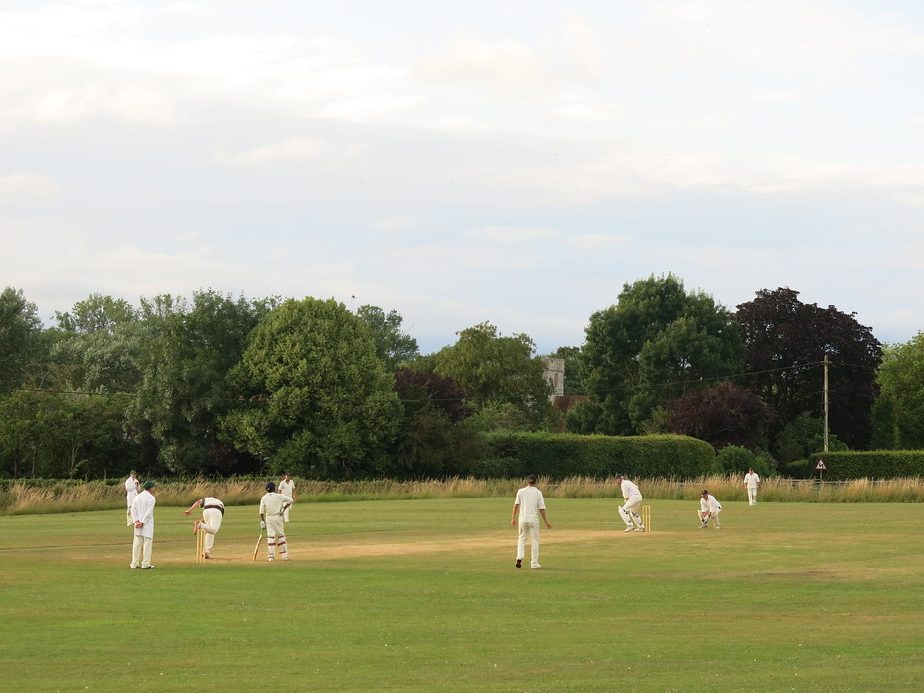
You swore at me and hurled your ring into the pond then drove off back to London “for some bloody fun” with friends whose Chelsea coven held you in its bond. I was next in, scored twelve and hit the winning run.
The beers were long and cool, the Captain shook my hand. Dusk shaded in, a final liquid blackbird sang. A coughing tractor crawled a strip of fading land. An owl flew low across the pitch, a church bell rang.
Two muddy urchins with a shrimp-net dredged the pond their hopeful piping rippling in the cooling air while you choked on exhaust at Guildford or beyond along your golden road to Knightsbridge and Sloane Square.
Another world and just two perfect hours away your eyes had been bright green. Or brown. Or were they blue? I still recall the details of that Summer day so much more clearly than I now remember you.
*****
Martin Parker writes: “The only point I might add is my hope that if the muddy urchins’ dredging efforts were rewarded they were not too disappointed to learn that the ring’s diamond might not have been a real one! The intervening sixty-five-plus years have, mercifully, erased the fact that I may have been nothing but a cheapskate!”
‘Man of the Match’ was first published in Snakeskin.
Martin Parker is a writer of mainly light and humorous verse much of which has appeared in national publications including The Spectator, The Oldie and The Literary Review. In 2008 Martin founded the quarterly light verse webzine, Lighten Up Online at www.lightenup-online.co.uk, now edited by Jerome Betts. His website at www.martinparker-verse.co.uk gives details and excerpts from his two “hopefully humorous and only occasionally wrily depressing books”.
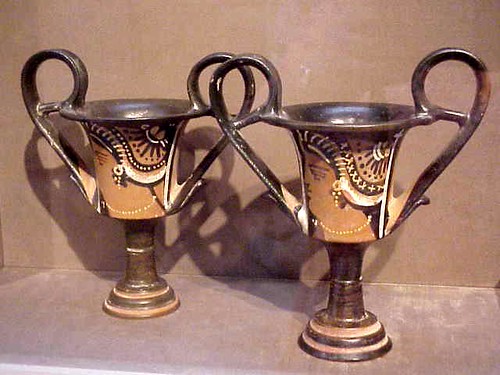
Look: formal verse can be china for tea, a golden goblet, a mug made of clay. Free verse is putting mouth to stream to drink. Yes, you could cup your hands… but do you think museums want to buy that to display your “memorable skill”, your “artistry”?
*****
‘Formal vs Free’ is published in the current ‘Blue Unicorn‘, in a section loaded, as often, with verse about verse.
The date has come; the boxes are all stacked, leaving pale squares where once the pictures hung. The ghosts of photos, souvenirs, are packed, the clocks are stopped, the pendulums have swung; familiar noises banished. Here we sit, nothing to do, for once: suspended time can hold its breath and let the minutes knit the final rows, and then cast off. The climb
into the future’s not so very hard now all the work is done: decisions made, the papers signed, that border crossed, the yard cleared of dead plants, and every last bill paid. The clocks are stopped, the pendulums have swung, The ghosts of photos, souvenirs, are packed, leaving pale squares where once the pictures hung. The date has come. The boxes are all stacked.
*****
D.A. Prince writes: “This is a memory of a house move in 1982 when, somehow, I found time to sit and reflect. Having moved house last month was a rather different experience – and not an experience for the faint-hearted – but I’m hopeful that eventually, there will be time to sit down. If poetry is ‘emotion recollected in tranquility’ I look forward to some restorative peace in the future.”
D.A. Prince lives in Leicestershire and London. Her first appearances in print were in the weekly competitions in The Spectator and New Statesman (which ceased its competitions in 2016) along with other outlets that hosted light verse. Something closer to ‘proper’ poetry followed (but running in parallel), with three pamphlets, followed by a full-length collection, Nearly the Happy Hour, from HappenStance Press in 2008. A second collection, Common Ground, (from the same publisher) followed in 2014 and this won the East Midlands Book Award in 2015. HappenStance subsequently published her pamphlet Bookmarks in 2018, with a further full-length collection, The Bigger Picture, published in 2022. New Walk Editions published her latest pamphlet, Continuous Present, in 2025.
My husband is a pale blur. The dark turns grainy as the blue hour tints our bedroom, my glasses somewhere near the nightstand’s edge.
He could almost be U2’s guitarist, Edge: goatee, pale arms, black T-shirt, trademark dark wool skull cap. Me: his groupie. His hotel room.
Distortion fades. Before he leaves the room, I feel a toe-squeeze, hear an air-kiss: edge of day, his way of sugaring the dark,
our portrait in the darkroom of a marriage.
*****
Nicole Caruso Garcia writes: “The inspiration for the tritina ‘Love Poem in Winter with Blackout Shades‘ came from a workshop led by Matt. W. Miller at the 2022 Poetry by the Sea Conference. He had us select one line from among a dozen or so poems by other poets, then use the line use as a springboard and incorporate it somewhere in a new poem of our own. My poem’s first sentence is a line from the middle of Aimee Nezhukamatathil’s ‘I Could Be a Whale Shark‘.”
‘Love Poem in Winter with Blackout Shades‘ was first published in Crab Orchard Review.
Nicole Caruso Garcia’s full-length debut OXBLOOD (Able Muse Press) received the International Book Award for narrative poetry. Her work appears in Crab Orchard Review, Light, Mezzo Cammin, ONE ART, Plume, Rattle, RHINO, and elsewhere. Her poetry has received the Willow Review Award and won a 2021 Best New Poets honor. She is an associate poetry editor at Able Muse and served as an executive board member at Poetry by the Sea, an annual poetry conference in Madison, CT. Visit her at nicolecarusogarcia.com.
Form is a slippery seed to be grasped. Free verse is form with its bra hook unclasped. Blocked is me chewing my fanciest pens. Pun is a test of my spouse and my friends. Drunk is the poet who’s making a pass. Prize is a unicorn chased by an ass. Tome is Uranus-sized ego unbound. Deep is the grave of my darlings I’ve drowned. Rhyme is the hill where I’m willing to die. Meh is the mic hog who sounds like AI. Crit is a cig from a firing squad. Light is the thirstiest verse. Please applaud.
*****
Nicole Caruso Garcia writes: “‘Po-Biz Ars Poetica‘ came about after I stumbled upon a metrical form Mary Meriam invented called the “Basic Me.” (I will include the link to its “rules” here.) Although Meriam says, “Basically, it means ‘what are your words and how would you define them?,” here I ascribed each trait to “po-biz” rather than to myself.”
‘Po-Biz Ars Poetica‘ was first published in the Winter/Spring 2025 issue of Light, where Nicole Caruso Garcia is the Featured Poet.
Nicole Caruso Garcia’s full-length debut OXBLOOD (Able Muse Press) received the International Book Award for narrative poetry. Her work appears in Crab Orchard Review, Light, Mezzo Cammin, ONE ART, Plume, Rattle, RHINO, and elsewhere. Her poetry has received the Willow Review Award and won a 2021 Best New Poets honor. She is an associate poetry editor at Able Muse and served as an executive board member at Poetry by the Sea, an annual poetry conference in Madison, CT. Visit her at nicolecarusogarcia.com.
Suddenly the kids, the car, the house, the spouse, the local bar, the work, have made you what you are. What doesn’t chill you makes you fonder.
Should you stay or should you go? The thrill you’re looking for, you know, could be right here at home, although what doesn’t thrill you makes you wander.
If, avoiding common truth, you dye your hair and act uncouth, will you find your misplaced youth – really, will you if you’re blonder?
It doesn’t matter if you’re strong or if you sing a pretty song, something, and it won’t be long, will come to kill you, here or yonder.
You’re human in the human fray, and choose among the shades of grey. No matter if you go or stay what might fulfill you makes you ponder.
*****
Marcus Bales writes: “This is a little more than a decade old, back when I still had a full time job. There is something looming in a life about a full time job that’s hard to escape entirely even when you’re determined to try. Must have been a bad day on the sales floor.
“This is one of those poems where a rhythm enters my mind and won’t go away until I put words to it. Of course it already HAD words to it, but I couldn’t use those. So after one quatrain it became a challenge to see how many of that refrain rhythm it was possible to make sense with. That’s actually sort of freeing, because once that becomes the challenge, it opens the poem, for me anyway, to using the randomness of the rhyme words, as they arise, to drive each stanza’s, and thus the whole poem’s, sensibility. This is a good example of how the aleatory dice of rhyme can be used to open up opportunities to say things I wouldn’t have thought of to say at all without having to work toward the rhyme word. This can be very bad for a poem, of course — one of the main ways to judge poems in meter and rhyme is on how hard it is to tell whether the poet was using the rhyme words that way or not. The goal, of course, in almost all rhyme, is to delicately decorate the poem rather than for it to be clear that the poet was merely chasing a rhyme. And when there’s a rhyming refrain line the danger is extreme.
“I remember being pretty happy with it at the time. I do like the way something seems to loom over the narrator, pressing him onward through his meditation, and providing, I hope, the reason that meditation is needed.”
Not much is known about Marcus Bales, except he lives and works in Cleveland, Ohio, USA, and his work has not appeared in Poetry or The New Yorker. His latest book is 51 Poems; reviews and information at http://tinyurl.com/jo8ek3r
Clip clop clip clop steady up yon stuntgrass rise, boy, long as low and stony-brown, slow like weeks with nothing in them: saddle-tick, dirt-crump, poker-face.
Clip clop clip clop privy-top and anchor-wires, church-cross, store-spike, steady boy, up yon one-street, just more-trodden dust: saddle-tick, dirt-crump, poker-face.
Clip clop clip clop steady, boy, through sad wood civics, rippled in yon saloon-glass store-side, road-end, horses maybe leaving: saddle-tick, dirt-crump, poker-face.
Clip clop clip clop rise, boy, steady, way ahead, purple-white mountains, nothing in them maybe, like weeks maybe: saddle-tick, dirt-crump, poker-face.
2.
My brother’s name was Crazy Sean. They shot him in the head. He rattled through the summer corn and turned the green shucks red.
I laid him in the willowbrake. I couldn’t stand to pray. I kissed his cheek for pity’s sake, and then I rode away.
The plains are full of buffalo. The woods are red and gold. The mountaintops are white with snow. His memory keeps me cold.
I’ve rode through Hope and Whisky Creek. I’ve rode through Faith and Love. I’ve laid in Hate and Hide-and-Seek, and run from God-Above.
The prairie shines, the buckdeer cry. The hawks hang in the heat. Clipclop clipclop, the world rolls by. They say revenge is sweet.
3.
Somewhere still, stark as an afternoon; Ached in long planks of sunshine; Like a gambler’s card dropped on an empty land; Vauntsquare, the nailed-up main street creaks Against the air. Clipclop – hotel, laundry, saddles, Telegraph, clap-houses, guns. The horse stops. Into this hollow spine of fellowship blows a slow O of wind. Three men clatter at a boardwalk: Nacarat boots, sharktooth mojos – oh my brother.
4.
I shot one on the shithouse board. His head smashed like a squash and sprayed the backboards red. He pissed his boots and died. The stinking hole spit up a fat, black fly, which was his soul. I shot one in the barbershop. The chair caught fire, and ate his o-colonied hair. He fell out like a slice of spitroast meat. The duster wrapped him in its winding-sheet. I shot one in the cornfield. Larks of blood flew off his skull and twittered in the mud. He rattled through the stalks. His mashy head threw up its brain and turned the green shucks red. I took a bath and threw away my gun. I rode away wherever. I was done.
5.
drizzle pops on his hatbrim, cord and wool and steam-sodden, saddleticks like an empty stomach.
windpump wires and tin-dump, like horizon-drowning, horse, then man, hat, gone, clipclop, dusk drips in.
paraffin lamplight pricks the town, glo-worms, night hunched above, coyotes carry their eyes like stars.
6.
reckoning done how will he ever be warm
purpose gone how will he outrun the storm
bearings none how will he find another
riding alone how will he tell his brother
*****
John Gallas writes: “‘Western Man’ is a weird one: I have a quite spooky love of Westerns, jogging as they do some very deep links with Old En Zed, remnants (many remnants!) of which I grew up with and in. Those old wooden towns, the dim General Stores, the slightly grim and mostly silent (mostly) men, the cheek-by-jowlness of town and bush. It means quite a lot to me. I find the end of most Clint Eastwood films, and especially ‘Once Upon A Time in the West’, as the hero says ‘I gotta go now’, and rides away into lonliness after some bloody vengeance or other, inexpressibly moving.”
John Gallas, Aotearoa/NZ poet, published mostly by Carcanet. Saxonship Poet (see http://www.saxonship.org), Fellow of the English Association, St Magnus Festival Orkney Poet, librettist, translator and biker. Presently living in Markfield, Leicestershire. Website is www.johngallaspoetry.co.uk which has a featured Poem of the Month, complete book list, links and news.
There’s a cross in the field where the scarecrow stood And the ravens have all come back And the ravens would say, if they only could That a scarecrow is straw and a cross is wood And the wings of a famine black.
There’s a cross on the grave where the hero lies He whose war was to end all wars And his empty skull holds a thousand why’s And the crow that struts on his grave replies With a thousand triumphant caws.
There’s a cross on the hill where the scapegoat hung Like a scarecrow to ward off sin And the prayers are said and the hymns are sung And the gorcrows perch on their hills of dung Where the plagues of the world begin.
There’s a cross in the dark of the Southern sky Where the stars wink a long farewell As the ghosts of the ravens prepare to fly To return to the void of their black god’s eye With a tale that they’ll never tell.
*****
Simon MacCulloch writes: “This poem melds the Christian symbol of death and resurrection with the Four Horsemen of the Apocalypse in an attempt to express how one feels after reading the world news in recent times.”
Simon MacCulloch lives in London and contributes poetry to a variety of journals including Reach Poetry, View from Atlantis, Spectral Realms, Altered Reality, Aphelion and others.
He doesn’t care for flowers or for fruit, so don’t implore him not to clip or prune the fig trees and camellias. His pursuit of geometric form makes him immune
to luscious tastes and beauties others crave. He doesn’t care for flowers or for fruit, so once the buds appear, don’t try to save them from his trimmer. All your pleas are moot.
He holds a tidy yard in high repute, a verdant symbol of his mastery. He doesn’t care for flowers or for fruit, but takes some pleasure in your misery
as he destroys what you had hoped to see. His need to have control is absolute, and you can’t argue with machinery. He doesn’t care for flowers or for fruit.
*****
Susan McLean writes: “This poem started with my desire to write a quatern, a form that I had encountered in Chad Abushanab’s workshop on rare poetic forms at the Poetry by the Sea conference in 2024. A quatern is four quatrains long, and the first line of stanza one becomes the second line of stanza two, and so on. As for the poem’s content, it grew out of a dispute about gardening practices with someone I know well. I was unable to convince him to change his ways. I should add that his ascribed motives are all conjectural on my part, not based on anything he said. But poets don’t really lose an argument; they just take the opportunity to restate it as a poem. This poem first appeared in the August 2025 issue of Snakeskin.”
Susan McLean has two books of poetry, The Best Disguise and The Whetstone Misses the Knife, and one book of translations of Martial, Selected Epigrams. Her poems have appeared in Light, Lighten Up Online, Measure, Able Muse, and elsewhere. She lives in Iowa City, Iowa. https://www.pw.org/content/susan_mclean
A dinosaur straddles a rocket And whether the pilot within Was trying to launch it or dock it To finish a trip or begin, It looks like a fight that the dinosaur might By weight and ferocity win.
But how did it mount there? Its wings Though bat-like are really too small To soar to the perch where it clings Indeed, to get airborne at all It better hold tight as the rocket takes flight For if it slips off it will fall.
The monster can only have boarded The spaceship when close to the ground (Its huge-muscled hind legs afforded The strength for a crouch and a bound) And as it gains height in the star-speckled night It will squat, legs and tail firmly wound.
A rodeo cowboy! Each buck Of boosters a challenge to greet! A contest of power, skill, luck To see if a lizard can beat This beast that takes fright at the terrible sight Of a dragon that thinks it’s in heat.
For that is the heart of the matter: This brute who bears down from above Will scrabble and buffet and batter Then, spent, wrap as close as a glove With licks to invite its cold mate to requite Its misallied dinosaur love.
*****
Simon MacCulloch writes: “Rocket Ride was inspired by Peter Andrew Jones’s book cover painting for The Second Experiment (Granada Books, 1975); the poem was first published in Aphelion.”
Simon MacCulloch lives in London and contributes poetry to a variety of print and online publications, including Reach Poetry, View from Atlantis, Pulsebeat Poetry Journal, Spectral Realms, Black Petals and others.