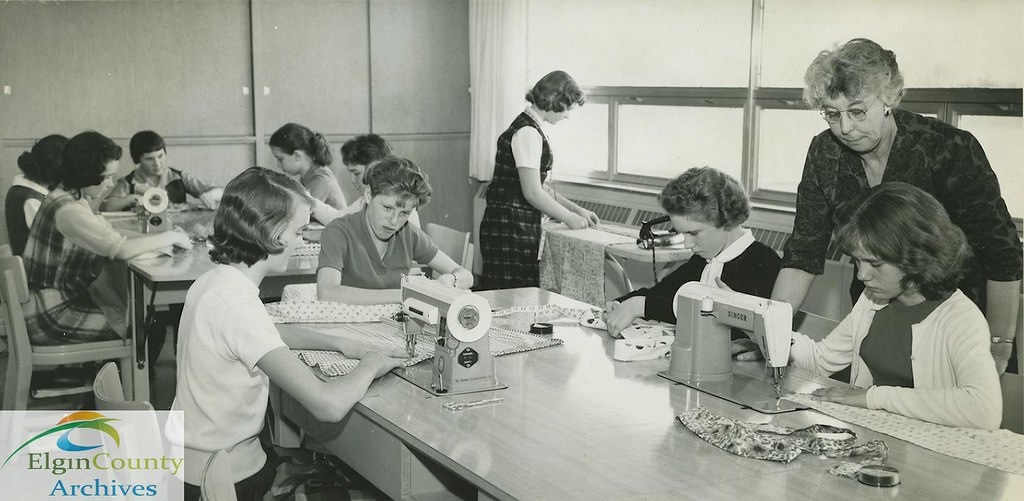
Like other teenage girls in ‘65,
I learned to knit, embroider, and crochet,
so if I’m teleported back in time
a century or two, I’ll do okay.
I learned the way to wrap a package neatly,
to tie a range of plain and froufrou bows,
to minimize my body flaws discreetly,
using the cut and pattern of my clothes.
I also learned to iron, hem, and baste,
to sew on zippers, trim, and appliqué,
to choose a hairdo that would suit my face—
and nothing that I ever use today.
*****
Susan McLean writes: “In the mid-Sixties, the times were changing, but the education of teenage girls was not. In junior high school home economics classes, which girls were required to take, the girls were trained in sewing and cooking skills as preparation for their future roles as wives and mothers. The ideas that men might need to know any of those skills or that women might have full-time careers were not considered. In addition to teaching girls domestic skills, the classes served to reinforce the gender roles and expectations of the time (which had not changed significantly from those of the previous few centuries).
“I slightly overstate my case when I say that I never use anything now that I learned in the two years of sewing classes I took. I still wrap a package and sew on a button occasionally, but I had learned both of those skills well before I took the classes. And even when I was taking the classes, I was already determined to have a career of my own. I petitioned successfully to be allowed to skip the cooking classes so that I could take art classes in their place (though, ironically or not, I am now an enthusiastic home cook). I didn’t mind learning various sewing skills, which had an artistic side, but I had no interest in spending a lot of time using them afterwards, and the view of my options that the classes conveyed was quite dispiriting. No one foresaw how radically the roles of many women would be changing soon afterwards. But I am very glad that they changed.
“The rhymed quatrains that the poem is written in are a standard poetic form, though the mix of slant rhymes with true rhymes suggests an underlying dissonance that ties in with the poem’s themes. The poem originally appeared in the online journal Umbrella and was later published in my second poetry book, The Whetstone Misses the Knife.”
Susan McLean has two books of poetry, The Best Disguise and The Whetstone Misses the Knife, and one book of translations of Martial, Selected Epigrams. Her poems have appeared in Light, Lighten Up Online, Measure, Able Muse, and elsewhere. She lives in Iowa City, Iowa.
https://www.pw.org/content/susan_mclean
Photo: “Home Economics Class at Elgin Court School, St. Thomas, 1961” by Elgin County Archives is licensed under CC BY-NC-ND 2.0.

 Form in Formless Times