Tag Archives: aging

Melissa Balmain, ‘Freud Drops by to Analyze My Remodeling Project’

Your teeth are looking yellow
and your hands and face are spotty?
Don’t fret a smidge! Your stainless fridge
is one unblemished hottie.

Your arms have gotten squishy
and your gut’s no longer jocky?
Your counters (quartz!) are strong as forts,
and rockier than Rocky.

Whenever you feel foggy,
“smart” new lighting is omniscient.
Although you’re tired, your oven’s wired
and energy-ecient.

So never mind the birthdays
that you’re obviously rich in:
Spend big and—whee!—pretend to be
as youthful as your kitchen.

*****

Melissa Balmain writes: “If I have to become a middle-aged cliché, I at least want to get a poem out of it.”

‘Freud’ was first published in Crab Orchard Review.

Melissa Balmain’s third poetry collection, Satan Talks to His Therapist, is available from Paul Dry Books (and from all the usual retail empires). Balmain is the editor-in-chief of Light, America’s longest-running journal of comic verse, and has been a member of the University of Rochester’s English Department since 2010.

Photo: “New Kitchen” by Graeme_S is licensed under CC BY-NC-ND 2.0.

Lee Evans, ‘Late in the Evening’

The more she strained her mother wit
To put the jigsaw into place,
The more the pieces wouldn’t fit.
 
Too bad the cat had felt the need
To leap into the midst of things—
The puzzle would have been complete.
 
Somehow she had misplaced the lid,
Which had a picture stamped on it
Of what she searched for in her head.
 
The work lay spread in front of her;
The shapes appeared and disappeared,
Each morphing into metaphor.
 
Sometimes they’d stay where they belonged—
But then, to her weak eyes, it seemed
She’d put them all together wrong.
 
She kept on shuffling scattered bits;
Meanwhile a lifetime passed beneath
Her aged, trembling fingertips.

*****

Lee Evans writes: “This particular poem arose from the year-long habit my wife and I have of doing jigsaw puzzles. (Big surprise!) In such circumstances one gets to thinking a lot about putting the pieces of one’s life together, especially those of us who are in our mid seventies. I may have stolen the title from a Paul Simon song, but that has nothing to do with it. Several people I have known have suffered from dementia late in life, but the poem is more about trying to grasp fluid realities than dementia, and attempting this in the frailty of one’s declining years. But that’s not all there is to the poem…”

‘Late in the Evening’ was first published in Snakeskin.

Lee Evans was born in Annapolis, Maryland and worked for the Maryland State Archives. Having retired to Bath, Maine, he worked for the local YMCA and retired from there. He has self-published 13 books of poetry, which can be found on Amazon and Lulu.com. He occasionally puts poems on a blog, The Road and Where It Goes  (Formal purists should be forewarned that he has written a fair amount of free verse!)

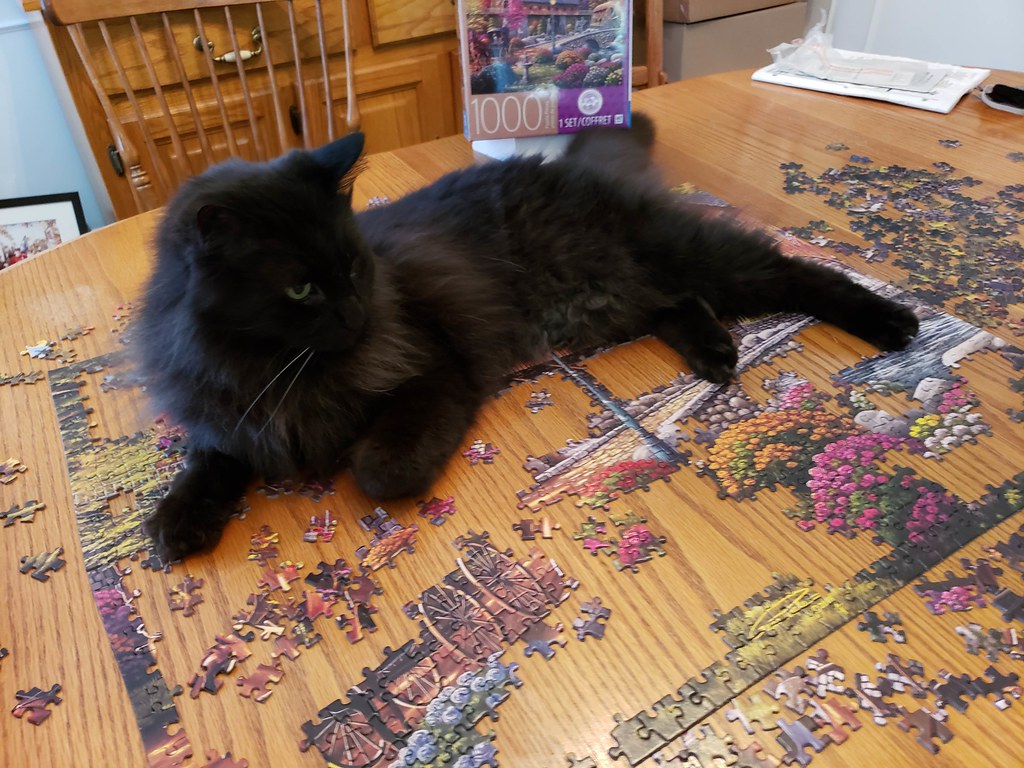
Photo: “Cosmo Helping with Jigsaw Puzzles – 2020” by cseeman is licensed under CC BY-NC-SA 2.0.

Marcus Bales, ‘Suddenly’

Suddenly the kids, the car,
the house, the spouse, the local bar,
the work, have made you what you are.
What doesn’t chill you makes you fonder.

Should you stay or should you go?
The thrill you’re looking for, you know,
could be right here at home, although
what doesn’t thrill you makes you wander.

If, avoiding common truth,
you dye your hair and act uncouth,
will you find your misplaced youth –
really, will you if you’re blonder?

It doesn’t matter if you’re strong
or if you sing a pretty song,
something, and it won’t be long,
will come to kill you, here or yonder.

You’re human in the human fray,
and choose among the shades of grey.
No matter if you go or stay
what might fulfill you makes you ponder.

*****

Marcus Bales writes: “This is a little more than a decade old, back when I still had a full time job. There is something looming in a life about a full time job that’s hard to escape entirely even when you’re determined to try. Must have been a bad day on the sales floor.

“This is one of those poems where a rhythm enters my mind and won’t go away until I put words to it. Of course it already HAD words to it, but I couldn’t use those. So after one quatrain it became a challenge to see how many of that refrain rhythm it was possible to make sense with. That’s actually sort of freeing, because once that becomes the challenge, it opens the poem, for me anyway, to using the randomness of the rhyme words, as they arise, to drive each stanza’s, and thus the whole poem’s, sensibility. This is a good example of how the aleatory dice of rhyme can be used to open up opportunities to say things I wouldn’t have thought of to say at all without having to work toward the rhyme word. This can be very bad for a poem, of course — one of the main ways to judge poems in meter and rhyme is on how hard it is to tell whether the poet was using the rhyme words that way or not. The goal, of course, in almost all rhyme, is to delicately decorate the poem rather than for it to be clear that the poet was merely chasing a rhyme. And when there’s a rhyming refrain line the danger is extreme.

“I remember being pretty happy with it at the time. I do like the way something seems to loom over the narrator, pressing him onward through his meditation, and providing, I hope, the reason that meditation is needed.”

‘Suddenly’ was first published in The Rotary Dial, which is now offline… but this issue, the Best of 2015, is at https://midnightlanegalleryii.wordpress.com/wp-content/uploads/2014/10/7c8e9-december15.pdf

Not much is known about Marcus Bales, except he lives and works in Cleveland, Ohio, USA, and his work has not appeared in Poetry or The New Yorker. His latest book is 51 Poems; reviews and information at http://tinyurl.com/jo8ek3r

Photo: “Decisions decisions ..” by monkeywing is licensed under CC BY 2.0.
Using form: Villanelle: Rachel Hadas, ‘However Cool’

However cool X may have thought he was
made very little difference in the end.
We are transformed as we approach the close.

Everyone is subject to these laws.
Ozymandias collapsed in sand,
however cool he may have thought he was.

We live in structures—marriage, job, or house—
steered steadily toward an unknown land,
slyly transfigured as we near the close,

additions and subtractions dealt by whose
enormous unseen hand?
However cool Y may have thought Z was,

her freshness faded like a poet’s rose,
malady no medicine can mend
disguising her before she reached the close.

Think of it as time; a veiled command;
a principle: I do not give. I lend.
However cool we might have thought A was,
we all are changed as we approach the close.

Rachel Hadas writes: “The villanelle ‘However Cool’ was occasioned by a conversation with a friend; she and I were talking about a mutual acquaintance who was ill, and my friend uttered a perfect iambic pentameter line which became the first line of the poem, as well as, with variation, one of the repeated lines.  It was fun to keep switching initials – the “however cool…” downward arc applies in different ways to so many people.

“A.E. Stallings has commented that villanelles are more fun to write than to read, and she may have a point.  At this point in life, I certainly find them easier to write than sonnets. But I hope there’s a bit of rueful fun to be had in ‘However Cool’.”

Rachel Hadas’s recent books include Love and Dread, Pandemic Almanac, and Ghost Guest. Her translations include Euripides’s Iphigenia plays and a portion of Nonnus’s Tales of Dionysus. Professor Emerita at Rutgers-Newark, where she taught for many years, she now teaches at 92Y in New York City and serves as poetry editor of Classical Outlook. Her honors include a Guggenheim fellowship and an award from the American Academy-Institute of Arts and Letters.

Photo: “cool for kids – summer holidays” by oddsock is licensed under CC BY 2.0.