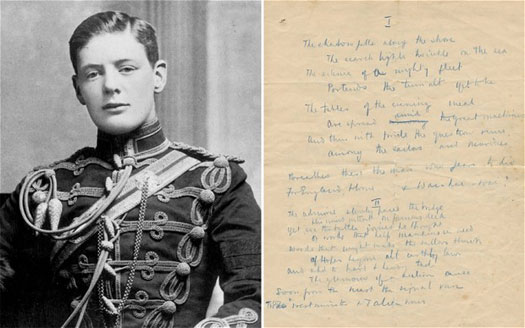
I
The shadow falls along the shore
The search lights twinkle on the sea
The silence of a mighty fleet
Portends the tumult yet to be.
The tables of the evening meal
Are spread amid the great machines
And thus with pride the question runs
Among the sailors and marines
Breathes there the man who fears to die
For England, Home, & Wai-hai-wai.
II
The Admiral slowly paced the bridge
His mind intent on famous deed
Yet ere the battle joined he thought
Of words that help mankind in need
Words that might make sailors think
Of Hopes beyond all earthly laws
And add to hard and heavy toil
The glamour of a victorious cause.
*****
Around 115 years after it was written, the only known poem written by Winston Churchill as an adult was discovered by Roy Davids, a retired manuscript dealer from Great Haseley in Oxfordshire: ‘Our Modern Watchwords’, which was apparently inspired by Tennyson and Kipling.
Written between 1898 and 1900 when Churchill was a cornet (equivalent to today’s second lieutenant) in the 4th Hussars, the 10-verse poem is a tribute to the Empire. The author peppers the poem with the names of remote outposts defending Britain’s interests around the world, many of which he would have visited as a young officer and even fought at, including Weihaiwei in China, Karochaw in Japan and Sokoto in north-west Nigeria. Written in regular iambic tetrameter but with irregular rhymes, the poem exists in a tradition that stretches back to Homer’s Iliad: the soldier waiting impatiently for the battle to begin. As Churchill writes: ‘The silence of a mighty fleet / Portends the tumult yet to be.’
Davids, who says the poem “is by far the most exciting Churchill discovery I have seen”, admits it is merely “passable”.
Andrew Motion, the former Poet Laureate, goes further, calling it “heavy-footed”. “I didn’t know he wrote poems, though somehow I’m not surprised: oils, walls, why not poems as well?” said Motion. “This is pretty much what one would expect: reliable, heavy-footed rhythm; stirring, old-fashioned sentiments. Except for the lines ‘The tables of the evening meal/Are spread amid the great machines’, where the shadow of Auden passes over the page, and makes everything briefly more surprising.”
Despite its lack of literary virtues, however, the poem written in blue crayon on two sheets of 4th Hussars-headed notepaper was expected to raise between £12,000 to £15,000 when it went on sale in 2013. Its price reflected its rarity: the only other poem known to be penned by Churchill is the 12-verse ‘The Influenza’, which won a House Prize in a competition at Harrow school in 1890 when he was 15. However ‘Our Modern Watchwords’ failed to sell at the auction as bidding never reached the reserve price.
Churchill was well-known for his love of poetry. He won the Headmaster’s Prize at Harrow for reciting from memory Macaulay’s 589-line poem ‘Horatius at the Bridge‘.
Allan Packwood, director of the Churchill Archive Centre at Churchill College, Cambridge, said the wartime prime minister’s interest in poetry spanned the sophisticated to the more earthy: “In his speech accepting freedom of the city of Edinburgh in 1942, he quoted Robert Burns and ended by quoting the music hall entertainer Sir Harry Lauder, who was in the audience. This was no cheap politician’s trick, Churchill was an admirer of Lauder’s.”
By the way, Churchill was well-known for his oratory and repartee, but he wasn’t always the victor. My favourite story involves Richard Haldane in the 1920s. Churchill prodded Haldane’s ample belly and asked “What’s in there?” Haldane answered: “If it is a boy, I shall call him John. If it is a girl, I shall call her Mary. But if it is only wind, I shall call it Winston.”
 Form in Formless Times