Michael R. Burch’s poems have been published by hundreds of literary journals, taught in high schools and colleges, translated into 23 languages, incorporated into three plays and four operas, and set to music, from swamp blues to classical, 78 times by 35 composers. He is also the founder and editor-in-chief of The HyperTexts.
Sometimes I visit bodies where I almost roamed and the curves are made of clouds I almost dreamed,
a consummation missed by just a touch, an air-to-air refueling broken off,
the hose retracted and the thirst abandoned as both planes bank in opposite directions.
I hold my almosts in a contact list of hands I never held, and never lost,
my store of acorns, little lids on ache, my unmates boarding, one by one, an ark
that sails them, as it must, away from this life, where I have these three kids, this house, and this wife,
although it could have been somebody else, a past I passed on quickening my pulse.
When I pull my present closer by the waist, almost wears the skin of never was.
*****
Amit Majmudar writes: “Poem That Almost Rhymed operates by slant rhymes, mimicking phonetically the speaker’s romantic near-matches that ended up being near-misses. “Close but no cigar,” as the saying goes: the speaker reflects on friends who almost made love using words that almost chime in melodiously coupling couplets. Incomplete. The sexual imagery is clear but hopefully sophisticated enough not to seem vulgar–particularly the coitus interruptus implicit in the image of mid-air refueling. The last slant rhyme “waist” almost consummates with “was”–two more letters, and the rhyme would fulfil itself as “waste,” the word that epitomizes the underlying regret of the speaker, who acknowledges his happiness but knows, too, that his happiness could have taken another form, perhaps (sigh) one that would have been an ever-so-slightly better match….”
Amit Majmudar is a poet, novelist, essayist, and translator. He works as a diagnostic nuclear radiologist in Westerville, Ohio, where he lives with his wife and three children. Recent books include Twin A: A Memoir (Slant Books, 2023), The Great Game: Essays on Poetics (Acre Books, 2024), and the hybrid work Three Metamorphoses (Orison Books, 2025). “Poem That Almost Rhymed” was first published in Bad Lilies. Majmudar’s next collection, Things My Grandmother Said, is scheduled for early 2026. More information at www.amitmajmudar.com
now we, the people, willingly obtuse and largely satisfied with self-abuse
elect a narcissistic psychopath who rules with lies, incompetence, and wrath;
accept a healthcare system that’s a mess and limp from life to death with less and less;
continue to dismiss without a care the shit we dump in water, land, and air;
allow the filthy rich to have their way, to run the world, to bleed us day by day;
abandon logic, reason, vital news and swallow whole all sorts of crackpot views —
we piss away our brains, our soul, our nerve and get the fucked up country we deserve
*****
Richard Meyer writes: “Current cultural and political circumstances have me feeling ornery, so I hammered out this verse about the great American democratic experiment. My caustic verse was partly inspired by the comments of various prominent writers throughout history, including Thomas Jefferson who said, “The government you elect is the government you deserve”.”
Richard Meyer, a former English and humanities teacher, lives in Mankato, MN. A book of his collected poems,Orbital Paths, was a silver medalist winner in the 2016 IBPA Benjamin Franklin Awards. He was awarded the 2012 Robert Frost Farm Prize for his poem “Fieldstone” and was the recipient of the 2014 String Poet Prize for his poem “The Autumn Way.” His poetry has appeared in a variety of print and online journals and has also received top honors several times in the Great River Shakespeare Festival sonnet contest. His most recent book, Wise Heart, is a memoir of his mother Gert who was born in poverty, came of age during the Great Depression, enlisted in the army during World War II, served overseas, and was awarded the Bronze Star for meritorious service performed during the Battle of the Bulge. His books are available through Amazon.
His heart is okay (it has been checked) but not far from the top his pace is checked
and he stops. ‘Enough. Let’s go back.’ Mrs Philpott doesn’t want to go back.
If they get to the summit, they’ll see the view. He doesn’t give tuppence about the view.
‘It’s not far,’ she says. ‘Too far,’ he says. She doesn’t care a bit what he says,
she wants to get to the top of the hill. ‘Come on,’ she says. ‘Best foot forward.’ ‘You go on,’
he says. ‘I’ll wait here.’ So she walks on her own and quickly sets up a pace of her own
not pausing and not once looking back until for some reason she stops and looks back
and he’s quite out of sight, could be anywhere and a sort of fear catches her where
head and heart meet. This stupid emotion is love and because of that, because of her love,
if he won’t get to the top of the hill, then she won’t get to the top of the hill
either. Anyway, a few drops of rain fall on her hair and she knows he hates rain.
He might even have turned and gone home without her. She turns
and half-runs down the path. He’s waiting for her, sitting on his coat and waiting for her.
‘About time,’ he says. ‘Where have you been?’ She says, ‘Where do you think I’ve been?’
He doesn’t ask about the view from the top. She doesn’t tell him she didn’t get to the top.
She might think, ‘This is the story of my life,’ but although this is the story of her life
that is not what she thinks. She thinks something else.
*****
This poem comes from midway through Helena Nelson’s 2022 book ‘Pearls – The Complete Mr & Mrs Philpott Poems‘, some 100 poems (I haven’t counted) detailing their years of marriage, starting with a couple of references to their first marriages, through to their own noticeable ageing.
The book’s blurb asks: ‘Where did Mr and Mrs Philpott come from? The author has no idea. They popped into her head over twenty years ago and have refused to go away. Their story is one of ordinary, difficult, everyday love. And yet they themselves aren’t ordinary. Their dreams, anxieties and needs, their separate and difficult pasts, have somehow coalesced into mutual understanding–even sudden spurts of happiness–despite the rainy holidays, arguments and illness. The ordinariness of their love is magical and miraculous. Because ordinary love is a kind of miracle.’
Helena Nelson writes: “I didn’t choose this absorption with the Philpotts. It just happened, and it seems I really have stopped writing them now. But I’m terribly fond of them and often think about them. Probably one of my top favourite Philpott poems is ’The Hill’. Nearly all the poems have some kind of formal pattern underpinning them. Even when they appear to be free, the rhythms are deliberate. I don’t know if I could say any more about them. I feel as though they’ve gone off on their own now, for better or worse, and I’m happy about that.”
Helena Nelson runs HappenStance Press (now winding down) and also writes poems. Her most recent collection is Pearls (The Complete Mr and Mrs Philpott Poems). She reviews widely and is Consulting Editor for The Friday Poem.
When I was in the printing biz, in magazines (I worked at MS), under my office door was slipped a neatly-typed-out MS, its cover letter curt and snippy, return address in MS. And what a scoop! New drug (its doses prescribed for MS) a fraud! The source, in bold defiance, a chemist with a MS. I showed my boss. “Yeah, right!” she reckoned, and canned me in a MS.
*****
Daniel Galef provides this key to the various standard meanings of the abbreviation: “Ms. Magazine; manuscript; Mississippi; multiple sclerosis; Master of Science degree; millisecond.”
Daniel Galef’s first book, Imaginary Sonnets, was published last year. ‘Letters to an Editor’ was published as part of his being the Featured Poet in Light Poetry Magazine. He is currently working on a book of comic poetry and wordplay, as well as on a PhD from the University of Cincinnati.
“Write nothing down in ink” is the secret’s first rule; “You promise not to tell?” said the secret’s first fool.
A secret’s likely safe if entrusted to a stranger; one who knows no English will further lessen danger.
Don’t hide a guilty secret no other person knows; like mold behind a ceiling, a spreading fester shows.
Secrets may be sweet, too delicious not to share. To savor them together might double tempting fare.
Revealing every secret, a link to each regret, will drain away a soul to an empty fishing net.
“Three may keep a secret if two of them are dead.” . . . but more about the bodies, Ben Franklin never said.
*****
Barbara Lydecker Crane writes: “Sometimes when I am casting around for new ideas to write about, I browse Bartlett’s Familiar Quotations. That’s how this one got started; the rest is classified information!” (But it is known that the poem was first published in Autumn Sky Poetry Daily.)
Barbara Lydecker Crane was a finalist for two recent Rattle Poetry Prizes. She has received two Pushcart nominations and various awards from the Maria W. Faust and the Helen Schaible Sonnet Contests. Her poems have appeared in Atlanta Review, Ekphrastic Review, First Things, Light, THINK, Valparaiso Literary Review, Writer’s Almanac, many others, and in several anthologies. Her fourth collection, You Will Remember Me (ekphrastic, persona sonnets) was recently published by Able Muse Press, and is available from Amazon: https://www.amazon.com/You-Will-Remember-Me-Ekphrastic/dp/1773491261. Barb lives with her husband near Boston.
Small herds of Two-Legs roll across the plain and stop to stare at us in our domain.
They rumble in their giant metal hunks, which belch the fumes that irritate our trunks.
These creatures demonstrate a lack of strength. They seldom run, nor walk for any length.
We assume their eyesight is defective: the flat things that they click must be corrective.
Why do they retreat from every shower, since rain-washed hide will dry within the hour?
When darkness comes these creatures enter tents and miss the night-shift intrigue of events.
As for their young, we’ve spotted precious few— a doubtful future, from our point of view.
We shake our heads when Two-Leg herds arrive. We have concluded they will not survive.
*****
Barbara Lydecker Crane writes: “I wrote this while looking at videos of wildlife in Tanzania – in one, an elephant was peering into a tent with excited humans inside, whispering and filming; I had fun imagining that the elephant had been sent by his herd on a reconnaissance mission, and would report back to them.”
Barbara Lydecker Crane,a Rattle Poetry Prize finalist in 2017 and 2019, has received two Pushcart nominations and several awards. Her poems have appeared in Ekphrastic Review, First Things, Light, Measure, THINK, and many others. Her fourth collection, entitled You Will Remember Me (sonnets in the imagined voices of artists through history, with many color images of artwork) is about to be published by Able Muse Press.
Reading this do not expect An unconditional respect
This poem is an unsafe space You may be told things to your face
This poem may not feel the need To be polite about your creed
It may not think your origins Excuse your weaknesses or sins
It maybe will not lend its voice To validate your lifestyle choice
It may resist attempts to curb Its power to worry or disturb
It may not think its task to be To flatter your identity
Although its author’s male and white It may perhaps assert the right
To speak of gender and of race. This poem is an unsafe space
*****
George Simmers continues to be amazed and amused by the warnings that some University lecturers seem to think it essential to give their students. He writes: “Last week there was a warning that Jane Austen’s novels contain some outdated sexual attitudes. The week before that, students thinking of taking a course on tragedy needed to be told that it might contain references to violence and other disturbing themes. The week before that someone was worried that Peter Pan contained material that some students might find it hard to cope with. Why is this? Are the lecturers afraid of legal action from the helicopter parents who are the plague of some University departments today? Or do they really feel that their students are all delicate blossoms? Or do the warnings reflect their own discomfort with the canonical material they are obliged to teach? In the past people often did not think or behave the way that responsible modern people think they should have. It must be worrying.”
Editor’s comments: Poems written as a string of rhyming couplets can quickly start to feel mechanical and boring, but they are very effective when a straightforward list of ideas is being presented, as in this poem by Simmers. ‘The Latest Decalogue‘ by Arthur Hugh Clough is a classic of good usage (and also a classic of “unsafe space”).
George Simmers used to be a teacher; now he spends much of his time researching literature written during and after the First World War. He has edited Snakeskin since 1995. It is probably the oldest-established poetry zine on the Internet. His work appears in several Potcake Chapbooks. ‘Trigger Warning’ is from his ‘Old and Bookish‘ collection of poems. https://greatwarfiction.wordpress.com/ http://www.snakeskinpoetry.co.uk/
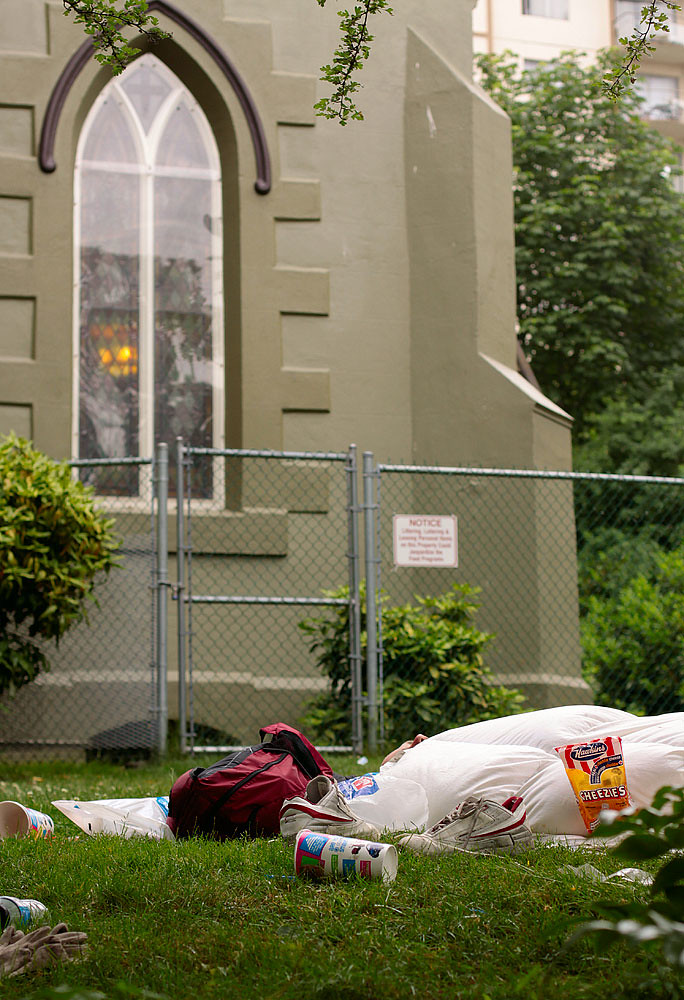
Baroque chamber ensemble and homeless encampment, Saint Paul
Perfect: the singers, strings, and keyboards. Perfect Bruised sky above the tents of the squatters’ district the little jewel-box church, its bright acoustic calm in the year’s last mildness, the only music softened a little in the candles’ lighting, the mumbling underpass. The wind. No fighting for this is God’s mind, woven of harmonies for once. Tonight, for once, no one ODs— and our souls thread through the flame of the vigil lamp someone got lucky at the entrance ramp as we hold, hold to Monteverdi’s line (panhandling, on this warm day, with a sign) and stop our breath until the last string dies and parcels out his manna of salty fries in the last great chord of his Beatus vir while sirens wail some sorrow, far from here.
*****
Editor’s comments: “In case it isn’t clear from whatever device you are reading this on, each couplet here is comprised of a line about a musical ensemble in a church followed by a line about a homeless encampment under a highway. You can read it straight through as a soft-voiced line followed by a harsher one; or you can read every other line in one voice and the remaining lines in a different voice; either way, you are blending two very different aspects of city life into a larger, richer picture of community sharing, whether in glamour or squalor. This is an unusual and remarkably effective use of rhymed couplets of iambic pentameter. The contrast built into the poem, and the skill with which it was done, made it a natural poem for inclusion in the ‘City! Oh City!‘ Potcake chapbook. It first appeared in Measure Review; and is included in the collection In Code.“
Maryann Corbett writes: “Events that trigger a poem need not be as simultaneous as the poem makes them seem. The choral concert in this poem took place on a subzero night during the Christmas season; the rise of homeless encampments occurred at a warmer time of year–but both could be happening in my city at any time, and they probably still are.”
Maryann Corbett earned a doctorate in English from the University of Minnesota in 1981 and expected to be teaching Beowulf and Chaucer and the history of the English language. Instead, she spent almost thirty-five years working for the Office of the Revisor of Statutes of the Minnesota Legislature, helping attorneys to write in plain English and coordinating the creating of finding aids for the law. She returned to writing poetry after thirty years away from the craft in 2005 and is now the author of two chapbooks, five full-length collections already published, and a forthcoming book. Her fifth book, In Code, contains the poems about her years with the Revisor’s Office. Her work has won the Willis Barnstone Translation Prize, has appeared in many journals on both sides of the Atlantic, and is included in anthologies like Measure for Measure: An Anthology of Poetic Meters and The Best American Poetry 2018.