Tag Archives: David Stephenson

David Stephenson, ‘Payday’

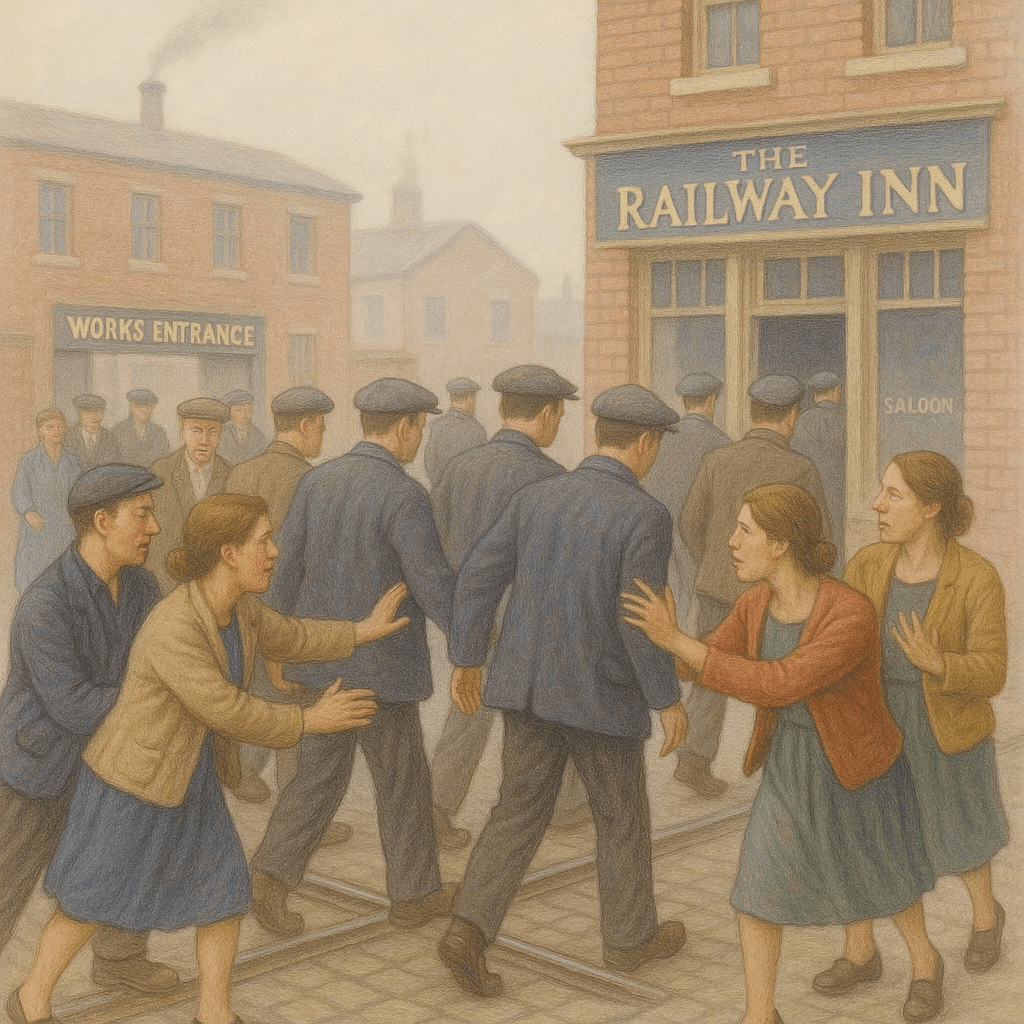
My dad’s plant was across the railroad tracks
from half a dozen shot and chaser bars,
and on paydays the bars were visited
and stocked with stacks of bills by armored cars,
 
and women waited at the gates and tracks
at shift changes, to try to intercept
their thirsty husbands in the passing throng
before they cashed and drank up half their check.
 
At the time, I didn’t think about
how desperate those women must have been
to go out on a crowded public street
and chase after their irresponsible men;
 
I guess I found it droll.  But if I’d been
more aware, what could I have done or said?
When people’s lives are going off the rails
strangers only frown and shake their heads.

*****

David Stephenson writes: “When I was in high school, my dad worked at John Deere Plow-Planter—now called Seeding and Cylinder—in Moline, Illinois.   This was before direct deposit, so the workers got paper paychecks.  As with many factories, there were several taverns nearby, any of which would happily cash a paycheck.  If I borrowed Dad’s car, I would have to pick him up and drop him off, so I was sometimes there during shift changes.  On paydays you would see armored cars outside the bars, and at the end of the afternoon shift you would see women waiting on the railroad tracks, as described in the poem.  It didn’t really register with me at the time, but later on I realized it was quite sad.  I wrote the first two stanzas of the poem four or five years ago, but was stuck as to how to proceed, since I didn’t know what to say about the scene.  What can you say?  I finally came up with the current ending, which says there isn’t anything to say, but says it well.”

‘Payday’ was first published in Snakeskin.

David Stephenson is a retired manufacturing engineer from Detroit, and the editor of Pulsebeat Poetry Journal.  His most recent collection is Wall of Sound (Kelsay Books, 2022).

Illustration: RHL and ChatGPT

Using form: Sonnet: David Stephenson, ‘Hold My Beer’

One day a great idea just comes you,
like using some old stuff stored in your shed
for some pyrotechnic derring-do,
and you can’t get the thought out of your head,
and you’re excited but a little scared,
since carrying the stunt out would require
some tricky timing. You feel unprepared
and think of all the ways it could backfire…

And yet key elements are on the scene—
the tires and lumber, and most critically
a full two-gallon can of gasoline—
as if assembled there by destiny.
You know you won’t rest till this thing gets done.
Carpe diem. Light the fuse and run.

*****

David Stephenson writes: “On the background for the poem (just published in Rat’s Ass Review), I thought of the title first, as sometimes happens, and was trying to think up some verse that would go with it.  I have habitually written sonnets for years, but hadn’t written one in a while when I was working on this, and I thought it had potential for a good sonnet, since most things do.  One thing I like about the form, in addition to the technical challenge, is its endless flexibility.   Some of the details comes from bonfire videos that I’ve seen on Youtube, in which somebody pours a couple of gallons of gas on a woodpile and lights a match, resulting in an explosion.  I find these videos fascinating and always wonder what they were thinking.  I was also thinking of one of my favorite quotes, from the Kurt Vonnegut novel Galápagos:
That, in my opinion, was the most diabolical aspect of those old-time big brains: They would tell their owners, in effect, ‘Here is a crazy thing we could actually do, probably, but we would never do it, of course. It’s just fun to think about.’ And then, as though in trances, the people would really do it…

David Stephenson is a retired engineer.  He writes: “I worked in the automotive business and have lived in Detroit for many years, although I am originally from the same part of rural Illinois as Carl Sandburg, my favorite poet.  I was a technical expert in machining operations, first at General Motors and later at Ford.  My mother was a school teacher and my father was a skilled craftsman who worked in various factories for John Deere, mostly the big ones along the Mississippi River in Moline.  I write poetry out of a desire to make music; if I could play an instrument and was more presentable, I would have formed a band instead.  I have two collections out, Rhythm and Blues, which won the 2007 Richard Wilbur Award, and Wall of Sound, which was published by Kelsay Books in 2022.  Both are available on Amazon.  And as you know, I am also editor of Pulsebeat Poetry Journal.”

Photo: “Fire man!” by redeye^ is licensed under CC BY-ND 2.0.

Review: ‘Rhythm and Blues’ by David Stephenson

David Stephenson’s ‘Rhythm and Blues’ was the 2007 Richard Wilbur Award winner, and contains some excellent poems. Its back-cover blurbs are accurate–as Kim Bridgford states, the collection has “wisdom, a plain-spoken, convincing style, and a sense of irony… all the time with impressive technical skill.”

Several of the sonnets are excellent: ‘Pilate’ meditates on the harshness of the law,
But why waste breath? In six months, who will mourn
This insect, or recall that he was born?

The ‘Geologist’ speaks of his passion for the history of rocks, ending:
The present is a world of dirt and sand
And people–they of the immortal soul–
Whom I do not pretend to understand,
Though I admire them in their long-term role
As precursors to limestone, chalk, and coal.

And beyond the sonnets are villanelles, and longer blank verse monologues in the voices of a toll collector, a housebreaker, a corporate hatchet man, and so on; and poems with various structures of stanza.

But there is a problem: the ruthless, relentless, metronomic use of iambics. The entire collection is in either iambic pentameter or iambic tetrameter. In general, the shorter pieces are good; the longer pieces are thematically interesting, but I find pages of blank verse unappealing. Stephenson can obviously think easily in iambic pentameter; but that skill tends towards blather. As the book title suggests, there is rhythm; but with insufficient variety for the claim of music.

But maybe this is expecting too much. Stephenson is a committed formalist, to the extent of having started his own Pulsebeat Poetry Journal for formal verse. His sonnets in particular are very good. And the book is highly readable and rereadable–though in small doses, not straight through in one go.

And there is actually one break in the unremitting use of iambics, in the shortest and most whimsical poem in the book–and for all those reasons perhaps my favourite. It is ‘To a Garbage Truck’:

Stop for me, romantic sloop,
When all your cargo is on board
And your ride low upon the waves,
For I would cast my lot with yours

And put forth on the open street
En route to some strange orient
Full of exotic ports of call
Beyond the gray horizon.

New magazine’s Call For Submissions – Pulsebeat Poetry Journal

Poet (and engineer) David Stephenson contacted me recently with the message “I am starting a new journal, Pulsebeat Poetry Journal, for poems with a strong musical element, especially poems in meter and rhyme. I don’t think there are enough venues for rhyming poetry.” He is putting out a general Call for Submissions on his web page https://pulsebeatpoetry.com/guidelines/

“Poems full of music, using meter and rhyme or other means, previously unpublished… Theme should be the human condition… Submissions by December 31, 2021, for the first issue to be posted in January, 2022.” More submission details are at that link above.

David Stephenson has published in The Formalist, The Lyric, etc. His ‘Rhythm and Blues‘ won the Richard Wilbur Award in 2007, which puts him in excellent company. On the Masthead page of his web site you can find links to more recent poems of his, published in Autumn Sky Poetry and Avatar Review.

I look forward to reading the Pulsebeat Poetry Journal, and wish David Stephenson good luck with the venture.