1700 BCE A length of fibre to extract a tooth – a flint to decorate yourself with scars – a large, strong thorn to make holes for tattoos – an oyster shell to scrape off excess hair… so health’s improved and beauty is accented.
1700 CE High heels and wig show stature, vigour, youth; a monocle improves both look and looking. How we’ve advanced, compared to ancient times! Some say there’ll be advances still to come, but how, when all’s already been invented?
This poem is a riff on a 19th century joke. Charles H. Duell, the Commissioner of US Patent Office in the late 1890s, is widely quoted as having stated that the patent office would soon shrink in size, and eventually close, because “Everything that can be invented has been invented.” (In fact Duell said in 1902: “In my opinion, all previous advances in the various lines of invention will appear totally insignificant when compared with those which the present century will witness. I almost wish that I might live my life over again to see the wonders which are at the threshold.”) But the joke appears to have had earlier incarnations in the 19th century in Punch magazine and elsewhere, presumably as the world was adapting to the reality of life changing more and more rapidly.
The poem is in iambic pentameter, but the only rhymes are between the two verses: the first lines of each and the last lines of each. But I feel that produces enough echo to make it sound adequate. My thanks to Bill Thompson for including it in the Alabama Literary Review – ALR 2021.
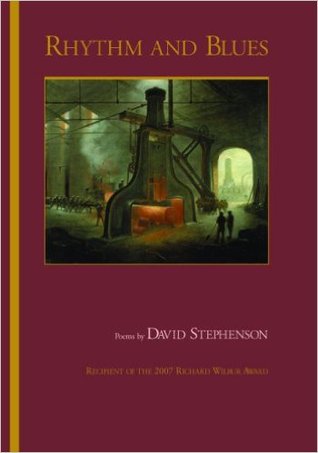
David Stephenson’s ‘Rhythm and Blues’ was the 2007 Richard Wilbur Award winner, and contains some excellent poems. Its back-cover blurbs are accurate–as Kim Bridgford states, the collection has “wisdom, a plain-spoken, convincing style, and a sense of irony… all the time with impressive technical skill.”
Several of the sonnets are excellent: ‘Pilate’ meditates on the harshness of the law, But why waste breath? In six months, who will mourn This insect, or recall that he was born?
The ‘Geologist’ speaks of his passion for the history of rocks, ending: The present is a world of dirt and sand And people–they of the immortal soul– Whom I do not pretend to understand, Though I admire them in their long-term role As precursors to limestone, chalk, and coal.
And beyond the sonnets are villanelles, and longer blank verse monologues in the voices of a toll collector, a housebreaker, a corporate hatchet man, and so on; and poems with various structures of stanza.
But there is a problem: the ruthless, relentless, metronomic use of iambics. The entire collection is in either iambic pentameter or iambic tetrameter. In general, the shorter pieces are good; the longer pieces are thematically interesting, but I find pages of blank verse unappealing. Stephenson can obviously think easily in iambic pentameter; but that skill tends towards blather. As the book title suggests, there is rhythm; but with insufficient variety for the claim of music.
But maybe this is expecting too much. Stephenson is a committed formalist, to the extent of having started his own Pulsebeat Poetry Journal for formal verse. His sonnets in particular are very good. And the book is highly readable and rereadable–though in small doses, not straight through in one go.
And there is actually one break in the unremitting use of iambics, in the shortest and most whimsical poem in the book–and for all those reasons perhaps my favourite. It is ‘To a Garbage Truck’:
Stop for me, romantic sloop, When all your cargo is on board And your ride low upon the waves, For I would cast my lot with yours
And put forth on the open street En route to some strange orient Full of exotic ports of call Beyond the gray horizon.
Indescribable—our love—and still we say with eyes averted, turning out the light, “I love you,” in the ordinary way
and tug the coverlet where once we lay, all suntanned limbs entangled, shivering, white… indescribably in love. Or so we say.
Your hair’s blonde thicket now is tangle-gray; you turn your back; you murmur to the night, “I love you,” in the ordinary way.
Beneath the sheets our hands and feet would stray to warm ourselves. We do not touch despite a love so indescribable. We say
we’re older now, that “love” has had its day. But that which Love once countenanced, delight, still makes you indescribable. I say, “I love you,” in the ordinary way.
Michael R. Burch writes: “These are some tidbits about the poem: This was my first villanelle and it’s missing a tercet. The missing tercet was pointed out to me by the formalist poet Richard Moore, who said he still liked the poem. I didn’t feel that I had anything to add, so I left the poem as it was. I’ve never been a stickler for the rules, anyway. ‘Ordinary Love’ was originally published by The Lyric. It later won the 2001 Algernon Charles Swinburne Poetry Award, was published by Romantics Quarterly, which had sponsored the contest, and RQ nominated it for the Pushcart Prize. The poem has been translated into Hungarian, as noted below. That’s not too shabby for my first villanelle! Here is the complete publication history: Published by The Lyric, Romantics Quarterly, Amerikai költok a második (in a Hungarian translation by István Bagi), Mandrake Poetry Review, Carnelian, the Net Poetry and Art Competition, Famous Poets & Poems, FreeXpression (Australia), PW Review, Poetic Voices, Poetry Renewal, Poem Kingdom and Poetry Life & Times; also winner of the 2001 Algernon Charles Swinburne Poetry Award sponsored by Romantics Quarterly and nominated for the Pushcart Prize. The last time I checked online, it returned nearly 10,000 results for the first line.”
Michael R. Burch is an American poet, editor and translator who lives in Nashville, Tennessee with his wife Beth, two outrageously spoiled puppies, and the ghost of a hamster, Olive, murdered by a former canine family member. For an expanded bio, circum vitae, career timeline, reviews, interviews and other information of interest to scholars, please click here: Michael R. Burch Expanded Bio. To read the best poems of Mike Burch in his own opinion, with his comments, please click here: Michael R. Burch Best Poems.
Amidst a sere Midwestern winter night December 1917, she’s born, A staunch Germanic woman’s child. Bedight In dearth and loss, she learns too young to mourn A mother’s death. She knows a woman must Prepare the meals, evoke good cheer, and thrust Her bitter tears inside where no one sees. She weds a Coast Guard vet and oversees His household — bears three girls, subsists on grace. And steadfast ‘til succumbing to disease, Upon her own, she wears her mother’s face.
Unwanted infant hurtles toward the light In 1944, her mam too worn And poor to greet her daughter with delight. The wealthy gent who claims the babe has sworn To sate her whims, exchange her doubts for trust. But Virgin-named, she’s Snake incarnate, trussed In greed. She flaunts her swindling expertise, Yet knows that costly baubles won’t unfreeze Her heart, or fill an absent mother’s space. And void, despite full coffers overseas, Upon her own, she wears her mother’s face.
She’s born in 1945, clasped tight Within her mother’s arms. And ne’er forlorn, This nurtured daughter dreams she’ll wed a knight Who’ll grant her nuptial bliss, and — fast foresworn To loyalty — a doe-eyed child who’ll just Love her. When falseness renders faith to dust And pregnant prayers produce no guarantees, She nonetheless adheres to memories Of Mother’s happy tales. She weighs her case, Then smiling, phones adoption agencies. Upon her own, she wears her mother’s face.
From birth, a target of her small town’s spite, She sprints through cornfields, fleeing bullies’ scorn, Hurled stones, and taunts of “freak”! Wisconsinite In ragtag 1980s garb, she’s borne Her share of tyranny. Her heart’s robust Enough to weather gibes, but grief’s the gust She can’t withstand. At forty-one, she frees Herself and downs the sleeping pills that squeeze Her breath away. Her mother deems her base Look odd, but with some rouge — an eyebrow tweeze — Upon her own, she wears her mother’s face.
Abandoned infant left upon a white Korean orphanage’s stoop, she’s shorn Of roots upon her trans-Pacific flight To Heartland serendipity. She’s torn Between identities, but must adjust: Refute all claims of foreignness. Nonplussed, Her heart aligns to these: Wisconsin cheese And apple pie. She’d always deemed “Chinese” A slight, but now she sees each buried trace Of her within her children’s eyes. And pleased, Upon her own, she wears her mother’s face.
A steadfast matron, serpent quick to tease, She’s part Korean, one-eighth Japanese, Idealist, rebel geek without a place — My post-millennial, she’s all of these. Upon her own, she wears her mother’s face.
Mindy Watson writes: “I’m probably most proud of this chant royal titled ‘Her Mother’s Face’ that narratively links the most influential women in my life, ultimately culminating in my daughter’s overall connection to her (mostly unknown) maternal lineage. It was an unconventional topic for me (as my go-to inspirations are normally bugs, science, mythology, etc. and I’ve a hard-wired aversion to delving into my lost cultural roots—Midwestern U.S. white Protestant upbringing and all that), but it just intuitively sprang from the 11-line stanza/repeated refrain/converging envoi-type structure. Humorously, the poem’s impetus was a poet e-friend of mine mentioning that this form (I’d never heard of) was the most difficult he’d ever tried and hadn’t ever conquered—so of course I took that as a dare/challenge, lol… but I ended up unexpectedly enjoying the composition process (and reminiscing about a few souls lost too soon. Also I disagree with my friend—I personally think pantoums are among the most vexing forms…”
Mindy Watson is a formal verse poet and federal writer who holds an MA in Nonfiction Writing from Johns Hopkins University. Her poetry has appeared in venues including Snakeskin, Think Journal, the Poetry Porch (where ‘Her Mother’s Face’ was first published, April 2018), Orchards Poetry Journal, Better Than Starbucks, Eastern Structures, the Quarterday Review, and Star*Line. She’s also appeared in Sampson Low’s Potcake Poets: Form in Formless Times chapbook series and the Science Fiction and Fantasy Association’s 2019 Dwarf Stars Anthology. You may read her work at: https://mindywatson.wixsite.com/poetryprosesite.
Ignoring clockwork towns and fertile farms Tied to the sun-swing as the seas to moon, They searched for verse in deserts without rhyme, Lifted erratic rocks nonrhythmically In search of poetry, then through the slough Of their emotions hunted for a trail:
“The scent is cold. Its Spirit must have fled; The body of its work, though dead, Has been translated to some higher plane. Look how the world’s translated verse Comes to us plain—why can’t we emulate? Then if the words themselves are unimportant, If poetry in essence is idea, And song is wrong, Rhyme a superfluous flamboyance (Like colour in Van Gogh), Rhythm a distraction to the memoring mind, Then we determine poetry’s true form is mime!”
While in the air the deafening blare Confounds their silence everywhere: Before our hearts began to beat We were conceived in rhythmic heat; So, billions strong, we sing along For all the time, in time, our time, the song Goes rocking on in rhythmic rhyme. Rock on!
“Unversed” means “not experienced, skilled, or knowledgeable”. Poetry takes different forms in different languages, but the forms all have the same desirable outcome: to make it easier to memorise and recite word-for-word. Alliteration, assonance, rhyme, metre – these are all useful tools for achieving this, along with less tangible tools such as fresh or startling imagery. Metre/beat/rhythm is viscerally important to us, because the mother’s heartbeat is the background to sensory development in the womb, and our own heartbeat and breathing rhythms continue throughout life. As humans we drum, we dance, we sing, just as we walk and run rhythmically, tap our fingers rhythmically when we are bored, teach small children to clap and sing, teach older children clapping and skipping games. Rhythm is built into us from before birth.
Rhythmic poetry didn’t die when it almost stopped being publishable. It just went into folk songs, blues, rock, country-and-western, musicals, rap, hip hop… Popular music let teenagers and adults continue to thrive with what they were not given by schools: rhythm and rhyme. This drive to make words memorable and recitable is part of who we humans are. So schools do best when they leaven “creative self-expression” with getting kids to learn things by heart, and getting them to pay attention to the qualities that make it easy to memorise and recite.
Old fool! You really think yourself the same As I who write to you, aged 22? Ha! All we’ve got in common is my name: I’ll wear it out, throw it away, You’ll pick it up some other day…. But who are you?
My life’s before me; can you say the same? I choose its how and why and when and who. I’ll choose the rules by which we play the game; I may choose wrong, it’s not denied, But by my choice you must abide…. What choice have you?
If, bored, I think one day to see the world I pack that day and fly out on the next. My choice to wander, or to sit home-curled; Each place has friends, good fun, good food, But you sit toothless, silent, rude…. And undersexed!
Cares and regrets of loss can go to hell: You sort them out with Reason’s time-worn tool. Today’s superb; tomorrow looks as well: The word “tomorrow” is a thrill, I’ll make of mine just what I will…. What’s yours, old fool?
This poem, first published in Snakeskin No. 147, September 2008 and recently reprinted in the Extreme Formal Poems Contemporary Poets anthology edited by Beth Houston, is symptomatic of my constant concern with mortality. It was also a way to be provocative: under the guise of insulting myself, I got to insult all older generations. And it was also an exercise in poetic structure: each stanza presents an aspect of the superiority of present youth over future age. (Premise and conclusion aren’t necessarily made as statements, many times rhetorical questions are used instead.) The structure of each stanza is to begin with pentameters for a sense of reasonableness in the first three lines, pick up the pace for the next two lines, and end with a short punchline. Aggressive and effective.
Yes, I wrote it when I was 22. I don’t know if I will be able to concoct a suitably terse and dismissive answer when I’m 72. But it’s a favourite poem of mine, and I owe it a response.
My looming silhouette, obese and bald, As well as my distinctive semi-slur Still resonate, and even now I’m called The cinema’s preeminent auteur, Epitomising what François Truffaut Revered: a moviemaker in control Of everything on screen. I ran the show: Finessing scripts and casting every role, Selecting music and the mise-en-scène. Unwilling as I was to look beyond Simplistic plots that featured guiltless men Plus pretty women (preferably blonde) Entangled in intrigues, they all had doubt, Not payoffs, situated at their heart: Set bombs a-ticking, tension builds throughout, Explode them and you blow it all apart.
Rob Stuart writes: “This poem was previously published in ‘Snakeskin’ although I have revised it since.
“Is this my best poem? Probably not, but it’s certainly the fiddliest I’ve ever written and consequently the most satisfying to have (perhaps) finished. A rhymed acrostic gives one very limited room for manoeuvre as it imposes constraints at both the beginning and end of each line, and this led to all manner of contrived rhymes and clunky word choices in my early drafts, including the version that was originally published a few years ago, and I have literally spent hours poring over lists of verbs beginning with a ‘u’ and synonyms for ‘suspense’ in the search for suitable replacements. I may yet go on to revise the poem further (I’m still not sure that the second to last line quite works), but I think it reads pretty damned well now. It’s a dinky little lesson in film history, too.”
Rob Stuart’s poems and short stories have been published in numerous magazines, newspapers and webzines including Ink Sweat and Tears, Light, Lighten Up Online, M58, Magma, New Statesman, The Oldie, Otoliths, Popshot, The Projectionist’s Playground, Snakeskin, The Spectator and The Washington Post. His work appears in the Potcake Chapbooks ‘Careers and Other Catastrophes‘ and ‘Wordplayful‘. He lives in Surrey, England with his family.
Nakedness is the best disguise. When you discard the final veil, it always takes them by surprise.
Because men think that compromise is weak—that if you yield, you fail— nakedness is the best disguise.
Though you expose your breasts and thighs, your mind is as opaque as shale. It always takes them by surprise
to find out that the body lies. Surrender can conceal betrayal. Nakedness is best. Disguise,
equivocation, alibis can be seen through. To lay a trail that always takes them by surprise,
hide nothing and you’ll blind their eyes. Go ask Judith. Go ask Jael. Nakedness is the best disguise. It always takes them by surprise.
Susan McLean writes: “When I think of which subjects have lasting appeal in poems, I think of the subjects that have never changed and never will, such as human nature, but also of the questions that have no definitive answers, such as the nature of truth. This poem expresses several paradoxes: that overt shows of openness are the most successful ways to deceive someone; that everyone lies, so telling the truth is always surprising–and is often not believed; that no matter how much truth you tell, there is always much that you don’t say; that when there is a power difference between two people, surrendering can be a tool of resistance.
“Another thing that I think gives a poem lasting appeal is the use of rhythm and sound to create a music with words. Though we live in a time in which free verse is dominant and ubiquitous, I don’t think people will ever lose their innate love of the songlike in poetry, a quality that also makes poems easier to remember. One of the most songlike of poetic forms is the villanelle, and it has been one of my favorite forms for many years. Though I know that many readers find the repeating lines in villanelles to be tedious, small variations in the lines, in their punctuation, and in the surrounding lines can enable the narrative to move forward without losing the appeal of a songlike refrain.”
Susan McLean grew up in Oxon Hill, Maryland, attended Harvard University and Rutgers University, and taught English for thirty years at Southwest Minnesota State University. She has published two books of poetry, The Best Disguise (winner of the 2009 Richard Wilbur Award) and The Whetstone Misses the Knife (winner of the 2014 Donald Justice Poetry Prize), and one book of translations of the Latin poet Martial, Selected Epigrams. She lives in Iowa City, Iowa.
‘Deep Cover’ was originally published in Mezzo Cammin, a journal of modern formalist poetry by women. Susan McLean’s ‘Lessons From A Fool’ appears in the Potcake Chapbook Careers and Other Catastrophes.
On the funeral road, five miles beyond the farm it looms still, like a silo, then diminishes as you get close. Your sound won’t raise alarm out here. There’s none but you. The wishes of no one left alive will keep you out, or let you in. The door is probably locked anyway, closed upon itself, redoubt for certainties. Surrounding it the block foundations — reservoirs of ice and weed — still cluster, like white holes around the heart. You will not try the door — where it might lead, you cannot say. The dead have done their part, for here you are among them once again, between the legacies of grief — the snow, the boxes of white quiet, the leaving, then the watching it loom larger as you go.
Brian Gavin writes: “I like this piece because the church-image haunted (or taunted!) me for several years before I got around to giving it some context in a poem. When it finally came to the page it felt like I had paid off a debt — like I had finally given the image a chance to tell its story. The fact that this story turned out to be no story at all — just a bunch of hints and implications — seemed to fit the image.“
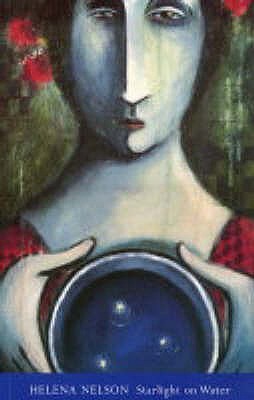
Helena Nelson’s 2003 poetry collection ‘Starlight on Water‘ is quiet, reflective, beautiful and intensely intimate. Not necessarily personal – in some of the poems the poet has no children, in others a daughter or two, so there is no guarantee Nelson is writing of herself – but intimate with the senses and memories of existence. One of my favourite poems is ‘Ironing Day’:
I’ve never had an ironing board cover that fits or a baby of my own. None of the doors here properly shuts and the garden wall’s come down.
But I shouldn’t ever want to lose my iron. Pressing hard, I remember grass between my toes and the soft rain of September.
This speaks to several of my biases: going barefoot, enjoying rain, tolerating imperfection, triggering memories… and the music of casually rhythmical rhymed verse.
Not all of her verse is in the same style. Some poems are formally structured, some are free; the bulk of the book wanders all over internal and external landscapes, while the last third circles around and around Mr. and Mrs. Philpott, first one and then the other, a very caring couple of very distinct individuals in their mature second marriage. Here are some opening lines at random from the 19 Philpott Poems:
At the kitchen window in his dressing gown, Philpott stands alone his sons have gone. He’s on his own.
and
The sweetness of June, a summons conveyed from strawberry fields, calls her to pick. She drives to the farm, the car arrayed with Tupperware tubs.
and
His father died at fifty-eight and so he will die at fifty-eight. He fetches a tumbler. Two years to go.
and
Philpott’s anger lives in his shoes. It tangles in the laces and he wrestles like a lover
The first part of the book is about all manner of things – the spirit of a dead cat, say, or a night in an isolated Scottish cottage, or the teasing poem ‘Genderalisation’:
Women keep scales in their bedrooms; Men keep weights.
The latter part of the book is just the Philpotts. What the whole book has in common is, without any sentimentality, the deep love that comes from respect, patience and close observation. It is all very intimate, and Nelson appropriately ends the Philpotts and the book with this short poem, ‘Love’:
He has tipped, he has spilled his soul into her and she carries it still like starlight on water.








 Form in Formless Times