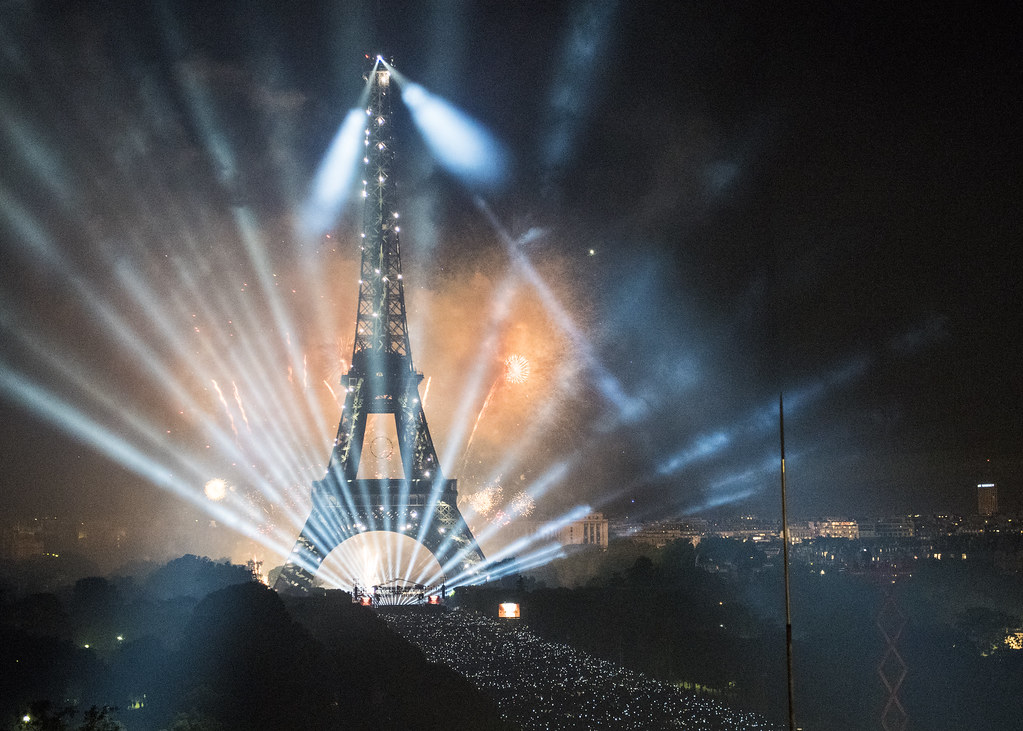
On a trip to Paris one day, little Sophie
Met a giant lady lighting up the night sky.
“What’s your name, you magical monster?”
“My many visitors call me the Eiffel Tower.”
“In all your attire, don’t you sometimes tire
Of being seen only as a humdrum tower?
You, a dragon, a fairy watching over Paris,
An Olympic torch held aloft in grey skies?”
“How you flatter me! So few poets these days
Ever sing the praises of my Parisian soul,
As did Cocteau, Aragon, Cendrars,
Trénet and Apollinaire… Since you’re so good
At seeing beneath the surface, you could
– If you like, when you’re back from France –
Take up your pen and write down
Why you like me – it would be nice and fun!”
“You can count on me! There’s so much to say!
I’ll write twenty lines… but who will read them?”
“Well, I know a man who’ll read your verse.”
“Really? Who?”
“The President of France.”
En voyage à Paris, la petite Sophie
Croisa une géante illuminant la nuit.
“Comment t’appelles-tu, monstre surnaturel?”
“Mes nombreux visiteurs m’appellent Tour Eiffel.”
“N’es-tu pas parfois lasse, avec tes mille atours
Que l’on ne voie en toi qu’une banale tour?
Toi le dragon, la fée, qui veille sur Paris,
Toi, immense flambeau planté dans le ciel gris!”
“Quel plaisir tu me fais! Ils sont devenus rares
Ceux qui comme Cocteau, Aragon ou Cendrars,
Trenet, Apollinaire, avaient su célébrer
Mon âme parisienne aux charmes singuliers.
Puisque tu sais si bien percer les apparences,
Tu pourrais, si tu veux, à ton retour de France,
Prendre à ton tour la plume et conter en anglais
(It would be nice and fun) ce qui chez moi te plaît!”
“Tu peux compter sur moi! Il y a tant à dire!
Je t’écrirai vingt vers… Mais qui voudra les lire?”
“Oh, moi j’en connais un qui lira ton cantique.”
“C’est?”
“Monsieur le président de la République.”
*****
This poem by French President Emmanuel Macron is in French alexandrine: 12 syllable lines, rhyming couplets. The translation is either by him (he is fluent in English) or by the French Embassy in London, as the poem was written for the English girl Sophie’s 13th birthday. She herself had initiated everything with the poem below, which she had sent in April 2017 to the French President… at that time the President was François Hollande, but Macron won the presidency later that year, and responded for Sophie’s birthday on November 1st. Her poem was 20 lines long, written out on her drawing of the Eiffel Tower; his response is also 20 lines long (counting the final question and answer as a single line, which it clearly is by metre and rhyme).
Here is 12-year-old Sophie’s ‘Centre of Attention’:
She has four beautiful legs,
Which help her stand proud,
She looks over everyone,
With her head in the clouds,
She is elegant and tall,
Wears a pretty, lacy skirt,
Whilst staring at her in awe,
Your eyes will not avert,
Her spine is amazingly straight,
Whilst her head touches the sky,
People look up and take pictures of her,
As they are passing on by,
You need to tilt your head up,
To be able to see all of her,
But when you do,
She is as pretty as a picture,
She is the centre of attention,
Noticed by everyone.
She is the Eiffel Tower,
She is second to none.
Macron created a nice circularity with his response to Sophie’s poem, by pretending it was written first and caused Sophie’s poem, rather than the other way round. All very playful.
Photo: “170714-D-PB383-151” by Chairman of the Joint Chiefs of Staff is licensed under CC BY 2.0.
 Form in Formless Times